


Tech industry gloom
- 22 Jan 09, 17:50 GMT
It's been a dreadful 24 hours for companies in the technology industry - with just a couple of exceptions. Microsoft, Sony and Nokia have all announced poor results. The tech giants who appeared confident six months ago that they would ride out a recession are now rushing to blame the global downturn for their individual problems
 Microsoft says 5,000 jobs are going worldwide in departments ranging from HR to IT. This is the first time in its history that the company has cut its workforce (other than a bit of natural wastage).
The cuts follow an 11% fall in net profits, and Microsoft blames "the further deterioration of global economic conditions". So how did that make itself felt? Microsoft had been expecting the PC market on which it depends for Windows revenues to grow by more than 10%. Instead it was flat, with a fall in sales of desktops only partly offset by the surge in netbook sales.
Steve Ballmer is not underplaying the seriousness of the situation - he told analysts on a conference call that the economy was "resetting", and he didn't expect a quick rebound. Hard-pressed consumers who couldn't afford to refinance their homes weren't going to rush to buy PCs.
He also came out fighting, saying that Microsoft had come from a zero share of the netbook market to 80%, and suggested that customers would look far more critically at the kind of price premiums that they paid for a Macintosh compared with a PC.
Nokia also had some chilling news for the whole mobile phone industry. This was not so much a 69% fall in profits as its forecast that the global handset market would shrink by 10% in 2009 - this in an industry which has had nearly a quarter of a century of continuous growth, apart from a small fall back in 2001.
Nokia saw sales of its own handsets fall around the world. In China sales were down 36% compared to the same quarter in 2007. With companies pinning their hopes for growth on developing countries, this is very scary.
Sony appears to be in an even grimmer position. It had already announced job cuts and warned of a record loss this year. The company is keen to blame the strong yen for its woes, but it's clear that it also has problems competing in some key product areas. Its TV division keeps losing money, and the PlayStation 3 has been bested by Nintendo's Wii and by the Xbox 360.
The idea was that gamers would pay a premium for a console which was technically more advanced than its rivals. That strategy was already in question and as the recession hits consmer spending it looks even more dubious.
So amidst this gloom who is still prospering? Well, Apple of course as we mentioned earlier, though I still think there's a question over whether consumers will carry on paying a premium for its products through the recession. Another business defying the gloom is Britain's Autonomy, a database-search company which more than doubled its profits in the last quarter - and promptly announced it was spending $750m buying another software firm.
This is not a great time to be running a technology company - but for just a few, it's a chance to grow bigger while their rivals hide under the table and wait for the recovery.
Is Apple recession proof?
- 22 Jan 09, 09:11 GMT
A year ago, Apple's shares stood somewhere around $155 when I posted here about a hugely impressive set of results. The shares fell back because Wall Street was disappointed with Apple's forecast. They then climbed to around $200, before plunging downhill with the rest of the market.
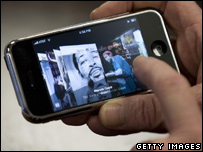 Now Apple has produced another sparkling set of figures for the last three months - perhaps even more impressive given that they come in the depths of our harsh economic winter. Record quarterly revenues - more than $10bn for the first time - record profits of $1.6bn, and the company is now sitting on an enormous cash pile of $28bn. So surely the shares will now leap ahead from their current level of $83? Well, maybe. Let's first take a closer look at the results.
Where is the cash coming from? 22.7m iPods, 4.7m iPhones, more than 2.5m Macintosh computers - and a profit margin of nearly 35%, with Apple benefiting from falling component prices.
On the analysts' conference call, Chief Financial Officer Peter Oppenheimer and Tim Cook, the stand-in CEO in the absence of Steve Jobs, basked in the admiration of Wall Street, with some analysts prefacing their questions with congratulations.
So is Apple that rare corporate creature - the recession-proof business? Well, lurking in the results there were just a few warning lights.:
iPods: Despite having more than 70% of the MP3 player market, the iPod just keeps on growing. But has it finally peaked? Apple revealed that all the growth in the last quarter came outside the US (where sales actually fell) and, but for an amazing last week when frenzied present-buyers apparently stormed the stores in search of Christmas presents, there would have been an overall fall. Endless innovation - colour, video, touchscreen - has so far kept new buyers coming. It is difficult to see what the next trick will be.
Mac: While the halo effect of the iPod and iPhone continues to drive customers to the Mac, there was a major shift away from desktops to portable computers. iMac sales, compared with very good figures the previous year when a new version came out, actually fell while the Macbook range saw sales rise 34% after it was refreshed in the autumn. Tim Cook said that this was all part of an industry-wide shift away from the desktop and that Apple had outperformed the market. But the growing phenomenon in portable computing is netbooks - cheap pared-down machines. Apple has stayed out of this market so far and Tim Cook was dismissive of netbooks - "less powerful than customers want, cramped keyboards, small displays... we don't think people are going to be pleased with those type of products". They are of course unlikely to provide the kind of margin Apple has achieved with its bigger shinier laptops. But perhaps they're just what a customer wants in a recession?
iPhone: The "Jesus" phone has comfortably passed Steve Jobs' prediction of 10m sales by the end of 2008 - but were quarterly sales of 4.3m just a tad disappointing? Wall Street had expected more. But Peter Oppenheimer and Tim Cook were more bullish about this product than any other during the call. "We continue to believe we are years ahead of the competition," said Oppenheim. But there is of course plenty of smartphone competition out there now . Earlier this month, Palm unveiled its Pre, the closest imitation so far of the multi-touch iPhone. Without naming Palm, Tim Cook issused a clear threat to rivals who might copy Apple too closely: "We like competition as long as they don't rip off our IP (intellectual property). We will not stand for having our IP ripped off and we'll use whatever weapons we have at our disposal."
Of course, the big unanswered - if not unasked - question during the conference call was when and whether Steve Jobs will return to the helm. But Tim Cook - an obscure figure until now to most outsiders - did himself no harm with a calm, if combative performance as he outlined Apple's performance. But the company admits that the road ahead through a global recession lacks "visibility", so these will be testing months.
A constant stream of innovative new products has kept customers coming to the Apple stores, even in a holiday season which was bleak for many retailers. Now, with nothing very new in those stores and consumers hunkering down for hard times, will this be the quarter where the iMachine finally comes to a halt?
The BBC is not responsible for the content of external internet sites
This is dot.life - a blog about technology from BBC News.
Rory Cellan-Jones is the BBC's technology correspondent.
Maggie Shiels is the BBC's tech reporter based in Silicon Valley.
Archive
« January 2010
| Sun | Mon | Tue | Wed | Thu | Fri | Sat |
|---|---|---|---|---|---|---|
| 1 | 2 | |||||
| 3 | 4 | 5 | 6 | 7 | 8 | 9 |
| 10 | 11 | 12 | 13 | 14 | 15 | 16 |
| 17 | 18 | 19 | 20 | 21 | 22 | 23 |
| 24 | 25 | 26 | 27 | 28 |
Being Discussed Now
- Logging out... and straight back in(3)
- Gadgets of the Noughties(20)
- Plastic Logic's long journey to Vegas(21)
- Sexting teens(17)
- Wikipedia on the wane?(49)
- 'Cooling-off' for mobile phones? Not on the High Street(37)
- 2009 - the social year(36)
- Twitter, Iran and #uksnow(25)
- Broadband Britain - how far down the league?(55)
- Microsoft and Murdoch: Teaming up to bash Google?(34)
BBC Technology Headlines
- %28none%29
%28none%29 - %28none%29
%28none%29 - %28none%29
%28none%29
Visit the Technology index
Visit the BBC News website
Rory's TV/Radio reports
- Residents block Google car
Broadcast: 3 April 2009 - New adverts to tackle film piracy
Broadcast: 2 April 2009 - Call to scrap 'illegal databases'
Broadcast: 23 March 2009 - Female robot takes to the catwalk
Broadcast: 16 March 2009 - Super-charged battery breakthrough
Broadcast: 12 March 2009

- News Editors
- Sport Editors
- Journalism Labs
- BBC Internet Blog
- Radio 4 Blog
- Peston's Picks
- Nick Robinson's Newslog
- Stephanomics
- Mark Easton's UK
- Mark Mardell's America
- Nick Bryant's Australia
- Andrew Harding on Africa
- Gavin Hewitt's Europe
- Soutik Biswas' India
- dot.Rory
- Science: Jonathan Amos
- Richard Black on environment
- Today: Tom Feilden
- Fergus Walsh's medical files
- Newsnight: Paul Mason
- Newsnight: Mark Urban
- Torin Douglas
- Will Gompertz's arts
- Phil Coomes on photojournalism
- Magazine Monitor
- Mark D'Arcy in Westminster
- NI: Mark Devenport
- Scotland: Brian Taylor
- Scotland: Douglas Fraser
- Wales: Betsan Powys
- Martin Rosenbaum on FOI
- 5 Live Breakfast
- Newsnight
- PM programme (iPM)
- World Tonight: Robin Lustig
