


A hi-tech snow event
- 2 Feb 09, 15:29 GMT
The heaviest snowfall in south east England since the early 1990s has brought out the best in the most technically-aware sections of the population - or the worst, if, like many in other parts of the country, you think this is just an excuse for soft Southerners to stay at home putting their feet up.
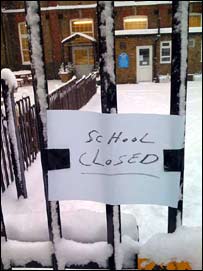 From late on Sunday, social networks - particularly Twitter - were alive with excited speculation about the arrival of the snow. Then on Monday morning, there was a new rush of information and photos, with useful detail about transport problems, school closures, and local snow conditions. I set off for school with a child this morning - and posted this picture when we arrived. Rapidly, more information came my way advising me on how I might get to work. The web was working in a useful collaborative way.
But Ben Marsh went one step further. He's a web developer who was hanging around on Twitter on Sunday afternoon. "I was looking at snow-related posts. Someone had suggested putting a postcode and a rating of how much snow they were getting next to the #uksnow tag on Twitter. Someone else said it would be really nice to see that on a map, so I thought let's give it a whirl."
By Sunday evening he'd finished it, and as soon as he put a link to advertise it, his snow map began to take off. Now it's receiving reports from across Britain - and Northern France - giving details of snow conditions, plus the occasional picture.
Technology hasn't just made it easier to communicate about the effects of a weather emergency; it has probably lessened its economic impact. Plenty of people appear to have decided it is better to work from home rather than risk taking to the roads or public transport - just stick "working from home" into the Twitter search box to find out.
Some may be skiving, but others insist that the arrival of broadband has meant they are as effective at home on the laptop - or even more so - than they would be at their desk in the office. While I have manfully struggled my way into the office today (okay, I only live five miles away), I've found myself speaking to plenty of people on the phone who are working from home, without any apparent impact on their ability to do business.
Among them is Ben Marsh, who besides knocking up that map, has been working away for his web development firm from home. "I've got remote access, I'm straight in - and I've got everything here," he told me. And before you ask, Ben is not a soft Southerner - he lives in Derbyshire and getting to his office in Derby just hasn't been possible.
Google's 55 minute crisis
- 2 Feb 09, 10:21 GMT
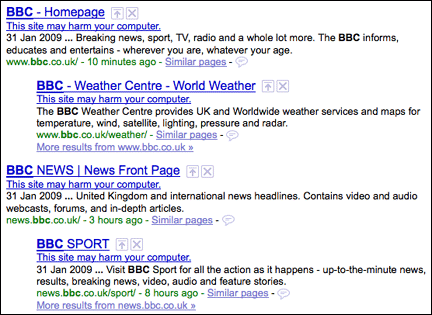
It was the weekend which shook Google to its very foundations... possibly. All around the world, users of the search engine which prides itself - and has built a multi-billion dollar business - on providing the best, most useful answers to every query were greeted with a message warning that "this site may harm your computer".

The same text was pasted next to every search result - for everything from Aardvarks to Zoroastrianism. In effect, Google was warning users that the entire internet was sick and shouldn't be touched with an electronic bargepole.
Panic spread as the global web community told each other about this apparent breakdown. Google eventually fixed the problem, explaining that an update of a list of malicious sites somehow ended up including every web address, instead of one specific URL. But what a textbook example of a corporate disaster allowed to rage out of control...
...hold on a minute. The entire incident lasted just 55 minutes. And if you were on the West Coast of the USA, where Google is based, you are unlikely to have been affected, because it started at 0630 your time on a Saturday morning and was over by 0725. So why all the hoo-hah?
Well, news spread like wildfire around the blogosphere - or more accurately the Twitterverse - as everyone seemed determined to pass on their panic, along with rumours that Google's Gmail was also misfiring. So far. more people knew about the "may harm" incident than were affected by it. I got off a plane on my way home from a holiday on Saturday afternoon, asked online whether I'd missed any big tech stories, and was bombarded with messages about the Google crash.
So what's the verdict on the importance of this incident? One blogger decided that Google could have done better, awarding the company just 5 out of 10 for its handling of the crisis and accusing it of failing to respond as quickly as it could have done. That seems a bit harsh - it sounds like someone was hauled out of bed in Mountain View at 0645 on a Saturday to tinker with the engine, and got it sorted straight away. But it does go to show how rapidly you need to react to a crisis in a world where your mistakes will be the subject of web chatter within minutes of them happening.
Two Twitterers gave rather different views of Google's 55 minute crisis. One said, perhaps not completely seriously: "kennedy, lady di crash, and now #googmayharm! Everyone will remember what they were doing". Another put it like this: "small message under Google search results brings Twitterverse to a halt. Real world curiously unaffected!"
And the other thing to remember is that while the web's reactions may be fast, and its gaze intense, its attention span is very short. In Britain at least, a temporary problem with a search engine has been eclipsed by the arrival of snow. #uksnow is the tag attracting thousands of comments on Twitter - and I suspect it may take a little longer than 55 minutes to sort that out.
The BBC is not responsible for the content of external internet sites
This is dot.life - a blog about technology from BBC News.
Rory Cellan-Jones is the BBC's technology correspondent.
Maggie Shiels is the BBC's tech reporter based in Silicon Valley.
Archive
« January 2010
| Sun | Mon | Tue | Wed | Thu | Fri | Sat |
|---|---|---|---|---|---|---|
| 1 | 2 | |||||
| 3 | 4 | 5 | 6 | 7 | 8 | 9 |
| 10 | 11 | 12 | 13 | 14 | 15 | 16 |
| 17 | 18 | 19 | 20 | 21 | 22 | 23 |
| 24 | 25 | 26 | 27 | 28 |
Being Discussed Now
- Logging out... and straight back in(3)
- Gadgets of the Noughties(20)
- Plastic Logic's long journey to Vegas(21)
- Sexting teens(17)
- Wikipedia on the wane?(49)
- 'Cooling-off' for mobile phones? Not on the High Street(37)
- 2009 - the social year(36)
- Twitter, Iran and #uksnow(25)
- Broadband Britain - how far down the league?(55)
- Microsoft and Murdoch: Teaming up to bash Google?(34)
BBC Technology Headlines
- %28none%29
%28none%29 - %28none%29
%28none%29 - %28none%29
%28none%29
Visit the Technology index
Visit the BBC News website
Rory's TV/Radio reports
- Residents block Google car
Broadcast: 3 April 2009 - New adverts to tackle film piracy
Broadcast: 2 April 2009 - Call to scrap 'illegal databases'
Broadcast: 23 March 2009 - Female robot takes to the catwalk
Broadcast: 16 March 2009 - Super-charged battery breakthrough
Broadcast: 12 March 2009

- News Editors
- Sport Editors
- Journalism Labs
- BBC Internet Blog
- Radio 4 Blog
- Peston's Picks
- Nick Robinson's Newslog
- Stephanomics
- Mark Easton's UK
- Mark Mardell's America
- Nick Bryant's Australia
- Andrew Harding on Africa
- Gavin Hewitt's Europe
- Soutik Biswas' India
- dot.Rory
- Science: Jonathan Amos
- Richard Black on environment
- Today: Tom Feilden
- Fergus Walsh's medical files
- Newsnight: Paul Mason
- Newsnight: Mark Urban
- Torin Douglas
- Will Gompertz's arts
- Phil Coomes on photojournalism
- Magazine Monitor
- Mark D'Arcy in Westminster
- NI: Mark Devenport
- Scotland: Brian Taylor
- Scotland: Douglas Fraser
- Wales: Betsan Powys
- Martin Rosenbaum on FOI
- 5 Live Breakfast
- Newsnight
- PM programme (iPM)
- World Tonight: Robin Lustig
