


Stumping for Obama and McCain
- 24 Oct 08, 10:05 GMT
Mr Schmidt (that's Eric of Google to you and I) didn't go to Washington like Frank Capra's Mr Smith but he did go to Florida to shill for presidential hopeful Barack Obama.
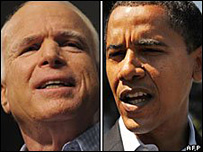 The Google CEO billed it as a "personal" mission and nothing to do with any issues the company has with the government. The US Justice Department is investigating a planned Google/Yahoo advertising deal on anti-trust grounds.
And while Google said in a statement that "the company remains neutral" in the presidential race, Mr Schmidt has been advising the Obama camp for months on technology and energy.
The Googleplex in the heart of Silicon Valley is like a mecca to White House wannabes and the welcome mat is practically worn out by those making the pilgrimage to win over the technorati.
If you want to know who looks like winning the Google workforce vote then just follow the money. So far Google employees have contributed nearly $500,000 (£309,000) to Senator Obama's campaign while Senator McCain's has pulled in just over $20,000 (£12,345).
But on the CEO front, four out of five prefer the GOP.
On the campaign trail Mr McCain has for months had Meg Whitman who used to run the online auction site e-Bay campaigning by his side. Alongside her has been John Chambers the head of Cisco systems the world's leading supplier of networking equipment for the internet.
And also going to bat for Senator McCain is Carly Fiorina the ousted CEO of Hewlett Packard. Although she has been somewhat conspicuous by her absence of late after saying that she didn't think Republican VP Sarah Palin was capable of running a company, but that it didn't matter because that would not be her role. Ouch!
So what's in it for everyone? Henry Brady a professor of political science at UC Berkeley
told me that for the candidates it's all about showing they are pro-business. For the CEO's it's probably about personal beliefs with perhaps a little bit of vanity thrown in as they strut a much bigger stage than normal. And for the company it's a realisation that government really does count.
"A lot of these start ups started with the notion that they could rule the world," explained Professor Brady.
"The internet would be an alternative way to learn about the world and change the world and the way it is viewed. And then they realised that government mattered to them because it regulates the telecoms industry, it gets involved in issues of privacy and confidentiality and rights. These are issues that the government decides."
That is of course for the next couple of week because who runs the next government will be down to the American people come 4 November.

An apology (in fact several)
- 24 Oct 08, 09:20 GMT
Looking back over various blog posts I've written in the last couple of weeks, I realise I owe certain people an apology.
First, members of LinkedIn. A number of you took offence at my dig that your social network was "Facebook for losers". You were right to be cross - and now you can laugh at my lack of foresight after LinkedIn closed a $23m funding round with the likes of Goldman Sachs. An arctic winter is blowing through Silicon Valley - and Wall Street - so it's quite an achievement to raise that kind of money.
It's also a marker that we are entering more serious times, when a social network has to be about more than poking, vampires, and other assorted tomfoolery - it needs to be useful in getting you a job or helping you make business contacts. I've taken note and might even go and refresh my untended LinkedIn page.
Then, there are all of those people who make a great contribution to this blog in their comments, and are then frustrated when the conversation just stops. It was put rather well by someone who responded to my post on "Is blogging dead?":
"...much as I enjoy reading many of the blogs by BBC journalists, I do find it a little disappointing that it tends to be a rather one-way exchange. True, most of the responses to blogs are inane drivel, but some of them are witty and insightful, and more to the point, deserving of a response. That response is seldom forthcoming.
I'd enjoy the BBC's blogs a bit more if the owners of the blogs read their responses and replied to the interesting ones more often."
We try to answer specific queries, but I think we do need to make more of an effort to respond to responses, and so prove that our blogs are not just one-way streets.
Finally, I need to apologise to my teenage son. I accused him of excessive use of our domestic bandwidth when he downloaded a 2Gb patch for World of Warcraft the other day. Fellow gamers were quick to leap to his defence, pointing out that a patch like that only comes once a year and deriding my estimate of 120Mb for four hours' solid WoW play - given to me, I hasten to add, by one of the ISPs.
Well, earlier this week I was away from home for a day or so - and therefore not online - and our bandwidth use dropped from over 1Gb to 200Mb. So it looks as though I'm the one chewing through our broadband usage quota, though I can't quite work out how my computer is leaking so much data. Sorry, Adam.
The BBC is not responsible for the content of external internet sites
This is dot.life - a blog about technology from BBC News.
Rory Cellan-Jones is the BBC's technology correspondent.
Maggie Shiels is the BBC's tech reporter based in Silicon Valley.
Archive
« January 2010
| Sun | Mon | Tue | Wed | Thu | Fri | Sat |
|---|---|---|---|---|---|---|
| 1 | 2 | |||||
| 3 | 4 | 5 | 6 | 7 | 8 | 9 |
| 10 | 11 | 12 | 13 | 14 | 15 | 16 |
| 17 | 18 | 19 | 20 | 21 | 22 | 23 |
| 24 | 25 | 26 | 27 | 28 |
Being Discussed Now
- Logging out... and straight back in(3)
- Gadgets of the Noughties(20)
- Plastic Logic's long journey to Vegas(21)
- Sexting teens(17)
- Wikipedia on the wane?(49)
- 'Cooling-off' for mobile phones? Not on the High Street(37)
- 2009 - the social year(36)
- Twitter, Iran and #uksnow(25)
- Broadband Britain - how far down the league?(55)
- Microsoft and Murdoch: Teaming up to bash Google?(34)
BBC Technology Headlines
- %28none%29
%28none%29 - %28none%29
%28none%29 - %28none%29
%28none%29
Visit the Technology index
Visit the BBC News website
Rory's TV/Radio reports
- Residents block Google car
Broadcast: 3 April 2009 - New adverts to tackle film piracy
Broadcast: 2 April 2009 - Call to scrap 'illegal databases'
Broadcast: 23 March 2009 - Female robot takes to the catwalk
Broadcast: 16 March 2009 - Super-charged battery breakthrough
Broadcast: 12 March 2009

- News Editors
- Sport Editors
- Journalism Labs
- BBC Internet Blog
- Radio 4 Blog
- Peston's Picks
- Nick Robinson's Newslog
- Stephanomics
- Mark Easton's UK
- Mark Mardell's America
- Nick Bryant's Australia
- Andrew Harding on Africa
- Gavin Hewitt's Europe
- Soutik Biswas' India
- dot.Rory
- Science: Jonathan Amos
- Richard Black on environment
- Today: Tom Feilden
- Fergus Walsh's medical files
- Newsnight: Paul Mason
- Newsnight: Mark Urban
- Torin Douglas
- Will Gompertz's arts
- Phil Coomes on photojournalism
- Magazine Monitor
- Mark D'Arcy in Westminster
- NI: Mark Devenport
- Scotland: Brian Taylor
- Scotland: Douglas Fraser
- Wales: Betsan Powys
- Martin Rosenbaum on FOI
- 5 Live Breakfast
- Newsnight
- PM programme (iPM)
- World Tonight: Robin Lustig
