


Is blogging dead?
- 22 Oct 08, 18:12 GMT
As I was walking the dog this morning, I checked Twitter on my phone and saw that it was alive with comments about "the death of blogging." According to an article in Wired Magazine, Twitter, Flickr and Facebook make blogs look "so 2004". Oh dear. My response was to go straight home - and write a blog post.
The Wired article argues that fresh, genuine voices have been drowned out by a "tsunami of paid bilge", that blogs attract too many comments from net lowlife, and that the action has moved elsewhere. So is there any truth in the notion that blogging is dead? Well, in the words of the Brains Trust - a kind of 1950s radio blogosphere - it all depends on what you mean by "blogging", and by "dead".
If, by blogs you mean any online article or diary which allows interaction with its audience, then it's a phenomenon that is far from moribund - indeed it is growing every day. But its nature is changing. When blogging first entered the public consciousness it seemed the whole point was that it was amateur, a medium where anyone and everyone could distribute their thoughts, profound or banal. Now every major media organisation, most political parties and lobby groups, and a growing number of businesses have decided that a blog is a good way to communicate.
If I were asked to name the single most influential journalistic product of the moment - in the UK at least - it would be a blog written by a BBC colleague. Robert Peston's Peston's Picks has been the essential guide to the current financial crisis, and is read avidly in the City and at Westminster. It gets an audience of more than 650,000 on some days, and hundreds of comments from readers.
But the very success of the professional bloggers may be draining traffic - and attention - away from the amateurs of the "real" blogosphere. Does that matter? Well it certainly makes it harder for fresh new voices to be heard - can you name a blogger who's burst onto the scene in the last year?
But the argument that it's all getting far too noisy seems a little bizarre. If blogging is supposed to be a conversation, does it really make sense to take fright when too many of those taking part in the dialogue turn out to have little to say that is either articulate or polite?
The more powerful argument is that we are now moving beyond blogging - from the blogosphere to the Twitterverse. In other words, short-form social networking is proving a more useful way of communicating than the more long-winded and less intimate form of the blog. It follows on from the recent "Google is making us stupid" argument, that our attention span is now so short that we can't read more than the 140 characters in a Tweet or the one line status update you see on Facebook.
I do think that there is evidence that early adopters from the tech crowd have moved on, perhaps disappointed that their blogs are not reaching a mass audience - or discovering that it's easier to have a conversation in a smaller space, where the madding crowd doesn't keep butting in.
But what I think we're seeing is the development of a mixed economy, where blogging has many forms, professional, amateur, micro and mega. I started thinking about this post by sending out messages to my Twitter friends, who responded speedily:
"people will continue to blog in the same way that some still use typewriters, but Twitter, Facebook etc will kill blogging".
"social networking is *really* about community ... & the mega-blogs don't foster community in their 1000s of comments".
"I blog more now as twitter and Facebook has given my blog much more traffic."
But, of course, I've ended up blogging - and, with a bit of luck, thousands more will read this than will listen to me on Twitter or Facebook. Let me know what you think - if blogging really is still alive, then we can prove it by having a healthy debate right here.
Apple shines, Yahoo slumps
- 22 Oct 08, 09:23 GMT
Two of the best known names in technology reported their latest results last night, with Wall Street anxiously scanning the figures for clues as to the impact of an economic downturn. And what a contrast. One firm used this kind of language in its statement:"disappointed", "challenging", "softening advertising demand". The other spoke of "spectacular performance", "the strongest product line in our history", "zero debt" and "one of the best quarters". The first was Yahoo, the second Apple, and the funny thing is that both companies delivered better than expected results and may see their shares rise in the short term.
 What's most frightening about Yahoo's statement is not the 53% drop in profits compared to last year (it made $70 million in the quarter compared to Apple's $1.14 billion profit) but its gloom about advertising. It seems only days ago that every web company I met was assuring me that they were not seeing any downturn - and even if advertising budgets did come under pressure they would be fine because canny customers would just shift even more of their spending online. Now what do we hear from Yahoo? "Online advertising softened in the third quarter."
So either those other companies were being economical with the truth - or Yahoo is underperforming the rest of the industry. I suspect, though, that a host of Web 2.0 companies with a business model entirely dependent on advertising are facing a battle for survival. For Yahoo staff, the outlook is particularly grim - the company is planning to lay off 10% of its workforce. Mind you, it promised similar surgery earlier this year, only to recruit more people than it had laid off. But the analysts seemed cheered by the promise of cost-cutting and relieved that the results weren't even worse - a measure of how low expectations of this former star performer have fallen.
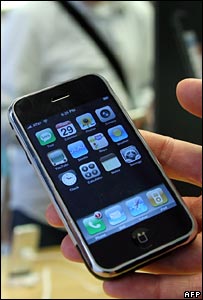 Apple, by contrast, was resolutely cheerful about its current state - while cautious about predicting how many iPods, iMacs and iPhones consumers will want as the economic gloom deepens. The iPhone results, in particular, look stunning. 6.9 million 3g phones went in their first three months on sale - that compares to the 6.1 million first generation iPhones sold over the 15 months it was in the shops. Steve Jobs boasted that his phone had even outsold Blackberry, and it looks as though Apple's entry into the smartphone market can now be judged a major success, though it will be interesting to see how it fares as rivals like the G1 jostle the iPhone in the Christmas market.
Perhaps even more significant is the 2.6 million Mac computers shipped in the quarter - more evidence that the halo effect from the iPhone and the iPod is persuading consumers to switch from PC to Mac. And with over $25 billion in the bank and no debt, Apple looks well placed to weather a recession - and perhaps snap up a few juicy businesses at bargain basement prices.
With two such contrasting corporate stories, you would think that their share prices would have gone in different directions over recent months. But Yahoo' share price has dropped from $26 to $12 in the last six months, while Apple's has fallen from $180 to $91 - so the market has decided that each of them is worth about half as much now as they were in May.
Later today, analysts are predicting that shares in both will rise - a relief rally for Yahoo, and a reward rally for Apple's spectacular figures. In the longer run (which in stock market terms means a few weeks) they will probably both fall back again, with Yahoo falling much further than Apple. So what's the moral? Markets may eventually get it right - but in the short term, terrified investors just have no idea what a technology firm is worth.
The BBC is not responsible for the content of external internet sites
This is dot.life - a blog about technology from BBC News.
Rory Cellan-Jones is the BBC's technology correspondent.
Maggie Shiels is the BBC's tech reporter based in Silicon Valley.
Archive
« January 2010
| Sun | Mon | Tue | Wed | Thu | Fri | Sat |
|---|---|---|---|---|---|---|
| 1 | 2 | |||||
| 3 | 4 | 5 | 6 | 7 | 8 | 9 |
| 10 | 11 | 12 | 13 | 14 | 15 | 16 |
| 17 | 18 | 19 | 20 | 21 | 22 | 23 |
| 24 | 25 | 26 | 27 | 28 |
Being Discussed Now
- Logging out... and straight back in(3)
- Gadgets of the Noughties(20)
- Plastic Logic's long journey to Vegas(21)
- Sexting teens(17)
- Wikipedia on the wane?(49)
- 'Cooling-off' for mobile phones? Not on the High Street(37)
- 2009 - the social year(36)
- Twitter, Iran and #uksnow(25)
- Broadband Britain - how far down the league?(55)
- Microsoft and Murdoch: Teaming up to bash Google?(34)
BBC Technology Headlines
- %28none%29
%28none%29 - %28none%29
%28none%29 - %28none%29
%28none%29
Visit the Technology index
Visit the BBC News website
Rory's TV/Radio reports
- Residents block Google car
Broadcast: 3 April 2009 - New adverts to tackle film piracy
Broadcast: 2 April 2009 - Call to scrap 'illegal databases'
Broadcast: 23 March 2009 - Female robot takes to the catwalk
Broadcast: 16 March 2009 - Super-charged battery breakthrough
Broadcast: 12 March 2009

- News Editors
- Sport Editors
- Journalism Labs
- BBC Internet Blog
- Radio 4 Blog
- Peston's Picks
- Nick Robinson's Newslog
- Stephanomics
- Mark Easton's UK
- Mark Mardell's America
- Nick Bryant's Australia
- Andrew Harding on Africa
- Gavin Hewitt's Europe
- Soutik Biswas' India
- dot.Rory
- Science: Jonathan Amos
- Richard Black on environment
- Today: Tom Feilden
- Fergus Walsh's medical files
- Newsnight: Paul Mason
- Newsnight: Mark Urban
- Torin Douglas
- Will Gompertz's arts
- Phil Coomes on photojournalism
- Magazine Monitor
- Mark D'Arcy in Westminster
- NI: Mark Devenport
- Scotland: Brian Taylor
- Scotland: Douglas Fraser
- Wales: Betsan Powys
- Martin Rosenbaum on FOI
- 5 Live Breakfast
- Newsnight
- PM programme (iPM)
- World Tonight: Robin Lustig
