


Technology - lessons from history
- 20 Oct 08, 09:10 GMT
Imagine a decade of unprecedented technological advance. It's a time when a new form of communications technology transforms the way consumers live their lives, where the number of scientists working in R&D in American labs more than doubles, and investors rush to put their money into the smartest new firms. Then there's the kind of stockmarket crash we haven't seen in decades.
 Or think about an earlier period, when another newly invented industry attracts a wave of money from an eager new class of middle-income investors, after the government relaxes stock market regulation put into place to stop a previous stock market bubble. The industry itself is almost totally unregulated, and MPs, many of whom are keen investors themselves, act as cheerleaders rather than watchdogs. Again, there is an extraordinary boom, followed by a terrifying bust, in which many of the new middle-class investors lose their shirts.
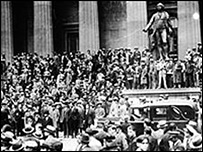
The decade I describe in the first paragraph is the 1920s, when radio was the technology which helped inflate a bubble which burst with the Wall Street crash, and was followed by the great depression. And the second bubble was the Railway Mania which swept Britain in the 1840s, aided by the removal of restraints imposed after the South Sea Bubble. So what we are experiencing right now has depressing echoes of the past. But if we look at what happened to technology after those two great crashes, we can find reasons to be cheerful - about the prospects for continued innovation, if not for stock market investors.
First the 1920s. An article by an American economist Tom Nicholas looks at how the stock market valued technological advances, as measured by patents, before and after the crash. He stresses what an extraordinary period this was - the time when electricity first surpassed steam as a source of power, when new materials such as nylon were invented, and when refrigerators became common in American homes. But it was radio which caused most excitement - at the start of the 1920s nobody had a radio set, by the end they were in 12 million American homes.
But Mr Nicholas finds that after the crash innovation did not stop, although as he puts it "high technology firms did not earn significant excess returns over low technology firms." Indeed, there was twice as much spent on research and development as in the previous decade, General Electric registered twice as many patents in the thirties as in the twenties, and the radio business RCA, which had been the "dotcom" stock of the 1920s was back in profit by 1934. The thirties was a disastrous decade in many ways but it was also a period of rapid technological change.
And what happened to the development of the railways after 1846, when the market fell to earth? Well luckily so much money had been poured in, that they continued to grow. By 1855, there were over 7000 miles of railway in Britain, compared to 1500 miles in 1840. And while the rate of investment slowed right down, passenger numbers really took off, from 30 million in 1845 to nearly 240 million in 1865. In other words, all that money thrown at the new technology by the mug punters of the 1840s ended up transforming Britain's transport system and changing the social fabric of the country.
I am writing this on a train, using an online document, and connecting to the internet via a 3G dongle. Which would not have been possible had the mobile operators - the mug punters of 2000 - not poured billions into 3G licences and the cost of rolling out new networks. So the investment in technology that we've seen in the good times may slow down a bit, but its effects will continue to be felt.
Mind you, the journey from London to Wrexham is taking me four hours and involves two changes. Have we really made that much progress since the 1840s?
The BBC is not responsible for the content of external internet sites
This is dot.life - a blog about technology from BBC News.
Rory Cellan-Jones is the BBC's technology correspondent.
Maggie Shiels is the BBC's tech reporter based in Silicon Valley.
Archive
« January 2010
| Sun | Mon | Tue | Wed | Thu | Fri | Sat |
|---|---|---|---|---|---|---|
| 1 | 2 | |||||
| 3 | 4 | 5 | 6 | 7 | 8 | 9 |
| 10 | 11 | 12 | 13 | 14 | 15 | 16 |
| 17 | 18 | 19 | 20 | 21 | 22 | 23 |
| 24 | 25 | 26 | 27 | 28 |
Being Discussed Now
- Logging out... and straight back in(3)
- Gadgets of the Noughties(20)
- Plastic Logic's long journey to Vegas(21)
- Sexting teens(17)
- Wikipedia on the wane?(49)
- 'Cooling-off' for mobile phones? Not on the High Street(37)
- 2009 - the social year(36)
- Twitter, Iran and #uksnow(25)
- Broadband Britain - how far down the league?(55)
- Microsoft and Murdoch: Teaming up to bash Google?(34)
BBC Technology Headlines
- %28none%29
%28none%29 - %28none%29
%28none%29 - %28none%29
%28none%29
Visit the Technology index
Visit the BBC News website
Rory's TV/Radio reports
- Residents block Google car
Broadcast: 3 April 2009 - New adverts to tackle film piracy
Broadcast: 2 April 2009 - Call to scrap 'illegal databases'
Broadcast: 23 March 2009 - Female robot takes to the catwalk
Broadcast: 16 March 2009 - Super-charged battery breakthrough
Broadcast: 12 March 2009

- News Editors
- Sport Editors
- Journalism Labs
- BBC Internet Blog
- Radio 4 Blog
- Peston's Picks
- Nick Robinson's Newslog
- Stephanomics
- Mark Easton's UK
- Mark Mardell's America
- Nick Bryant's Australia
- Andrew Harding on Africa
- Gavin Hewitt's Europe
- Soutik Biswas' India
- dot.Rory
- Science: Jonathan Amos
- Richard Black on environment
- Today: Tom Feilden
- Fergus Walsh's medical files
- Newsnight: Paul Mason
- Newsnight: Mark Urban
- Torin Douglas
- Will Gompertz's arts
- Phil Coomes on photojournalism
- Magazine Monitor
- Mark D'Arcy in Westminster
- NI: Mark Devenport
- Scotland: Brian Taylor
- Scotland: Douglas Fraser
- Wales: Betsan Powys
- Martin Rosenbaum on FOI
- 5 Live Breakfast
- Newsnight
- PM programme (iPM)
- World Tonight: Robin Lustig
