


Silicon Valley and same-sex marriage
- 27 Oct 08, 10:30 GMT
They make unlikely bedfellows but some of the biggest titans in the Valley are donating large sums of money in a political battle that has gripped California.
These companies, which normally eschew going public on politics because it is bad business, have decided to raise their heads above the parapet in the controversial fight to abolish same-sex marriage under a proposition being put forward for Californians to vote on come election day.
Prop 8, as it is known, would prevent gays and lesbians from getting married in the Golden State by overturning a California Supreme Court decision that legalised same-sex marriages earlier this year.
It is one of the most fiercely contested propositions that people are being asked to consider and despite the liberal politics of California, which side will win the day is no slam dunk with recent polls pitching 52% against and 44% for Prop 8.
 A lot of money is being spent by both sides but the "No on 8" campaign has been given a financial and high profile boost with the decision by Apple to contribute $100,000 (£63,500).
In a statement the company said "Apple was among the first California companies to offer equal rights and benefits to our employees' same-sex partners, and we strongly believe that a person's fundamental rights - including the right to marry - should not be affected by their sexual orientation."
Apple said it views this as a civil rights issue rather than just a political issue.
 The Cupertino based company followed in the footsteps of Googlewhich had also entered the political fray by ponying up some serious cash. Sergy Brin has contributed $100,000 (£63,500) while fellow co-founder Larry Page has given $40,000 (£25,500) to the "No on 8" campaign.
In the Google blog, Mr Brin wrote: "While there are many objections to this proposition - further government encroachment on personal lives, ambiguously written text - it is the chilling and discriminatory effect of the proposition on many of our employees that brings Google to publicly oppose Proposition 8."
The search giant said it sees this also as an issue of equality.
What is interesting about the involvement of Apple and Google in such a high profile and bitterly contested fight is that it could be argued these companies are risking their bottom line by being so public about their involvement.
Some supporters of Prop 8 have said they would protest businesses that actively oppose the measure unless they make similar donations to their group ProtectMarriage.com.
In the normal realm of big business and politics, companies would generally donate money to candidates on both sides of the aisle to preserve access no matter who wins. This issue however certainly seems to be different.
"This is an propositon where you are on one side or the other. You vote yes or no, not yes and no," said Robert Sterm, president of the nonpartisan Center for Governmental Studies.
Naturally enough both companies are taking some heat for their stance with bulletin boards and blogs inundated by comments both for and against what Apple and Google have done.
They range from "Go Apple! Go Google!" to "Protecting people's rights is awesome" and from "It is easy for Apple to support this measure because most of their customers are wealthy liberal folks" to "Apple should be ashamed. I am very upset and may no longer buy Apple products due to this stupid decision by Apple."
While both companies have said they are neutral in the presidential race, it is noteworthy that two such big Silicon Valley names have decided to go public on this divisive issue and back it with some serious cash.

The town in the cloud...
- 27 Oct 08, 09:15 GMT
I'm in the United States to report on several stories, including the whole phenomenon of cloud computing. More on that on the television and radio on Tuesday, but in the meantime, let me take you to one of the places we've filmed, the town with its head in the cloud.
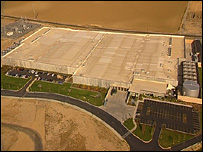 We've been to Quincy, a remote farming town of 5,000 inhabitants in the middle of the state of Washington, where just about the only activities until recently were either planting potatoes or turning them into chips - or rather French fries. Now it's home to three giant data centres.
The biggest belongs to Microsoft, which completed its brutally ugly building on a former bean-field last year, to be followed swiftly by Yahoo and now the financial software firm Intuit. We were allowed access to Microsoft's centre - the first TV crew to get inside - and after passing through several layers of security found ourselves in one of the server rooms.
In order to see this content you need to have both Javascript enabled and Flash installed. Visit BBC Webwise for full instructions. If you're reading via RSS, you'll need to visit the blog to access this content.
There are 10 of them, with up to 30,000 servers in each, an almost unimaginable amount of computing power. Walking around, deafened by the roar from the cooling systems needed to keep the computers chilled, you feel you're right in the belly of the modern internet.
What are these places for? Well they currently handle everything from search queries and instant messaging to the storage of digital photos. But in the future, much of the computing power here and at similar centres will be leased out to companies wanting to engage in cloud computing - running applications on Microsoft's servers rather than their own. Consumers will also be encouraged to put more of their data into Microsoft's cloud, so that it can be accessed anywhere, from any device. It's a fashionable new business where the likes of Google and Amazon are already well entrenched.
Why Quincy? Well these places use an awful lot of energy - 50 megawatts at the Microsoft centre - and nearby on the Columbia river there's a series of dams providing relatively cheap hydro-electric power. The people we met at the Microsoft centre talked like power generation specialists rather than software types. When they kept mentioning redundancy I thought they were worried for their jobs. It turned out they were describing two back-up power systems, generators and batteries, which are supposed to ensure the place never goes offline, even if the Columbia river stops flowing.
Places like Quincy tell us a lot about the way economic power is shifting - as Detroit became Motown, so Quincy may become Dataville. Land values in the area tripled after Microsoft moved in, and one young security guard told me he was grateful for his job, the best paid work he could find round here. But let's not exaggerate the local impact - few people are needed to run these vast buildings and the computers inside them, and the numbers are going to fall as processes become ever more automated. Eventually, it may be just the security guards who are left.
It's the power these data centres give to their owners which is more likely to give pause for thought. Only a few very wealthy businesses will be able to afford a global chain of data centres (Microsoft will only say it has "more than 10 and fewer than 100") and we could all end up entrusting our data to one of these competing "clouds".
We used to think the internet was a kind of commonwealth we all owned, with the telecoms companies looking after the basic infrastructure but data free to flow wherever we wanted. But if so much of the world's computing power - and data - ends up in the hands of Microsoft, Google or Amazon, won't they end up ruling the internet?
 As I left the server room in the Quincy data centre, I noticed a big red button on the wall, with a notice above saying: "Pressing button will switch off computer room". For a moment, I was tempted...
The BBC is not responsible for the content of external internet sites
This is dot.life - a blog about technology from BBC News.
Rory Cellan-Jones is the BBC's technology correspondent.
Maggie Shiels is the BBC's tech reporter based in Silicon Valley.
Archive
« January 2010
| Sun | Mon | Tue | Wed | Thu | Fri | Sat |
|---|---|---|---|---|---|---|
| 1 | 2 | |||||
| 3 | 4 | 5 | 6 | 7 | 8 | 9 |
| 10 | 11 | 12 | 13 | 14 | 15 | 16 |
| 17 | 18 | 19 | 20 | 21 | 22 | 23 |
| 24 | 25 | 26 | 27 | 28 |
Being Discussed Now
- Logging out... and straight back in(3)
- Gadgets of the Noughties(20)
- Plastic Logic's long journey to Vegas(21)
- Sexting teens(17)
- Wikipedia on the wane?(49)
- 'Cooling-off' for mobile phones? Not on the High Street(37)
- 2009 - the social year(36)
- Twitter, Iran and #uksnow(25)
- Broadband Britain - how far down the league?(55)
- Microsoft and Murdoch: Teaming up to bash Google?(34)
BBC Technology Headlines
- %28none%29
%28none%29 - %28none%29
%28none%29 - %28none%29
%28none%29
Visit the Technology index
Visit the BBC News website
Rory's TV/Radio reports
- Residents block Google car
Broadcast: 3 April 2009 - New adverts to tackle film piracy
Broadcast: 2 April 2009 - Call to scrap 'illegal databases'
Broadcast: 23 March 2009 - Female robot takes to the catwalk
Broadcast: 16 March 2009 - Super-charged battery breakthrough
Broadcast: 12 March 2009

- News Editors
- Sport Editors
- Journalism Labs
- BBC Internet Blog
- Radio 4 Blog
- Peston's Picks
- Nick Robinson's Newslog
- Stephanomics
- Mark Easton's UK
- Mark Mardell's America
- Nick Bryant's Australia
- Andrew Harding on Africa
- Gavin Hewitt's Europe
- Soutik Biswas' India
- dot.Rory
- Science: Jonathan Amos
- Richard Black on environment
- Today: Tom Feilden
- Fergus Walsh's medical files
- Newsnight: Paul Mason
- Newsnight: Mark Urban
- Torin Douglas
- Will Gompertz's arts
- Phil Coomes on photojournalism
- Magazine Monitor
- Mark D'Arcy in Westminster
- NI: Mark Devenport
- Scotland: Brian Taylor
- Scotland: Douglas Fraser
- Wales: Betsan Powys
- Martin Rosenbaum on FOI
- 5 Live Breakfast
- Newsnight
- PM programme (iPM)
- World Tonight: Robin Lustig
