Overview of A Voice Spoke To Me At Night by Helen McClory
- A Voice Spoke To Me At Night is a short story by Helen McClory.
- In the story, the narrator's name and gender are never revealed to us.
- They live on their own in an unnamed town. They are lonely and isolated.
- One night they hear a voice and put this down to various things such as turning on the phone by accident, but eventually they see a man in the mirror in their bedroom.
- The man is from the ancient past and speaks a mixture of Latin and Scots so the narrator records their conversation and translates it later.
- The man in the mirror tells the narrator that everyone in his village has died of the plague and he is all alone.
- He tells the narrator all about his life and once it gets dark the man disappears, not to return.
- The narrator is left contemplating the man, and ideas of loneliness and connection.
The story has themes of:
- isolation and loneliness
- connection and communication
- the supernatural
- imagination
- time
You can read A Voice Spoke To Me At Night by Helen McClory and the other short stories on the SQA website.
Plot summary
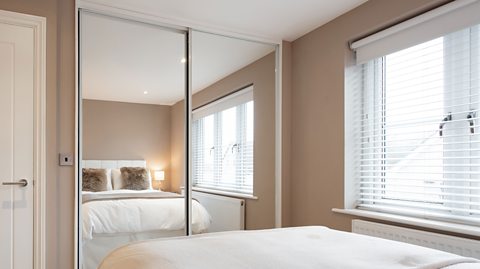 Image source, Getty Images
A Voice Spoke To Me At Night is told in the first person by an unnamed, ungendered narrator. The title also acts as the first sentence of the story, taking us straight into this action.
The narrator lives in an ordinary flat above a convenience store on land that has no real past. The details of their life are vague: they have a job but otherwise live an isolated life, interacting with the world through online games, content and apps.
Over three nights, the voice speaks to the narrator. It seems to come from long ago and speaks in a mixture of Scots and Latin – the narrator likens the voice to Geoffrey Chaucer who was a writer in the 14th century, but we also learn the voice has ‘a Scottish character to it’.
The narrator reveals details of their ordinary, isolated life: scrolling on their phone, gaming, watching online videos, listening to podcasts, looking through a dating app "to look at some faces". The narrator is prone to feelings of anxiety about work, the changing seasons and being alone. Autumn especially makes them "a bit sad without specific reasons".
The next night the narrator sees the owner of the voice, a man, in the mirror. A;though the man says ""Nolit timere," which the narrator understands to mean "do not be afraid," their initial reaction is one of fear and they back away, out of the room.
When they go back to the bedroom the man is still in the mirror so the narrator starts to talk to him.
The man gives his name as ‘Mal-something’ but the language they speak is hard to understand, so the narrator records their conversation on their phone and translates it later.
Mal-something’s story is that he is the only person left alive in his village after the plague killed everyone else. He talks about trying and failing to bury everyone and to harvest all the crops himself and how he has moved into the laird’s big house but feels guilty about that. He says that when he was a boy he lived in a monastery for a time but as he was needed to help on the farm his father took him back. He also speaks of reading books from the large library at the laird’s house. These facts could explain his knowledge of Latin but, as with the narrator’s own story, there is a lack of detail.
The man in the mirror worries about whether he is cursed because he left the monastery, or for other unspecified sins he has committed. The narrator thinks Mal-something overthinks things, perhaps because he is on his own, then goes on to demonstrate that they overthink things themselves, perhaps for the same reasons. The narrator thinks about how they might cope if they were the last survivor of a plague, then tells us what they wished they had asked the man in the mirror, although it is not clear why they didn’t ask him these things as they seemed sure they wouldn’t encounter him again after darkness fell.
Finally the narrator tells us the event with the man in the mirror has made them think quite deeply about issues such as loneliness and connection. They wonder how this portal has been created and how Mal-something has seen them. They wonder why the connection has been made between the two of them. The narrator tries to cling on to the connection but it fades as the light fades and the narrator is left hoping this was as meaningful for the man in the mirror as it has been for them.
Image source, Getty ImagesCharacters in A Voice Spoke To Me At Night
The narrator
The narrator of the story is unnamed, ungendered and ageless. They give some information about their life but it all seems vague, bland and deeply ordinary. The story and the manner in which they tell it reveal an isolated, lonely and anxious character. Despite their low self esteem they are not without a sense of humour and show feelings of empathy with the man in the mirror.
Isolated
The narrator is shown to be deeply isolated through both their lifestyle and their thoughts.
live in a new-build house above a Tesco Metro. This part of town seems to be historyless:
The setting feels modern, impersonal and disconnected from history or community, and this reflects the narrator themselves. Their daily routine is repetitive and solitary. Their connection to the wider world is through their phone, scrolling through news, playing games, watching streamed gameplay or listening to podcasts. Although they go on Tinder they don't attempt to set up a date:
but only because I wanted to look at some faces, not to make any decisions.
Their behaviour at work also reveals social isolation. They explain that they "don't join in with workplace bonding, chatting about the telly and politics and that,” separating themselves from colleagues emotionally and socially.
Low self esteem
I’m not very interesting, or powerful
The narrator demonstrates negative feelings about themselves, putting themselves down and minimising their own importance. They describe themselves as “not a brave type,” showing low confidence and a lack of self-belief. They also think their boss “doesn’t think much of me,” suggesting insecurity and fear of being judged.
Their loneliness and lack of confidence shape how they see both their life and their relationships with others.
The narrator shows a subtle sense of humour through self-deprecating comments. They joke that the voice might be a "bored" spy, "so low down on the list of spy-employees that his job was spying on me." They also say “I’d be the last to get picked for a special mission to save the earth,” and humorously describe themselves as “the first to die in a magical world.” These moments lighten the story, and suggest the narrator has an active imagination. There is mention of their interest in fantasy, which could be a means of escape from their ordinary day-to-day existence.
Anxious
The narrator is shown to be anxious and fearful, constantly worrying about both ordinary life and imagined dangers.
Early in the story, they admit to an irrational fear of leaving their feet uncovered in bed:
a terrible fear that something will come and drag me by the ankles.
This childish but intense fear immediately suggests an overactive and nervous imagination. They are also disturbed by “the mirrored sliding doors” in their room.
Their anxiety affects everyday life too. Meetings with their boss leave them with “the usual unpleasant feelings,” and autumn makes them imagine falling unseen in the street and being left alone in the dark. These thoughts show how easily their mind drifts towards worst-case scenarios.
When the supernatural events begin, their fear becomes even more physical and intense. Hearing the mysterious voice makes them struggle not to scream, while seeing the man in the mirror causes them to experience “quick and shallow breaths” and “whole body trembling.”
They also panic over whether they they are suffering from mental ill health, saying, “I was either mad, or I wasn’t mad, and both options were f***ng awful.”
Empathetic
The narrator shows empathy through their emotional understanding of the lonely man in the mirror.
Despite their initial fear, they listen carefully to the man's tragic story and feel genuine compassion for his suffering. They admire his intelligence and resilience:
I wanted to tell him I was impressed by that.
They also recognise the pain of his isolation:
I was sorry he was so alone in his world.
Their empathy becomes so strong that they think, “I’d have done anything for him.”
By the end, the narrator is left wondering what the man got from the encounter, and hoping their presence was comforting. This attitude shows their kindness, emotional connection and understanding.
Positive
Early in the story, we are given a hint that the narrator is capable of seeing things more positively. While the build up of wet leaves on the pavement feels threatening to them, they recognise that there is another view:
making the pavement even more treacherous, but beautiful too,
And they also recognise there is value to looking for the positive:
There’s always something beautiful going on, which I should try to notice and remember.
By the end of the story, the narrator has developed a more positive attitude through their encounter with the man in the mirror.
This interaction gives them a sense of purpose and emotional connection. They reflect warmly that “he came to me,” suggesting the experience has changed how they see themselves. This is suggested by their hope that the man too gained from their meeting:
I hope he thinks for all that, that it was a good face too, that my company was good for him, after so much time alone.
Instead of focusing only on fear and anxiety, the ending is filled with compassion, affection and emotional openness, showing personal growth and hope.
The man in the mirror
The man in the mirror first appears as a voice speaking to the narrator at night, but does not appear as a person until later. It is never made clear whether he is a supernatural presence, or a creation of the narrator’s imagination, but it seems significant that he appears in their mirror and bears some similarity to the narrator – he is isolated and lonely, intelligent and responsible.
We are told, when he was just a voice, that he is ‘from years and years in the past’ because the language he is speaking is hard to understand, ‘garbled old language’, like the Chaucer the narrator studied in school, though with ‘a Scottish character to it’.
Isolated and lonely
The third time the voice is heard, the narrator detects a tone of ‘neediness’ in it, and this is the first suggestion that, like the narrator, the man is lonely:
I could hear some emotion other than need – like he needed to know I was listening, but also that the story he was telling was something that was painful to him and important.
While the narrator seems isolated by modern life, the man in the mirror has been left alone and lonely as a result of plague:
- 'He told me he was the only man left alive in his village."
- 'There was no one left to bury but everyone left to cry for."
- 'nothing much else to do with his days except feel his heart's pains…'
These statements convey the deep sense of grief the man must feel, not just for one death, but for everyone he knows.
In theory, the narrator could reach out to colleagues, neighbours, or even other Tinder users, to overcome his isolation. The man in the mirror has no such choice. Death has taken everyone else in his village, and so this encounter through the mirror is the only connection available to him.
But this man kept himself going, he said, for a whole turn of the seasons, a year. All alone, with nobody coming.
The narrator clearly admires the man's resilience, to keep himself going and stay alive with only himself to rely on. And while he senses the man's extreme loneliness, he sees this almost as a positive power which has made their connection through time possible:
the force of his loneliness, making a portal or something
Intelligent
Despite being a medieval peasant with little formal education, the man is highly intelligent and eager to learn.
He said he had learned to read from a brief stay with some monks as a boy.
However, when the man is needed to help on his father's farm, he is forced to leave the monastery:
It had broken his heart, because he had loved learning.
When left alone as a result of the plague, the man continues to educate himself, even when there is no obvious outlet for his learning:
- 'In the laird’s house there was a library of books, and he spent some time reading.'
- 'He taught himself Greek and how to read better.'
- 'He was someone who thought a lot.'
- 'I wanted to tell him I was impressed by that.'
Perhaps the man's strong intellectual curiosity provides a focus, helping him cope with his loneliness, just as the narrator passes his time on his phone. It seems he finds additional meaning through religion, although this too is linked to his suffering:
He mentioned God a lot. …he said it with a lot of pain.
Responsible
The man is shown to be caring and compassionate to the others in his village. Even after they have died he works hard to do what he thinks is best for them:
He couldn’t keep up with burying, but he had tried his best.”
And he continues to carry out his responsibilities, of dealing with the harvest:
He talked about the grain rotting in the field; he had been trying to get it all in for the winter. He said his hands bled from effort…
As well as working hard in its own right, the man is concerned that it is known that he has worked hard:
he hoped that I would believe him that they bled from effort, and not think he had just given himself an easy life.
The man in the mirror seems fearful of moral judgement, either for not working hard enough, or for moving into the laird's house:
he wanted to reassure me he didn't have any ideas about his station in life suddenly being raised above what was natural.
Above all, he seems concerned about sin and whether his actions were the cause of the plague and his situation. This sense of anxiety links him to the everyday fears that the narrator experiences. It is left to the reader to decide whether shared emotions and outlooks have brought the two characters together, or whether the situation is a result of the narrator's imagination, and they are projecting aspects of themselves onto an imagined person.
Narrative and structure
The story is told through the narrator’s first-person voice.which builds the reader's understanding of the character while moving the narrative forward. The narrator's voice is conversational and informal, sometimes humorous, and we are able to share their thoughts and emotions as the story develops.
The story uses gradual revelation to build tension. The voice first appears as something vague and explainable, possibly coming from neighbours or technology. Only slowly does the narrator, and reader, realise that the voice has a supernatural source. When the man in the mirror finally appears, we share the narrator's initial sense of shock, but as the focus moves to the narrator's reaction to the situation and their relationship with the man, the tone is one of curiosity and empathy rather than horror.
While the narrative leads us through events chronologically, the narration follows a stream of consciousness, moving between the narrator's observations, worries and imagination as they occur to them. For example, a change in the weather leads them to reflect on how autumn makes them feel, before steering off into an imagined situation where they fall over and lie unseen on a slippery pavement.
This technique adds intimacy and allows the reader to experience the narrator's anxiety and thoughts. The combination of reporting real events and imagined situations creates uncertainty, leaving it open for the reader to decide whether the man in the mirror is real, or the narrator's invention.
Setting
The setting of A Voice Spoke To Me at Night highlights the narrator’s isolation and creates a contrast between the modern world and the medieval past.
Most of the story takes place in the narrator’s small flat "above a Tesco Metro.” This setting feels ordinary, impersonal and disconnected from wider society. The narrator even describes the area as “historyless,” suggesting a world lacking deeper meaning or connection.
Inside the flat, technology dominates the narrator's daily life. However, instead of making them feel connected, these things emphasise their loneliness.
The bedroom is the main setting, and this most personal space helps create a sense of intimacy between the narrator and the man in the mirror.
The mirrored wardrobe doors create an unsettling atmosphere long before the supernatural events begin. The narrator admits, “I never liked the empty space of the mirrors,” showing that the setting reflects their anxiety and discomfort. The mirror can be seen in many ways:
- it is reflective and could be seen as showing the narrator an altered reflection of themselves.
- It acts like a screen, similar to the narrator's phone, offering a link to a wider world and the promise of connection.
- It is a window that allows the two characters to see and communicate with each other.
- It is a barrier that limits the contact that the two characters can have.
On the other side of the mirror. is a bleak medieval setting. devastated by plague. The harsh landscape, grey skies and isolation create an atmosphere of death and loneliness.
The contrast between the modern flat and the medieval landscape shows that although the two characters live centuries apart, both experience deep isolation.
Themes in A Voice Spoke To Me At Night
Isolation and loneliness
The story is primarily about loneliness and this theme runs through the whole text from the beginning when the narrator takes their phone into bed and spends a lot of time on it, perhaps for company, to the clear statements at the end:
Loneliness is a terrible thing, wherever you are. I think it’s a stronger force than lovethe force of his loneliness, making a portal or something
Both characters in the story are isolated and lonely. The narrator lives by themselves and seems to seek out connection through technology whilst shunning real company at work or by meeting people properly online.
The man in the mirror is literally alone, his loneliness is due to him having lost his entire village to the plague. In his time in the past, this means he is on his own perhaps forever as the villages provided community.
While the characters do remain isolated – they are in different places and in different time periods, and when they try to reach each other through the mirror this fails – their brief coming together appears to be a valuable experience that lessens their loneliness.
And the narrator expresses loneliness in a positive way, suggesting it is a powerful type of love.
Connection and communication
 Image source, Getty Images
The other side of loneliness and isolation is connection with others. Both the narrator and the man in the mirror do both try to connect with others in their worlds, but only find a meaningful connection with each other.
While the narrator, for whatever reason, avoids connecting with colleagues, they do seek out some form of connection with others through technology. They are often listening to something through ‘headphones’; they game and watch videos of others gaming; they mention Twitter and Tinder which feature people but they do not seem to connect with others directly through these apps:
only because I wanted to look at some faces, not to make any decisions
The man in the mirror has had connection with others in the past, having been part of his village community, and in his time learning at a monastery. When plague hits the village, the man tries to support others - ‘He said that he went into every house and that death was inside each one’ – and he carries on as though he was still part of the community with the harvest, burying the dead and grinding flour.
He tells the narrator that ‘in the empty house he taught himself Greek and how to read better’ and perhaps this is an attempt to connect with the world – in a similar way to the narrator connecting through their phone.
The connection between the man in the mirror and the narrator occurs despite the barriers of living in different times, speaking different languages, and being separated by the surface of the mirror. By the narrator feels that the man in the mirror has specifically chosen them to contact. Although the reason is not explained, this could be because of their shared sense of loneliness.
There are gaps in the communication as the narrator wishes they had asked questions and sometimes the man says something the narrator hasn’t understood and hasn’t had time to record. Presumably this works both ways although the man in the past has no means to record or translate what the narrator is saying.
Despite these issues, or perhaps because of them, it feels very powerful that they have connected with each other and they both try to push through their portals to reach each other but fail. The feeling at the end of the story, though, is that what they have gained from this experience is enough:
I looked at him for a long time saying nothing. He looked back at me.
Image source, Getty ImagesThe supernatural
There is certainly a sense of the supernatural about this story. If we believe the narrator's account, there can be no natural or rational explanation for what happens.
Th story follows the pattern of a ghost story. Events start small, with the voice of the title, which the narrator tries to ignore or explain away. But the voice becomes more insistent or 'needy', and eventually the visitor manifests itself as a man in the mirror. Despite initial fear, the man in the mirror doesn’t seem to be scary, and in fact the connection seems to be a positive thing for both parties.
The writer's word choices, and the narrator's generally fearful nature build the atmosphere of the supernatural throughout the story:
- ‘I have a terrible fear that something will come and drag me by the ankles’
- ‘it had decided to become autumn overnight’
- ‘I feel vaguely anxious’
- ‘treacherous’
- ‘jaggy layers’
- ‘nervous’
- ‘magical cards’
- ‘disconcerting’
- ‘sickening’
- ‘shudder’
- ‘trembling’
- ‘terrifying’
- ‘dark’
The narrator’s physical description of the man in the mirror is as though he is a ghost, and although he seems alive, he could not possibly be, having lived so long in the past:
- ‘deeply set eyes pale back there in his skull’
- ‘he moved like no-one else I’ve ever seen’
- ‘the fingers were long’
"Mal-something" references death adding to the supernatural theme:
- ‘bodies … stacked up everywhere’
- ‘shivered’
- ‘angel of death’
- ‘a kind of curse’
- ‘The children were dead too … Everyone was dead’
As in many stories of the supernatural, events are not fully explained and the writer creates uncertainty about whether we can believe the narrator.
Imagination
One reading of the story is that the narrator has dreamed up the man in the mirror. They certainly have an active imagination:
- They imagine something might grab them by the ankles at night.
- The mirror in their bedroom is said to ‘unsettle’ them.
- One explanation for the voice is that it is ‘maybe a spy whose equipment had malfunctioned.’
- ‘in my imagination [the streetlights] are activated by motion’.
- They imagine in detail how they would cope if everyone around them died, and what might happen if they did successfully move through the mirror into the past.
At one point they refer to "the time he's supposed to be from" which suggests the man is an invention rather than real.
There are hints too that the narrator's interest in history and fantasy, including watching a "Let's Play of a kingdom-building game," would give them enough knowledge to create the man and his story. It is a gap in their knowledge, their inability to remember Mal-something's name, that they say shows they did not invent the situation:
I'm giving this as kind of evidence that I didn't hallucinate him, because if I had, I probably would have made up a name I could remember.
But
Time
There are different references to time throughout the story, whether it be the time difference between the narrator and the man in the mirror, the idea of history or time passing within the story.
The narrator refers to their knowledge of history, and shows it through their references to Chaucer and Francis Drake. This interest in the past contrasts with their attitude to the world around them. They describe their part of town as ‘historyless’, and their flat as "new-build". These and the many references to phones, gaming, apps and "scrolling" suggest they have a negative opinion of the modern world.
In contrast, the voice is described as coming from ‘years and years in the past’ and this past is very different to the narrator's world. The narrator's life is isolated, their connections are through technology, we don't know what their job actually is, and we have little idea about what they believe in. The man in the mirror was part of a community, experiences genuine loss and grief, works at the harvest, tries to mill grain, learns through books and believes in God. It could be argued that the narrator envies them and sees them as a fuller, more resilient person than themselves. Do they feel the past has meaning that the present day lacks?
But while their worlds may be different, the story shows the two characters are not so different. They share basic emotions like loneliness, and basic needs, like human contact. The world may change but people are at heart the same.
Comparisons to other short stories
The supernatural
We see the supernatural in all of the stories in this selection.
- A Voice Spoke to Me at Night features a ghost from the past who appears in the narrator’s mirror
- Andrina features a ghost from the past who visits her sickly grandfather soon after her death
- Things My Wife and I Found Hidden in Our House features hauntings and curses and supernatural creatures such as witches and kelpies
- Death in a Nut features Death as a supernatural creature which can change in size
There has been a long tradition of the supernatural featuring in Scottish stories. Death in a Nut is the most traditional story is this set. Andrina is set in the past and the setting at the edge of an island community gives it a traditional feel. Both A Voice Spoke to Me at Night and Things My Wife and I Found Hidden in Our House take place in a modern, present-day setting, which could be seen to make the central characters more relatable, and provides an interesting contrast with the idea of ghosts, witches or kelpies. ,
Relationships
All the stories deal with relationships in some way, or the lack of them, and associated ideas such as isolation and loneliness.
- In A Voice Spoke to Me at Night the narrator has no relationships and is isolated, perhaps largely through choice. The narrator forms a kind of bond with the man in the mirror who is also isolated. Their loneliness seems to bring them together.
- In Things My Wife and I Found Hidden in Our House the central relationship is strong, but there is a hint that it is endangered by the kelpie's curse. The destructive nature of relationships forms the background to the story, with the love triangle between Alice's grandmother, grandfather, and his first wife as the source of the curse.
- Andrina deals with the narrator’s relationship with Andrina’s grandmother long ago. Bill Torvald abandoned Sigrid when she became pregnant, and he seems filled with regret and lonely. The ghost of Andrina leads him to face what he did and, together with Sigrid's letter, brings his comfort and sense of closure.
- In Death in a Nut the relationship Jack has with his mum is so strong he feels he cannot face the isolation and loneliness her death would bring. He later learns to accept that everyone, including his mother, must die.
Death
Death features in all four stories in different ways and to different degrees. In A Voice Spoke to Me at Night, the shadow of death is there in the man in the mirror’s story as he has seen his whole village die from plague.
- In Things My Wife and I Found Hidden in Our House, the grandmother's death has resulted in Alice and Rain inheriting her house. But it is the death or disappearance of the grandfather’s first wife that is more important. It is this which sets off the whole kelpie curse, and sets up doubt over how the grandmother has died
- In Andrina, Sigrid’s letter tells the narrator his granddaughter, Andrina, has died having never met him. He, and we, learn that Andrina has been a ghost, and through death she is able to help Torvald accept his past, and perhaps be ready for his own death.
- In Death in a Nut, the main theme of the story is about coming to terms with death as part of the natural order of things
Time
Time plays a part in all of the stories.
- In A Voice Spoke to Me at Night despite a difference of centuries between the man in the mirror and the narrator, they are able to connect because of their shared loneliness. Although the narrator's isolation seems tied to technology and modern life, there is a suggestion that feelings of loneliness have always, and will always exist.
- In Things My Wife and I Found Hidden in Our House the lives and relationship of the main characters are threatened by actions of two generations ago. The past continues to have an impact.
- In Andrina, the title character's visits to her grandfather lead him to face his past actions and overcome his regrets.
- In Death in a Nut, Death is portrayed as an old man, suggesting he has always existed. The theme of time links to how Jack matures and becomes an adult through his encounter with Death, and through the idea that trying to stop death almost stops time in the way it prevents normal life from taking place.
Communication
- In A Voice Spoke To Me At Night, although they share an emotional connection, there are communication issues between the man in the mirror and the narrator. This is mainly due to the language barrier as the man from the past speaks a mixture of Scots and Latin, meaning the narrator has to record him and translate it later.
- In Things My Wife and I Found Hidden in Our House, Rain seems naive and feels Alice's grandmother was trying to communicate positively with them. It is Alice who communicates the back story to the haunting.
- In Andrina, Bill tells Andrina exaggerated stories about his life. Sigrid's letter is a key communication that informs Bill about his granddaughter, her death, and the life Sigrid had after Bill abandoned her.
- In Death in a Nut, Jack learns his lesson about the necessity of death when he finally listens to his mother and accepts that she is willing to die.
Love
All the stories deal with love, or the lack of it, in some way, and associated ideas such as isolation and loneliness.
- In A Voice Spoke to Me at Night the narrator has no relationships and is isolated, but then forms a bond with the man in the mirror. The narrator comes to see loneliness as a powerful force - "a kind of love for everyone that is never returned".
- Andrina deals with the Torvald’s youthful loving relationship with Sigrid, and how he abandoned her when she became pregnant. But we are shown the enduring power of love as expressed in Sigrid's letter, and in the way the ghost of Andrina comforts the grandfather she never knew.
- In Things My Wife and I Found Hidden in Our House, the central relationship remains strong and supportive, but is still threatened by the supernatural.
- In Death in a Nut, Jack's love for his mother is so strong that he battles Death rather than lose her. The mother shows love by being willing to sacrifice herself so that the world can return to normal.
Quiz
Revise A Voice Spoke To Me At Night and other short stories with some interactive quizzes.
More on Scottish short story collection
Find out more by working through a topic
- count5 of 5

- count1 of 5

- count2 of 5