Overview of Things My Wife and I Found Hidden in Our House
- Things My Wife and I Found Hidden in Our House is a short story by Kirsty Logan.
- Kirsty Logan has drawn from stories about kelpies to create a modern folk tale of her own.
- The narrator, Rain, and her wife, Alice, have inherited Alice’s grandmother’s house and while they clear it they find a series of strange objects.
- The objects build up a story that suggests Alice’s grandmother may have killed her husband's first wife, and that that woman may have been a kelpie.
- In turn the grandmother may have died as a result of a curse that the kelpie placed on the house.
- Rain herself nearly drowns in the bath, and finds long black hair in her hand after the incident.
- Despite Rain and Alice disposing of all the items they find, they return to find more black hair on the door handle, suggesting they may not be free of the past.
The story has themes of:
- the supernatural
- relationships
- communication
You can read Things My Wife and I Found Hidden in Our House by Kirsty Logan and the other short stories on the SQA website.
Video - Reading from Things My Wife and I Found Hidden in Our House
In this video from BBC Authors Live, Kirsty Logan reads an extract from her short story Things My Wife and I Found Hidden in Our House.
Kirsty Logan reads an extract from Things My Wife and I Found Hidden in Our House.
KIRSTY So the story is about a married couple named Alice and Rain, and they are renovating a house that they have inherited and they find a series of objects in the house, which seem quite innocuous at first, but become more and more sinister as time goes on.
And I wrote this story after my dad died. My dad died very suddenly when I was in my 20s. And a lot of the stories in this book are about loss and grief. And there's a line in the story which is not from the part I'm going to read, which is just because you inherit something doesn't mean you get it for free. My dad did not leave me a house full of spooky things, sadly, because I feel like that would be very on brand for me. But it did make me think a lot about what is passed on to us.
It's interesting, Nadine, you were talking about identity and the identities that we are given, but also the identities that we choose. So for me, that's very much what the story is about. What do we accept from what we're given and what do we decide that actually we don't want. So this is the third object that they find in the house.
Number three a horse. Alice found this one. It was the size of a thumb, wedged into the skirting board under the bed. She brought it to the kitchen as I was making tea and said, "Rain, I can't find my glasses. Can you read this?"
I rubbed the tiny horse's haunches, feeling the symbols etched into the copper. "It's not words," I said. "It's runes or something. Maybe it's an old Highland superstition, and your gran left it to protect us from being trampled by. Well, not a horse, but life, sadness, money worries."
Alice raised her eyebrows. "Well, my mum always did say my gran was a witch. She stole my grandad from another woman. Did I ever tell you that?"
Alice took the horse from my hand. "He was married to someone else when they met a woman, always dressed in green, who wore strange jewellery. Rings made of glass she found washed up on the beach. She had green eyes and long black hair. Black as a winter night. Black like it was always wet."
My eyes were wide. "What happened? My gran went round to talk to her, to say basically I want your man and there's nothing you can do about it. And she must have been pretty convincing, because the next day the woman was gone. She left the village, went for a job down south or something. But you know the strange thing? No one ever saw that woman again."
"Oh, my God," I said. "Did your gran… Do you think she… Could she have done something?"
Alice laughed. "Come on Rain, what you think my wee old granny was a murderer?"
"Why not? Every murderer has a family."
"It's just a silly story," Alice said. "Gran obviously didn't kill anyone. She was just the other woman. So she had to make up stories about my grandad's ex, make her into a spooky witch, a baddie, not a poor lass who'd had a man stolen. If the first wife was the villain, then Gran was the hero and she could feel better. Simple as that. And she…"
At this, Alice jerked her hand and dropped the horse. It thudded to the floor and skittered away. All I could do was stare at the blistered outline of the copper horse burned into Alice's palm.
BRYAN Wonderful. Thank you very much. Let's have a round of applause for Kirsty.
Context
 Image source, Getty Images
Logan is known for writing contemporary fairy tales, often inspired by Scottish folklore. This story set in the present day, is about a kelpie – a supernatural creature from Scottish folklore.
What is a kelpie?
- A kelpie is a mythical creature found near bodies of water and known to shapeshift, usually into the form of a black horse, or sometimes into a beautiful human with black hair, often wearing green.
- The beauty of the creature lures the victim but when someone touches the kelpie they can’t let go and they are dragged to the bottom of the water and drowned, then eaten, all but the inside organs such as the liver, which are left on the bank.
- To take a kelpie’s bridle or necklace means you have control over the being and to kill it you must use silver, like the silver knife in this story.
- The famous statues of the Kelpies near Falkirk remind us of these stories and many bodies of water in Scotland are thought to ‘have a kelpie’ so the tales last to this day.
Image source, Getty ImagesVideo - What is a kelpie?
In this short video, Kirsty Logan explains what a kelpie is and why she was drawn to writing about this mythical creature.
Kirsty Logan explains why she was drawn to writing about kelpies in Things My Wife and I Found Hidden in Our House.
So a kelpie is a mythical creature which usually manifests as a very beautiful, usually black or dark horse. And it will be usually by water. And if you think, "I like that horse, I'm going to have that horse". If you climb on the horse to attempt to take it away with you, you will become fused to the horse, and it will then go into the water and drown you because it's an evil creature. Or some may say it's evil, and it can also sometimes manifest as a human, which is usually a man, usually a beautiful man with dark hair, but can also be a woman.
And I just really like that. I like this idea. I love stories about transformation. Any creature, like a selkie, which is somebody who is a human and also a seal, a mermaid doesn't really transform, but it's kind of two, two things at once. A werewolf who can be a human and a wolf. I love stories of of transformation. I think we're always in flux. We're always transforming as people. So I was very drawn to that. I was drawn to the ludicrousness of it and also the the sense of transforming.
What is the plot of Things My Wife and I Found Hidden in Our House?
The story is told by Rain, who, together with her wife, Alice, are clearing out the house the have inherited from Alice's grandmother. As they do so, they find a series of strange objects that supernatural forces from the past are still present in the house.
The story is told in sections, each based around the discovery of one of the objects.
1. A RING
The first part of the story throws us straight into the action: Rain finds a ring and thinks her wife’s grandmother has left it for them to welcome them to the house. Alice doesn’t think so and we get the first hint that her grandmother wasn’t a very nice person. We learn that Alice’s grandmother never really accepted their relationship, referring to Rain as Alice’s ‘friend’.
2. PAPER
The couple finds a note as they are removing the old bathtub in which Alice’s grandmother had a stroke and drowned. It says ‘KELPIES TO HELL’ and Alice explains to Rain what kelpies are. This is the first definite suggestion of the supernatural, but Alice explains the note in terms of her grandmother ‘losing it towards the end’.
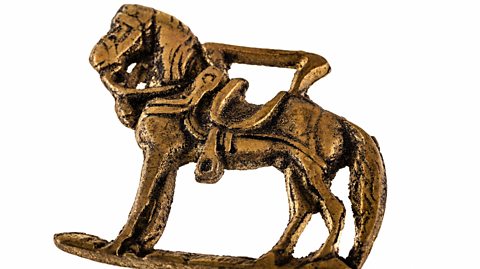 Image source, Alamy Images
3. A HORSE
The next find is a small copper horse. There are unreadable markings on it, possibly ancient runes, and this leads Alice to talk about how her mum used to say her gran was a ‘witch’. She tells the story of her gran stealing her grandfather from another woman, who then disappeared.
The description of the other woman matches traditional descriptions of a kelpie’s human form and the jewellery she wore matches the ring found at the start of the story.
A woman always dressed in green, who wore strange jewellery, rings made of glass she found washed up on the beach. She had green eyes and long black hair — black as a winter night, black like it was always wet.
When Rain asks if Alice’s grandmother might have done something to the first wife, Alice laughs and says that her gran simply made the first wife look bad to make herself look better, but that she couldn’t be a ‘murderer’. At that moment the copper horse in Alice’s hand burns hot and she drops it, but not before it leaves a burn mark on her skin.
Image source, Alamy Images4. PEARLS
A few days later, Rain finds a string of pearls, ‘as long as a bridle,’ on top of the wardrobe. Alice explains that a string of pearls could be used to tame a kelpie, and that her grandfather claimed to have caught one. The couple makes love in this section but Rain tastes blood in her mouth afterwards.
5. HAIR
In the following section Rain has a bath, saying she can never feel clean in this house which feels ‘rotten to the core’. She suddenly feels like she is sinking under and when Alice pulls her out she has long dark hair in her hand like a ‘horse’s mane’.
6. A GLASS JAR
Rain finds a glass jar in the bathroom wall. It contains a liver and Alice tells Rain that, after a kelpie eats its victim, it leaves the liver by the side of the water.
7. A KNIFE
The couple search for and find a silver knife - a weapon Alice’s grandmother could have used if she had killed a kelpie. The clues are all pointing towards an unearthly battle between a kelpie and a witch. To try to end the curse on their house the couple collect up everything they have found and travel for hours to the coast where Alice's grandparents and the first wife had lived all those years ago. They throw the collected objects off a cliff and into the sea.
8. MORE
When they return, long black hair is wrapped around the door handle, leaving the ending of the story very open and the reader guessing what might happen next to the couple.
Video - Why did Logan choose an open ending?
In this video, Kirsty Logan talks about leaving space for the reader to decide what Things My Wife and I Found Hidden in Our House is about.
She refers to a critical essay called The Death of the Author by Roland Barthes, and explores the idea that once a writer has put their work out into the world, it is up to the reader to decide what it is about.
Kirsty Logan explains why the ending of her short story is left so open.
BRYAN In ghost stories, though, it's not always clear what happens at the end. How important is it for you as a writer to leave space for the reader to to almost put their own spin on the story?
KIRSTY Yeah, so important. I love that question. I very much see reading as a collaborative act. Big believer in 'Death of the Author', meaning that it's not that the author has the definitive say on what a story is.
We certainly have intentions when we write a story. We are trying to say something, but whether or not that's what the reader takes from the story is out of our control.
It's not that the writer produces something and we just mindlessly consume it, and it's exactly what we're told it is. I don't think that's what reading is at all. It's you who creates the story in your mind. You hear the characters speak in your mind. You make the images.
So I never would argue with somebody's interpretation of my story. It might not be what I intend. It might take me by surprise and I might think, "wow, I didn't I didn't expect that." But that's because every reader is bringing themselves to the story. Everyone who, because there's no description really of what the house looks like, we're all going to have a different mental image of what a house looks like.
So I can't control that and I wouldn't want to control that. I love to leave space for the reader to bring themselves their experiences, their emotions, whatever it is that the reader is, is dealing with or is struggling with in their life, I hope that a story in some way, or a poem or a novel, anything can help them to to process that and deal with it.
Characters
Rain
Rain is the narrator of the story and the wife of Alice who has inherited the house. She has stumbled upon these supernatural tales as a result of her relationship. From the start, Rain seems quite an innocent, naive person, believing the best in people and quite romantic:
And isn’t that sweet? Isn’t it just too perfectly sweet, like it’s a message of hope left for me and Alice, a blessing for our life together?
Rain's opening thoughts are positive and hopeful, in contrast to the overall tone of the story. It is quickly established that Alice's grandmother did not support their marriage, but despite the evidence, Rain is ready to overlook this:
I thought maybe Alice’s granny had left it for us on purpose. Maybe she wasn’t so bad after all.
And she raises this idea with Alice:
Do you think it’s a good-luck charm from your gran? To wish us well?
This contrasts with Alice's comments, which seem more realistic, about her grandmother.
Rain's naivety is further shown by her lack of knowledge of folklore. We may presume this is because she is English and has not grown up with an understanding of Scottish traditions and legends:
Call me a Sassenach if you like, just tell me
As a "A derogatory term for an English person. ", Rain does not know about kelpies, and combined with her positivity, this means she is keen to learn more. This works well as a narrative device as it means Alice explains everything to Rain, and to the reader at the same time.
The separation between Rain and Scottish folklore is also shown when they find the copper horse:
Maybe it’s an old Highlands superstition, and your gran left it to protect us from being trampled by — well, not a horse, but — life? Sadness? Money worries?
While the story is based on (possible) murder, curses and the supernatural, Rain's concerns are about everyday, practical issues. And even when they find the liver in a jar, her initial reaction is to assume it is jam, which leads her to picture an idyllic, happy scene:
I thought about toast and tea and the sweet smear of berries, sitting in the sun with Alice, the sound of her laugh.
By expressing ideas like this, Rain is shown to be imaginative. She uses figurative language that describes objects and events in imaginative ways, that link effectively to the overall ideas and themes of the story:
“A little circlet of glass, green as a summer sea, bright on its surface but with shadows at its centre.”
I felt my muscles relax into liquid and heard my heart boom, boom, boom, steady as footsteps, steady as hoofbeats.
Rain is innocent and open enough to become drawn in by Alice's stories:
My eyes were wide. ‘What happened?’
She has an excitement that makes her seem detached from the horror of what may have happened. She continues to seem like a child in the way she avoids actually referring to murder or killing.
‘Oh my God!’ I said. ‘Did your gran — do you think she — could she have done something?’
It could be said that Rain is an unreliable narrator as she has a strong imagination and is perhaps too keen to believe in the folklore Alice is telling her.
Despite all the events they go through, including her near drowning, Rain remains optimistic until the end, ever hopeful that her marriage is strong enough to overcome any dark forces:
A steady calm grew in our hearts; we knew that it was over, that we had cleansed the house and ourselves, that we had proven women’s love was stronger than women’s hate.
Alice
Although Rain is the narrator, it is really Alice who drives this story.
The house they are clearing is Alice’s grandmother’s and the stories Rain hears of the love triangle and kelpies all come from Alice.
While Rain seems naive and romantic, Alice is portrayed as being very practical, down-to-earth and matter-of-fact. Her first words are:
These are going straight to the tip.
Other examples of her practical nature include:
- ‘None of this means anything’
- ‘Alice was fixing the radiator’
- 'They’re damp. Damn, I hope it’s not in the walls.'
She is unimpressed with the ring Rain has found and her reaction to it contrasts with Rain's romantic idea:
It looks like it came out of a vending machine. Throw it away, there’s enough junk in this house already.
And, at least at first, she does not get caught up in the strange objects they find and what they might mean:
It’s just a silly story.
Overall, Alice is rational and her thoughts seem based on facts and evidence.
Trust me, Rain. My gran didn’t wish anybody well.
Her opinion of her grandmother fits better with the woman's actions, for example insisting on calling Rain "Alice's friend". Even when she reveals, "my mum always did say my gran was a witch," we could take it that she is using the term to refer to the old woman's behaviour, rather than actual witchcraft.
She dismisses the dramatic idea that her grandmother was a murderer, and explains the kelpie story away in terms of everyday psychology:
She was the other woman, so she had to make up stories about my grandad’s ex. Make her into a spooky witch, a baddie, not a poor lass who’d had her man stolen.
Later in the story, after being burned by the horse, Alice seems caught up with the idea of the kelpie. She mentions parts of the legend several times:
- 'That’s how you catch a kelpie, you know. With a string of pearls around its neck.’'
- 'My grandad told me — he caught a kelpie once.’'
- 'It’s what the kelpie leaves,’ Alice said…'
- 'It drags you to the bottom of the loch and eats you, every single bit of you except your liver.'
- 'Alice had told me that a silver knife through the heart is the only way to kill a kelpie'
She makes all these statements as if they were facts, and she seeks out the silver knife with a confidence that suggests she fully believes that there is a supernatural explanation to all that went on in the past.
There are clues that Alice is unsettled by all the objects they find and what they might mean:
- ‘frowning’
- 'Alice hadn’t laughed for a long time.'
- ‘She looked at it for a long time’
- ‘shaking’
- ‘her voice didn’t sound right’
At least in part, this change in Alice can be seen as part of her loving feelings for Rain.
We see the strength of Alice's feelings when the couple ‘make love’ after Rain finds the pearls, and she is very loving towards Rain, especially at the end of the story when they are ‘holding hands’.
And she is protective of Rain, telling her, "Trust me" when talking about her gran, and trying to shield her from the disturbing note that they find:
- “Alice tucked the paper in her pocket”
- "‘No, it’s nothing.’ And she balled up the paper and put it in the glove compartment.
When Rain nearly drowns, it is Alice who saves her:
Then Alice was pulling me out.
In the end, Alice shows a mix of belief in the supernatural and a practical nature in the way she attempts to end the curse. The way she gathers all the objects and throws them away, is similar to the way she discards unwanted belongings at the tip. But in driving for miles to the location where the events of the past took place, she seems to show respect to the magical side of her family story.
Alice’s grandmother
Although the reader never encounters Alice’s grandmother directly, she is portrayed as a mysterious and possibly dangerous woman.
The first impression given is that she is unpleasant and possibly prejudiced against the central couple.
She called me Alice’s friend, and I could hear the way she put inverted commas around it.
When Rain suggests ‘maybe she wasn’t so bad after all,’ Alice’s reaction confirms the negative picture of her gran:
My gran didn’t wish anybody well.
Even this opinion might not reflect the reality of Alice’s grandmother. When Alice says, “my mum always did say my gran was a witch,” it seems a jokey comment, but the reader is led to believe there is truth to these words. The story about her stealing Alice’s grandfather from another woman also adds to this impression.
No one ever saw that woman again.
After the grandmother confronts the woman, we are left with the disturbing possibility that the grandmother may have harmed or even killed her. Later on, the discovery of the knife seems to confirm this:
a silver knife through the heart is the only way to kill a kelpie.
Despite her negative portrayal, there is a hint of A drama or story in which a character contributes to their own downfall through a flaw in their character and how this affects their judgement and behaviour. to the character. At the heart of the story, is her struggle with another woman over the man she loved. While the grandmother may have behaved badly, even murderously, events lead to her own death. Alice talks about the kelpie story as a legend built by her gran to present herself in a better light, and it may be that her isolation and bitterness are a result of how others have always judged her.
Or it could be that she took on, and temporarily defeated, forces beyond her control. The hidden objects and warnings imply she spent her final years terrified of the kelpie and haunted by the past. This may have contributed to her mental decline:
My gran was losing it towards the end.
Even her death is tragic: she “had a stroke and drowned” in the bath. The similarity to Rain's near drowning suggests she was ultimately destroyed by the dark powers surrounding her life.
Narrative
The story is told in the first person by Rain.
Rain is English, unfamiliar with Scottish folklore and has married into the family whose backstory is the centre of the story. This allows Kirsty Logan to reveal the story bit by bit. Just like Rain, the reader begins with a lack of knowledge, and as more objects are found and Alice explains more of the background to Rain, we build up a picture of events alongside her.
Rain is optimistic, and her tone provides an effective contrast with the sinister events of the story, and the suggestions of violence and the supernatural.
She is also imaginative, and this allows the writer to use imagery effectively to suggest danger, death and the presence of the kelpie:
- "green as a summer sea, bright on its surface but with shadows at its centre"
- "yellow as old bones"
- "salt-heavy like old seaweed"
- "steady as hoofbeats"
The story relies on Alice to explain events, and this ensures that the couple and their interactions remain at the centre. This builds our empathy for the characters, encouraging the reader to care about them and what might happen to them. It also allows us to observe how Alice's character changes from practical and rational, to increasingly caught up, even obsessed, with the idea of the kelpie, shown by her search for the silver knife.
Structure
The narrative is told in a series of short episodes, each centred on one of the objects found. This structure allows the story to unfold gradually, revealing more about the house, the grandmother, and the supernatural presence with each discovery.
A key technique is gradual escalation. At first, the objects seem harmless or meaningless, but they become increasingly disturbing, building tension step by step.
The early discoveries, like the ring, are interpreted positively by Rain as “a message of hope,” creating a calm, even romantic tone. However, as more objects are uncovered (such as the jar with the liver and the knife) the tone darkens, shifting towards horror. This progression reflects the increasing influence of the kelpie myth and Alice’s growing belief in it.
The story ends with an open or unresolved ending. After the couple believe they have “cleansed the house,” the final image of the door knob covered in hair suggests the danger is not over. As a horror story, this is possibly a more effective ending than explaining events as having either a rational, or a definitely supernatural cause. But there is enough of a suggestion that a sinister threat remains to reinforce the theme that the past cannot be easily escaped and leaves the reader with a lasting sense of unease.
What are the themes in Things My Wife and I Found Hidden in Our House?
The supernatural
This story is set in the present day so is modern but it deals with the supernatural in a way that draws heavily on Scottish tradition, superstition and folklore. It is difficult to read this story as anything other than supernatural but there are glimpses of doubt here and there that leave room for the imagination and belief to play a role.
The story uses dark word-choice throughout. This creates a sinister, mysterious and ominous atmosphere. Some examples are:
- ‘shadows at its centre’
- ‘black as a winter night’
- ‘the purplish thing in the jar quivered’
- ‘haunting’
To add to this, we are told that the house ‘always smelled like the sea even though it was miles from water.’ The motif of damp and dirt runs through the whole story, reminding us that kelpies are linked to water, as well as suggesting there is something decaying or unpleasant about the house:
- ‘musty’
- ‘damp’
- ‘filth’
- ‘grubby’
- ‘rancid…like old seaweed’
- ‘rotten to the core’
There are also frequent references to harm or death: ‘blistered’; ‘burned’; ‘drowned’; ‘nasty scrape’; ‘murderer’; ‘eaten someone’; ‘knife’.
The events of the story are difficult to explain rationally, suggesting something supernatural is going on. Alice’s explanations of kelpies support this. The note (‘KELPIES TO HELL’) is the first clear reference to the supernatural and leads Alice to explain this ‘mythical creature’. When they find the copper horse with runes on it Rain suggests it has been left as part of ‘an old Highlands superstition … to protect us’.
When Alice tells Rain, and the reader, about her grandmother’s love life we see immediately it is full of supernatural suggestion and imagery: ‘my gran was a witch’ and the description of the first wife matches that of a kelpie’s human form:
A woman always dressed in green, who wore strange jewellery, rings made of glass she found washed up on the beach. She had green eyes and long black hair — black as a winter night, black like it was always wet
It is difficult to explain the copper horse in Alice's hand glowing so hot it blisters her skin. It seems as though the spirit of the kelpie is there in the copper horse and it doesn’t like the version of the story Alice is telling.
The other things they find in the house support the supernatural kelpie myth. The string of pearls "as long as a bridle", the liver in the jar, and the silver knife, are the most obvious examples, but there are others. For example, iron is said to ward off evil spirits which could explain the
cluster of nails left inexplicably spiked through a cupboard door.
Rain's near drowning is the most supernatural element of the story. It links the sound of "hoofbeats", water, and "long black hair, black as a winter night, and as long as a horse's mane" heavily implying the incident is linked to the kelpie.
The end of the story echoes this scary event, as the couple find more black hair around their door knob. This twist suggests that a curse remains and the couple are still in danger from a supernatural threat.
Time and the past
Things My Wife and I Found Hidden in Our House explores the theme of time and the past by showing how the history of the house and Alice’s grandmother continues to affect the present.
The hidden objects act as physical links to the past, gradually revealing disturbing events that cannot be forgotten or escaped. At first, Rain imagines them as positive, like “a message of hope,” but they later become connected to darker memories and folklore.
The story also blends past and present through the kelpie myth, suggesting that ancient beliefs and violence still have power. Alice’s growing obsession shows how the past begins to control the present, especially as she believes her grandmother may have “killed” a kelpie.
Ultimately, the ending reveals that the past is not gone, as the reappearance of the hair shows its continued influence and unresolved danger.
Imagination
The theme of imagination is explored through the differing characters of Rain and Alice.
Rain is imaginative and optimistic, shown by the way she invents possible meanings for the objects they find. She sees the ring as a "message of hope" and in contrast to the dark atmosphere of the story, she pictures an idyllic scene of her and Alice together:
I thought about toast and tea and the sweet smear of berries, sitting in the sun with Alice, the sound of her laugh.
But her imagination also allows her to join together clues and guess that Alice's gran may have committed murder.
At the start, Alice is more logical and dismisses these ideas. However, as the story continues, she becomes increasingly influenced by the kelpie myth and begins to believe in it. This shift shows how imagination can grow and take over from more rational thought.
By the end, imagination is no longer comforting or hopeful but unsettling and dangerous.
Death
The story explores the theme of death through the presence of past violence and decay in the house.
The house is filled with unsettling reminders of death, such as the bath in which Alice's gran drowned, the jar containing a liver, and the silver knife which may have been used to kill the kelpie. The objects suggest that death is not cleanly resolved but hidden and preserved.
Rain's near drowning suggests that the death and violence of the past don't just haunt the present, they are an active threat.
Love
The story explores the theme of love through the grandmother's past, and the relationship between Rain and Alice.
The destructive nature of love is reflected by the history of Alice’s grandmother. Alice explains that her gran “stole my grandad from another woman,” suggesting a relationship built on desire without regard for others. The grandmother confronted the first wife, and afterwards “no one ever saw that woman again,” hinting that her love may have driven her to violence.
The kelpie myth further suggests that love became dangerous and consuming.
In contrast, Rain and Alice's love is shown as strong, intimate and meaningful, especially in moments of closeness such as when they make love. From the start we know that the couple have remained united in the face of opposition, enduring visits to Alice's disapproving gran. This suggests that love can provide comfort even in a difficult or frightening environment.**
Rain’s optimism also reflects love: she sees the ring as “a blessing for our life together,” and imagines "sitting in the sun with Alice, the sound of her laugh." These show her belief in loving future together. By the end, Rain's faith in the strength of love is clearly stated:
we had proven women’s love was stronger than women’s hate.
However the final twist introduces a sense of doubt. The couple return to the house "hands still held" but the sight of the black hair their "hands unlinked". The reader is left questioning whether their love is strong enough to endure or whether they will be broken apart by forces they cannot control.
Connection and communication
The story explores communication and connection through both the relationship between Rain and Alice and the messages left from the past.
Rain repeatedly interprets objects as meaningful communication. She sees the ring as “a message of hope… a blessing for our life together,” believing Alice’s gran intended to connect with them kindly. Similarly, she treats the note “KELPIES TO HELL” as a deliberate warning, even when Alice dismisses it. These moments show Rain’s desire to find meaning and connection where it may not exist.
The communication between the couple is sometimes good, for example when Alice tells Rain about the kelpie myths and her grandmother’s past, but at times we are told the communication between them falls away completely:
- ‘Alice didn’t reply’
- ‘I drove … in silence’
- ‘I hadn’t said anything to Alice’
The communication between the pair and Alice’s grandmother seems to be lacking as well, as they visit her many times but she clearly disapproves of their relationship so a lot seems to have been left unsaid.
The hidden objects also act as a form of communication from the past. They seem to send messages or warnings, though their meaning is unclear.
Do you think it’s a good luck charm from your gran?
This suggests Rain thinks the ring has been left as a message to them and perhaps it has, but not in the way she thinks. The note they find, which reads “KELPIES TO HELL,” appears to be a warning from the grandmother, but its meaning is unclear and frightening. Instead of helping them understand, it increases confusion and tension, showing how communication can fail.
The copper horse has runes on it which might have communicated something but they cannot read them; then the horse burns Alice which could be the kelpie trying to communicate her displeasure. And the appearance of black hair around the door knob can be read as a message or warning from the kelpie, that the haunting is not over.
Although the events of the story bring strain to the central relationship, Rain and Alice are shown to have a deep emotional connection. When Rain wears the pearls and they make love, it shows a deep physical and emotional bond between them. This moment suggests they can connect beyond words, sharing closeness even when they disagree.
Video - Love and ghost stories
In this extract from BBC Authors Live, Kirsty Logan discuss the theme of love in ghost stories:
I think every every ghost story is a love story.
Kirsty Logan explains the importance of love in ghost stories on BBC Authors Live.
I actually think everything I've ever written is about love. You know, my tenth book just came out this year, and although my stories do tend towards horror or the darker side, the spookier side of life, I think they're all love stories. They're all, they're all about love, I suppose I should say. I think every every ghost story is a love story, just as every love story is a ghost story, because it's about what haunts us, what stays with us. And I think everyone we've ever loved haunts us. Everyone we've ever loved is a part of us and stays with us. So to me, I don't think you can have a ghost story without love. Because if we don't love, if we don't care, we would just walk away. Right? Yeah. It's something about being so stuck with someone, which doesn't have to necessarily be a negative, but kind of taking someone into your life and into your heart and yourself means that they're a part of you now.
Comparisons to other short stories
The supernatural
We see the supernatural in all of the stories in this selection, but each uses the idea differently:
- Of all the stories, Things My Wife And I Found In Our House is the one that most treats the supernatural as a source of horror and threat. It uses the mythology of the kelpie to explore how past crimes can continue to threaten the living. Rather than offering comfort and support, here the supernatural threatens life and relationships.
- A Voice Spoke to Me at Night features a ghost from the past who appears in the narrator’s mirror. Initially the narrator shows fear and a lack of understanding of what is happening, but forms a connection with the man in the mirror that they find comforting and positive.
- Andrina features a an old man visited and comforted by the ghost of the granddaughter he never knew. Initially, Andrina appears as a living and comforting, if mysterious presence. It is only later that Torvald finds out her true nature. But again, the ghost brings comfort and a sense of closure.
- Death in a Nut features Death as a supernatural force in human form. Although he appears sinister he is later shown to be understanding and compassionate.
Love
All the stories deal with love, or the lack of it, in some way, and associated ideas such as isolation and loneliness.
- In Things My Wife and I Found Hidden in Our House, the central relationship remains strong and supportive, but is still threatened by the supernatural.
- In A Voice Spoke to Me at Night the narrator has no relationships and is isolated, but then forms a bond with the man in the mirror. The narrator comes to see loneliness as a powerful force - "a kind of love for everyone that is never returned".
- Andrina deals with the Torvald’s youthful loving relationship with Sigrid, and how he abandoned her when she became pregnant. But we are shown the enduring power of love as expressed in Sigrid's letter, and in the way the ghost of Andrina comforts the grandfather she never knew.
- In Death in a Nut, Jack's love for his mother is so strong that he battles Death rather than lose her. The mother shows love by being willing to sacrifice herself so that the world can return to normal.
Death
Death features in all four stories in different ways and to different degrees.
- In Things My Wife and I Found Hidden in Our House, despite the death of Alice's grandmother, and her grandfather's first wife, the results of their actions live on, threatening the lives and relationship of Alice and Rain. Doubt is introduced over how the grandmother died. Rain's near drowning strengthens our suspicion.
- In A Voice Spoke to Me at Night, the man in the mirror has become isolated because everyone in his village has died from plague.The loneliness this causes him seems to bring about the connection with the equally isolated narrator.
- In Andrina, the death of Andrina and her subsequent ghostly visits allow Torvald to revisit his past and find a sense of peace and closure.
- In Death in a Nut, the main theme is about coming to terms with death as part of the natural order of existence.
Time
Time plays a part in all of the stories.
- In Things My Wife and I Found Hidden in Our House the lives and relationship of the main characters are threatened by actions of two generations ago. The past continues to have an impact.
- In Andrina, the title character's visits to her grandfather lead him to face his past actions and overcome his regrets.
- In A Voice Spoke to Me at Night despite a difference of centuries between the man in the mirror and the narrator, they are able to connect because of their shared loneliness. Although the narrator's isolation seems tied to technology and modern life, there is a suggestion that feelings of loneliness have always, and will always exist.
- In Death in a Nut, Death is portrayed as an old man, suggesting he has always existed. The theme of time links to how Jack matures and becomes an adult through his encounter with Death, and through the idea that trying to stop death almost stops time in the way it prevents normal life from taking place.
Communication
- In Things My Wife and I Found Hidden in Our House, Rain seems naive and feels Alice's grandmother was trying to communicate positively with them. It is Alice who communicates the back story to the haunting.
- In A Voice Spoke To Me At Night, although they share an emotional connection, there are communication issues between the man in the mirror and the narrator. This is mainly due to the language barrier as the man from the past speaks a mixture of Scots and Latin, meaning the narrator has to record him and translate it later.
- In Andrina, Bill tells Andrina exaggerated stories about his life. Sigrid's letter is a key communication that informs Bill about his granddaughter, her death, and the life Sigrid had after Bill abandoned her.
- In Death in a Nut, Jack learns his lesson about the necessity of death when he finally listens to his mother and accepts that she is willing to die.
Quiz
Revise Things My Wife And I Found Hidden In Our House and other short stories with interactive quizzes
More on Scottish short story collection
Find out more by working through a topic
- count5 of 5
- count1 of 5

- count2 of 5