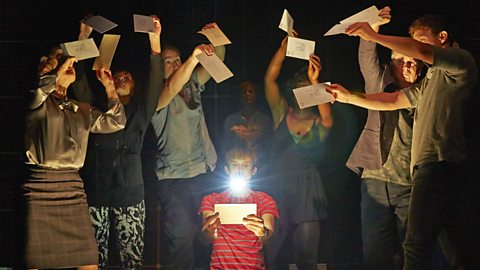
Characters in The Curious Incident of the Dog in the Night-Time
The action in Simon Stephens' play The Curious Incident of the Dog in the Night-Time (adapted from Mark Haddon's novel) revolves around the The chief character in a novel, film or play. Christopher Boone.
Initially, the audience watches him interact with Mrs Shears (the owner of Wellington the dog), his teacher, Siobhan, and his father, Ed. Once Christopher begins his investigation into the murder of Wellington he comes into contact with Mrs Alexander, his elderly neighbour, and as his story moves to London he makes contact with Judy, his mother whom he thought was dead, and her boyfriend, Roger who was married to Mrs Shears.
Christopher meets a number of minor characters along the way including 'Man with Socks', 'Punk Girl', a number of policemen, Reverend Peters and his head teacher, Mrs Gascoyne.
Christopher Boone
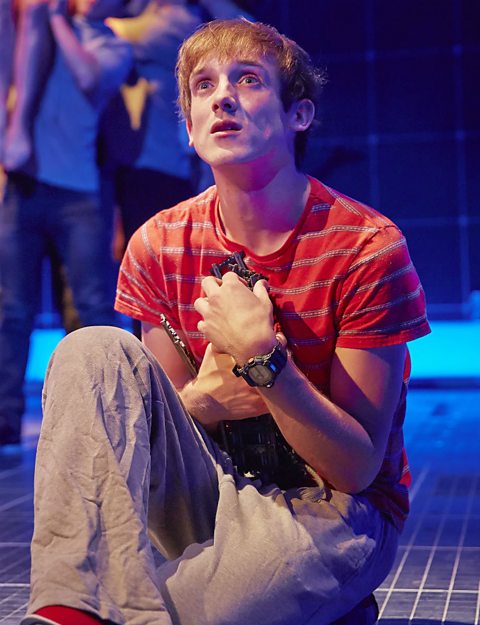 Image source, Gielgud theatre
Christopher Boone is a very talented 15-year-old. He knows a lot about space and mathematics – he also finds people confusing and notices the tiniest details about the world around him that most people would ignore. He and his father Ed are very similar in that they are both quite stubborn and determined.
While the unique behaviours he presents could suggest that he is on the Autism is a neurodevelopmental condition which often involves differences in thinking patterns, sensory processing, communication and social interactions. Because autism affects people differently, some people don't need a lot of help, but others might need extra support throughout their life. spectrum, it is important to realise that this is never mentioned directly in the play.
The audience watch as Christopher investigates the killing of Wellington the dog, then travels to London to find his mother and finally takes his Maths A-level. During the course of his journey, he learns that he can achieve anything that he puts his mind to.
Christopher often behaves in a way that some people might consider unacceptable. However, could it be that Stephens uses Christopher to make the audience question their own ideas about what is 'normal' behaviour? By the end of the play, the audience realises that Christopher, despite his behaviour is a human being just like them, with the same hopes and fears and that there is no definition of 'normal'.
Image source, Gielgud theatre The actor Luke Treadaway, who played Christopher in the National Theatre production, talks about his understanding and interpretation of the character
Siobhan, reading Christopher's book: "My name is Christopher John Francis Boone. I know all the countries of the world and their capital cities, and every prime number up to 7,507."
Luke Treadaway (Christopher): Christopher Boone is a remarkable human being. He has a massive imagination and a massive comprehension of the universe and science and maths.
Christopher: Then, they worked out the universe was expanding, that all the stars were rushing away from one another after the Big Bang. The further the stars were away from us, the faster they were moving, some of them nearly as fast as the speed of light.
Luke Treadaway (Christopher): Things like numbers and maths and sciences are definite concrete things which he can understand.
Mrs Alexander: I bet you're very good at maths, aren't you?
Christopher: I am. I'm going to take A-level maths next month and I'm going to get an A-Star.
Mrs Alexander: Really? A-level maths?
Christopher: Yes…
Marianne Elliott (director): Christopher is incredibly sharp in some ways but, in other ways, he's quite immature I suppose, or undeveloped.
Mrs Alexander: I have a grandson your age.
Christopher: My age is 15 years and three months and three days.
Mrs Alexander: Well, almost your age.
Marianne Elliott (director): He's never been outside of his street on his own, ever. He goes to school on a school bus that picks him up and drops him off at home.
Christopher: In the bus on the way to school we passed four red cars in a row.
Siobhan: Four?!
Christopher: So today is a good day.
Siobhan: Great. I am glad.
Marianne Elliott (director): Humans are very puzzling to him whereas animals aren't, which is why he's very upset about the dog's death at the top of the show. He understands animals, he doesn't understand humans.
Christopher: I don't always do what I'm told.
Siobhan: Why?
Christopher: Because when people tell you what to do, it is usually confusing and does not make sense. For example, people often say "be quiet", but they don't tell you how long to be quiet for.
Luke Treadaway (Christopher): He finds it very hard, for instance, to look at people's faces because he finds facial expressions very hard to understand.
Siobhan: "Siobhan says that if you raise one eyebrow it can mean lots of different things. It can mean, 'I want to do sex withyou'." I never said that!
Christopher: Yes, you did!
Siobhan: I didn't use those WORDS, Christopher.
Christopher: Yes, you did, on September 12th last year at first break.
Robyn Seward (autism consultant): Part of my job role is working with people on the autistic spectrum and Christopher demonstrates quite a number of characteristics of the autistic spectrum. So, for example, he finds it very difficult to be touched, and he can't predict when somebody's going to do something and therefore it becomes a shock. He needs routine, and if something changes, that makes him very anxious.
Woman at train station: I think there's someone out there on the platform looking for you.
Christopher: I know.
Woman at train station: Well, it's your look out.
Christopher: 103, 107, 109, 113.
Robyn Seward (autism consultant): He has a relationship with maths. It's what he finds comforting, it's what he turns to when he's stressed, I suppose a bit like a comforting blanket.
Christopher: 223, 227, 229.
Woman at train station: Coming!
Marianne Elliott (director): We all did a lot of research, actually, about the condition that Christopher might have. We went to various schools and talked to various teachers and talked to a lot of kids who had Asperger's syndrome.
Luke Treadaway (Christopher): I'd go in and speak to the kids or watch from the back of a classroom as they were having an art class, and that was just so useful to me.
Marianne Elliott (director): Everybody is so individual on that spectrum, that our job, really, was to be true to Christopher, what was happening for Christopher and what was right for him.
Christopher: This water, this rain, has evaporated, actually, from somewhere like maybe… the Gulf of Mexico maybe, or Baffin Bay, and now it has fallen in front of the house, and then it will drain in the gutter and then it will flow to a sewage station where it will be cleaned, and then it will go into a river and then it will go back into the ocean again.
Simon Stephens (playwright): One of the challenges that I faced was developing Christopher's character. For me, that came not necessarily through what Christopher was saying, but what the characters were doing to one another.
Ed: Sharing your life with other actual human beings…
Simon Stephens (playwright): By watching Ed Boone, for example, who is Christopher's Dad, share a space with Christopher, and the way Ed moves and the way Ed behaves around him, by showing how difficult it is for Ed to touch Christopher, just those little physical moments allow us an insight into Christopher that Christopher can't allow us into because he can't identify those emotional experiences.
Luke Treadaway (Christopher): I think Christopher's character does change throughout the book.
Female train announcer's voice: Please use assistant's phone opposite, right of the ticket office.
Luke Treadaway (Christopher): The whole process of him going to London and having to be brave and having to overcome that most terrifying of journeys, I think, leaves him at the end, especially when he gets his A-level result, I think it leaves him thinking that, actually, you know what? Anything is possible, and going on that huge journey to London, I think, has been something which has given him courage.
Christopher: I got an A-Star.
Siobhan: Ooh! Oh! That's just… That's terrific, Christopher!
Christopher: Yes.
Siobhan: Aren't you happy?
Christopher: Yes, it's the best result. I know it is.
| Character trait and explanation | Evidence | Analysis |
|---|---|---|
| Finds people confusing In some of his interactions with other characters, Christopher shows that he can find people difficult to understand. For example, when the police officer is asking him lots of questions and he responds by groaning. He is aware of this issue and writes it in his journal. | "I find people confusing. This is for two main reasons. The first main reason is that people do a lot of talking without using any words"…"The second main reason is that people often talk using A metaphor is a word or a phrase used for dramatic effect, to describe something as if it were something else.." | This shows that Christopher struggles to understand facial expressions which can impact how he interacts with people. It also shows that he cannot understand metaphors or abstract ideas like "I am going to seriously lose my rag" because he takes things very literally. |
| Talented Christopher continuously shows that he has a great understanding of very complicated astrological and mathematical ideas. For example he explains why the sky is dark at night to a confused Ed. | "The stars were all rushing away from one another after the Big Bang and the further the stars were moving away from us the faster they were moving, some of them nearly as fast as the speed of light, which was why their light never reached us." | Christopher shows that he has a very clear understanding of complicated ideas about the universe. This is especially impressive considering he is only 15 years old. |
| Determined Christopher's continued determination helps him get to London by himself and helps him to take and pass his Maths A-level, even though he is only 15. | "I am going to get an A* grade. And that is why I have to go back to Swindon. Except I can’t see father. So I have to go back to Swindon with you." | The language Christopher uses indicates clearly how determined he can be. He states with confidence that he will get an "A* grade" and that he "has" to go back to Swindon with his mother. Despite her initial reservations his mother cannot refuse his request. |
Ed Boone
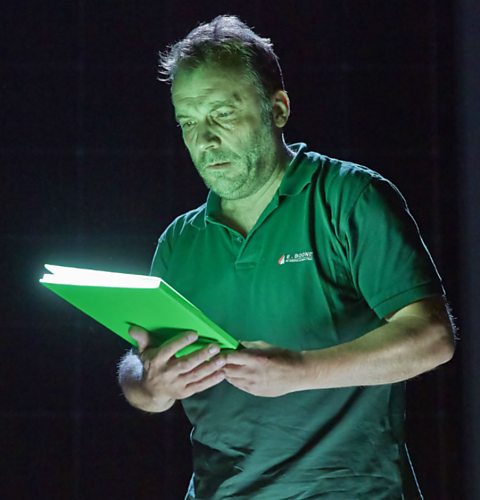 Image source, Gielgud theatre
Ed is Christopher's father. Ed and Christopher have a loving but at times tense relationship.
Ed has some very good traits, he is very patient and caring with Christopher and, like his son, he shows stubborn determination when the school initially won't allow Christopher to take his Maths A-level. However, on occasions Ed loses his temper with Christopher – in one scene he and Christopher actually have a fight.
As Christopher investigates the murder of Wellington the dog, he and the audience discover two disturbing truths about Ed – that he lied to Christopher about his mother's death and that he killed Wellington. These revelations cause a complete breakdown in Ed and Christopher's relationship – it is not until the end of the play that Christopher begins to trust him again.
Ed sometimes gets frustrated with Christopher and loses his temper. At one stage this results in an actual fight. However, Stephens wants us to see that this is not because of Christopher's unique behaviours. Living with people and parenting in general can be very challenging. In fact, Ed doesn’t see Christopher's conduct as strange – as Judy says, he just "gets on with it" and tries to help him get through day to day challenges like any good parent would.
Image source, Gielgud theatreSean Gleeson, who played Ed, explains the tense and strained relationship between Christopher and Ed
Ed: What do you fancy for chow tonight?
Christopher: Baked beans and broccoli.
Ed: Yeah, I think that can be very easily arranged.
Sean Gleeson (Ed): He's a hard-working, loving father, although he has difficulty, I think, translating that into how you might expect a father to love their son.
Ed: Just going to put those shelves up in the living room if that's all right with you. I'll make a bit of a racket, I'm afraid, so if you want to watch the television, we're going to have to shift it upstairs.
Christopher: I'll go and be on my own in my room.
Ed: Ah-ha, good man.
Sean Gleeson (Ed): Ed's got in his mind that he is a single dad and he's going to do this. He's trying to enjoy his son who he can't communicate with, he can't hold him, can't play football with him, can't enjoy him as maybe the son he thought he would have. They do still have a relationship where they still know how to communicate affection the little that they can by the touching of fingertips.
Christopher: I could see the Milky Way as we drove towards the town centre.
Sean Gleeson (Ed): He loves his son so he'll make it the best he can. So, he's running a business, holding down a home, looking after Christopher, and I think that's all fairly straightforward until now.
Ed: How many times do I have to tell you, Christopher? Keep your nose out of other people's business!
Christopher: I think Mr Shears probably killed Wellington.
Father: I will not have that man's name MENTIONED IN MY HOUSE!
Luke Treadaway (Christopher): Christopher's relationship with his dad is quite strained, probably not unlike a lot of 15-year-old boys with their fathers, and he's going through puberty and his hormones are raging.
Christopher: Why not?
Luke Treadaway (Christopher): And he also has Asperger's, so there's kind of more challenges on top of that as well.
Ed: I asked you to do one thing for me, Christopher, ONE THING!
Christopher: I didn't want to talk to Mrs Alexander! If Mrs… Ah!
Sean Gleeson (Ed): The relationship is kind of more volatile, because Ed, I think, feels he needs to close this down and regain control. Because in order for Ed to survive and keep things manageable, he has to have control, is how he feels.
Ed: No!
Sean Gleeson (Ed): You do see him hit Christopher. He's obviously a volatile man.
Marianne Elliott (director): As the play, or the book, develops, they come to a crisis point, I suppose, and it comes to a head and it explodes in a horrible way.
Luke Treadaway (Christopher): When he finds out that his mother was still alive, and all these letters that his dad's been hiding from him, then that changes everything.
Ed: I don't know what to say. I… I was in such a mess. I said she was in hospital because I didn't know how to explain, it was so complicated, it… Once I said it I couldn't change it, it just…
Sean Gleeson (Ed): I think Ed did that, not just selfishly because of the humiliation of the mother having had an affair and leaving, but how do you explain that to an autistic boy, that their mother can't be there any more because she can't do it? So, apart from his own anger and frustration with the mother, I think it was also to cushion the boy. But it's just turned into an ugly mess.
Ed: I'm going to have to touch you, but… it's going to be all right.
Sean Gleeson (Ed): I don't believe that he's a malicious man. I think he's a frustrated man and a wounded man.
Simon Stephens (playwright): For me it was really important that Ed wasn't a bad guy. He was a human, he was struggling, he was doing his best. Sometimes he did a really, really bad job as a father, but, you know, every father who's ever lived, at times, has done a really bad job at being a father.
Sean Gleeson (Ed): You also see a bit of evolution afterwards, cos I think you see Ed coming round to understanding that this isn't just a lad he needs to control. He finds new respect for him and a love for him that's open, and he tries to live more mutually with him.
Ed: Now, you have to learn to trust me and… I don't care how long it takes. If it's a minute one day and two minutes the next and three minutes the next, if it takes years, I don't care, because this is important. This is more important than anything else.
| Character trait and explanation | Evidence | Analysis |
|---|---|---|
| Determined Ed shows his determination when he stubbornly fights for Christopher to do his Maths A-level in school. | "Mrs Gascoyne: 'Mr Boone, nobody has ever taken an A-level in the school before.' Ed: 'He can be the first then.' Mrs Gascoyne: 'I don't know if we have the facilities in the school to allow him to do that.' Ed: 'Then get the facilities.'" | Ed shows that he will not take 'no' for an answer from the head teacher Mrs Gascoyne. Ed is determined to get the best for his son in the same way Christopher is determined to go to London and later take his A-level. |
| Caring and patient Ed is frequently caring and patient with Christopher, he puts up with Christopher’s sometimes unusual habits and behaviours. | "Ed: 'Christopher, do you understand that I love you?' Ed holds his right hand up and spreads his fingers out in a fan. Christopher does the same with his left hand. They make their fingers and thumbs touch each other." | Ed is open about his feelings for Christopher and tells him very plainly and clearly that he loves him. The stage directions show how Ed and Christopher interact physically, it is a sign of how close they are – Christopher normally reacts violently if touched. |
| Fiery-tempered Ed shows on a number of occasions that he has a fiery temper. Hitting Christopher is an example of this. | "Ed: 'I ask you to do one thing for me, Christopher. One thing.' Christopher: 'I didn't want to talk to Mrs Alexander. It was Mrs Alexander who…' Ed grabs Christopher’s arm. Christopher screams. They fight each other. Ed shakes Christopher hard with both hands. Christopher falls unconscious for a few seconds. Ed stands above him." | Although it doesn't say that Ed hits Christopher in the stage directions, Ed later apologises for hitting him. Seeing this scene on stage is shocking for the audience and they see that Ed can have an explosive temper. It is important to remember that Ed is not a villain. Although his use of violence cannot be condoned, he is only human. The audience can empathise with him losing his temper. His wife left him for a neighbour, his relationships with both his wife and Mrs Shears did not work out and he is caring for Christopher by himself. He has a lot to be stressed about, which may explain his temper. |
Judy Boone
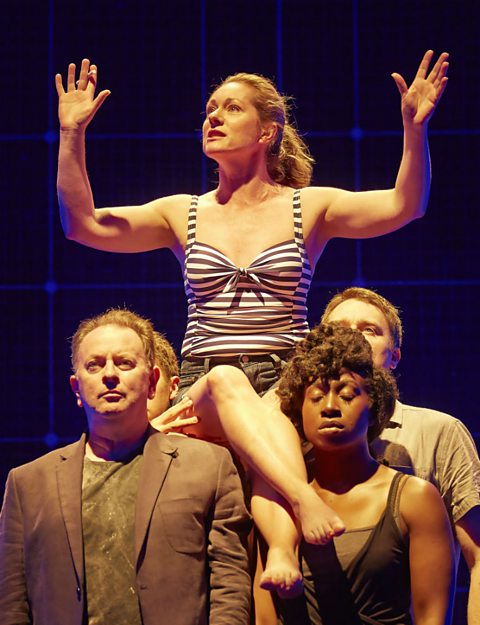 Image source, Gielgud theatre
Judy is Christopher's mother. At the start of the play, Christopher thinks that she died, two years ago after going to hospital. The audience finds out that this is not true when Christopher discovers a number of letters she has sent to him during his investigation of the killing of Wellington the dog.
Through these letters the audience discovers that Judy struggled to cope with Christopher and his unusual behaviours. Her relationship with Ed was under enormous strain and she felt that she wasn't as good at coping with Christopher as Ed was. She left the family home in Swindon and went to live in London with Roger Shears with whom she was having an affair. Judy is honest and open about her shortcomings to Christopher and she reveals that she has a fun-loving and romantic outlook on life.
Judy is not like Ed. She struggles with Christopher's behaviour whilst he copes with it. She mentions the time they went to the department store and Christopher had an episode - she could not help him and found the whole incident very upsetting. She also hints that she would like an easier more 'normal' life, presumably without Christopher. This is very sad, but Stephens does not make Judy the villain – the audience can sympathise with her as she still loves Christopher dearly.
Image source, Gielgud theatreExplore the different ways that Judy is presented in the play
Siobhan, reading Christopher's book: "Mother died, two years ago. I came home from school one day and no-one answered the door."
Marianne Elliott (director): Christopher hasn't seen his mum in two years, and he has been told that his mum died of a heart attack. So the very first time we hear about the mum is in a memory that he has before she died, when he was at a beach in Cornwall.
Judy: Christopher!
Christopher: Mother said…
Judy: Over here! Christopher! Look! It's lovely!
Christopher: And she jumped backwards and disappeared under the water, and I thought a shark had eaten her and I screamed. And then she stood up out of the water and came over to where I was standing and held up her right hand and spread out her fingers like a fan.
Judy: Come on, Christopher. Touch my hand.
Luke Treadaway (Christopher): They had a really good relationship. Then she obviously went through a period of sort of depression, I think, and not coping very well with having a young boy with autism, and she left.
Judy: Because I often thought I couldn't take it any more. And your father is really patient, but I'm not. I get cross even though I don't mean to.
Luke Treadaway (Christopher): So he's not known about what she's been doing for the last two years.
Judy: Dear Christopher… I'm sorry it's been such a very long time since I wrote my last letter to you.
Nicola Walker (Judy): The audience meets Judy through her letters. You only know this woman through her words.
Judy: Also, we've moved into a new flat at last, as you can see from the address. It's not as nice as the old one, and I don't like Willesden very much, but it's easier for Roger to get to work.
Nicola Walker (Judy): I think the relationship between Judy and Christopher is probably a little more complex than a lot of mother-son relationships.
Judy: You haven't written to me yet, so I know that you are probably still angry with me. I'm sorry, Christopher. But I still love you. I hope you don't stay angry with me forever, and I'd love it if you were able to write me a letter.
Nicola Walker (Judy): She is a mother who can't cope and who takes an opportunity to get herself out of the family situation when it arises.
Judy: And now… I have… lots of time.
Nicola Walker (Judy): She then has to deal with the overwhelming guilt and shame that she feels for having left her son.
Judy: I was not a very… good mother, Christopher. Maybe if things had been different… Maybe if you'd been… different, I might have been better at it.
Christopher: Left, right, left, right, left, right…
Nicola Walker (Judy): There comes the point where Christopher arrives in London.
Christopher: You weren't in, so I waited for you.
Nicola Walker (Judy): When she first sees him, she wants to grab him and hold him, that's her instinct and you see that happen on the stage, and he just pushes her away.
Judy: Christopher!
Christopher: Uh!
Nicola Walker (Judy): And I think that's the main difficulty, that in a sense, she has to sit back on a natural maternal instinct and try to be less emotional, but she's a very emotional woman.
Judy: Where's your father, Christopher?
Christopher: I think he's in Swindon.
Roger: Thank God for that.
Judy: Well, how did you get here?
Christopher: I came on the train.
Judy: Oh, my God, Christopher, I didn't think… Why are you here on your own?
Nicola Walker (Judy): When they meet, it should be perfect and there's a moment for Judy where she thinks maybe it is going to be perfect.
Judy: Will you let me help you get your clothes off? I can get you a clean t-shirt and you can get yourself into bed.
Nicola Walker (Judy): But then, of course, there's the reality of this boy being in this different life with her and Roger in London, and it falls apart very, very quickly.
Judy: Christopher, if you drink 200ml then I'm going to put a bronze star on your chart.
Roger: I don't believe this!
Roger, for God's sake, please. If you drink 400 ml, then you get a silver star.
[ROGER LAUGHS]
Judy: And if you drink 600 mil, you get…
Roger and Judy together: A gold star!
Roger: Well, that's very original, I have to say.
Judy: Roger, stop it. You're not helping!
Nicola Walker (Judy): You see Judy realise that the only choice she has, in actual fact, is to go back home and be with her son, and find a way to look after Christopher.
Judy: Right, you come downstairs… you bring Toby, and you get into the car.
Christopher: Into Mr Shears' car?
Judy: That's right.
Christopher: Are you stealing the car?
Judy: I'm just borrowing it.
Christopher: Where are we going?
Judy: We're going home.
| Character trait and explanation | Evidence | Analysis |
|---|---|---|
| Honest Judy is honest in the letters she writes explaining her feelings and failures to Christopher. | "I'm not like your father. Your father is a much more patient person. He just gets on with things and if things upset him he doesn't let it show." | It must be hard for Judy to be this honest – she admits failure in her lack of patience and openly explains to Christopher why she left. Ed avoids being this honest with Christopher until the end of the play. She clearly knows herself well too, like Christopher does. |
| Romantic Judy reveals that she has an active and romantic imagination - the audience discover this as she describes how her life could have been in a flashback sequence. | "If I hadn't married your father I think I'd be living in a little farmhouse in the South of France with someone called Jean. And he'd be, ooh, a local handyman." | Judy shows her romantic view of the life she could have had if she had not married Ed. This sadly shows that she was not satisfied with life as she knew it, she couldn’t just "get on with things" like Ed could. |
| Struggles to cope with Christopher In another reflection of her honesty Judy admits that she found it hard to cope with Christopher at times. She describes how she felt after an argument with Christopher resulted in her having broken toes. | "And I remember looking at the two of you and seeing you together and thinking how you were really different with him. Much calmer… And it made me so sad because it was like you didn't need me at all." | Judy feels, rightly or wrongly, that Christopher is calmer around his father. This realisation comes after she lost her temper and Christopher threw a chopping board and it hit her foot, breaking her toes. She felt as if Ed and Christopher were better off without her. |
Siobhan
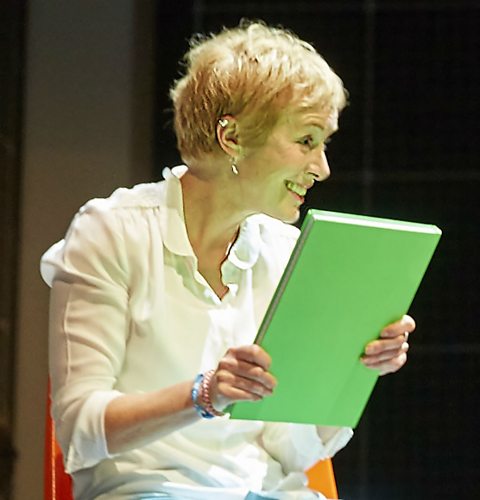 Image source, Gielgud theatre
Siobhan is Christopher's teacher.
Christopher talks to her about his problems and she reads the notebook in which Christopher records his investigation and writes his stories. She is very encouraging and gives him advice about what he should and shouldn't do.
She acts as an interesting Any use of staging that adds to the drama of a performance. as sometimes she can The teller of a story; the voice in a text that describes or narrates the events of the plot. The narrator is often either a character in the story, or an authorial voice who gives a commentary on events but doesn't take part.a scene as she reads from Christopher's book, and at other times she can appear as a calming voice in Christopher's head to guide him through a difficult situation.
Image source, Gielgud theatre| Character trait and explanation | Evidence | Analysis |
|---|---|---|
| Encouraging Siobhan offers Christopher encouragement as he is writing his book. | "But you can still be very proud because what you've written so far is just, well it's great." | We see that Siobhan is a very encouraging teacher and wants Christopher to feel proud of his achievements. She eventually encourages him to turn his book into a play to perform at school. |
| Calming When Christopher is trying to navigate the London Underground Siobhan appears as a calming voice in Christopher's head, helping him to cope with the challenge. | "In your head imagine a big red line across the floor. It starts at your feet and goes through the tunnel. And walk along the line. And count the rhythm in your head because that helps doesn’t it?" | Siobhan helps Christopher stay calm through this difficult situation by reminding him of strategies that they must have discussed in class. This also shows that Siobhan knows Christopher well because she relates the problem to rhythm which must be something Christopher can use to make things easier for himself. |
| Dramatic device Siobhan acts as a dramatic device – she is a narrator, or a voice in Christopher's head. This means that the action can move location and time rapidly and fluidly. Sometimes she can also be Christopher's voice as she reads from his book. | "Sometimes when I want to be on my own I get into the airing cupboard and slide in beside the boiler and pull the door closed behind me and sit there and think for hours and it makes me feel very calm." | Siobhan is reading from Christopher's book and so is acting as his voice and giving the audience an insight into some of his behaviours. This means that all of this information about Christopher can come from a variety of places, not just from him. |
Roger Shears
Roger Shears becomes the prime suspect in Christopher's investigation of the murder of Wellington the dog. He is the only person Christopher can think of that might not like Mrs Shears, as they are divorced.
The audience meets Roger when Christopher goes to London to find his mother. During Christopher's stay at their flat, he is initially reluctantly accommodating but increasingly loses his patience with him, becoming more and more sarcastic and eventually losing his temper with Christopher.
 Image source, Gielgud theatre
| Character trait and explanation | Evidence | Analysis |
|---|---|---|
| Lacks understanding Roger can be quite sarcastic about the way Judy looks after Christopher. He lacks understanding of Christopher's behaviour. | "A gold star. Well that’s very original I have to say." | Roger shows a lack of understanding of Christopher's behaviour and does not appreciate that he needs encouragement to eat at this point in the play. Although strategies like this seem childish, they might help Christopher. |
| Short-tempered At first Roger accommodates Christopher when he arrives at the flat but eventually he grows tired of the strain he puts on his relationship with Judy, which results in him aggressively grabbing Christopher. | "You think you're so clever don't you? Don't you ever, ever think about other people for one second, eh? Well I bet you’re really pleased with yourself now aren't you?" | Roger asks Christopher this series of questions whilst he is drunk. They reveal how little he understands Christopher and his unique behaviour. Christopher is very clever but he is not arrogant and, whilst he doesn't actively do things for others, he is not selfish. |
Mrs Alexander
 Image source, Gielgud theatre
Mrs Alexander is an elderly lady who lives on Christopher's street. He sees her as a stranger and visits her during the course of his investigation.
She is kind and welcoming whenever she sees Christopher but the audience might see her as a gossip when she reveals to Christopher that his mother had an affair with Mr Shears.
Image source, Gielgud theatre| Character trait and explanation | Evidence | Analysis |
|---|---|---|
| Kind Mrs Alexander is very welcoming and kind when Christopher first visits her during his investigation. | "I'm afraid marzipan is yellow too. Perhaps I should bring out some biscuits instead. Do you like biscuits?" | Mrs Alexander kindly tries to accommodate Christopher by offering him biscuits when she discovers he doesn't like the colour yellow and so won't eat Battenberg cake. It is likely that she is so kind because she is lonely and will do anything to get a visitor to stay. |
| Gossip Mrs Alexander is at first reluctant to discuss Mr Shears with Christopher but eventually she discusses his mother's affair directly with him. This could be seen as gossiping. | "I am going to say something to you and you must promise not to tell your father that I told you this." | Mrs Alexander knows that she should not be discussing the details of the affair with Christopher so she tries to make him keep it a secret. It could be argued that she feels that she is doing the right thing but it is not very responsible of her to discuss this information with Christopher. |
Test yourself
Further study
The Curious Incident of the Dog in the Night-Time: From Page to Stage. collection
Specially shot interviews, combined with clips from the show and exclusive behind-the-scenes rehearsal footage, reveal the thinking and process behind the adaptation.

Artisits at Work. podcast
Mark Haddon discusses his best-selling novel The Curious Incident of the Dog in the Night-Time with Harriett Gilbert.

Open Book. audio
Mariella Frostrup talks to Mark Haddon about his novel The Curious Incident of the Dog in the Night-time.

More on The Curious Incident of the Dog in the Night-Time
Find out more by working through a topic