Applicable context
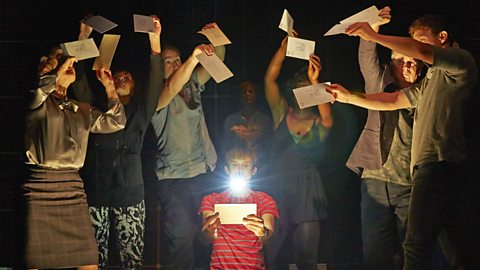
- Mark Haddon approached Simon Stephens to adapt his novel for the stage. Stephens used the dialogue from the novel as the driving force for the adaptation. He felt that its popularity was due to the play being a story about family and bravery. The play was first staged in 2012 at the National Theatre. It was very popular with audiences and has since moved to the West End and Broadway.
- Many readers discuss and recognise Christopher as having Autism is a neurodevelopmental condition which often involves differences in thinking patterns, sensory processing, communication and social interactions. Because autism affects people differently, some people don't need a lot of help, but others might need extra support throughout their life.or Asperger's syndrome. This, however, is never mentioned directly in the novel. Haddon also states that he did very little research into the topic of autism whilst writing the book, and offers the idea that Christopher’s value as a The chief character in a novel, film or play. comes from his unique perspective on the world and not from any particular diagnosis he could have had. In the 21st Century, autism is more widely referred to as ‘There is no ‘right’ way for how people’s brains should work, but many people think and act in similar ways. Neurodivergent people process information, learn, and behave differently from what some people think is ‘typical’. Neurodiversity is all about understanding that people’s brains are different. We all think and learn differently, have different attention spans and experience different moods.’, recognising that it affects how people with the condition process information but does not mean their skills or understanding are any less than those of ‘neurotypical’ or non-autistic people.
- Sherlock Holmes is an iconic literary figure created by Sir Arthur Conan Doyle and widely acknowledged in popular culture to be “the world’s greatest detective”. His methods of detection were firmly based in logic but often appeared almost supernatural to observers because of their ingenuity, while popular characterisations of Holmes in film and TV have often emphasised how his great intellectual skills make him seem out of step with ordinary people and everyday society. Aside from admiring his methods and abilities, Christopher seems to feel a kinship with Holmes for not fitting in with what is deemed ‘normal’.
The themes in The Curious Incident of the Dog in the Night-Time
An exploration into the themes of The Curious Incident of the Dog in the Night-Time by Mark Haddon, adapted for the stage by Simon Stephens
Simon Stephens (playwright): For me, it's a novel about how you live with other people. It's about family, it's about love, it's about how you articulate love, it's about the importance of being honest, it's about the difficulty of truthfulness.
Ed: Your mother has died. She's had a heart attack.
Simon Stephens (playwright): Is lying ever kind? Is it ever cruel to tell the truth, or actually is being truthful the most human and the most important thing that we can do to one another?
Ed: I don't know what to say. I… I was in such a mess, I said she was in hospital because I didn't know how to explain it, it was so complicated.
Nick Sidi (Roger): It's a story about family, I think it's a story about parenting and about being a child, and I think that the family in this show, and all the characters in this, try really hard to survive in not always the easiest world.
Judy: This is my house too, in case you've forgotten.
Ed: What, is your fancy man here as well?
Judy: Don't do that Ed!
Sean Gleeson (Ed): It is about difference. About how different we are and seeing life from different perspectives, and the way Mark Haddon has done that, quite fantastically, is to go to a perspective that we don't normally get and have the main protagonist be autistic/Asperger's.
Christopher: I like looking at the rain.
Ed: Terrific.
Christopher: I like it because it makes me think how all the water in the world is connected.
Ed: Does it?
Christopher: This water, this rain, has evaporated actually from somewhere like maybe the Gulf of Mexico, or maybe Baffin Bay, and now it has fallen in front of the house and then it will drain into the gutter, and then it will float to a sewage station, where it will be cleaned, and then into a river and then back into the ocean again.
Marianne Elliott (director): It relates to a lot of us all of the time, I think. We all spend many hours of our lives feeling perplexed by why other people are behaving in the way that they are behaving.
Christopher: 73, 79, 83…
Woman at train station: Argh!
Christopher: …89, 97.
Woman at train station: You scared the life out of me, can I just get my bag?
Marianne Elliott (director): And it's a very humanist way of looking at those moments.
Christopher: Reverend Peters is going to invigilate.
Judy: It's only an exam, I can ring the school. We can get it postponed, you can take it some other time.
Christopher: I can't take it some other time, it's been arranged!
Nicola Walker (Judy): You look at Christopher and you enter his world and you understand it and it's not so different to our world. Yes, he has lots of difficulties, but we can all relate to some of those difficulties.
Siobhan: I wonder if you can understand any of this. I know it will be difficult for you.Judy: I thought what I was doing was the best for all of us.
Niamh Cusak (Siobhan): Everybody is desperately trying to understand each other and obviously Christopher is an extreme version of that, because he finds communication quite difficult.
Christopher: I want to go to London.
Ticket clerk: Single or return?
Christopher: What does 'single or return' mean?
Ticket clerk: Do you want to go one way or do you want to come back?
Christopher: I want to stay there when I get there.
Niamh Cusak (Siobhan): The story that we're watching is the story of a family and most families have times where it's difficult for them"* to communicate, look after each other, be truthful with each other.
Ed: It will get better, I promise. Now, you don't have to say anything, not right now, but you have to think about it.
Niamh Cusak (Siobhan): I suppose that's what the book and the play reminds us of.
The main themes in The Curious Incident of the Dog in the Night-Time are:
- family
- honesty and trust
- braving the unknown
Simon Stephens explores these themes during the course of the play.
Family is at the heart of the play, and through Christopher's relationships with his mother and father, Stephens explores the idea of what makes a parent and also what family means. The challenges of living with other people are also shown as Christopher moves from his father's house to his mother's.
Honesty and trust is another key theme, all the characters at different points are either dishonest with others or with themselves.
Finally the theme of braving the unknown is largely explored through Christopher and his experiences in the world.
Family
The Curious Incident of the Dog in the Night-Time can be considered a family drama. The idea of family and what it means is explored throughout the play.
Christopher comes from a family that has fallen apart. He has to deal with the impact this has on his life and the lives of his mother and father.
The idea of what makes a parent is further explored through Ed and Judy. Ed can be bad-tempered but is there for Christopher when it matters most. Judy leaves home but that doesn't mean she doesn't love her son. Christopher lives with his father and then his mother and Mr Shears, and the challenges of living with other people are explored through these situations.
The play explores the importance of family, its impact and its nature.
In The Curious Incident of the Dog in the Night-Time, Stephens explores the theme of family through:
- the breakdown of Christopher's family life and the impact that has on each family member
- what living with other people can be like
- the nature of being a parent
 Image source, Gielgud theatre
| Theme focus and explanation | Evidence | Analysis |
|---|---|---|
| Christopher's mother | ||
| Through her letters to Christopher we get a sense of how she feels about the breakdown of the family. | “I know you are probably still angry with me. I’m sorry Christopher. But I still love you. I hope you don't stay angry with me for ever.” | Judy clearly fears for the relationship she has with Christopher. As she is only able to communicate with him through letters, she does not know if Christopher forgives her for leaving. She assumes that he is still angry with her. |
| Christopher's father | ||
| Ed can lose his temper, especially when Christopher is looking into the past, which he finds very painful. | “Not to mention Mr Shears' name in the house. And not to go asking Mrs Shears, or anyone about who killed that bloody dog. And not to go trespassing on other people's gardens. And to stop this bloody ridiculous detective game.” | Christopher repeats Ed's words back to him. The list of commands and frequent use of swear words show how agitated Ed has been with Christopher. The reason he finds this so hard is because he doesn't want Christopher uncovering his painful past. |
| Living with other people | ||
| Ed can become weary of living with Christopher. Instead of losing his temper he can sound as if he is tired of him. | “Could you please, just, give it a bit of a break, mate. Please.” | Ed repeats “please”, showing that he is being as polite as he can despite clearly being very tired of Christopher's non-stop chatter. |
| Being a parent | ||
| Ed and Judy are very different types of parent. They are both ‘good’ and ‘bad’ at it at different points of the play. Through their actions, Stephens explores what it means to be a parent. | “I love you very much Christopher. Don't ever forget that. I know I lose my rag occasionally. And I know I shouldn’t. But I only do it because I worry about you” | Ed uses simple language to explain why he loses his temper and to make it clear to Christopher how much he loves him. Ed realises that he isn't always a perfect parent but even his mistakes come from the heart. Contrast this to Judy who leaves when parenting Christopher becomes too much of a challenge. |
Honesty and trust
Honesty and trust is a key theme in The Curious Incident of the Dog in The Night-Time.
Each of the main characters has issues of trust and honesty with each other. Ed lies to Christopher about his mother, Christopher lies to Ed about stopping his investigation. When Christopher discovers the truth about his mother and Wellington, he feels he can no longer trust his father.
Christopher's mother, Judy is more honest with her feelings towards Christopher but the audience might initially find it hard to trust her after she walked out on the family.
 Image source, Gielgud theatre
As well as these issues within his family, Christopher maintains a mistrust of strangers but trusts the advice of his teacher, Siobhan. She has worked with him for a long time and taught him strategies to cope with challenges. During the course of the play, Christopher also learns that he can trust himself to achieve his goals.
In The Curious Incident of the Dog in The Night-Time, Stephens explores the theme of honesty and trust through:
- the lies of Christopher's father, Ed
- the honesty of Christopher's mother, Judy
- the trust issues Christopher has with other characters
| Theme focus and explanation | Evidence | Analysis |
|---|---|---|
| Ed's lies | ||
| Ed tries to keep the truth about Judy leaving home from Christopher. | “Ed: ‘Christopher, I'm sorry your mother's died. She's had a heart attack. It wasn't expected.’ Christopher: ‘What kind of heart attack?’ Ed: ‘I don't know what kind of heart attack. Now isn't the moment Christopher to be asking questions like that.’” | This is a shocking lie for a father to tell their son. Ed avoids telling the truth so he doesn't have to confront the reality of his marriage breaking down. Ed realises the error of his ways when the truth comes out later and realises that it is important to be honest with people from the outset because it can only be more hurtful if you are not. |
| Judy's honesty | ||
| Judy is honest in her letters to Christopher about her feelings and her own failings. In this sense she is braver than Ed. | “And I remember that night I just cried and cried and cried and your father was really nice about it at first and he made you supper and put you to bed and he said these things happen and it would be OK. But I said I couldn’t take it anymore and eventually he got really cross.” | It is very brave for Judy to be this honest. She is not afraid of painting Ed in a positive light even if it makes herself look worse. It is clear that she really struggled with some of Christopher's more unusual behaviours but her openness and honesty earns her the respect of the audience. |
| Christopher's trust issues | ||
| Christopher separates the people he meets into two categories: friends and strangers. He trusts friends but not strangers. This means he reacts in a way the audience might consider “different” when talking to people he doesn't know, like Mrs Alexander for example. | “I began to get nervous because I didn't know her well enough to know whether she was telling the truth about getting orange squash and Battenberg cake. And I thought she might be ringing the police and then I'll get into much more serious trouble because of the caution. So I walked away.” | Christopher walks away from a conversation because he doesn't know the person very well. This uncertainty can make Christopher very nervous. He struggles to trust people that he doesn't know as friends. He learns later in the play, much to his distress, that he sometimes can't trust people that he knows very well, like his father. |
Braving the unknown
Braving the unknown is a theme that plays a big part in Christopher's experiences during the play. He has to be brave and try new things in order to get to the bottom of his investigation of Wellington's death.
He also has to be very brave during his journey to London to find his mother, tackling the daunting London Underground by himself. He also has to face the uncertainties of his A-level exam.
In getting through all these challenges Christopher grows as a person and learns a lot about himself and his own capabilities.
 Image source, Gielgud theatre
Stephens shows that facing your fears and conquering the unknown is a positive challenge to undertake.
In The Curious Incident of the Dog in The Night-Time, Stephens explores the theme of braving the unknown through:
- Christopher trying new things while he is investigating into the dog's death
- Christopher's journey to London and the challenges he faces along the way
- Christopher taking his A-level exam, when he is only 15, and passing it
- showing how much Christopher has grown through these experiences
| Theme focus and explanation | Evidence | Analysis |
|---|---|---|
| Christopher's investigation | ||
| Christopher has to go and speak to strangers to investigate the dog’s death. He sometimes finds this very challenging. | “I don’t talk to strangers. But I'm doing detective work.” | As Christopher states, he doesn't usually talk to strangers, but he knows that he must if he is to complete his investigation. He bravely speaks to people he doesn't know. |
| Christopher's journey to London | ||
| When Christopher goes to London, buying a ticket and getting on the train is a huge challenge for him to overcome. The different voices of the Ensemble get across how chaotic Christopher finds the experience. | “Voice One: Customers seeking access to the car park please use assistance phone opposite, right of the ticket office. Voice Two: Warning CCTV in operation. Voice Three: Great Western. Voice Five: Cold beers and lagers. Voice Two: CAUTION WET FLOOR.” | Having several different voices stating the sights or sounds that Christopher might be experiencing gives the audience a clear idea of how chaotic and difficult this situation must be for him. Until now he has never gone much further than the end of his own street. Christopher perseveres however and completes his journey. |
| Christopher taking his A-level exam | ||
| Exams can be challenging experiences and have an element of the unknown to them. Christopher admirably rises to the challenge of his Maths exam despite being very tired at the time of taking it. | “I can see the questions but I can’t read the questions because when I look at the words they all seem confused and the wrong way round and mixed up to me.” | Christopher is so tired he cannot read the questions that are in front of him. Despite this he manages to get himself together and take the exam. This again shows Christopher braving the unknown despite the difficult circumstances he finds himself in. |
| How Christopher has grown | ||
| By the end of the play Christopher has grown and realises that he is capable of facing any challenge by himself. By braving the unknown he has become a better person. | “Yes. Does that mean I can do anything do you think? Does that mean I can do anything Siobhan? Does that mean I can do anything?” [The two look at each other for a while. Lights black.] | Christopher asks repeatedly if he can do anything. At first he is addressing Siobhan, but the audience are asked the question too. The answer is of course he can. Christopher has shown through facing all of his trials with bravery, he can do whatever he puts his mind to and his future is bright. |
Test yourself
Further study
The Curious Incident of the Dog in the Night-Time: From Page to Stage. collection
Specially shot interviews, combined with clips from the show and exclusive behind-the-scenes rehearsal footage, reveal the thinking and process behind the adaptation.

Artisits at Work. podcast
Mark Haddon discusses his best-selling novel The Curious Incident of the Dog in the Night-Time with Harriett Gilbert.

Open Book. audio
Mariella Frostrup talks to Mark Haddon about his novel The Curious Incident of the Dog in the Night-time.

More on The Curious Incident of the Dog in the Night-Time
Find out more by working through a topic