Quick version
Due to limestone being A type of rock which allows water to pass through its joints and cracks, eg limestone. and the processes of physical and The erosion of rocks by chemicals that react with their minerals. , underground features form
- limestone caverns
- stalactites
- stalagmites
Large caverns can form underground in carboniferous limestone landscapes. They form when chemical solution is more active.
Stalactites form when water drips from the roofs of caverns very slowly. As the water evaporates solid calcium carbonate is left on the cavern roof.
Stalagmites are short, wide, dumpy features grow upwards from the ground.
Pillars are when stalagmites and stalactites grow towards one another and join to form a rock pillar.
Underground features
In this video, learn how underground limestone features, like stalagmites and stalactites, are formed.
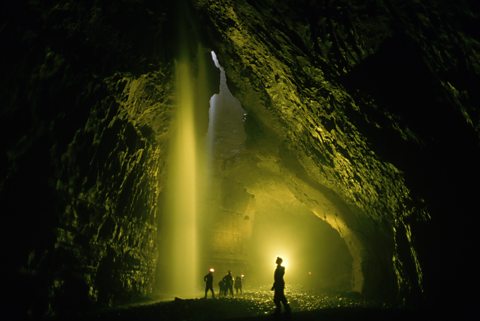
Upland limestone landscapes have many distinctive features, but not all are visible on the ground or on a map, like this underground cavern full of stalactites and stalagmites.
Let's take a closer look at how these are formed.
Limestone is permeable so rainwater can pass through the cracks and joints dissolving the calcium carbonate.
This erosion of limestone over thousands of years can form large caverns.
As the water drips from the cavern ceiling, it evaporates and solid calcium carbonate is redeposited.
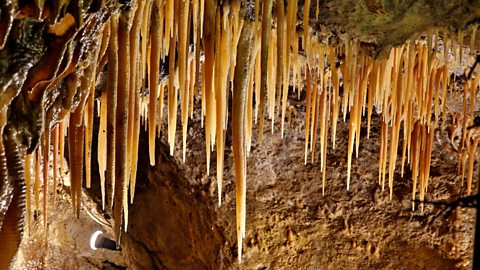
Over time deposits grow down into long, thin-icicle like objects called stalactites.
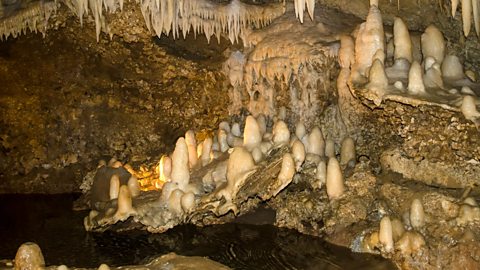
Some drops of water fall to the floor, splash and evaporate. This again leads to the redeposition of calcium carbonate but more spread out. Over time, these deposits build up into shorter stumpier stalagmites.
Caverns, stalagmites and stalactites: thousands of years in the making beneath your very feet.
Limestone caves or caverns
Inside a limestone cave, there are a number of distinctive features, which have formed over thousands of years. They are all the result of water:
- permeating the rock
- dissolving the limestone
How do caves and caverns form?
Where a stream passes onto limestone it can form a swallow hole.
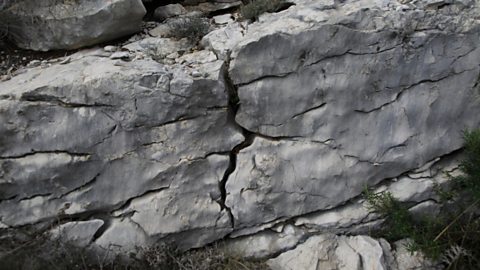
Water enters the limestone and passes through A crack in a rock formed when the rock dried out or pressure is released. and .
Chemical weathering dissolves limestones and widens cracks, where there are many joints and bedding planes together, widening cracks erode the rock between them to form caves.
The caves are widened by erosion processes:
- Chemical weathering continues to dissolve limestone
- Hydraulic action of water breaks off pieces of rock
- Corrasion (Abrasion) caused by rocks carried by the water erodes the surfaces it passes
- As a cave widens, its ceiling becomes unsupported
- When the ceiling collapses a much larger cavern is formed
Stalactites and stalagmites
Some limestone features are formed by deposition. When water that contains dissolved limestone evaporates, it leaves behind calcium carbonate.
Stalactites
- Water drips from the roofs of caverns very slowly and When water turns from a liquid into a gas..
- This will build-up over time to form long, thin deposits which grow downwards and look like icicles hanging from the ceiling of a cavern. These are called stalactites.
Stalagmites
- Some drops of water fall to the floor of the cavern where they splash and evaporate.
- The splash spreads the deposit of calcium carbonate and as more and more calcium carbonate builds up on the floor.
- Short, wide, dumpy features grow upwards from the ground. These are called stalagmites.
Pillars
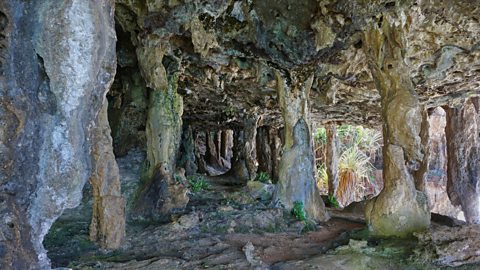
Occasionally stalagmites and stalactites grow towards one another and join to form a rock pillar.
In this slideshow, you can view images of underground limestone features from around the world.
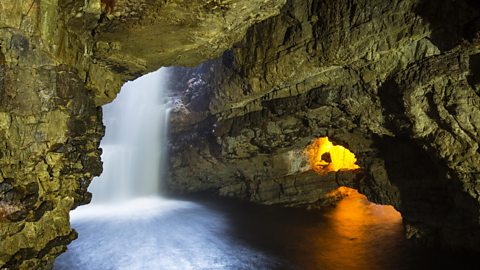
Image caption, Cave
Limestone caves can form when cracks in limestone are dissolved and get wider and wider over time. The Smoo Cave in Durness is a huge sea cave in limestone cliffs. It is the largest sea cave in the UK. (Ashley Cooper pics / Alamy Stock Photo)
1 of 4
Sample question
Identify the features marked on the diagram by matching them to the names of features given.
limestone underground answer
Quiz
Recap
Due to limestone being A type of rock which allows water to pass through its joints and cracks, eg limestone. and the processes of physical and The erosion of rocks by chemicals that react with their minerals. , underground features form
- limestone caverns
- stalactites
- stalagmites
Large caverns can form underground in carboniferous limestone landscapes. They form when chemical solution is more active.
Stalactites form when water drips from the roofs of caverns very slowly. As the water evaporates solid calcium carbonate is left on the cavern roof.
Stalagmites are short, wide, dumpy features grow upwards from the ground.
Pillars are when stalagmites and stalactites grow towards one another and join to form a rock pillar.
More on Upland limestone landscapes
Find out more by working through a topic
- count1 of 5