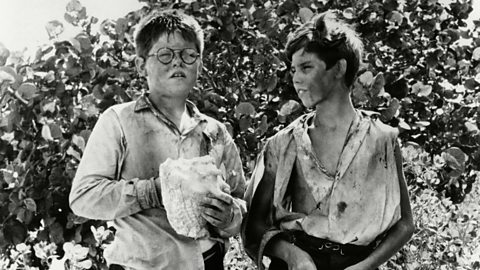
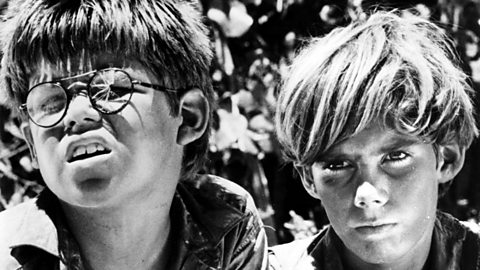
Lord of the Flies fact file

Summary:Lord of the Flies was written by former schoolteacher William Golding and published in 1954. It is set on a remote island and shows how a group of stranded schoolboys go from civilisation to savagery in a very short space of time.
Title:Lord of the Flies is a phrase offered by Simon as he ‘converses’ with the pig’s head surrounded by flies. In Hebrew scripture, the Lord of Flies is an epithet or identifying nickname for Beelzebub, a devil who may be Satan himself or Satan’s highest lieutenant. This link to Biblical evil ties in with the theme of the darkness of human nature in the novel.
Narrative perspective:Lord of the Flies is told from a third person omniscient narrative perspective, where the story is related by a voice from outside the characters who can access everyone’s thoughts and feelings, and who describes the action without taking part.
Setting: An unnamed and uninhabited tropical island, during an unspecified year when a nuclear world war is going on.
Themes: Evil and human nature, childhood and maturity, weakness and strength, leadership, civilisation and savagery, war, group dynamics and social hierarchies, emotion vs reason.
Characters overview
All of the characters in Lord of the Flies are young schoolboys. They try to exist without the rules of adult society which would normally govern their behaviour.
As with any group, some of the boys emerge as leaders and others become followers. Some behave well, most behave badly. A few demonstrate wisdom and maturity, while others become little better than savages.
Main characters
- Ralph
- Jack
- Piggy
Secondary characters
- Simon
- Roger
Minor characters
- Sam and Eric (Samneric)
- The Littluns
- The choir/hunters
- Maurice, Robert and Bill
- The naval officer
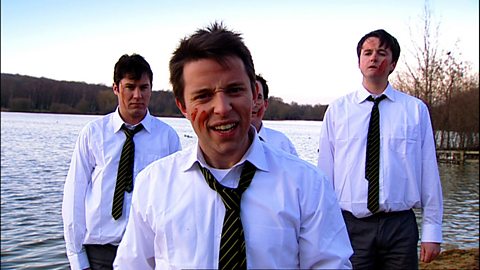
Katy Brand introduces us to the characters in Lord of the Flies
In Lord Of The Flies, Ralph is the person we like the most.
Out of all the boys, he acts with the most maturity.
The other boys want to play, Ralph wants to elect a chief,
light a signal fire, establish rules, and build huts.
What can I say? I like huts.
He sounds like a bit of a geek.
Actually, Ralph is really brave and cool under pressure.
This is shown when he frequently stands up for Piggy.
Ralph: Hey, hey, hey! You leave Piggy alone!
Piggy: Can you not call me Piggy?
Ralph: Quiet, Piggy, I'm protecting you.
It is for these reasons Ralph is elected leader.
But as the novel progresses, some of the children don't want rules.
All they want is to have fun and hunt.
They become more savage and at the end of the book,
Ralph's authority has diminished, and he's left an outcast.
Ralph is not perfect. He gets carried away with the violence of killing the pig.and joins in the crazy dance that leads to the death of Simon.
But he never fully succumbs to his dark side.
Ralph learns the true human capacity for evil.
Narrator: Great! He gets rescued and lives happily ever after.
All: Hooray!
Jack is the opposite of Ralph.
Jack is just ugly.
Jack: That's not what my mum says.
He is the leader of The Choir, but he's not a natural leader like Ralph.
He is only able to rule with cruelty and bullying.
Jack paints war paint on his face to camouflage himself during the hunt.
This encourages his inner savage.
He is the first to commit an act of violence against another boy.when he punches Piggy.
Piggy: But, do I die?
Narrator: No, unfortunately, you're rescued and probably go on to become an estate agent.
Now, Piggy—Ralph tells the other boys his hated nickname,
and from that moment on, Piggy is the only name he is known by.
Piggy: Thanks a lot(!).Hey, I know about the true darkness of the human soul. Give me a break.
Piggy is not altogether likeable.
He participates in Simon's death dance and he is a little bit lazy.
Piggy: I've got asthma.
But he also has good points. He's intelligent.
He makes the sundial so they can tell time.
He's kind to the little 'uns and cares for them when the others go off hunting.
His accent also sets him apart.
This, along with his non-standard grammar, suggests he comes from a poorer and less-educated background.
Narrator: Which character believes he sees the pig's head talk?
It's Simon who believes he sees the pig's head talk.
Simon is presented as a very spiritual person.
We know he is delicate and has epilepsy.
He works only to help others, finding fruit for the little 'unsand helping Ralph build shelters.
He is also wise.
He works out that the beast only exists within them.
But no-one else understands what he is trying to say.
Simon: I'm like some sort of ninja psychic monk.
Ironically, he's killed because the boys think he's the beast.
Narrator: He did look quite beastly.
Ralph

Lord of the Flies both begins and ends by focusing on Ralph and it is his journey that we follow throughout the story.
Ralph has fair hair, is described as 'attractive' and has a degree of natural Attractiveness or charm that others admire and look up to..
Although he is quite typical of a 12-year-old boy, Ralph also displays flashes of maturity and common sense which make him seem older.
He has qualities of natural leadership such as bravery, fairness and a sense of justice, so it is not surprising when he is elected to lead the others.
Ralph tries to keep to a civilised code of conduct but circumstances are against him.
By the end of the novel, he is being hunted down by the other boys and it is only by a stroke of good fortune that he is rescued from certain death.
| Characteristic | How is Ralph like this? | Evidence and analysis |
|---|---|---|
| Leader | Ralph is one of the oldest boys and is quickly elected as Chief. He is generally fair-minded and decisive. He listens to others but takes control when necessary. | “Something deep in Ralph spoke for him. ‘I'm chief. I'll go. Don't argue…’ He found his voice tended either to disappear or to come out too loud. He looked at Jack.” Ralph speaks in very short, definite sentences so there is no doubt about what his orders are. However, he is not totally confident in his role and his voice wavers; he then looks to Jack, another senior boy, for approval. |
| Charismatic | Ralph is presented as an attractive character from his first appearance, when he is contrasted with Piggy. He has brains and is also athletic. He is still young but his body is beginning to mature into that of a man rather than a child. | “You could see now that he might make a boxer, as far as width and heaviness of shoulders went, but there was a mildness about his mouth and eyes that proclaimed no devil.” Ralph has athletic qualities and the beginnings of physical maturity that would make other boys look up to him but he also has a generally kind nature which is shown in his face. |
| Organised | Ralph quickly realises that the two things that the boys will need are shelter and a signal to attract attention and he sees that these are achieved. He organises a sub-group to hunt for food and holds assemblies. | “The time had come for the assembly and as he walked into the concealing splendours of the sunlight he went carefully over the points of his speech… This meeting must not be fun but be business.” He knows that the meeting will be difficult so he carefully rehearses what he is going to say and the points he is going to cover. Although he is finding this tricky, he perseveres and comes to a firm conclusion. |
| Civilised | Ralph thinks it is important to have rules and be organised. He has a great sense of 'fair play' and defends others who are weaker than himself. As the novel progresses, Ralph begins to think increasingly about the civilised world that has been left behind. | “Once, following his father from Chatham to Devonport, they had lived in a cottage on the edge of the moors… Mummy had still been with them and Daddy had come home every day. Wild ponies came to the stone wall at the bottom of the garden, and it had snowed.” Ralph daydreams about a time when adults made the decisions and he lived comfortably in a nice house with a nice garden and its own boundaries. He also remembers being formally educated. |
Jack
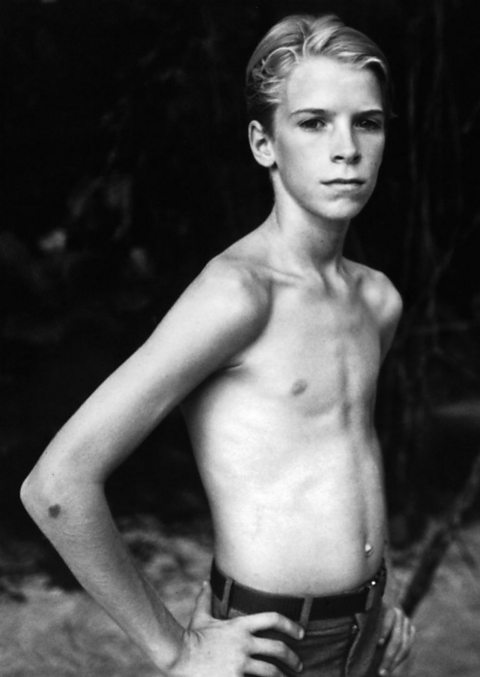
Jack has red hair and freckles and is tall, thin and bony.
When Jack first appears he is already in a position of authority as he is the Head Boy of his school and lead chorister.
It is no wonder that he is annoyed when Ralph is elected leader above him. Jack is clearly used to getting his own way and is a bully – he uses verbal and physical violence when necessary.
It is noteworthy that Jack has a knife with him which he produces in one of the first conversations with Ralph. Although he hesitates to kill the first pig they come across, it is not long before Jack is able to do so – at which point other boys start to follow his ways.
Jack eventually forms a breakaway group of his own and swiftly becomes a violent dictator.
By the end of the novel, he is ordering the torture of other boys and even tries to organise the murder of Ralph.
Jack is an unlikeable character, motivated by evil and whose bad traits only get worse as the story progresses.
| Characteristic | How is Jack like this? | Evidence and analysis |
|---|---|---|
| Savage | Right from the start, Jack has a savage nature. He is a cruel bully and picks on those who are weaker than himself. Throughout the novel he gradually turns into a real savage with no sense of justice or what is right. | “He began to dance and his laughter became a bloodthirsty snarling. He capered toward Bill, and the mask was a thing on its own, behind which Jack hid, liberated from shame and self-consciousness.” Jack has been painting his face with war paint to make him look even more menacing than he already is. The mask seems to turn him into something else – a dancing, leaping savage whose laugh becomes the growling of an animal. |
| Rule-breaker | When it suits him, Jack ignores the rules or makes up new ones to suit his purpose. He expects others to stick to the rules but does not see the need to do so himself. | “‘The rules!’ shouted Ralph. ‘You're breaking the rules!’ ‘Who cares?’ Ralph summoned his wits. ‘Because the rules are the only thing we've got!’” In the middle of an argument, Ralph tries to remind Jack of the rules that he (Jack) first suggested. He refuses to be part of the system he set up. |
| Tyrant | When Ralph is elected leader Jack is far from happy and spends the rest of the novel trying to win back the power he has lost. To do so he has to form a separate group and then rules them with terror and fear. In the end Jack is a vicious dictator. | “Power lay in the brown swell of his forearms: authority sat on his shoulder and chattered in his ear like an ape. ‘All sit down.’ The boys ranged themselves in rows on the grass before him…and pointed at them with the spear. ‘Who's going to join my tribe?’” Jack is connected to the words “power” and “authority”. He tells the boys abruptly what to do, and they do it without question. His mask and spear are symbols of his power. |
Piggy

Piggy seems to come from a lower social class than the other boys but he is more thoughtful and mature than his companions.
He uses rational thinking to come to conclusions and very soon realises that without adults the boys are in danger of becoming uncivilised and that they will need leadership, rules and organisation.
It is easy to see why the other boys could find him annoying, because Piggy always seems to want to spoil their fun.
He is also physically different from them as he is fat, has asthma and wears glasses.
All these things go towards making him an outsider to the rest of the group.
Piggy's real name is never revealed. Instead he is treated as though he is one of the pigs on the island – also like one of them, he is brutally killed.
Piggy remains an outsider and a victim throughout the novel, though Ralph does come to respect him.
| Characteristic | How is Piggy like this? | Evidence and analysis |
|---|---|---|
| Outsider | There are many things that mark Piggy out as "different". He comes from a lower social class than the others and has been brought up by an auntie. He wears glasses, is fat, has asthma and seems to be a bit lazy. | “Piggy saw the smile and misinterpreted it as friendliness. There had grown up tacitly among the biguns the opinion that Piggy was an outsider, not only by accent, which did not matter, but by fat, and ass-mar, and specs, and a certain disinclination for manual labour.” Piggy is not good at picking up on other people's body language towards him. When Piggy thinks he has won approval he goes too far and, once again, finds that he is back on the outside. |
| Rational | Piggy is full of thoughts and theories and is fond of reminding the others about the adult world that they have left behind them. He often quotes what his auntie would do or think but the other boys are not interested in what grown-ups would do. | “‘Life,’ said Piggy expansively, ‘is scientific, that's what it is. In a year or two when the war's over they'll be travelling to Mars and back. I know there isn't no beast - not with claws and all that, I mean but I know there isn't no fear, either.’” Piggy places great trust in the capabilities of science and technology and uses these to explain the situation they are in. Some of the boys fear that there is a Beast after them but Piggy dismisses both the Beast and fear as unscientific. He is a very practical person, finding solutions where he can. |
| Organiser | Right from the start Piggy tries to be a good organiser when he suggests to Ralph that they use the conch to call the others to their first meeting. As soon as the boys arrive, he starts making a list of names. | “Piggy lost his temper. ‘I got the conch! Just you listen! The first thing we ought to have made was shelters down there by the beach…how can you expect to be rescued if you don't put first things first and act proper?’” Piggy thinks there is a right way and a wrong way to do things and that things should be tackled in a specific order if good results are to be obtained. |
Simon
Simon is small and skinny with a pointed chin. He has black hair, bright eyes and tans easily. He is considered strange or odd by the others as he is rather shy and secretive. He has a habit of going off on his own which sets him apart and he is also not physically strong.
When we first see Simon he has fainted, which draws disdain from Jack. Golding hints that Simon may have epilepsy which makes him different from the other boys. Simon does, however, show bravery when he goes to look for the Beast. Simon is the only one of the boys who can really see what is going on and that they are being driven by the evil which is inside themselves.
| Characteristic | How is Simon like this? | Evidence and analysis |
|---|---|---|
| Solitary | Simon frequently goes off on his own to a private place on the island. Here he can think things through and come to reasoned conclusions. The other boys find this odd. | “He went on among the creepers until he reached the great mat that was woven by the open space and crawled inside. Beyond the screen of leaves the sunlight pelted down and the butterflies danced in the middle their unending dance.” Simon has gone to his secret place but on this occasion it seems much less comfortable and more threatening. The sun is extremely hot and almost seems to be a weapon attacking him (“pelted” is usually a word associated with heavy rain). |
| Considerate | Simon shows concern for others and helps those less able than himself. For instance he is the only one who really helps Ralph with building the shelters and he makes sure the younger boys are kept fed. | “Simon found for them the fruit they could not reach, pulled off the choicest from up in the foliage, passed them back down to the endless, outstretched hands. When he had satisfied them he paused and looked round. The littluns watched him inscrutably over double handfuls of ripe fruit.” Although there is some food already available, Simon wants to make sure that the younger boys are properly cared for. So he pauses in his journey into the jungle to gather fruit for them. He makes sure that they are all fed well (“double handfuls”) and that they get the best fruit available (“choicest”). |
| Perceptive | It is Simon that realises there is nothing to fear but each other and themselves. He understands that the beast is not real. | “Simon's mouth laboured, brought forth audible words. ‘Pig's head on a stick.’ ‘Fancy thinking the Beast was something you could hunt and kill!’ said the head… ‘You knew didn't you? I'm part of you?..’” It is Simon who creates the phrase 'Lord of the Flies', which is what he names the pig's head given as an offering to the Beast. |
Roger
Roger is black-haired with a fringe that covers his forehead and makes him look sinister. He has an extremely cruel and Gaining pleasure out of being extremely cruel. streak in his nature which attracts him to Jack’s way of doing things.
Roger is an uncommunicative, moody and secretive loner, preferring to use power as a weapon of evil. Although all the boys are involved in Simon’s death, it is Roger alone who murders Piggy.
| Characteristic | How is Roger like this? | Evidence and analysis |
|---|---|---|
| Watchful | Roger is often to be found watching events or listening to the discussions in the assembly silently and without comment. It is as though he is biding his time and waiting to strike. | “Roger remained, watching the littluns. He was not noticeably darker than when he had dropped in, but the shock of black hair, down his nape and low on his forehead, seemed to suit his gloomy face…” Roger's silent watchfulness is eerie and disturbing. He has just kicked over the littluns' sandcastles and now makes them even more scared by simply staring at them. His physical appearance adds to the sense of him being dangerous. |
| Menacing | Roger wants power so that he can hurt others. Early in the novel he throws stones at Henry and he is a natural part of the hunting group. By the end of the novel he has committed murder and become Jack's henchman. | “Roger edged past the chief, only just avoiding pushing him with his shoulder. The yelling ceased, and Samneric lay looking up in quiet terror. Roger advanced upon them as one wielding a nameless authority.” Although Golding does not spell it out, it is clear that Roger is about to do something extremely vicious to Sam and Eric who have been captured and tied up and are now looking at their torturer in silent horror. |
Minor characters in Lord of the Flies
Sam and Eric (Samneric): Twins whose names are blurred together as one word in the boys’ speech. They stick with Ralph’s group until they are taken captive by Jack’s group towards the end of the novel.
The Littluns: The younger boys in the survivors, who are vulnerable and impressionable. They aren’t able to help much with survival tasks and they trade irrational and fantastical information about the beast that easily stokes fear in the group. It’s unclear how many of them there are, and they are usually referred to as one group since they are all small and tend to stick together. Some of the individuals are Phil, who says he saw the beast, Henry, at whom Roger throws rocks, and Percival Wemys Madison, who uselessly states his name and address when anyone speaks to him. This suggests his parents taught him to parrot this information in case he ever became lost, as a way of keeping him safe. They couldn’t have anticipated the different kind of danger he would end up facing on the island, and his habit of reciting the information reminds us of how unprepared all the boys, but especially the littluns, really are. At the very end, he attempts to introduce himself to the naval officer but can no longer remember his name or address, showing how thoroughly the island has changed him.
The choir/hunters: Jack’s position as lead chorister in the choir means that it seems natural for the other choirboys to join his pack of hunters when he is put in charge of hunting. This juxtaposes the idea of choirboys, stereotyped as innocent and angelic in their associations with church and beautiful music, with the image of the bloodthirsty hunters they become.
Maurice, Robert and Bill: Some of the biguns.
The naval officer: The officer appears at the end of the novel, in a crisp uniform with “gilt” buttons and traveling in a “trim cruiser”. He symbolises adulthood and civilisation as well as a lifeline for Ralph in particular, yet he himself is involved in a war that threatens humanity.
Test yourself
Further study
Lord of the Flies (2026) video
Jack Thorne's bold retelling of a dystopian classic, where a gang of stranded schoolboys create their own community – but, when the rules vanish, the beast within awakens.

The Dreams of William Golding. video
An Arena documentary revealing the extraordinary life of one of the greatest English writers of the 20th century.

William Golding on how he writes a novel. video
Golding talks candidly about the process of writing a novel and the painstaking craftsmanship that he brings to his work.

More on Lord of the Flies
Find out more by working through a topic
- count3 of 5
- count5 of 5
- count1 of 5