Form
The form of a text is the type of text you are reading or watching.
The form of Lord of the Flies is a novel.
More specifically, it is:
- an adventure novel
and
- an A story or poem which has a hidden (usually political) meaning.
Adventure novel
‘While we're waiting we can have a good time on this island.’ He gesticulated widely. ‘It's like in a book.’ At once there was a clamour. ‘Treasure Island-‘ ‘Swallows and Amazons-‘ ‘Coral Island-‘ Ralph waved the conch. ‘This is our island. It's a good island. Until the grownups come to fetch us we'll have fun.’
One particular genre (type) of fiction is the adventure story, often set on a deserted island and featuring people being brave and resourceful, living a carefree existence and overcoming any obstacles. These books, such as Robinson Crusoe and Treasure Island, were extremely popular with young readers.
When writing Lord of the Flies, Golding was thinking of one such book in particular. The Coral Island by RM Ballantyne was written a century before Golding's book and features three shipwrecked boys called Ralph, Jack and Peterkin. Together, and with no help from adults, they construct shelters, find food, defeat pirates and generally have a great time while remaining friendly and supportive to each other. As a teacher of young boys, Golding found all this hard to believe and set out to turn this sort of fiction on its head.
Allegory
An allegory is a A story. which has a A literary device where an object, person, place, or event represents something beyond its literal meaning. and deeper level of meaning. Characters, setting, objects and colours, as well as having a place in the story, also stand for or represent other bigger ideas. So, in Lord of the Flies:
Ralph represents civilisation, order and A type of government where people govern themselves or elect representatives to govern for them.
Jack stands for savagery, disorder and A country ruled by someone who has complete authority.
Piggy symbolises rational scientific thought
Simon represents human morality and goodness
the island setting is a One small version of a larger world, eg a school could be described as a microcosm of society. of the wider world
An allegory can be seen as a very long A metaphor (where one thing is represented by another - eg hope as a seed) that is developed or recurs throughout a text.. The symbolic meaning of an allegory is often political (eg George Orwell's Animal Farm) or religious (eg CS Lewis' Narnia books); Lord of the Flies is both.
Structure
The structure of a text refers to the way in which events are organised inside the novel as a whole. In the case of Lord of the Flies, the structure is chronological, meaning events are revealed to the reader in the order in which they have happened. The book is divided into 12 chapters, the titles of which summarise key events in the plot.
Foreshadowing
A key technique Golding uses in structuring Lord of the Flies is Hint at something that will happen later and have greater significance.. Here the author describes a seemingly ordinary event which will happen again much later in the book, only this time it will be far more significant. Sometimes the hint can be as simple as something that somebody says or an action they carry out. Some examples of foreshadowing in Lord of the Flies are:
Roger throws stones towards Henry (though not actually at him). At this stage, the behaviour that Roger has been taught at home stops him from going any further. Towards the end of the novel, the small stones have become a huge rock which Roger rolls down the hill onto the unsuspecting Piggy, who is killed as a result. The difference between the two events shows how far Roger’s understanding of civilised behaviour has broken down.
The pig hunt game which the boys play foreshadows two significant events. At first it is just a silly game with one of the boys pretending to be a pig and the others chasing after it. The next time it becomes more physical and Robert (pretending to be the pig) is hurt. The boys begin to accompany the game with a sinister chant "Kill the pig" and turn the whole thing into a wild and savage dance. They eventually get so carried away with all this, that Simon is brutally killed. Therefore the game foreshadows Simon’s death. It also foreshadows the final hunt to slaughter Ralph.
When Ralph and Simon discuss being rescued, Simon says that he thinks Ralph will be rescued. Ralph is rescued, of course, though perhaps not quite in the circumstances which they might have imagined. Interestingly, Simon does not include himself in this rescue – a hint to the reader that he will not actually survive.
Analysing structure
Examining structure in a text can also refer to looking at the writer’s deliberate arrangement of sentences and paragraphs. This is known as syntax.
Here is an example of how such a piece of text might be analysed:
He jerked his head off the ground and listened. There was another noise to attend to now, a deep grumbling noise, as though the forest itself were angry with him, a sombre noise across which the ululations were scribbled excruciatingly as on slate. He knew he had heard it before somewhere, but had no time to remember.
Break the line.
A tree.
Hide, and let them pass.
A nearer cry stood him on his feet and immediately he was away again, running fast among thorns and brambles. Suddenly he blundered into the open, found himself again in that open space – and there was the fathomwide grin of the skull, no longer ridiculing a deep blue patch of sky but jeering up into a blanket of smoke.
In this extract, Ralph is on the run and being hunted down by the other boys and the structure of the passage helps to demonstrate this.
The sentences where Ralph is running and moving are longer and suggest his continued movement. When he pauses to stop, listen or get his breath back they are shorter – in fact they are often phrases rather than sentences.
The three central phrases are Ralph's thoughts (“Break the line.” / “A tree.” / “Hide, and let them pass.”). They are incomplete and broken up, as thoughts would be, and they appear on separate lines to emphasise this further.
At the moment when Ralph comes across the pig's head, use is made of a dash in the middle of the sentence. This indicates that Ralph has come to a sudden halt as he sees the horrible sight which is in front of him, and gives more dramatic significance to the information that follows the dash.
Literary devices and narrative techniques
Language refers to the choices of style and vocabulary made by the author. When analysing the language that William Golding uses you should think about:
What? – the author's choice of specific words and literary devices (language techniques)
Where/how? – the way in which the writer uses them
Why? – the effect on the reader
Literary devices are language techniques or methods an author uses to add meaning or interest to a text, such as A metaphor is a word or a phrase used for dramatic effect, to describe something as if it were something else., A simile is a word or phrase used to make a comparison for dramatic effect, using 'like' or 'as'. or A sound feature; the repetition of the same sounds usually at the beginning of words..
Golding uses the following literary devices in Lord of the Flies:
Imagery – Golding uses lots of animals and nature in his language, creating images and pictures in the reader's mind
A literary device where an object, person, place, or event represents something beyond its literal meaning. – Golding uses items which, as well as being themselves, also stand for something else
Imagery
Imagery is the general term covering the use of literary devices which encourage the reader to form a mental picture in their mind about the way something or someone looks, sounds, behaves, etc.
The language used often relates to one or more of our five senses.
The most common literary devices which come under this heading are A simile is a word or phrase used to make a comparison for dramatic effect, using 'like' or 'as'., A metaphor is a word or a phrase used for dramatic effect, to describe something as if it were something else. and A type of imagery in which non-human objects, animals or ideas are given human characteristics..
Where and how does Golding use natural imagery in Lord of the Flies?
Images of nature, particularly animals, appear throughout the novel, forming a deliberate pattern. Many of the boys are described using animal-like behaviour or appearance especially as they become more savage. Golding generally uses similes for these comparisons as he wants to compare a specific aspect of the character to the animal in question.
| Character | Image | Analysis |
|---|---|---|
| Ralph | “Ralph launched himself like a cat.” | This emphasises Ralph’s agility in escaping from the others who are hunting him. |
| Jack | “Authority sat on his shoulder and chattered in his ear like an ape.” | This shows that Jack has descended into a primitive state. He is powerful but he has no human sense of right or wrong – he simply wants power. |
| Piggy | “Piggy’s arms and legs twitched a bit, like a pig’s after it has been killed.” | Unsurprisingly, Piggy is compared to one of the wild pigs already on the island. Just as they have been killed, Piggy has now been murdered. |
| Sam and Eric | “The two boys…flung themselves down and lay grinning and panting at Ralph like dogs.” | The twins are compared to a pair of overgrown puppies looking eagerly at their master. They will be loyal to Ralph throughout the novel. |
| The littluns | “‘Then you don’t know how many of us there ought to be?’ ‘How could I with them little ’uns running round like insects?’” | Piggy tries to count the younger boys but they are constantly moving around like annoying insects. This foreshadows the later scene with the flies buzzing around the pig’s head. |
Natural images are also used in descriptions of the island and its environment. Golding frequently uses personification in this aspect of his writing.
| Environmental aspect | Image | Analysis |
|---|---|---|
| The sea | "Now he saw the landsman's view of the swell and it seemed like the breathing of some stupendous creature." | Ralph looks out to sea and thinks of it as an unspecified animal (perhaps the Beast). |
| The heat | "He knelt down and the arrow of the sun fell on him." | Although the sun can be warm and comforting these images emphasise the intense heat acting like a weapon on the boys. |
| The wind | "The wind came again, stronger now, cuffing the forest heads till they ducked and roared." | Like the heat, the wind also attacks and hurts. The forest responds like a wounded animal. |
| The forest | "The whole thicket bent and the roots screamed as they came out of the earth together." | The descriptions of the forest make it seem as though it is a living breathing thing with feelings and emotions of its own. This makes the forest seem alive and sinister. |
| The fire | "The flames, as though they were a kind of wild life, crept as a jaguar creeps on its belly toward a line of birch-like saplings that fledged an outcrop of the pink rock." | The forest fire accidentally started by the boys turns into a much larger and more ferocious beast (a jaguar) creeping up on them and ready to kill. |
Why does Golding use natural imagery in this way?
In a book set on a tropical island, it is highly appropriate that Golding makes use of natural imagery. He wants the reader to understand that the natural environment the boys find themselves is actually quite unnatural to them and the use of animal images and A type of imagery in which non-human objects, animals or ideas are given human characteristics. emphasises this and becomes more intense as the novel reaches its conclusion.
Symbolism
A symbol is something which as well as being itself also stands for something else, eg the Union Jack flag is an object made of wood and cloth but it is also a symbol of Britain. Symbols can be objects, characters, settings or colours and can symbolise more than one thing at once.
Where and how does Golding does Golding use symbolism in Lord of the Flies?
As a text which is an A story or poem which has a hidden (usually political) meaning., Lord of the Flies contains many things which are symbols and have a wider, deeper meaning. Here are some examples:
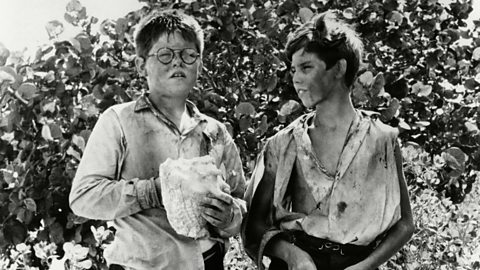
The conch – Law and order, democracy and civilisation
Ralph discovers the conch shell but it is Piggy who thinks what can be done with it. The conch summons the whole group together and, for a time, helps the boys to unite under one leader and have a single organised plan. As Jack breaks away from the group he refuses to see the conch as the powerful symbol it once was. Towards the end of the novel Piggy desperately clings on to the conch and at the moment when he is killed the shell is shattered. This A literary device where an object, person, place, or event represents something beyond its literal meaning. the destruction of the qualities it has come to represent.
Piggy's glasses – Rational thought, science and technology
Piggy is the rational thinker of the group and his glasses suggest that he is able to see what to do. Once the glasses are broken Piggy's powers decline and by the end of the novel Piggy is virtually blind. The glasses are also used to create fire and, for a while, become the most powerful object on the island. Once Jack and his tribe steal Piggy's glasses that power falls into the wrong hands and leaves Ralph's more civilised group in a hopeless situation.
Fire – Hope of rescue, and also destruction
Fire is first used to try to attract a passing ship which would take the boys back to civilisation. The boys keep the signal burning and their hopes alive. Then it is left to go out and this takes their hopes with it. When the first fire gets out of control, destruction follows and several of the smaller boys go missing - we presume they have died. Jack eventually steals fire but this is not for signalling for rescue - it is so his tribe can cook the carcass from the pig hunt. A ship does eventually see the smoke from a fire and comes to rescue the boys. However, this is smoke from a destructive use of fire - Jack's tribe are trying to smoke Ralph out of hiding so that they can kill him.
The parachutist – Adults and war
Apart from the naval officer at the end of the novel the only adult to appear in the story is the parachutist. However, as he is dead he can be of no use to the boys - in fact he becomes a A literary device where an object, person, place, or event represents something beyond its literal meaning. of terror to them when SamnEric mistake him for the Beast. The parachutist lands on the island as result of an aerial fight in the adult war that is going on in the wider world. The boys mirror the global events by starting a war of their own.
Other symbols include:
- Jack's mask and war paint
- the hunters' spears
- the pig's head
- Castle Rock
- the scar left by the plane crash
Test yourself
Further study
Lord of the Flies (2026) video
Jack Thorne's bold retelling of a dystopian classic, where a gang of stranded schoolboys create their own community – but, when the rules vanish, the beast within awakens.

The Dreams of William Golding. video
An Arena documentary revealing the extraordinary life of one of the greatest English writers of the 20th century.

William Golding on how he writes a novel. video
Golding talks candidly about the process of writing a novel and the painstaking craftsmanship that he brings to his work.

More on Lord of the Flies
Find out more by working through a topic
- count5 of 5
- count1 of 5
- count2 of 5

- count3 of 5