Aim
To learn about the history and purpose of Pride Month and marches in the UK, considering the continued need for awareness and understanding of the purpose of the Pride movement here and around the world.
The video
Around the world, Pride Month is most commonly held in June, honouring and celebrating the LGBTQ+ community and its allies.
LGBTQ+ stands for lesbian, gay, bisexual, transgender, queer or questioning, and the “plus” includes other diverse identities. It is an umbrella term for people with a range of sexual orientation or gender identities that are not hetrosexual.
Pride is about celebrating everyone for who they are and supporting equality and respect for all. The Pride march is a big part of that.
The first march in the UK was in 1972. A few hundred people gathered in London. They protested peacefully against discrimination on the basis of sexual orientation.
I was here on the first march. I was a 16 year old who had just been thrown out of school for being gay.
It was something new, it had never been done before. We were incredibly nervous, we feared arrest. But we marched defiantly.
Understanding and acceptance of individual differences takes time but changes to the law in the UK have strengthened equality.
1967 saw the decriminalisation of same sex relationships for men.
In 2010 the Equality Act protected people from all types of discrimination at school and at work.
And 2013, same sex marriage was legalised.
Today through legal and societal change, many who identify with the LGBTQ+ community feel seen and heard.
Musicians, actors, comedians, politicians and sports people.
Former Olympic diver Tom Daley came out in 2013.
That's the big thing is that for athletes to come out and be visible. I mean, when I was growing up, there weren't necessarily many out athletes. There were more people called ‘John’ than out athletes in London 2012. And the crazy thing is that in Tokyo 2020 there were more out athletes at that games than at all the previous games combined. So there is more visibility coming, which is extremely powerful because if you can't see it, you can't be it.
But despite the progress, there are still challenges. So Pride is more than a parade, it’s about advocating for real change and activism.
Pride has become so, like, I dunno, like a big party. Which I understand. We definitely have a lot to celebrate but we still have a lot to fight for.
We need to keep fighting to make sure that we actually do achieve equality and just acceptance.
People still face injustice. Some face hate through harassment and intolerance in real life or online, many young people are bullied at school. Some may feel a pressure to fit in. Some people may not feel represented or supported. There may be a fear of rejection, or cultural or religious stigma.
While challenges remain, there is a universal responsibility to embrace diversity, so everyone feels included and safe.
A strong community is key too, being seen and heard, but also a place of belonging and friendships.
I felt my life had been saved. It was just so great to meet my tribe. It changed my life actually.
I would like there not to be a need for a pride march, for the day when we treat each other with love and respect and honesty and not have to fight to achieve our rights.
In the UK, Pride has expanded well beyond its London roots.
Today it’s an opportunity to celebrate love, identity, and freedom, uniting millions of people across the country.
It’s a chance to honour those pioneers who paved the way, but also look forward with hope. By challenging stereotypes, and supporting difference and diversity, we can all help build a fairer future for everyone.
Around the world, Pride Month is most commonly held in June each year honouring and celebrating the LGBTQ+ community and its allies.
This video explores the following:
- What LGBTQ+ stands for
- The history of the UK Pride March
- Quotes from real people taking part in the march
- Changes to UK law over the years
- The positive themes and ideas linked to supporting diversity in society.
Video questions
Ask students if they are aware of what Pride Month is in support of. Ask students what LGTBQ+ stands for.
Discuss with students the introduction of the 2010 Equality Act and the legalisation of same-sex marriage in 2013. They might not be aware that it was illegal to have a same sex relationship until 1967, meaning people could be arrested and lose their jobs.
Ask students if they are aware of any Pride Month marches or festivals in their local area, outside of London. Students may not be aware that this is not a London-only celebration.
Key terminology
Introduce key terminology, including:
- LGBTQ+: stands for lesbian, gay, bisexual, transgender, queer or questioning; the ‘plus’ includes other diverse identities
- Equality: making sure all people are treated fairly and have the same opportunity
- Discrimination: treating someone unfairly because of who they are or a characteristic they have
- Decriminalisation: changing a law so something is not a crime anymore and people will not be prosecuted; it does not mean legalisation
- Stereotypes: making a generalised or over simplified belief about people or individuals based on a particular characteristic.
After watching the video
Discussion questions
- Will there always be the need for a Pride Month celebration?
- Why do some people attach discrimination to the sexual orientation or gender identity of a person?
- How can we improve equality and respect for all everywhere?
Activity ideas
- Students could design a poster or banner that could be displayed at a Pride Month march
- Divide the class into groups to discuss the need for a Pride Month march and at what point it might not be needed anymore.
Suggested framework
1. As pupils enter
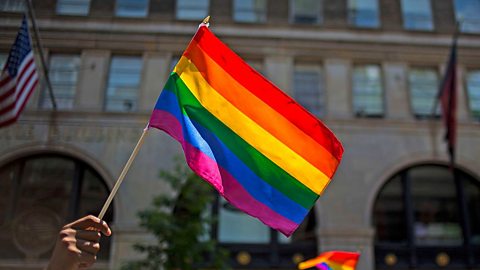
Music from a popular artist that supports the LGTBQ+ community could be played. Could also have the flag displayed to prompt further questions.
2. Introduction
Potential starting questions:
- When is Pride Month? You will have seen this flag in different places, do you know why it exists? [Ask for responses.]
- Where are Pride marches being held this year? [Ask for responses.]
- What is the purpose of the London, and other, Pride marches? [Ask for responses.]
3. Play the video
(Duration: 4’ 24” Final words: ‘…all help build a fairer future for everyone.')
You may wish to stop at relevant points during the video to pose questions and check understanding, or wait until the end.
4. After the video - Time to talk
Lead a discussion by asking some or all of the following questions:
- How many people do you think attended the 2025 London Pride march? [Over 30,000 estimated.]
- How do laws shape people's ability to live safely and openly?
- What does ‘decriminalisation’ mean?
- Why do many people in the entertainment, political and sporting world still prefer not to have the world to know their sexual orientation?
- Do students think the attitude to the LGTBQ+ community has changed in their lifetimes?
- Why did Pride start as a protest rather than a celebration? Why do we not hear many stories about heroes or people from the LGBTQ+ community in books or on television? Did anything challenge your assumptions or teach you something new? How does activism shape laws? Why is social change gradual rather than immediate?
5. Opportunity to sing
If your assembly includes a song this is an opportunity to sing it.
6. Closing the assembly
Some reflections on Pride Month and the need to support any community that still feel hate and intolerance in the 21st Century. [These questions should be considered by teachers before the assembly.]
- Would you support a local Pride Month event? [Ask for responses.]
- One of the people in the video says they would prefer there not to be a need for a Pride March, why might this be? [Ask for responses.]
- Are there any professions that people still believe they need to keep their sexual orientation or gender identity private? [Ask for responses.]
- A moment of quiet reflection could be added if appropriate.
Resources
Related links
How Gay Pride went from politics to pop. document
This Bitesize article for secondary students looks into the history of Gay Pride from battling for acceptance to playing a major part in popular cutlure.
Making a difference: My job at Manchester Pride. document
This Bitesize Careers article for secondary students introduces three young women who worked behind the scenes creating the Manchester Pride Festival 2019.

LGBT+ History Month - Teaching Resources
To help support teaching around LGBT+ history in the classroom we've put together a collection of BBC resources.

