All you need to know about 2027 Women's World Cup

- Published
The 10th edition of the Women's World Cup is due to take place in Brazil between 24 June-25 July 2027.
Eight venues will host matches in the tournament. All were previously used for the men's 2014 World Cup.
It will be the second and final year with 32 teams in the competition, with the 2031 edition expanding to 48 teams.
Brazil have already qualified as tournament hosts.
Current champions Spain beat England to win their first World Cup title in 2023.
Get in touch
Send us your questions
How did the first phase of qualifying work in Europe?
The first round of European qualifying for the World Cup took place between March and June 2026.
Fifty-three European nations were split into three leagues which are set by the 2025 Uefa Women's Nations League: 16 teams in each of Leagues A and B, and 21 in League C.
The four group winners from League A earned direct qualification to the 2027 World Cup. They were Denmark, France, Spain and Germany.
The remaining League A teams drop down to the play-offs, including England and the Republic of Ireland.
The top three sides from each League B group also enter the play-offs, as do the six League C group winners and the two best League C group runners up.
As well as World Cup qualification, qualifying also served as a promotion and relegation decider for the next edition of the Uefa Women's Nations League.
What about the other countries?
A total of 32 teams will qualify from six confederations and the inter-confederation play-off tournament:
Europe: 11 slots
Asia: Six slots
Africa: Four slots
North America, Central America and the Caribbean: Four slots
South America: Three slots
Oceania: One slot
Inter-confederation play-off tournament: Three slots
Four African teams have now qualified for the World Cup by making it to the Women's Africa Cup of Nations (Wafcon) semi-finals - Algeria, Morocco, Cameroon and Malawi.
The four losing Wafcon quarter-finalists will enter the inter-confederation play-off tournament in November and December, with Ghana, Ivory Coast, Nigeria and South Africa looking to claim the spots still up for grabs.
Who has qualified?
Confirmed to be joining hosts Brazil having earned qualifying places are:
Europe
France
Denmark
Germany
Spain
Asia
Australia
China
South Korea
Japan
Philippines
North Korea
Africa
Algeria
Morocco
Cameroon
Malawi
North America, Central America and the Caribbean
No teams yet
South America
Brazil (host nation)
Argentina
Colombia
Oceania
New Zealand
Inter-confederation play-off tournament
No teams yet
Who are in the European play-offs?
The draw for the European play-offs will take place on Thursday, 18 June.
The play-offs will take place in two rounds between October and December 2026.
In the first round, 32 teams will enter and be split across two paths - Path 1 and Path 2.
In Path 1, teams who finished second and third in League A will be drawn against the sides who reached the play-offs from League C. They will play in a two-legged match in October, with the winner reaching the second round.
In Path 2, the bottom-placed sides from League A and the top League B winners will be drawn against the second and third place teams from League B. Like Path 1, they will play in two-legged matches in October for a place in the second round.
In the second round, taking place across November and December, Path 1 winners will face Path 2 winners in two-legged matches. The winners will qualify for next year's World Cup.
Another nation that does not qualify directly for the tournament will earn a spot into the inter-confederation play-offs, where they will get a final chance to qualify for the World Cup
League A
Path 1
England
Norway
Netherlands
Italy
Republic of Ireland
Sweden
Iceland
Austria
Path 2
Slovenia
Poland
Serbia
Ukraine
League B
Path 2
Switzerland
Portugal
Scotland
Wales
Finland
Belgium
Turkey
Czech Republic
Albania
Northern Ireland
Slovakia
Israel
League C
Path 1
Hungary
Greece
Romania
Belarus
Kosovo
Lithuania
Croatia
Kazakhstan
What are the venues?
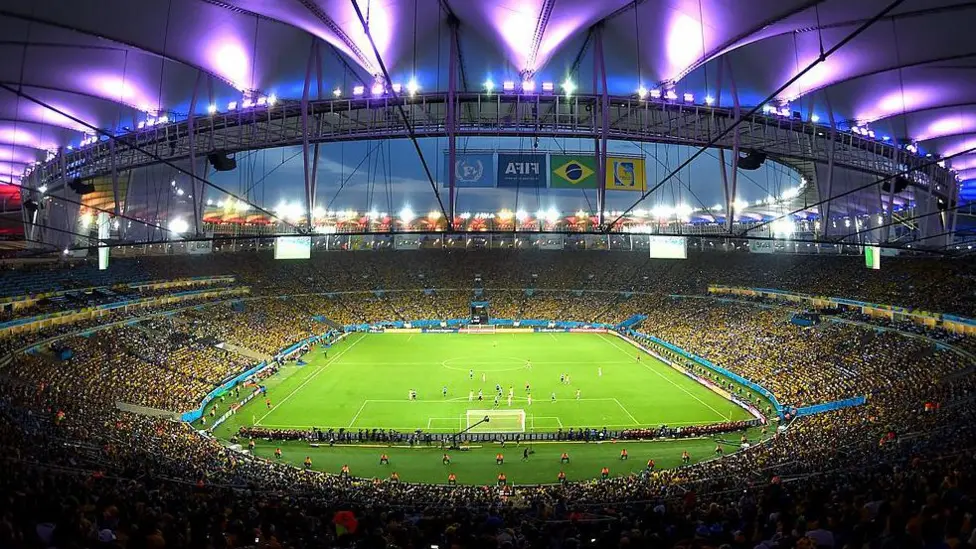
The Maracana in Rio de Janeiro hosted both the 1950 and 2014 men's World Cup finals
In May 2025, Fifa announced that Belo Horizonte, Brasilia, Fortaleza, Porto Alegre, Recife, Rio de Janeiro, Salvador and Sao Paulo would be the host cities.
Eight stadiums have been selected for the matches:
Estadio Mineirao, Belo Horizonte
Estadio Nacional, Brasilia
Arena Castelao, Fortaleza
Estadio Beira-Rio, Porto Alegre
Arena de Pernambuco, Recife
Estadio do Maracana, Rio de Janeiro
Arena Fonte Nova, Salvador
Arena Itaquera, Sao Paulo
The legendary Maracana in Rio, which hosted the 1950 and 2014 men's World Cup finals, is the largest stadium selected with a capacity of 78,838. It was also the stage for the final of the women's Olympic football tournament in 2016.
This article is the latest from BBC Sport's Ask Me Anything team.
