Eriksen at home and 'doing well' after collapse

Christian Eriksen has 151 caps for Denmark
- Published
Christian Eriksen says he is "doing well" and is at home with his family following his collapse in Sunday's game against Ukraine.
The 34-year-old spent the night in hospital following the incident, and wrote in a statement on Instagram, external that his "recovery has already started".
The game in Odense was stopped on 65 minutes when he collapsed and was abandoned shortly after, with Eriksen able to walk from the field after regaining consciousness.
The former Manchester United, Tottenham and Brentford midfielder was fitted with an Implantable Cardioverter Defibrillator (ICD) - a type of pacemaker - after suffering a cardiac arrest during a Euro 2020 match against Finland in 2021.
"As you can probably imagine, receiving a shock from my ICD has had a major effect on both me and my family, but I want to assure everyone that this was a different situation from what happened in 2021," wrote Eriksen.
"In addition to being grateful for the support and assistance of all the players and the medical team on the field, I am also incredibly grateful to the doctors who have cared for me and my heart over the years.
"Thanks to their expertise, my ICD did exactly what it was designed to do: protect me when I needed it.
The ICD allowed Eriksen to resume his playing career with Brentford in 2022 - eight months after his collapse at the Euros - before he spent three years with Manchester United.
On Sunday, Denmark national team doctor Morten Boesen said "the pacemaker responded as it should".
"For now, my focus is on recovering, spending time with my family, going on vacation, and playing football with my children," Eriksen added.
Speaking to BBC Sport before his comeback in 2022, Eriksen - who now plays for Wolfsburg - said he had no concerns about playing with an ICD.
"I don't see any risk, no. I have an ICD, if anything would happen then I am safe," he added.
Neither Denmark nor Ukraine qualified for the World Cup, which begins on Thursday.
- Image source, Getty Images
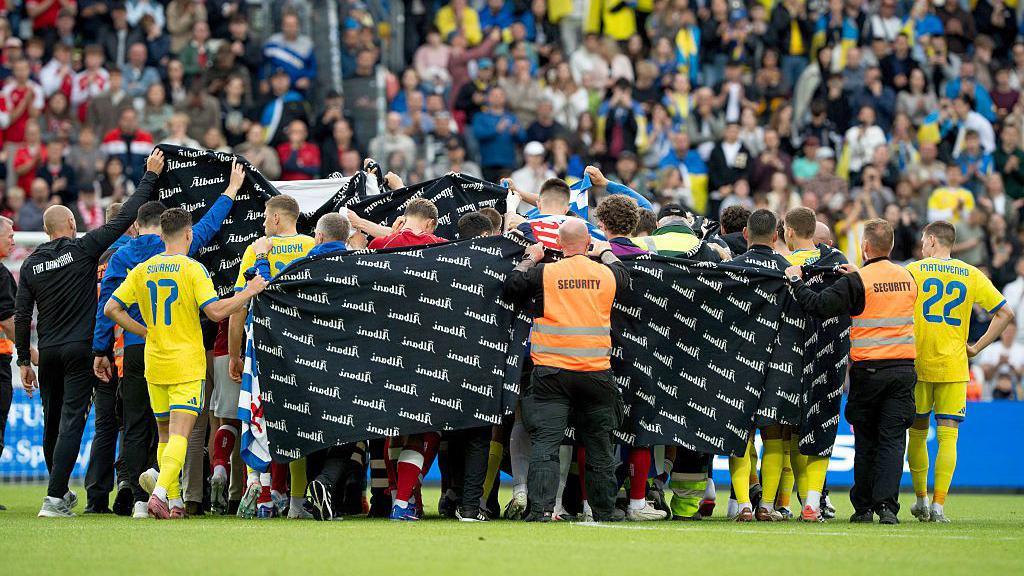
Image caption, Both sets of players formed a ring around Eriksen while he was receiving treatment on the pitch


1 of 4
Following his collapse at Euro 2020, Eriksen's Inter Milan contract was cancelled by mutual consent because players fitted with an ICD cannot compete in Serie A.
The Premier League and Bundesliga do not have the same regulations.
An ICD is a device about half the size of a mobile phone with thin wires leading to the area around the heart.
There are two main types of ICD.
One is fitted under the skin, usually near the armpit, and acts like a mini defibrillator.
"It works 24 hours a day and is constantly monitoring the heart rhythm," Aneil Malhotra, a professor in sports cardiology at Manchester Metropolitan University, told BBC Radio 5 Live.
"If the heart develops a dangerous rhythm that could lead to a sudden cardiac arrest, then the device can rapidly detect it and deliver treatment.
"That includes a shock, if necessary, to restore a normal rhythm. It takes out the human factor, as we saw at the Euros, where CPR had to be delivered externally.
"An ICD is already in the patient and saves crucial time."
The other main type of ICD is usually fitted in the space just below the collarbone and, like a pacemaker, can also send a regular electrical signal if it detects the heart is beating too slowly.
Eriksen's first collapse came nine years after Fabrice Muamba's near-fatal injury at Tottenham and 19 years after Marc-Vivien Foe tragically lost his life in Lyon.
Luton Town's Premier League match at Bournemouth was abandoned after their captain Tom Lockyer collapsed on the pitch in 2023.
Former Bolton midfielder Muamba retired aged 24 on the advice of his doctors, but others have continued to play with an ICD - including former Manchester United midfielder Daley Blind, who returned to play for Ajax and the Netherlands after being diagnosed with a heart condition in 2019.
Two years on from suffering his cardiac arrest, Lockyer returned to football with Bristol Rovers.
Eriksen speaking to BBC Sport in 2022 after joining Brentford
