|
| | | | |
|
|  We have a small stockpile of food and bottled water. We have a small stockpile of food and bottled water.
| | | How are the experts personally going to prepare for a pandemic? Mike Barnes This is a good question! I believe that I have already prepared myself and my family for a pandemic. We have a small stockpile of food and bottled water targeted for emergencies generally, a thermometer for the family, enough supplies of paracetamol to last a six-week period. I also requested that my ageing parents be vaccinated with the seasonal influenza vaccine and pneumococcal vaccine, since this is generally recommended for people over the age of 65. In addition to all of this, we are monitoring the news and information released by the government about avian influenza. Gina Samaan, Epidemiologist, World Health Organisation | |
| |
|
| There is little that members of the public (myself included) can do to prepare beforehand. | | | All the efforts I am making regarding preparation are in my laboratory where I am busy working on pandemic vaccine development. I do not have a personal stock of an anti-flu drugs (e.g. Tamiflu) nor have I been vaccinated against the H5 influenza virus (only experimental vaccines exist). There is little that members of the public (myself included) can do to prepare beforehand beyond increasing their awareness of public health recommendations and attention to good personal hygiene and, at the time of a pandemic, paying attention to anouncements from the health service regarding anti-viral use and vaccination. Dr Jim Robertson, National Institute for Biological Standards and Control | |
| |
|
| I am one of those who will not be able to stay out of circulation. | | | In terms of my main interest, which is how to bring new medicines through to the public by better bioprocesses, influenza should be a small part but working on pandemic preparedness is now taking about a quarter of my time so that is my personal preparation. Though not someone who should receive front line status I expect to be involved so I am one of those who will not be able to stay out of circulation. Peter Dunnill, Professor of Biochemical Engineering at University College London | |
| |
|
| I am not doing anything in particular to prepare. | | | I am not doing anything in particular to prepare. But I'm a virologist and so I do have a couple of antivirals at home - one is an M2 blocker, which has been sitting in my fridge for about 20 years, the other is a modern neuraminidase inhibitor that's also out of date. If pandemic flu does break out in the UK, I imagine that I'll give these away as soon as the first of my children or friends shows any symptoms. In the event of a pandemic, I would try and get vaccinated as soon as possible, and I would also try and increase my hygiene levels - wash my hands and clean surfaces more thoroughly and more often, for example. But apart from that, I would try to carry on as usual and go to work. I expect that my colleagues and I would be drafted in as volunteers to help analyse the first few 100 cases to gain knowledge to help everyone else. John Oxford, Professor of Virology at the University of London | |
| |
|
| My wife and I are stockpiling enough food and essential supplies for three to four months. | | | The lesson of Hurricane Katrina is that local government and local resources have primary responsibiltiy for recovery efforts after a large scale disaster, not the federal government. The worst case scenario in a pandemic could resemble the aftermath of Katrina on a national and international scale. If that happens, we can't rely on government at any level. We must be prepared to help ourselves. With that lesson in mind, my wife and I are stockpiling enough food and essential supplies for three to four months. We have purchased a high quality portable water filter and iodine so we will have access to safe drinkng water. We have two spare propane tanks for our outdoor grill. We plan to purchase a firearm for personal protection. We have a well-stocked first aid kit. We have bicycles for each family member. We have plans to quarantine my wife and children in our home for several months if necessary. Since I will be heavily exposed to flu anyway, I will be their link with the community to procure food and other essentials as needed. I have a high quality tent and camping gear for my own shelter so that I pose no risk to my family. I also plan to organise a neighbourhood patrol so that our immediate community has a means to disseminate information and to provide mutual support and security. Dr Jim Wilde, Medical College of Georgia Health System | |
| |
|
| Think how much many of you spend on insuring cars and houses or flats. | | | What can we do to prepare for a pandemic? Should we be stockpiling four months of food and water? Andrew Lam You should now store food and essentials and keep enough medicines that family members rely on so they are not close to running out at any time - this is official US Government advice. The UK Government should also advise this. If the action seems extreme, think how much many of you spend on insuring cars and houses or flats and unless you have a rare catastrophe with them you will never see the value of that money again. If you use the stored items within their shelf lives, you insure your family's lives - more important even than housing and cars - and you get the whole value back in a year or two. Not everyone can do this but a good buffer stock will avoid the impact of panic buying if a pandemic appears. If one bread winner in a family has to go to work they should take their share of the stock and stay at work. The level of storage does not need to be as extreme as that of the Florida couple shown in the programme. The US government has advised 3 months stock in a densely populated city. Peter Dunnill, Professor of Biochemical Engineering at University College London | |
| |
|
| A two-week supply of food and essentials is a reasonable target as a minimum. | | | In my opinion, it is prudent to have a three to four month supply of food stored in your home to be prepared for prolonged societal dysfunction due to pandemic flu or other disasters. If that is impractical due to expense or lack of storage space, I believe a two-week supply of food and essentials is a reasonable target as a minimum. Dr Jim Wilde, Medical College of Georgia Health System
| |
| |
|
| I think stockpiling four months of food and water would be overreacting. | | | I don't think stockpiling four months of food and water is necessary - I think that would be overreacting. But what you can do is have a strategy and be aware of how the virus spreads. So in the event of a pandemic, it might for example make sense not to go to work during rush hour to avoid crowded tube trains. Or if a friend calls and says he's feeling ill, it might not be the best idea to pop round to see him straight away, and so on. On any one day, about five per cent of the community will be ill, so 95% of the population will still be perfectly capable of going about their daily business. In fact, one of my biggest concerns is the worried well - people who will lock themselves away during a pandemic. That could amount to a huge number. And if that happens, and everybody goes into panic mode, the economy will collapse. John Oxford, Professor of Virology at the University of London | |
| |
|
| A pandemic is basically an epidemic on a larger, global scale. | | | What is the difference between a pandemic and an epidemic? Steve Bacon An epidemic is a disease outbreak, where the number of cases exceeds what is considered normal or "expected" based on previous months or years. A pandemic is basically an epidemic on a larger, global scale. Pandemics can cause large surges in the numbers of people requiring or seeking medical or hospital treatment, temporarily overwhelming health services. Pandemics can also lead to high rates of worker absenteeism which interrupt essential services, such as law enforcement, transportation, and communications. Gina Samaan, Epidemiologist, World Health Organisation | |
| |
|
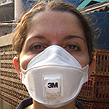
| Even a light weight paper mask will give you some protection, blocking out the virus for about 10 to 15 minutes. | | | How much protection does wearing a face mask give you against the virus? Richard Irving Wearing a face mask will offer you a reasonable amount of protection, so it's certainly worth thinking about. Even a light weight paper mask will give you some protection, blocking out the virus for about 10 to 15 minutes. But after that it gets sodden and won't be so effective any more. It is, however, important to have a face mask that fits you, especially around the nose. And you also need to be careful when handling it. If you've touched a surface contaminated by the virus and then touch your mask, you might transfer the virus onto the mask and get infected that way. Also it's worth remembering that you don't only get infected via the nose and mouth, your eyes are also a route into your body. And a face mask won't protect you if your hands are contaminated and you then touch your eyes. John Oxford, Professor of Virology at the University of London | |
| |
|
| The risk/benefit ratio is not likely to favour the use immune suppression in influenza. | | | If young, fit people are most at risk because of their healthy immune systems overreacting, would suppressing their immune system with drugs aid their chances of survival? Philip Davis There are no studies looking at deliberate immune suppression as a means to mitigate the impact of influenza in healthy people. However, there is some data supporting immune suppression in other infections. For example, suppressing the immune system using steroid therapy has been found to be of modest benefit in patients with some forms of bacterial meningitis. Immune suppression might help in some regard with severe flu, but our experience with immune suppression in transplant patients indicates that we would put them at significant risk for other potentially life threatening infections. Even in 1918, 98% of infected patients survived their infection. The risk/benefit ratio is not likely to favour the use of steroids or an other form of immune suppression in influenza. Dr Jim Wilde, Medical College of Georgia Health System | |
| |
|
|






 BACK: To top