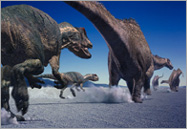
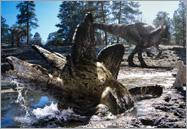
Tales of the tracksThe sauropod footprints are not the only ones preserved around the edges of the ancient lakes. Sometimes there are groups of carnivorous dinosaurs - probably Allosaurus - which seem to be following them. Some of these trackways, such as the famous Puluxy River tracks, seem to show a hunt in progress. However it is very difficult to interpret footprints left 150 million years ago! Allosaurus certainly ate sauropods. Sauropod bones are found with tooth marks and even shed Allosaurus teeth amongst them. Allosaurus' teeth were not firmly rooted like ours - they frequently lost them whilst feeding and simply grew new replacements. Brain waves of the AllosaurusOne of the most amazing fossil finds is a perfectly fossilised Allosaurus brain, found in the exceptional Cleveland-Lloyd Quarry of the Morrison Formation. Soft parts of animals are very rarely fossilised. In this case it seems that fine mud covered all the dying dinosaurs very quickly. In one skull, this fine mud preserved the actual brain in detail. This incredible fossil has enabled us to know a lot about how Big Al might have seen and reacted to the world around him. The overall shape of the brain is similar to that of a crocodile, with a similar region for detecting smell. The region devoted to hearing shows that it was not highly developed. Allosaurus would only have been able to detect loud and low sounds. The eyes are also rather small and not forward-facing, so Allosaurus would not have had particularly good vision. Therefore scent seems likely to have been very important to the dinosaur, both in finding prey and mates. Fossil beds and predator trapsThe Cleveland-Lloyd Quarry forms the background for the scene in Big Al Uncovered where a Stegosaurus becomes stuck in mud. Its rotting body attracts predatory Allosaurus to their deaths. Stegosaurus are found in the quarry (as well as some sauropods) but three quarters of the dinosaurs there are adolescent Allosaurus. It is very unusual to find so many predators compared to prey animals. Also, the bones haven't been assembled by a flood or any of the usual processes which lead to a large number of bodies being found in the same place. Instead, the sediment they are buried in seems to have been mud, kept wet by an underground spring. The bones in the quarry are all mixed up and show the tooth marks of predators. All the evidence seems to point to this site being a 'predator trap'. This happens occasionally when there is a natural trap where animals can get stuck. Another famous example is the La Brea tar pits in the USA, where sticky tar traps animals that accidentally wander into it. The bodies of these animals then attract carnivores, which also become stuck. The result is that large numbers of predators can become trapped and die in the same place. Big Al, though, avoids this fate in our programme. An adult Allosaurus could actually attack and eat a youngster like him and so, luckily, he steers clear. Next - living rough
|