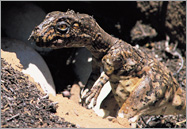
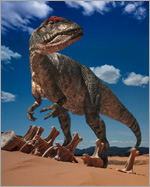
Mother's helpSince the mother is there when the baby Allosaurus hatch, she is there to help dig them out. If the mother is guarding the nest itself, then it might well be in her interest to stay around for longer and to guard the hatchlings. Whether or not this would be worth it depends on how at risk the babies were and how able the mother is to protect them. Baby Komodo dragons live up in the trees and cannot be eaten by other Komodos, their main predators. However, the mother is too big to climb trees and cannot help them. Crocodiles, though, lay very large numbers of eggs (between 60 and 80). Because their young are very vulnerable, many get eaten in their first year. However, with her young living in the same place, the mother crocodile can help protect them. She therefore keeps them together in a little creche for some time after they have hatched. The nest in Portugal shows that Allosaurus-like dinosaurs probably laid very large numbers of eggs like crocodiles. The embryos show that the young were like miniature adults. Although their teeth were only adapted for catching insects and small animals, they would otherwise have lived in the same way as the adults. The large number of eggs laid by Allosaurus seems to suggest that, like crocodiles, a large number of young were killed in their early years. So, it would have been in the female's interest to stay around and protect them, for a short while at least. From hatchling to juvenileBig Al grows rapidly. Although fossil bones look like solid rock, amazingly, microscopic details of the insides have been preserved. Studying the bone structure in fossils from a range of sizes of Allosaurus and comparing them to the bones of modern animals indicates that these dinosaurs grew very fast, rather like birds, reaching maturity in only about seven years. This was obviously an advantage as small, juvenile dinosaurs would have made an easy meal for predators like adult Allosaurus. Late Jurassic heatAs he grows, Big Al starts to hunt other small dinosaurs in the forests and on the plains. The Morrison Formation, where he was found, has given us many clues to the type of environment he lived in. There were lakes fed by large, meandering rivers but during the dry season there were often droughts. The lakes evaporated, leaving white soda crystals and dying fish. Many dinosaurs died of thirst. Their bodies dried out in the sun, which shortened the tendons along their backs. This would have pulled their heads and tails back into an arc above their bodies. Big Al was found in exactly this characteristic pose, which shows that he had died in a drought and was not discovered or scavenged by other animals. The sauropods like Diplodocus and Apatosaurus migrated to areas where it was still green and lush. Their footprints are fossilised travelling around the lakes and on for long distances. Next - tales of the tracks
|