Deadly Threads
A fibre analyst uses a groundbreaking technique to solve the murder of 91-year-old Edwin Hiles, and a forensic fire investigator helps to uncover the truth behind a tragic house fire.
The first case charts the investigation of a killing in Witney, Oxfordshire in 1992. Ninety-one-year-old Edwin Hiles was found stabbed and lying on the floor of his lounge. He had lived in the same housing estate for decades where he still worked as a small-scale money lender. When detectives arrived at the scene, the house was ransacked and the victim had fatal wounds to his neck. Police had no witnesses and no suspects, so the case would rely on any forensic evidence that could be gathered from the scene.
Crime scene manager Clare Houston noted that the activity around the body after it had been discovered had been minimal, meaning evidence would be undisturbed. With a new fibre-taping technique in its infancy, it could be used to show not only if a suspect was in contact with the victim but also the level and nature of that contact.
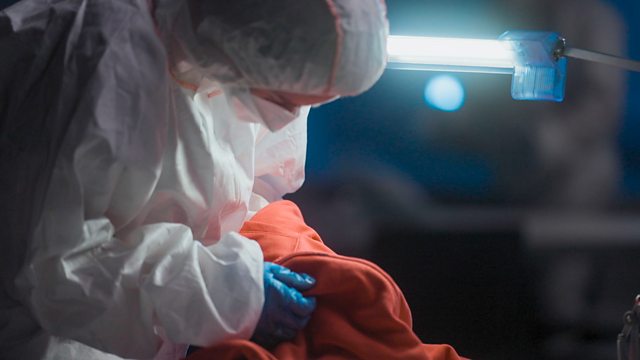
Tape was then applied to the victim’s whole body to pick up any fibres the killer may have left. This was the first UK crime the new one-to-one fibre analysis was used in. At this point, the forensic examination was turned over to expert witness and leading fibre analyst Tiernan Coyle. It was his job to examine the individual pieces of tape. Tiernan noted a high volume of black fibres and an even higher volume of red fibres – and they didn’t match anything the victim was wearing.
So when police got a tip off of a suspect, Paul Weedon, and found clothes he’d discarded, Tiernan was able to make a positive match to the fibres found at the scene. Weedon admitted to witnessing but not committing the crime, prompting Tiernan to use the ground-breaking fibre technique which would show him the actual contact the suspect’s clothing had with the body. He was able to match the injuries on the victim’s body with where the fibres were found and paint a horrific sequence of events. Weedon was found guilty of murder and sentenced to life. The programme includes insightful interviews from Tiernan Coyle, crime scene manager Clare Houston and Detective Supt Mark Warwick, who was the senior investigating officer on the case.
The second case looks at the work of forensic fire investigator Dan Matthews, who examined a devastating blaze at the home of Mick and Mairead Philpott. Five of their children perished in the fire and a sixth died later in hospital. The whole community of Derby reached out to the Philpotts with sympathy and offers of help.
Expert witness Matthews was brought in to try and determine what had caused the fire and whether it was accidental or deliberate. By analysing debris from where he believed the fire had started, Dan was able to conclude that an accelerant had been used, which pointed to arson. He was also able to connect Mick Philpott’s shoes to the fire by detecting traces of the accelerant used.
The Philpotts initially tried to blame a former girlfriend of Mick’s for setting the fire, but with Dan Matthew’s evidence – alongside covert recordings of the couple – they were found guilty of manslaughter.
Locked in a custody battle with his ex-girlfriend, Mick Philpott is believed to have lit the fire so he could be the hero and rescue his children, blame his ex-partner and win his other children back. His plan turned to tragedy.
Last on

Credits
| Role | Contributor |
|---|---|
| Presenter | Ashley John-Baptiste |
| Composer | Philip Guyler |
| Production Manager | Andrea McClelland |
| Executive Producer | Emma Barker |
| Executive Producer | Edward Hart |
| Series Producer | Lucy Wedlock |
| Producer | Gary Watson |
| Producer | Catriona Wright |
| Production Company | Rare TV |
Broadcast
- Tue 21 Jul 202610:45
