

Wednesday 24 Sep 2014
Programme Information
Network Radio BBC Week 13: Tuesday 30 March 2010
BBC RADIO 2 Tuesday 30 March 2010
www.bbc.co.uk/radio2
In his final Tuesday evening show before moving to his new Friday slot next week, Desmond Carrington rummages through his collection of 250,000 titles from his home in Perthshire, and looks at music with the theme of "getting away from it all" with ideas for an Easter break.
Desmond says:"When I was asked to introduce a record programme in 1981, the contract was for three months. With one or two changes, the latest being the move to Friday evenings at 7pm just after Easter, that three months will soon be 30 years! Thank you, BBC Radio 2, for keeping me young."
Presenter/Desmond Carrington, Producer/Dave Aylott
BBC Radio 2 Publicity
BBC RADIO 3 Tuesday 30 March 2010
www.bbc.co.uk/radio3
HK Gruber makes his debut as the BBC Philharmonic's composer/conductor with the UK première of his trumpet concerto Busking, performed with soloist Håkan Hardenberger, as well as music by Weill and Stravinsky.
Gruber starts his tenure with a programme with a typically 20th-century slant, presenting excerpts from Weill's Threepenny Opera as well as Stravinsky's Symphony In Three Movements, alongside his own work.
His own music is strongly influenced by jazz and cabaret and he is fascinated by the wealth of classical repertoire from the last century, which he believes to be under-explored. Busking is a three-movement concerto for string orchestra in which the soloist plays on three different trumpets, getting the instruments to variously twang, squeak and squawk, depending which mute is used.
Producer/Mike George
BBC Radio 3 Publicity
BBC RADIO 4 Tuesday 30 March 2010
www.bbc.co.uk/radio4
Betwen Ourselves continues this week as an Iraqi Kurd and an Iranian Azeri discuss life as a refugee in the United Kingdom.
Mohamed is from Iran and became a refugee in 2009, while Zirak was granted refugee status in 2002 and now has British citizenship.
They talk about what it is like to leave family and friends behind in your home country, possibly never to return, and whether they might have put them in danger by leaving. The men also discuss whether it is easy to settle in the UK, what kinds of prejudices they face and how it feels to be labelled a "refugee".
Zirak was involved with an organisation that wanted a free Kurdistan. When the group was discovered, two of his friends were arrested and tortured; one of them who had a heart condition subsequently died. He started receiving threatening letters and knew he had to leave. He left in 2002 and, from Turkey, was smuggled out in a lorry. When he eventually arrived in the UK, he didn't know what country he was in, and couldn't speak any English.
Mohamed travelled here to study music and became involved with Azeri politics; as a result a family member and his lawyer back home were arrested, and he realised that he, too, would be arrested if he returned to Iran. He applied for refugee status, which was quickly granted. He hopes to return home one day.
Presenter/Olivia O'Leary, Producer/Karen Gregor
BBC Radio 4 Publicity
A Musical Trip To South Africa – With Lenny Henry Ep 1/5

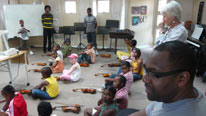
Lenny Henry experiences South Africa through its music, in this new series of five programmes.
South Africa has an extremely rich musical tradition with a wealth of talent to match. Lenny meets the cream of that talent – from the legendary trumpeter Hugh Masekela to the country's best-selling recording artist, Rebecca Malope.
Lenny begins the whole series centre pitch at Soccer City in Jo'burg to the accompaniment of a chorus of Vuvuzelas – the deafening trumpets that blast out at football matches. He's invited onto YFM youth radio station to hear about Kwaito, aka "township house" music, and finds himself in a recording studio with some of the country's hottest bands.
In other programmes Lenny looks at the role of music in the struggle against apartheid, the role of the church in South African music making and at the "lost tribes" of music makers – including white Africaaners who are having a punk revolution of their own. And, finally, he looks at the international ambitions – with world-class talent from Lira to Samson Diamond, the internationally acclaimed classical violinist.
Presenter/Lenny Henry, Producer/Susan Marling
BBC Radio 4 Publicity
Chris Ledgard investigates how living in the shadow of a nuclear power station has shaped a community, and visits the Somerset village of Stogursey, two miles from Hinkley Point.
In medieval times, the village of Stogursey on the edge of the Quantock Hills was a market town. Over the centuries, its importance diminished. Then work began on a nuclear power station on the Somerset coast just two miles away, and Stogursey found itself in demand again – families flooded in and the school sent its overspill to the village hall.
In Hinkley's Shadow is a portrait of a nuclear community. The first generation of Britain's nuclear power workers are now retired. At Hinkley, their children are now working on the site.
Chris talks to people who work in and around Hinkley, including a mud horse fisherman, said to be the last in the world, who fishes with a sledge he pushes out into Bridgwater Bay.
And as the debate on the new station, Hinkley Point C, develops, the anti-nuclear protestors enter another battle.
Presenter and Producer/Chris Ledgard
BBC Radio 4 Publicity
Poet Owen Sheers travels to one of the wildest corners of the country to discover the tragic tale of Britain's lost school of Post-Impressionism.
A century ago, Augustus John, doyen of the Café Royal and celebrity portraitist to London's top literary figures and socialites, fled the debauchery of London's bohemia to find a new purity – in one of the nation's most remote wildernesses. He had been tempted there by a unique kindred spirit – a fellow painter and bohemian wild child – whose rich imagination and relentless lust for life was spurred by the knowledge that he had just months to live.
John's friend, James Dickson Innes, has been virtually forgotten since his tragic death from tuberculosis aged just 27, yet is described by one critic as "indispensable" to British landscape art.
Their Eden was the Arenig Valley in North Wales – a sliver of craggy, swirling peaks and haunting, silent plateaux east of Snowdonia, between Bala and Ffestiniog. There, buffeted by the wind and blinded by the rain, they painted feverish, delirious landscapes together in the open air, a unique blaze of creativity amid the desolate countryside.
Yet after barely 18 months, their fire was extinguished as the spectre of war, illness and death abruptly drew a curtain upon their work. And, while John was to live on for nearly half a century, his reputation and infamy undiminished, Innes was to die barely a year later, his work unappreciated and unloved, in a Kent hospice. After Arenig, neither man was to paint landscapes ever again.
The programme features contributions from the famed travel writer Jan Morris, herself haunted by the Arenig Valley, which she describes as "hallucinogenic ... like entering a dream" – as well as Augustus John's biographer, Michael Holroyd, and the contemporary Welsh landscape artist Iwan Gwyn Parry.
Presenter/Owen Sheers, Producer/Steven Rajam
BBC Radio 4 Publicity
British musician and composer Nitin Sawhney explores the life of his musical hero, Ravi Shankar.
Most people outside of India are familiar with the sitar player and composer thanks to his association with The Beatles. But this one career highlight out of a cast of many often overshadows his extraordinary achievements as a world-class musician.
The great violinist Yehudi Menuhin once said of him: "To me, his genius and humanity can only be compared to that of Mozart's."
As Shankar approaches his 90th birthday this April, Sawhney meets up with his hero to discuss his life and music.
His story began 80 years ago when Shankar began his career as a professional dancer. By the time he was 18 he had chosen to master the sitar and began an intense period of training, often practising up to 14 hours a day.
By the Sixties he was performing in front of hundreds of thousands of people and on his way to collaborating with leading musicians such as Philip Glass and André Previn. But before Shankar could introduce the rest of the world to Indian classical music he first had to change the way this deeply traditional music was performed and presented – now listeners can find out how he did that.
As well as an exclusive new interview with Shankar there are contributions from his daughter, Anoushka Shankar, the famous Indian percussionist Zakir Hussain, George Harrison's wife, Olivia, The Who's Pete Townshend and music historian Ken Hunt.
Presenter/Nitin Sawhney, Producer/James Hale
BBC Radio 4 Publicity
This programme explores how a questionnaire devised at a kitchen table became the preferred professional development tool of some of the world's largest corporations.
It was created by a mother-and-daughter team, neither of whom were trained as psychologists, yet today it is the world's most widely used personality indicator, used as a professional development aid by leading companies like Procter and Gamble, Shell and Vodaphone.
Mariella Frostrup tells the story of The Myers-Briggs Type Indicator (MBTI), created by Katherine Cook Briggs and her daughter, Isabel Briggs Myers. Participants are asked a series of questions intended to reveal information about their thinking, problem-solving and communication styles.
At the end of the process each participant is handed one of 16 four-letter acronyms, which describes their "type". ENTPs are extrovert inventors, ISTJs are meticulous nit-pickers.
Katherine Cook Briggs and Isabel Briggs Myers devised their questionnaire during the Second World War to help women identify the sort of war-time jobs where they would be "most comfortable and effective". It was a long and arduous struggle to convince the bosses of IBM and General Motors that there was anything in it for them. Even today many psychologists question its validity, describing it as "so vague as to be meaningless", "unscientific" and "like a party game".
Myers-Briggs also seems to fit suspiciously well with the human resources ethos of the modern work place: no personality "type" is better than any other, teams and organisations benefit from having multiple perspectives, disagreements are all down to "where you are coming from".
Mariella asks what Myers-Briggs tells people that they couldn't have found out before?
Presenter/Mariella Frostrup, Producer/Lucy Adam
BBC Radio 4 Publicity
Novelist Louise Welsh investigates how a comic-book vampire brought horror to Glasgow's south side and its impact on Britain's censorship laws.
Glasgow's Southern Necropolis is an eerie place at the best of times but when two local policemen answered a call in September 1954 they encountered a bizarre sight. Hundreds of local children, ranging in ages from four to 14, were crammed inside, roaming between the crypts, armed with sharpened sticks, knives stolen from home and stakes. They said they were hunting down "a vampire with iron teeth" that had kidnapped and eaten two local boys.
The policemen dispersed the crowd, but they came back at sundown the next night and the next. The local press got hold of the story and it soon went national.
There were no missing boys in Glasgow at that time, and press and politicians cast around for an explanation. They soon found one in the wave of American horror comics with names like Astounding Stories and Tales From The Crypt, which had recently flooded into the West of Scotland.
Academics pointed out that none of the comics featured a vampire with iron teeth, though there was a monster with iron teeth in the bible (Daniel 7.7) and in a poem taught in local schools. Their voices were drowned out in a full-blown moral panic about the effect that terrifying comics were having on children. Soon the case of the Gorbals Vampire was international news.
The British Press raged against the "terrifying, corrupt" comics and, after a heated debate in the House of Commons where the case of Gorbals Vampire was cited, Britain passed the Children and Young Persons (Harmful Publications) Act 1955 which, for the first time, specifically banned the sale of magazines and comics portraying "incidents of a repulsive or horrible nature" to minors.
This programme explores how the Gorbals Vampire helped bring the censorship of comic books onto the statute books.
Presenter/Louise Welsh, Producer/David Stenhouse
BBC Radio 4 Publicity
BBC RADIO 5 LIVE Tuesday 30 March 2010
www.bbc.co.uk/5live
5 Live Sport

Mark Pougatch has all the day's sports news and, from 7.45pm, live Uefa Champions League quarter-final first-leg coverage. There are also updates from the night's Championship, Leagues One and Two matches.
Presenter/Mark Pougatch, Producer/Ben North
BBC Radio 5 Live Publicity
BBC RADIO 5 LIVE SPORTS EXTRA
Tuesday 30 March 2010
www.bbc.co.uk/5livesportsextra
Swimming
Uninterrupted commentary from the British Championships and Commonwealth Trials comes live from Sheffield.
Producer/Jen McAllister
BBC Radio 5 Live Sports Extra Publicity
BBC 6 MUSIC Tuesday 30 March 2010
www.bbc.co.uk/6music

Vampire Weekend join Nemone this afternoon and handpick tracks for this week's lunchtime playlist. They choose an eclectic mix of tracks including Matias Agvay, Tanlines, Yousou N'Dou, Interpol, DJ Kool and Serge Gainsbourg.
The Brooklyn-based band, from New York City, formed in 2006 and signed to XL Recordings. They released their second album, Contra, in January, which has seen them rise from underground heroes to the summit of the US album charts.
Presenter/Nemone, Producer/Jax Coombes
BBC 6 Music Publicity
Alongside his selection of brand new and classic tracks, Gideon Coe presents the unique Kraftwerk recorded concert in 1997 and a Baaba Maal live set from 1998. Listeners can also hear tracks from Sonic Youth's first Peel session, BBC session tracks from spectral US "psyche folk" band Espers recorded in 2006, G Lewis And DC Gilbert from Wire make an experimental sounds circa 1980 and, from 2004, a session from American beardie-boys Midlake.
Presenter/Gideon Coe, Producer/Frank Wilson
BBC 6 Music Publicity
Programme information
Network Radio
Network Radio – Days
Key
- New
- Live event/outside broadcast

- Interactive programme

- Picture available
BBC iD
BBC iDBBC navigation
BBC links

BBC © 2014The BBC is not responsible for the content of external sites. Read more.
This page is best viewed in an up-to-date web browser with style sheets (CSS) enabled. While you will be able to view the content of this page in your current browser, you will not be able to get the full visual experience. Please consider upgrading your browser software or enabling style sheets (CSS) if you are able to do so.
