Summary

  1. Earthquake death toll rises as search for survivors continuespublished at 21:04 BST 29 June

    Jacob Phillips
    Live reporter

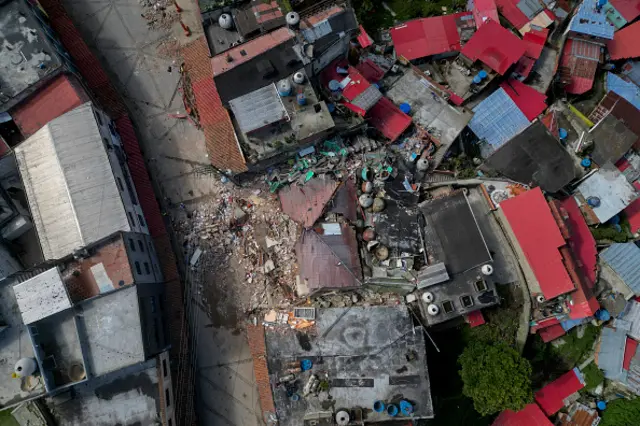
    An aerial shot shows a destroyed building in El Junquito in Venezuela. It is surrounded by the red roof tops of similar buidlingsImage source, Getty Images
    Image caption,

    Aerial view of El Junquito, Venezuela on Monday after the twin earthquakes on Wednesday night

    We're pausing our live coverage, but you can read more in our news story.
  2. Man desperately searches for his parents in rubble of their apartmentpublished at 21:02 BST 29 June

    Alice Cuddy
    Senior international reporter, in Caracas

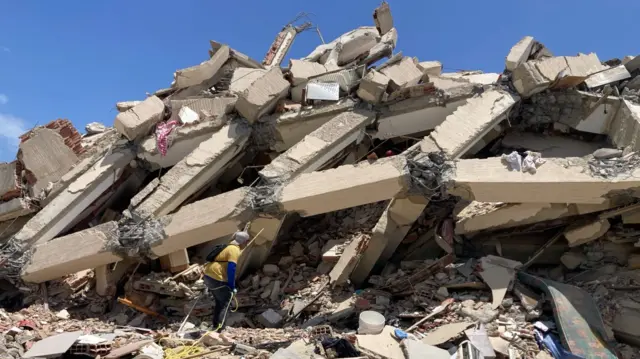
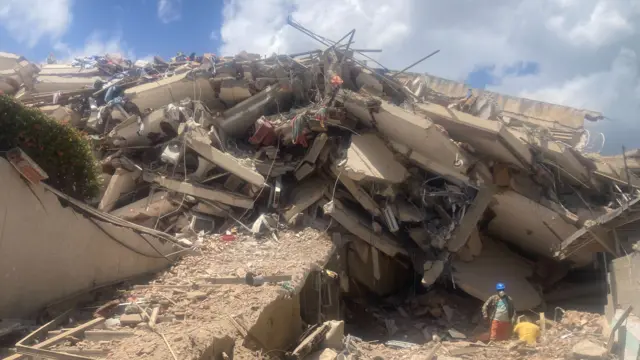
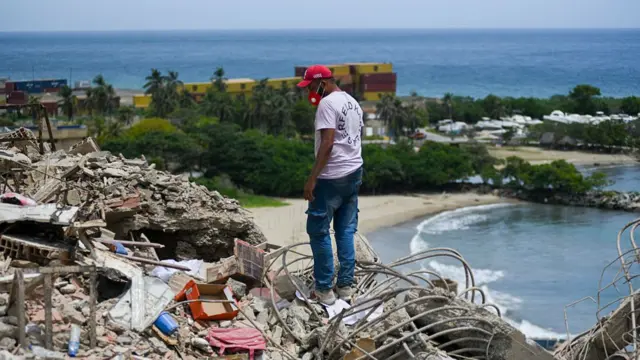
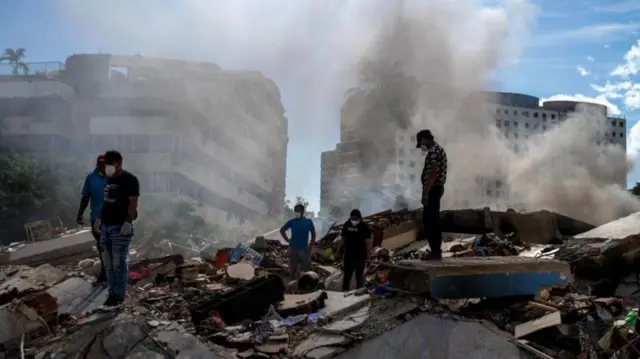
    Rubble from a destroyed building in La Guaira

    The desperate hunt for the missing is continuing today here in La Guaira.

    Photos of those unaccounted for are stuck to lamp posts and walls.

    At one building where residents yesterday told me of their frustration over the closure of official search efforts, they are today using heavy machinery themselves to clear the rubble.

    I just spoke to a man called Carlos whose two parents have been missing since the quakes on Wednesday.

    He has located their apartment in the massive pile of debris and is attempting with a friend to sift through it piece by piece in search of them.

    He tells me he doesn’t believe there is any chance they are alive, but will not give up until he finds their bodies.

    Destroyed buildings in La Guaira
  3. More than 25,000 emergency workers, police and soldiers deployed, Venezuela's president sayspublished at 20:39 BST 29 June

    Acting Venezuelan President Delcy Rodríguez says more than 25,000 emergency workers, police officers and soldiers have been assisting those who have been affected by the earthquakes.

    "Every life saved is a victory for hope," Rodríguez says on social media platform X.

    The president shared footage on X of people being rescued from rubble.

  4. La Guaira port repairs will ease aid access, US sayspublished at 20:09 BST 29 June

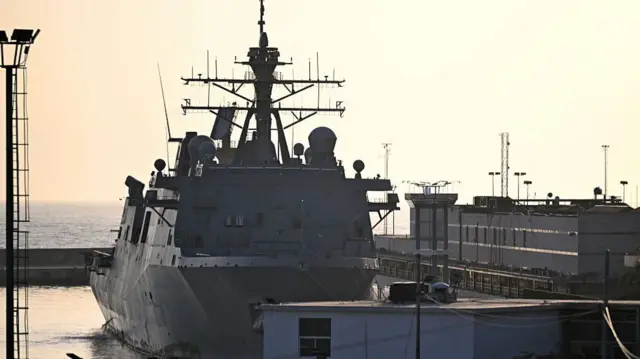
    The USS Fort Lauderdale docked in the port of La GuairaImage source, Getty Images
    Image caption,

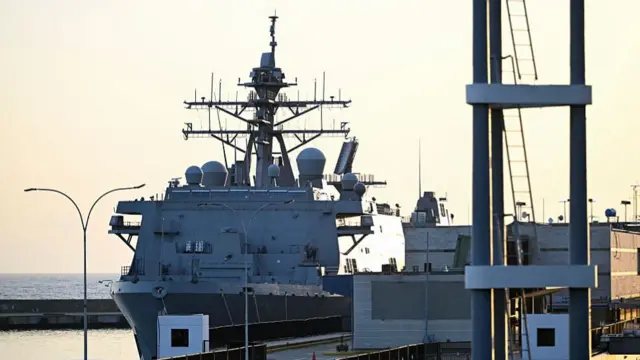
    The USS Fort Lauderdale is docked in the port of La Guaira to help deliver aid to coastal areas

    US Marines are working to repair the Venezuelan port of La Guaira, a senior administration official says according to the AFP news agency.

    It comes as Washington boosts its financial commitment for the earthquake-hit country to $300 million (£226m).

    A "specialised team of Marines" is "working around the clock to repair that port and allow the delivery of critical supplies by sea", the US official told journalists on condition of anonymity.

    Earlier the State Department said the US frigate, the USS Fort Lauderdale, remains docked off the coast of La Guaira. Sailors and Marines are using landing and amphibious craft to deliver supplies to the most affected coastal areas.

    The increase in US funding "will provide emergency medical care, food assistance, water and sanitation, shelter, protection, and logistics", the State Department said.

  5. Desperate search for earthquake survivors continues outside Caracaspublished at 19:51 BST 29 June

    Media caption,

    Desperate search for earthquake survivors continues outside Caracas

    The search for survivors continues in the city of Catia la Mar following the earthquake in Venezuela last week.

    In some areas, neighbours and family members have been searching for loved ones with their bare hands and any tools they can access.

    The BBC's Will Grant reports from the scene on the effort of locals to find any survivors.

  6. 'You can't really do much with just a pickaxe': Woman searches by hand for family beneath rubblepublished at 19:39 BST 29 June

    Norberto Paredes
    BBC Mundo correspondent, reporting from La Guaira

    Carolyn Zerpa, 39, has been trying to rescue her father and brother from beneath the rubble by hand in La Guaira.

    "You can't really do much with just a pickaxe," she tells me.

    Diggers and sniffer dogs eventually come, but she believes it’s too late and feels what has arrived won’t be enough to help: "It’s just one piece of machinery."

    Her focus has shifted from rescue to recovery – to find the remains of her family; to give them a proper burial.

    "I lost my niece and my brother-in-law. I think that if they (the rescuers and diggers) had come sooner, many people could have been saved," says Zuly Marín.

    She has lived in La Guaira for 15 years and believes it's impossible to prepare for a disaster like this.

    But she thinks the response has been too slow and Venezuela's current economic situation does not help.

  7. Earthquakes death toll rises to more than 1,700 - National Assembly presidentpublished at 19:19 BST 29 June
    Breaking

    The death toll from last week's earthquakes has risen to more than 1,700 people, according to Venezuela's National Assembly President Jorge Rodríguez.

    More than 5,000 were injured in the disaster, and tens of thousands of people have been left missing, he says in an address on state television.

  8. Over 500 aftershocks and 2,500 structures damaged in earthquakes - UN officialpublished at 18:57 BST 29 June

    Members of rescue teams from the Netherlands are conducting search operations in a building damaged by an earthquake in La Guaira, Venezuela, 29 June 2026Image source, EPA/Shutterstock

    We can now bring you more from the United Nations' resident humanitarian co-ordinator for Venezuela.

    Gianluca Rampolla Del Tindaro says there have been more than 500 aftershocks in the country since the two successive earthquakes on Wednesday night, including a magnitude 5.2 aftershock this morning.

    Tindaro adds that seven states have been affected, with La Guaira and the capital district of Caracas being the two most impacted.

    He also says at least 2,500 structures have been affected, most of which have fully collapsed.

    Despite the crucial 72 hour window to find people having passed, he says rescuers have still been able to retrieve survivors.

    "Yesterday alone, just four days after the event and one day after the critical 72 hours, the international rescuers were able to pull out seven alive people."

  9. UN to obtain 10,000 body bags as death toll will 'unavoidably' increase, official sayspublished at 18:36 BST 29 June

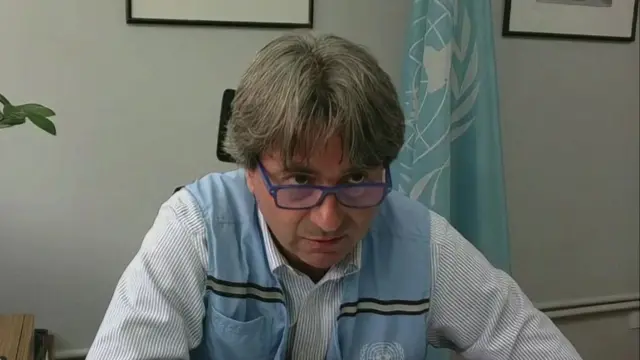
    Gianluca Rampolla Del Tindaro sits in a shirt and vest with the UN logo on it. A flag for the UN is visible behind himImage source, United Nations

    The United Nations (UN) is obtaining 10,000 body bags as part of its rescue operation in Venezuela, according to its resident humanitarian co-ordinator.

    Gianluca Rampolla Del Tindaro tells a UN press conference that while the latest update as of Sunday evening said 1,450 had lost their lives in the earthquakes, this number "will unavoidably and sadly" increase as search and rescue operations continue.

    He says the UN, in agreement with the authorities, is working on the assumption that it needs to obtain 10,000 body bags.

    "It is very sad and we truly hope that actually the number is going to be smaller than that and that's why we are focusing now on the rescue operation," Tindaro says.

    In the hours after the earthquakes, the US Geological Survey said there was a 44% chance the death toll could hit up to 10,000 and a 30% chance it could reach 100,000.

  10. Families painstakingly dig through rubble with their handspublished at 18:18 BST 29 June

    Norberto Paredes
    BBC Mundo correspondent, reporting from La Guaira

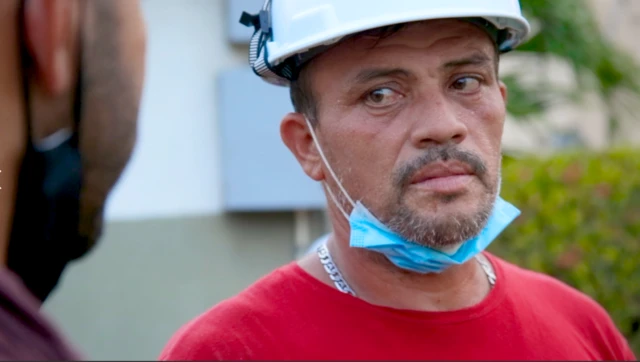
    Ronnie Navarro wearing a white hard hat and blue mask around his chin
    Image caption,

    Ronnie Navarro says his family are taking it in turns to dig around the clock

    I've been in La Guaira - one of the regions worst hit by the earthquake - speaking to family and residents who feel abandoned.

    The crucial window for rescuing people alive has now past and frustrations are running high.

    "We’re pitching in because the government won't help," says Ronnie Navarro, but commends the help from foreign countries. "They’re the ones helping the most."

    He says up until now it has been locals on the front line. His family are holding on to hope, digging around the clock, taking it in shifts to dig then sleep.

    Meanwhile, one woman says she wants to lodge a complaint after being left angry with the in-action of authorities.

    She feels the rescue effort has been mismanaged and slowed by bureaucracy and says families and volunteers have had to manage rescue operations alone.

    She points to where she believes her brother is trapped under the rubble, three families are trying to dig him and others painstakingly by hand.

    She feels Venezuela's recent political turmoil has left the country weakened.

  11. What causes an earthquake?published at 17:38 BST 29 June

    Mark Poynting
    Climate reporter

    The outer layer of the Earth is divided into different sections called tectonic plates - a bit like the Earth’s puzzle pieces.

    These plates move very slowly - perhaps only a few centimetres a year, which is roughly the same rate as your fingernails grow.

    Northern Venezuela sits on the boundary of the Caribbean and South American plates.

    As they move relative to one another, parts of the plates can get "stuck", and stress builds up over a long period of time.

    Eventually, this stress becomes too much and the plates jolt or slip back into place.

    That releases the huge amounts of energy experienced as an earthquake.

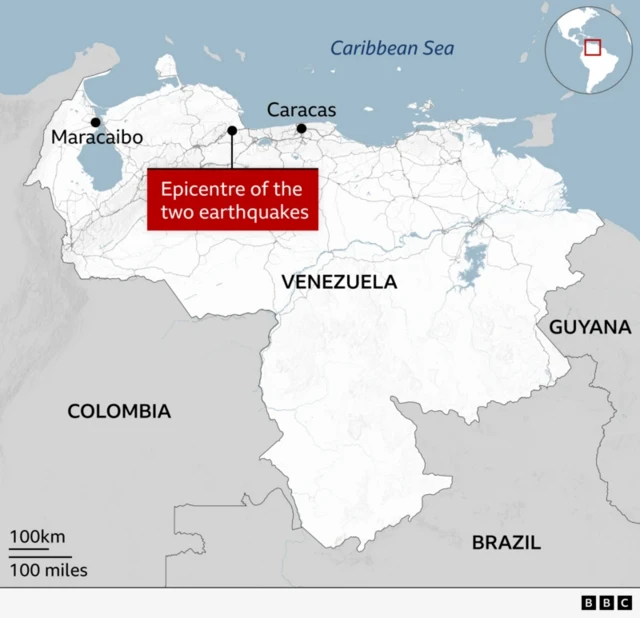
    A map showing the location of the epicentre of the two earthquakes in Venezuela - marked as Maracaibo in the north east and Caracas in the central north.
  12. Five days after earthquakes struck, rescuers keep hunting for survivorspublished at 17:23 BST 29 June

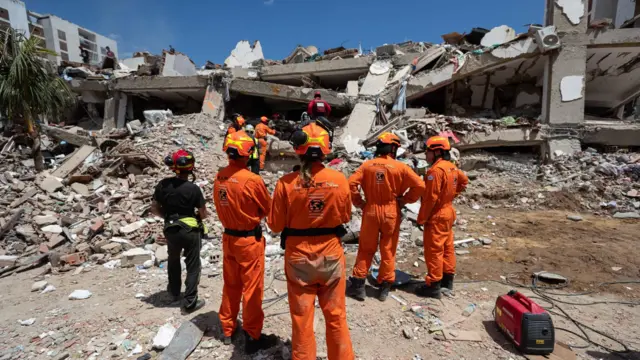
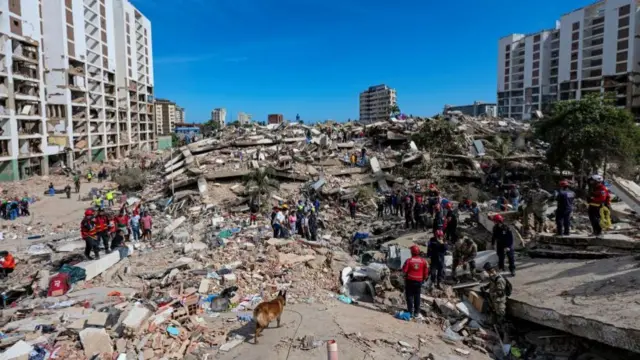
    Time is of the essence for rescue workers, some from overseas, to reach survivors trapped under rubble.

    Here are some of the latest images we're seeing of the operation:

    UK search and rescue team UKIsar carry out searches in Caraballeda La GuariaImage source, US ISAR
    Image caption,

    UK search and rescue team UKISAR carry out searches for survivors in Caraballeda, La Guaira

    Members of the French 7th Civil Security Training and Intervention Regiment in Catia La Mar, La Guaira stateImage source, Reuters
    Image caption,

    Members of the French 7th Civil Security Training and Intervention Regiment are dwarfed by a mountain of rubble in Catia La Mar, La Guaira state

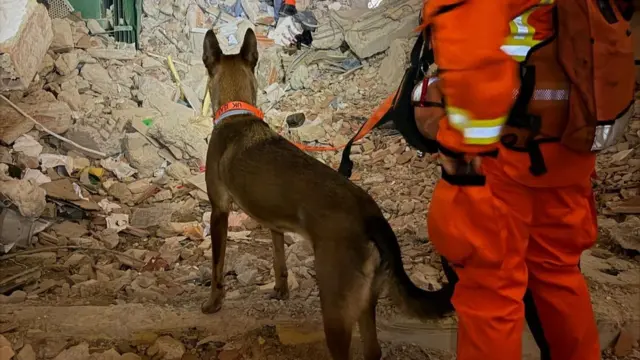
    A rescue dog from the Argentine search and rescue team is seen in the foreground in the rubble of a collapsed building in La GuairaImage source, AFP
    Image caption,

    A rescue dog from the Argentine search and rescue team is seen in the foreground in the rubble of a collapsed building in La Guaira

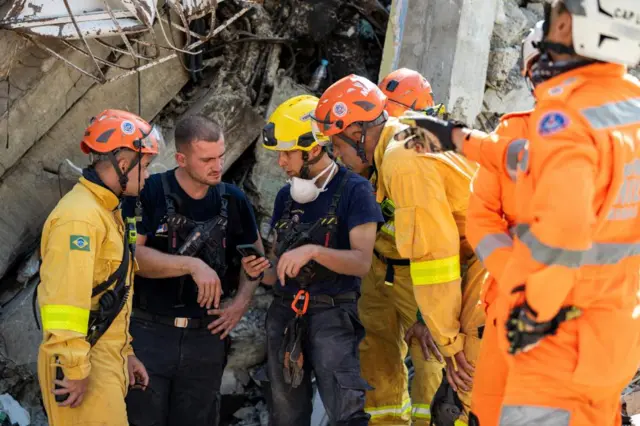
    The 7th Civil Security Training and Intervention Regiment exchange information with Brazilian rescue workers next to a damaged building in Catia La Mar, La Guaria stateImage source, Reuters
    Image caption,

    The 7th Civil Security Training and Intervention Regiment exchange information with Brazilian rescue workers next to a damaged building in Catia La Mar, La Guaira state

  13. How sniffer dogs are crucial to rescue operations in Venezuelapublished at 17:00 BST 29 June

    Freya Scott-Turner
    Live reporter

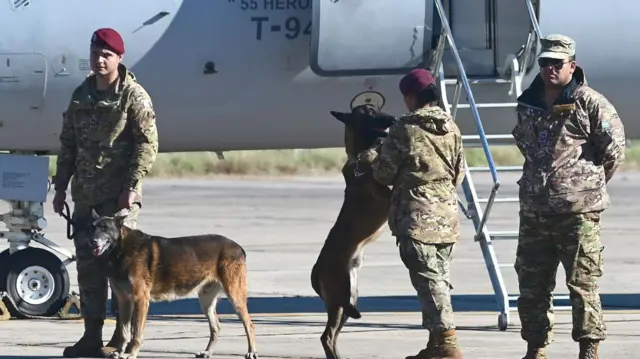
    Three people in military uniforms stand next to a plane with two dogs, one of them is jumping up.Image source, EPA

    Specialised sniffer dogs are critically important in search and rescue operations.

    With a sense of smell between 10,000 and 100,000 times stronger than humans, depending on the breed, trained dogs can quickly locate people trapped under dense rubble.

    They can also traverse rugged terrain and access hard-to-reach crevices, making them much faster and more efficient at rescuing survivors than humans.

    Countries around the world - including the UK, the US, the Netherlands, Switzerland and Colombia - have been sending these specially trained canines to Venezuela along with their emergency teams.

  14. What BBC correspondents are reporting from disaster-struck Venezuelapublished at 16:32 BST 29 June

    Volunteers and residents search for survivors in the rubble of collapsed buildings in Caraballeda, La Guaira state, Venezuela.Image source, Getty Images

    BBC News has several correspondents and reporters currently in some of the parts of Venezuela most affected by the earthquakes.

    Here are some of their latest updates:

    • Catia La Mar - in the badly impacted town, in northern Venezuela, Will Grant earlier sent a report on the toll being put on rescuers as the chances of finding living survivors rapidly shrinks
  15. Safety of damaged housing and infrastructure to be assessed, Venezuela's acting president sayspublished at 16:10 BST 29 June

    Acting President Delcy Rodríguez has announced a presidential commission to assess the state of housing and infrastructure damaged by the earthquakes.

    Speaking to state television, she says the group would determine who could return home using a traffic light system - green, yellow and red - to classify safety.

    The commission will be chaired by her brother, National Assembly President Jorge Rodríguez.

    Temporary camps to house those displaced are being set up in the meantime, she says.

    Delcy Rodríguez adds "at the same time, work begins on planning projects that will allow new homes to be built in a very short time".

  16. US boosts cash aid to Venezuela to $300 millionpublished at 15:53 BST 29 June

    The USS Fort Lauderdale is docked in the port of La Guaira on 29 JuneImage source, Getty Images
    Image caption,

    The USS Fort Lauderdale is docked in the port of La Guaira on 29 June

    The US is pledging more than $300 million (£227 million) to help Venezuela - an increase from its previous commitment of $150 million - the State Department says.

    "These funds will provide emergency medical care, food assistance, water and sanitation, shelter, protection, and logistics," the department says in a statement.

    The money is being directed through partner organisations including Samaritan's Purse, Catholic Relief Services, the World Food Programme and the Red Cross.

    The US has also reopened the Simón Bolívar International Airport in Caracas to help with international relief operations.

    A US frigate, the USS Fort Lauderdale, is currently positioned off the coast of La Guaira. Sailors and Marines are using landing and amphibious craft to deliver aid to the most affected coastal areas.

  17. Analysis

    Why Venezuela is so prone to destructive earthquakespublished at 15:25 BST 29 June

    Esme Stallard
    Senior climate and science reporter

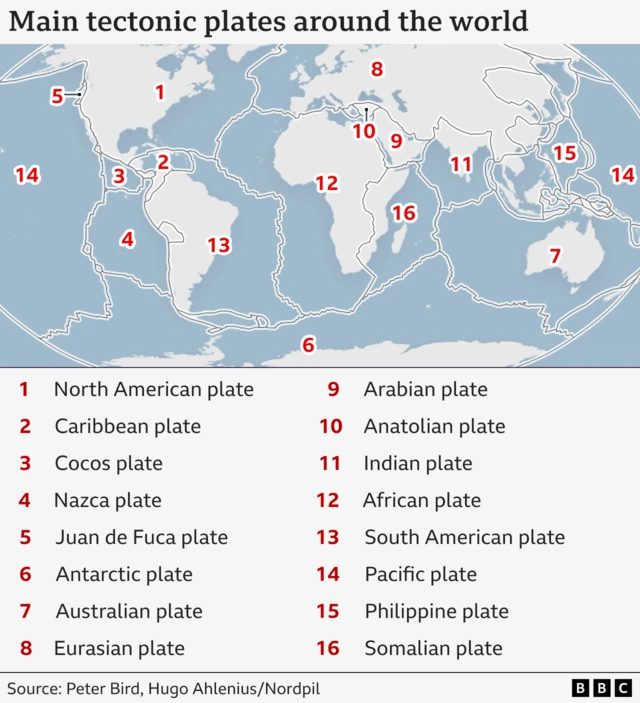
    Venezuela is located near the boundary of two tectonic plates, the Caribbean plate and the South American plate.

    Both tectonic plates try to pass over each other and sometimes they get stuck and energy builds up.

    When they finally start moving again, enormous amounts of energy are released, making Venezuela prone to earthquakes.

    The displacement of the Caribbean plate to the east of the South American plate, at a rate of two centimetres per year according to scientists' estimates, explains the seismic movements in the country.

    World map showing the main tectonic plates outlined by boundary lines and labelled with numbers 1–16. A legend identifies each plate: North American, Caribbean, Cocos, Nazca, Juan de Fuca, Antarctic, Australian, Eurasian, Arabian, Anatolian, Indian, African, South American, Pacific, Philippine, and Somalian. The Pacific Plate appears on both sides of the map, and plate boundaries are marked across oceans and continents. Source credited to Peter Bird, Hugo Ahlenius/Nordpil, BBC.
  18. Six search dogs from UK join British rescue teams in Venezuelapublished at 15:11 BST 29 June

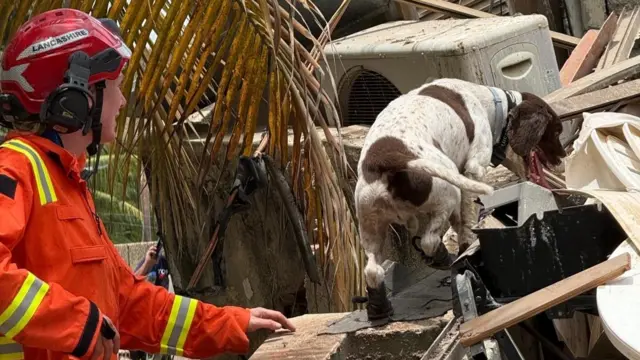
    A UK ISAR specialist working with a search dog in Venezuela following earthquakes.Image source, UK ISAR

    Six search dogs from the UK have travelled to Venezuela and are assisting the UK International Search & Rescue team (UK ISAR), the British government says.

    The Foreign Office says rescuers are also being supported by the Royal Air Force, with "specialist rescue equipment and drones" being used to support life-saving operations.

    UK ISAR, which has 68 specialists in the country, says its teams are now working across five different sites, with its search dogs being used to "detect signs of life within collapsed structures".

    Earlier, West Midlands Fire Service's Mark Leeson, who is in Venezuela as part of the UK-wide team, told the BBC that the window for finding survivors was shrinking, but adds "every now and then you will get that miracle rescue".

    UK ISAR specialists searching through rubble with a search dog following Venezuelan earthquakesImage source, UK ISAR
  19. Mayor of Chacao says 48 dead, 26 rescued alive and 'no-one is going to give up' searchpublished at 15:04 BST 29 June

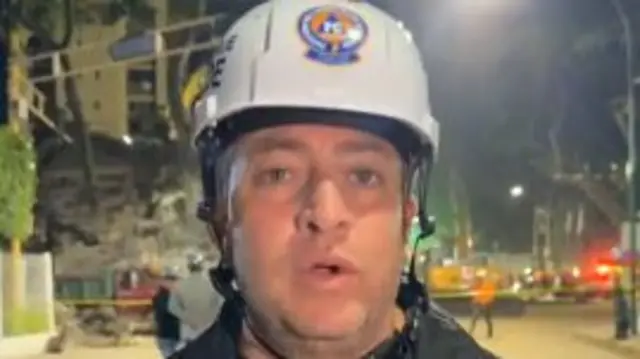
    Gustavo Duque speaking to the camera, wearing a helmet and wearing a black jacket which says: "Chacao alcalde"
    Image caption,

    "As you can see in the background, we are still working," he says in the video update

    The mayor of the Chacao municipality - an area in Venezuela's capital Caracas - says 26 people and five pets have been rescued from the rubble in the district.

    In a video update, shared on social media at 20:00 local time on Sunday night, Gustavo Duque says he regrets to report that 48 people have died following the earthquakes.

    "Here, no-one is going to give up. Hundreds of civil protection public servants are still looking for debris in the hope of finding a neighbour alive," Duque adds.

    Duque says "we will not give up" and adds search and rescue efforts are continuing with the hope of finding survivors.

  20. Analysis

    Locals with crowbars, mallets and pickaxes try to dig out loved onespublished at 14:37 BST 29 June

    Will Grant
    Reporting from La Guaira

    Rescuers and volunteers search for survivors in La Guaira on 28 JuneImage source, Reuters
    Image caption,

    Rescuers and volunteers searching for survivors in La Guaira, Venezuela, on Sunday

    The improvised nature of so much of the search and rescue effort is clear from the kinds of tools people are using.

    We have seen men and women equipped with little more than crowbars, mallets and pickaxes, wearing no more safety equipment than a bicycle helmet, trying to dig out their loved ones and neighbours from the rubble.

    At the other end of the scale, of course, the international rescue teams have the necessary equipment from torches and sniffer dogs to stretchers and medical equipment.

    The Venezuelan firefighters and emergency services may be underfunded but they’re still able to bring so much more kit, expertise and support to the search than desperate ordinary residents.

    Earth-moving equipment is being used across La Guaira and other affected areas but where it is being deployed is patchy and sporadic. We have seen people work for days on a single building alone, only to have the heavy machinery move in once it’s too late.

    In truth, though, what is missing is more of everything. More manpower, more machinery, more sniffer dogs, more support. And of course the one thing which no-one can provide: more time.