Our live coverage has endedpublished at 17:20 BST 30 April
Cross-examination has finished for Carter, who has left the stand.
Today's session is now over, with the inquiry returning after the bank holiday, on Tuesday.
A mental health nurse involved in the care of the Nottingham attacks killer has told a public inquiry he felt Valdo Calocane had "lied, deceived and out-manoeuvred medical staff"
Care co-ordinator Gary Carter resigned from Nottinghamshire Healthcare NHS Foundation Trust last year, and is facing disciplinary proceedings, the inquiry has heard
Carter admitted he had not been able to read Calocane's file in full so was unaware of the extent of his illness and offending. He added when he was well, Calocane was a "very sociable, well-behaved, polite man"
He says everyone involved in the inquiry had "come out bruised" or "broken" - adding teams had "failed" to manage the triple killer
The Nottingham Inquiry is examining Calocane's killings of Barnaby Webber, Grace O'Malley-Kumar and Ian Coates on 13 June 2023
Fellow care co-ordinator Abigail Parsonage told the inquiry earlier that she did not read any notes in relation to Calocane, and accepted her note-taking "was poor"
Cross-examination has finished for Carter, who has left the stand.
Today's session is now over, with the inquiry returning after the bank holiday, on Tuesday.
Calocane was not pleased at having Carter as his CCO, Carter's legal team has said.
Evidence put to the inquiry showed Birtles, his previous CCO, text messaged him to say Carter was taking over and Calocane replied to her to say that "it's not really convenient having to build a rapport all over again".
Carter said he was not aware of the messages and that he would have been happy to meet Calocane face to face to explain the changes if he had known.
Just tuning into today's evidence?
You can get up to speed on the inquiry until now with the video below.
Carter is now being questioned by his own legal team about informal conversations which did not get logged.
Carter agreed "it would be fair to say" if things are not logged that doesn't mean they weren't being considered.
He said: "There were a lot of conversations about that man over two years."
He is also being asked about multi-disciplinary team meetings and how decisions are made about what issues to raise.
Carter said: "There wasn't a great deal of time for anyone to discuss every one of their clients. Some might not get mentioned at all."
Carter has told Adam Straw KC, representing Calocane's family, that he does not know why a decision was made to discharge him back to his GP, meaning there would be no proactive management of his mental health problems.
He said: "I cannot understand why he was discharged for the life of me, I just cannot get my head around it."
He said he was not present at the meeting, and added: "I cannot work out who actually made that decision."
Carter said it was a failure on the team.
Following the Nottingham attacks, Carter said he questioned if the EIP "missed something" which could have "prevented" them.
Carter said after he was told there was "no way" it could have been prevented, he resigned.
He said: "I felt like if I didn't resign from the trust, I would be forced to just toe the line about what happened and wouldn't be able to express my own feelings about the tragedy."
He told the inquiry he has no intention of nursing in the future.
Cartwright is asking about the culture in the EIP team.
Carter said EIP was short staffed.
"When I joined the team in September 2020, it had not been developed properly," he said.
"We had one member of staff who was leaving for another team, Claudia had to go off a couple of weeks sick because she was so upset by the death of one of her clients.
"It really left me and Abi in the team, the two of us."
Carter said the care plan and risk assessment when he inherited Calocane should have been updated before he took over.
"It's not right leaving it to someone else to clean up," he said.
He said the team was "desperate" about what to do with Calocane.
He wrote in his statement that "it seemed we were... giving up on this man".
Cartwright said this equated to giving up on public safety.
Carter replied: "Yes."
Sophie Cartwright KC, representing the survivors, is referring back to Carter's "frank" comments in evidence that Calocane required "a lengthy admission in hospital and treatment".
She asked if when he became CCO, Carter ought to have read every page of Calocane's notes to see "just how dangerous VC was".
He said: "It's not as if I've just got this gentleman on my case, I've got other people on my caseload.
"I don't agree with that. To just expect me to start at page one and start reading, I'm sorry, I would not have had the time."
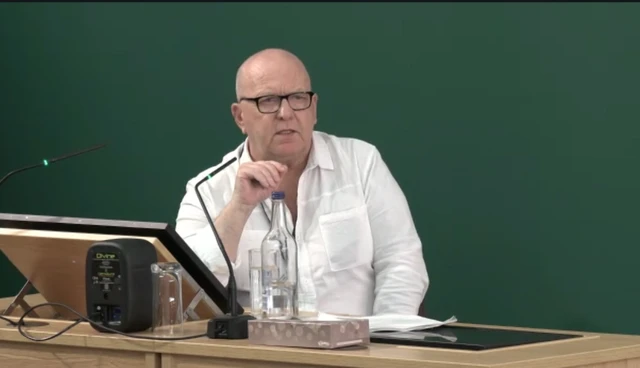 Image source, The Nottingham Inquiry
Carter is now being cross-examined by legal representatives.
Tim Moloney KC, representing the bereaved families, is asking about Calocane's former address in Ilkeston Road and if there were signs anyone was living there when Carter visited.
Carter said: "I didn't see inside."
He also questioned Carter about not reading back through the entire notes and knowing about Calocane's history.
Carter said: "Taking over as CCO, I would have asked if his risk assessment and care plan were up to date."
Moloney highlights that some of the incidents that Carter earlier said he was not aware of are included in the risk assessment.
Carter has disputed being involved in the decision to discharge Calocane.
"Basically, the team, if you want to call it that, had done everything they could to try and deal with this man, manage him in the community, and had failed.
"The inpatient services had failed. And basically, people ran out of ideas.
"People had just run out of ideas as to how to manage this man, when it was blatantly obvious what needed to happen to him," he said.
Langdale KC asked: "Which was what?"
Carter replied: "He needed to be admitted to hospital for a lengthy period of time and treated. It really is that simple."
Challenged on whether he took responsibility, he said: "I'm not avoiding nothing.
"Everybody who has attended this inquiry over the last two months has come out bruised. Some people have come out looking broken.
"I have played my part, there's no two ways about it."
Carter said it was not possible to ask colleagues to take on his caseload, to put in calls to police to report Calocane as missing, for example.
He said at its height, he was responsible for 24 individuals and this was not uncommon.
He said: "Asking other members of the team to take on parts of my caseload, I think there would have been an objection to that."
As Calocane began to disengage from the NHS trust, the inquiry heard he missed a number of calls and appointments between June and August 2022.
On 4 August, Carter made a cold call visit to Calocane's previous accommodation where they believed he lived.
In fact, that was accommodation Calocane was no longer allowed to live at or visit following an assault on a housemate, the inquiry heard.
Carter said that was the address Calocane had given him, but he did not take any further steps to find out where he lived.
Challenged on what he did to find out where Calocane lived, Carter said: "Well, ultimately after the failed visit on the 4th, as I look at it, we just had one more card left and that was contact the police.
"The alternative was discharge him and I didn't think that was a good idea."
Calocane was discharged in September.
In May 2022, Carter had two face-to-face visits with Calocane, when he collected his medication.
Carter recorded he tried to engage with Calocane but he took the medication and left.
He said he did not ask Calocane to take the medication in front of him and when asked why, he said he never asked a patient to take a dose "there and then".
Carter knew from September 2021 that Calocane was not concordant with his medication.
Asked if medication collections were "something of a tick box", Carter said: "Well, he has his medication.
"At least he's turned up for medication. That's an achievement in itself."
Asked if there was any hopeful prospect of monitoring Calocane's medication, Carter said: "Not from our team's point of view."
Calocane had gone in April 2022 to Raleigh Park, where he was not allowed to go after assaulting a flatmate there, and he gave a false name.
Carter said: "It's indicating that this man is quite poorly.
"He was not aggressive or confrontational but it is strange."
It was at a meeting shortly after that Carter was made his care co-ordinator, which Carter was not present at.
He said: "I find it unacceptable that I wasn't there."
Carter added he believed that more than one person should have been assigned to Calocane, as "even when he is reasonably well, he's not terribly well".
 Image source, Supplied
Carter is asked if, when a patient is not taking their medication as Calocane was in the build-up to his mental health assessment, they can be forced.
Carter said he was not aware of any discussions in the team about this, or Calocane's ability to understand why he should be taking it.
He said: "This had been tried with the crisis team, I believe. Despite their best efforts, a whole team could not ensure that this man was taking his medication.
"He should have been on the depot from, I would say, admission two onwards."
He said he raised this "on numerous occasions" to colleagues.
On 20 April, Carter recorded that Valdo Calocane had collected his medication for two weeks and abruptly left.
Langdale KC said: "So these exchanges are very surface aren't they? Very brief and very surface.
"We don't see you doing any mental state examination or profound conversation with him."
Carter said he would have liked to have 30 minutes to sit down and have a conversation with Calocane.
"He never did that with me. He was in the lead up to me taking over as his care co-ordinator," Carter said.
Carter added it was "necessary for him to make a number of assumptions" about Calocane without a formal handover from his colleague, Claudia Birtles.
After the ordered mental health assessment, Calocane spent time in a hospital in Darlington and then at The Priory in Nottinghamshire, and was due to be discharged in October.
It was suggested by Claudia Birtles at this point that a depot - which means administering Calocane's medication via injections - should be put in place.
Carter said it was well-known he did not take his tablets as he should and said: "Throughout his time with the EIP, I cannot understand how this man has avoided a depot.
"But this man negotiated his care and for God knows what reason, the medical nursing staff went with his wishes."
A Mental Health Act assessment was ordered for Valdo Calocane a few days later in September, during which he attacked a police officer.
Carter said he became aware of this at the next multi-disciplinary meeting, when it was explained he had been Tasered and led away in handcuffs and leg restraints.
He said: "We were very shocked. It wasn't only aggressive, it was very violent."
Carter has been questioned on a description of Valdo Calocane being polite and personable, which was repeated throughout his records.
"I would say that when he is well, he is a very sociable, well-behaved, polite man," he said.
Counsel to the inquiry Rachel Langdale KC asked: "Well you haven't seen him that often have you?"
Carter replied: "No I haven't."
Langdale said: "So how would you know that?"
Carter: "No, I don't know that for certain but I'm willing to give him the benefit of the doubt. I'm not going to be judgemental towards him."
Carter added when Calocane was unwell, he was a "different person completely", and knew what he was like when he was well from conversations with colleagues.
Langdale suggested the description of Calocane in the records "obscured" his risk for anyone else reading them.
Carter said: "Yes, I would probably agree with that, the wording there is not good."
Carter has told the inquiry "we do not want to stigmatise the patient", and so information was not shared with the University of Nottingham - where Calocane studied - or other agencies.
He said: "We do not want the whole world to know that he's got a diagnosis of paranoid schizophrenia.
"People suffer from various mental health problems, but not all of them are murderers or dangerous.
"They're trying to live with that, and we're trying to encourage them to be fully integrated in society."
He added Calocane's race may have been a factor too, in deciding what information to share. However, he said it was not discussed in any meeting or mentioned by colleagues.
