Summary

  1. Parts of Scotland hit by half a month’s rain in two dayspublished at 11:20 BST

    Catherine Lyst
    Reporting from Glasgow

    Castledykes Park, Dumfries
    Image caption,

    Castledykes Park, Dumfries

    In contrast to the drought conditions in England and Wales, north-west Scotland has been hit by half a month’s rain in two days.

    The Met Office says there was more than 100mm (3.9in) of rain on Friday and Saturday.

    However, BBC Scotland weather presenter Joy Dunlop says temperatures in some parts of Scotland could rise as high as 29C later in the week.

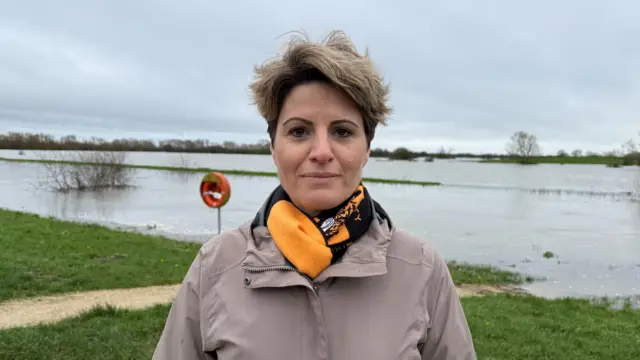
    As you can see from these images, parched ground has not been an issue in Scotland with lush greenery still on display.

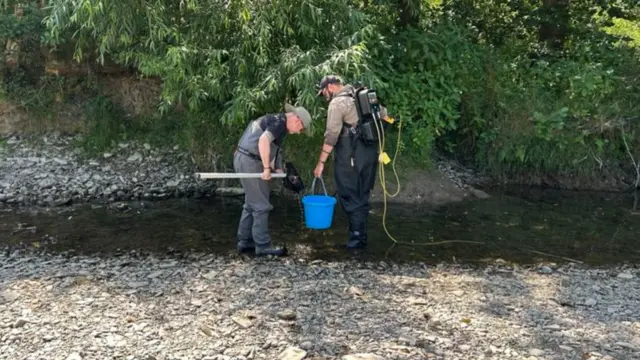
    The River Nith, Dumfries
    Image caption,

    The River Nith, Dumfries

  2. Parts of southern England almost two months without notable rainpublished at 11:16 BST

    Simon King
    Lead weather presenter, BBC Weather

    July was the driest on record across England and Wales and there has been no significant rain into August.

    Up to 8 August, on average, there has only been 3.7mm across England and Wales combined - just 4% of the monthly average.

    The current driest August was in 1995 where a total of 9.4mm was recorded.

    August is typically the wettest summer month with an average of 94mm across the UK, compared to July with 82mm or June with 77mm.

    However, as the fifth widespread heatwave of the year develops this week there’s no significant rain in the forecast for England and Wales.

    By the end of this week many parts of southern England will have gone two months without any notable rain.

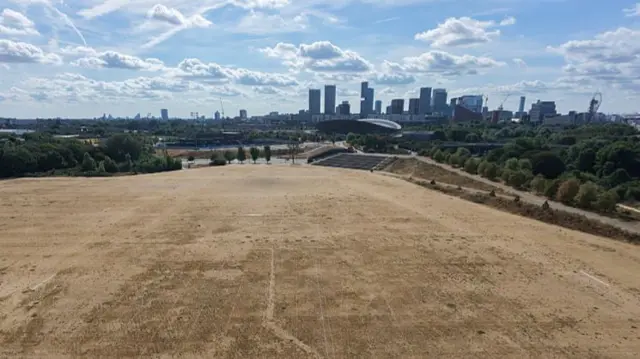
    An aerial view of a football pitch after weeks of no significant rainImage source, EPA
  3. Numerous fires across England over the weekendpublished at 11:05 BST

    An orange smoky sky burns behind treesImage source, Jehanna Stride
    Image caption,

    The smoke-filled sky near the New Forest in Hampshire

    With high temperatures and an extended dry spell across much of England and Wales, wildfires have been seen across multiple parts of the country.

    This weekend saw another spate that included areas across the Midlands, east of England and South East.

    • In Cambridgeshire, more than 80 firefighters worked to tackle a blaze that broke out on Saturday on Holme Fen peat nature reserve - the second fire at the site in two weeks
    • A "major incident" was declared by fire and rescue services in Nottinghamshire, after multiple call-outs - including to a major woodland fire that burned across both Saturday and Sunday at Strawberry Hill Heath in Rainworth - placed "significant pressure on operational resources"
    • Norfolk saw some homes badly damaged after a wildfire spread in Kenninghall on Sunday - no injuries were reported but aerial pictures showed the destroyed roofs of two homes
    • And firefighters are still working to put out a fire in the New Forest inHampshire, which spread after a van caught alight on Sunday afternoon. Emergency services have said that multiple crews are working in "challenging conditions" to control the blaze
    The destroyed roofs of bungalows can been seen, with smoke rising from them. There are other houses in a small road and a fire engine and firefighters are nearbyImage source, Lee Watson
    Image caption,

    Damaged properties in Kenninghall, Norfolk

  4. Firefighters continue to tackle New Forest fire that spread from vanpublished at 10:53 BST

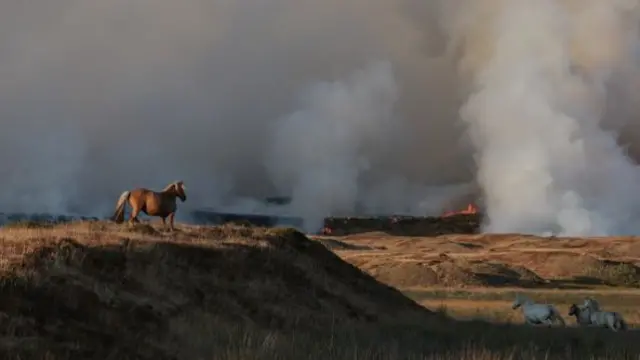
    In Hampshire, firefighters have worked through the night and are continuing to tackle a blaze that began with vehicle fire and has spread across healthland in the New Forest.

    The fire created a smoke plume that has been visible for miles - and can still be seen drifting over the national park today.

    It broke out on the A31 near Ringwood shortly after 17:20 BST on Sunday with some motorists forced to abandon their vehicles.

    Hampshire and Isle of Wight Fire & Rescue Service (HIWFRS) says crews in 10 fire engines and 10 off-road vehicles continue to work to bring the fire under control "in challenging conditions".

    The video below was captured by local resident Debs Stafford on Sunday evening.

    Media caption,

    Video shows the giant plume of smoke drifting from a fire around the A31.

  5. Warnings of impact on health care ahead of fifth heatwavepublished at 10:31 BST

    Simon King
    Lead weather presenter, BBC Weather

    The UK Health Security Agency have just upgraded the heat health alerts to Amber for most of England from Tuesday to Friday.

    They warn that significant impacts are likely across social and health care services due to high temperatures.

    Impacts are likely for those over 65 or with health conditions but there may also be impacts to younger age groups too.

    Amber alerts are in place for all regions of England, aside from the North East, which is under a Yellow alert for the same period.

    The heatwave will start to develop from Tuesday and then intensify for many, peaking on Thursday or Friday.

    And just as we saw during the June and July heatwaves, it will be extreme for some with temperatures into the mid-30s Celsius.

    The hottest weather on Tuesday is likely to be across the Midlands, central southern England and east Wales where temperatures will rise to 28 to 30C.

    By Wednesday the heat will spread more widely across England and Wales, with temperatures widely 30 to 32C.

    Then by Thursday, even hotter still with the temperature exceeding 35C for some in the Midlands, eastern and south-east England.

    The heat will persist on Friday for most but turning less hot across western areas - and then for all over the weekend as the heatwave eases.

  6. Amber heat health alerts issued for most of England from Tuesdaypublished at 10:18 BST
    Breaking

    Simon King
    Lead weather presenter, BBC Weather

    Heat health alerts have been upgraded to amber for most of England, except the North-East, from 09:00 BST on Tuesday to 21:00 on Friday.

    The alert warns that significant impacts are likely across health and social care services due to the high temperatures, including a rise in deaths, particularly among those aged 65 and over or with health conditions.

    We'll bring you more on this shortly.

  7. The Environment Agency uses four stages to assess drought or water shortagepublished at 10:14 BST

    As we mentioned in our last post, there is no single definition of drought.

    Caused by a shortage of rainfall, the characteristics of a drought - things like timing and duration - will vary.

    To determine an area's level of drought, in England, the Environment Agency will look at a number of factors including rainfall, river flows, groundwater levels and and public water supplies.

    It uses four stages to assess what response is needed:

    • Prolonged dry weather - which begins to impact river flows, groundwater levels and water levels in lakes and reservoirs
    • Drought - further deterioration to the environment with consequences for agriculture, people and businesses
    • Severe drought - prompting widespread and lasting effects on the environment, farming, people, communities, and the economy
    • Recovering from drought - the impacts on the environment are reducing

  8. How is drought defined?published at 10:00 BST

    There is no single definition of drought, but it usually refers to a period of prolonged unusually dry weather that can have impacts on people, nature and the environment.

    The Environment Agency says some droughts are short and intense, caused by a hot and dry summer, while others are long and develop over multiple seasons due to low rainfall.

    It also highlights different types of drought. They include agricultural drought when there isn't enough rainfall to support crops and farming, and water supply drought when companies have concerns about supplies for their customers.

    Natural Resources Wales agrees that "every drought is different", adding that some affect large areas while others are more concentrated.

    It says it declares drought when a combination of indicators show a "significant shortage of rainfall and water availability", impacting things like rivers, groundwater, ecosystems and agriculture.

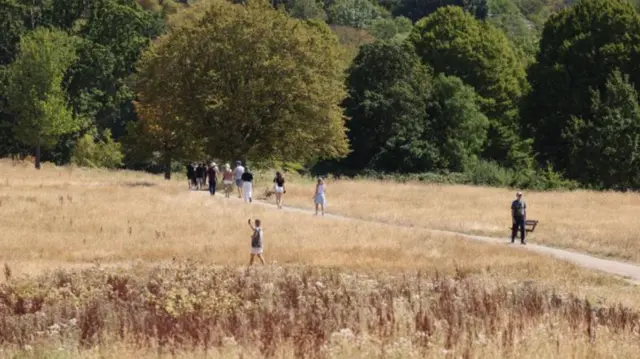
    Runners jog through dry grass at Hampstead HeathImage source, EPA
    Image caption,

    Runners jogging through dry grass at Hampstead Heath

  9. UK set for another hot week with possible highs of 36Cpublished at 09:47 BST

    The UK has experienced unusually high temperatures in recent months and heat is set to once again build throughout the week as a fifth heatwave is likely to be declared.

    Monday will provide a bit of a break from the intense heat - with maximum temperatures in northern areas of the UK around 18 to 24C and further south temperatures between 22 to 27C.

    However, temperatures are then set to soaracross much of England and Wales.

    By Tuesday, warmer air will start to move back in across the UK with the highest temperatures across central southern England, the Midlands and east Wales.

    Yellow heat-health alerts remain in force for much of England until 21:00 BST on Tuesday, though they are likely to be extended or upgraded as the heatwave nears.

    Wednesday will see temperatures widely across England and Wales head into the high twenties and low thirties.

    Temperatures are due to peak on Thursday with possible highs of 36C (97F) in south-east England, and up to 35C likely across central and eastern England.

    A graphic shows temperatures forecast for Monday afternoon with 17 in Aberdeen to 24 in Birmingham and 27 in London
    A graphic shows the peak of the heatwave, for later this week, with temperatures of 25 in Aberdeen, 32 in Birmingham and 36 in London

    You can read more in our weather story.

  10. Is there a hosepipe ban in your area? Use our tool to find outpublished at 09:32 BST

    This Flourish post cannot be displayed in your browser. Please enable Javascript or try a different browser.

  11. Which areas are currently in drought?published at 09:21 BST

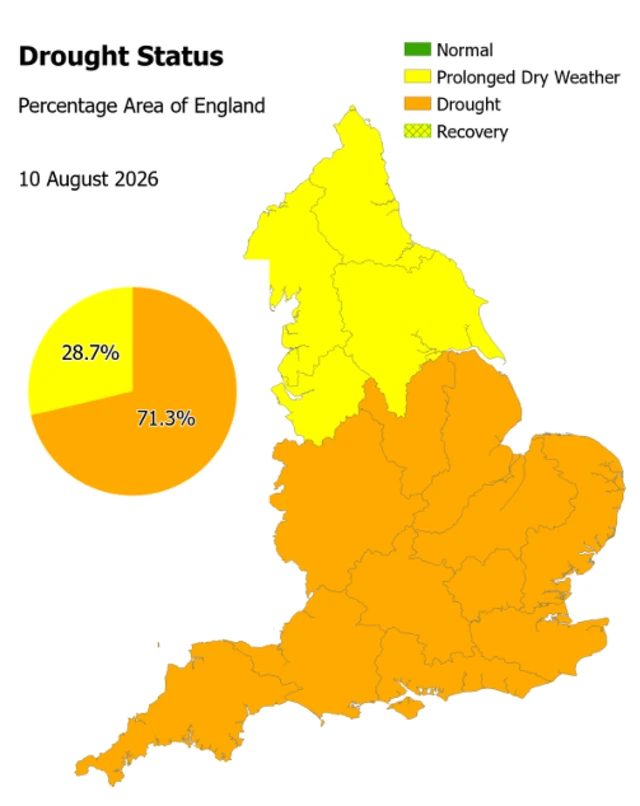
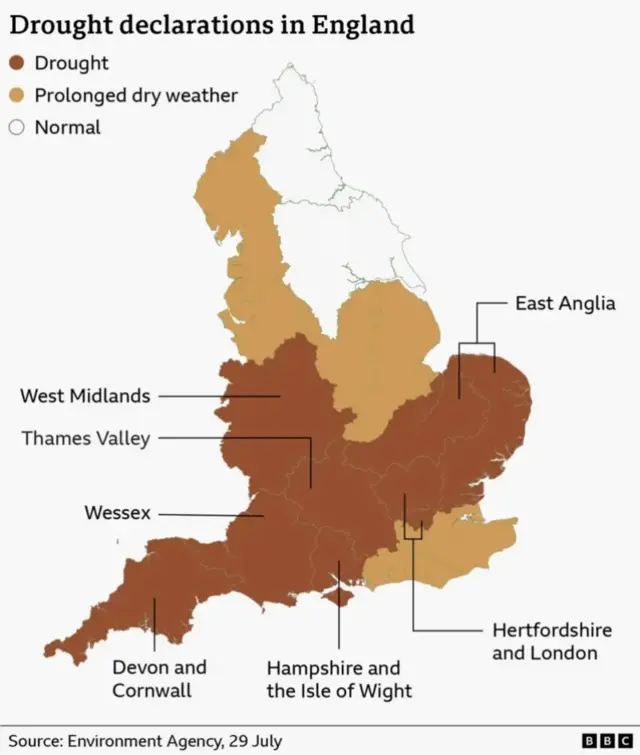
    Drought has already been declared in large parts of England, as well as the whole of Wales.

    The full list of English regions in drought conditions are:

    • East Anglia
    • Hertfordshire and the whole of London
    • Thames Valley
    • Hampshire and the Isle of Wight
    • Devon and Cornwall
    • The West Midlands
    • Wessex, covering Dorset, Somerset, Wiltshire, and South Gloucestershire

    The Environment Agency - which made the announcement for England - said in its latest update that the week from 31 July to 6 August was the "seventh consecutive week of less than 10mm of rainfall across England".

    Areas in the east and south-east saw less than 1mm, it added.

    Map showing drought conditions in England
  12. Parched ground and dried up lake beds across Englandpublished at 09:05 BST

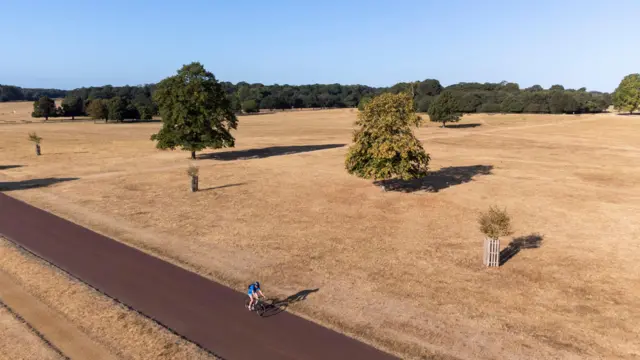
    With drought already declared across half of England, its effects are quite visible across the country.

    Photographers have captured dried up reservoirs and arid land around famous landmarks across England and Wales.

    Rings of dry brown grassland around StonehengeImage source, Reuters
    Image caption,

    Parched grassland around Stonehenge in Wiltshire

    Brown dry fields seen from above, with rows of treesImage source, PA
    Image caption,

    An aerial view of Primrose Hill in north London

    Clifton Suspension Bridge over dry grassImage source, Reuters
    Image caption,

    Clifton Observatory and Clifton Suspension Bridge after prolonged dry weather in Bristol

    Brown cracked ground with rocks scattered acrossImage source, EPA/Shutterstock
    Image caption,

    Low water levels have exposed the dry lake bed at Hanningfield Reservoir in Essex

    Low water levels at the Llwyn-On reservoir in South Wales revealed an old stone bridgeImage source, PA Media
    Image caption,

    Low water levels at the Llwyn-On reservoir in South Wales revealed an old stone bridge

  13. More of England could be declared in drought as fifth heatwave approachespublished at 08:56 BST

    Dry arid ground seen next to a water lineImage source, EPA/Shutterstock
    Image caption,

    Low water levels have left the lake's bed visible at Hanningfield Reservoir in Essex

    The National Drought Group is meeting later today, to decide whether more regions will be declared as being in drought.

    The group is made up of regulators, bodies such as the Environment Agency, government officials, water companies and agricultural bodies.

    Today's meeting comes as England and Wales brace for a fifth heatwave, while nearly two months without significant rainfall have placed growing pressure on water supplies and seen 23 million people subject to hosepipe bans.

    Half of England and the whole of Wales is already officially in drought.

    We’ll bring you all the latest on anything the National Drought Group announces, plus everything else you need to know on the weather, right here.