Summary

  • Just under one million young people in the UK are not in education, employment or training, according to Office for National Statistics (ONS) data

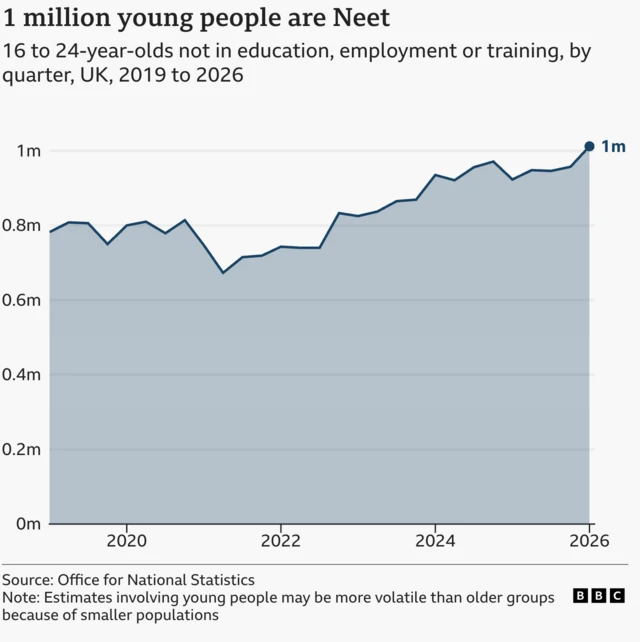
  • The latest figures suggest 981,000 people aged 16 to 24 were Neet between April and June - an estimated 13% of that age group

  • Today's figures are 3% higher than those for the same period last year

  • Attempts to get young people into work are crucial - but are there jobs to accommodate them? asks the BBC's Dharshini David

  • Work and Pensions Secretary Pat McFadden says the labour market is in a "robust position" but there has been a "long-term challenge for young people"

  • Prime Minister Andy Burnham has said he's "on a mission" to reduce the number of Neets - but has not put a date to his ambition

Are you out of work or education?

  1. ‘I know where I want to go. I just need that first opportunity,’ says Muhammed, 22published at 10:05 BST

    Muhammed Khan, 22, has been looking for work for more than three years.

    He finished college in 2023 and says he has been applying for jobs and looking for opportunities ever since.

    He joined the Restart programme, which provides a year's employment support, in 2025 and was referred to courses linked to the industry he hopes to enter, but says they did not lead to employment.

    More recently, he has been supported by a programme run by the charity Spear, which he says has helped improve his confidence, communication and interview skills.

    For Muhammed, a lack of experience is one of the biggest barriers to finding work. He says repeated applications and rejection emails, often without feedback, have become “really demotivating”.

    “I don’t think it’s because I don’t want to work,” he says. “The problem is getting somebody to give me that first opportunity.”

    He hopes to start in a front-of-house or receptionist role before eventually moving into IT.

    “I know where I want to go. I just need that first opportunity to get started.”

  2. Analysis

    Reducing number of Neets forces government to rethink spendingpublished at 09:53 BST

    Dharshini David
    Deputy economics editor

    A young cafe worker wiping down a table.Image source, Getty Images
    Image caption,

    Industries which had traditionally provided the first run on the jobs ladder, such as hospitality, have continued to shed roles

    Attempts to get young people into work are crucial: joblessness at the start of adulthood can cast lasting scars on lives and livelihoods.

    But the unanswered question: are there the jobs to accommodate them?

    Official employment figures show that industries which had traditionally provided the first run on the jobs ladder such as hospitality and retail have continued to shed roles.

    The official statisticians noted that some small employers also blamed rising costs for damaging hiring plans.

    Among the higher cost employees have separately complained about in recent years include higher taxes such as national insurance and the rising minimum wage.

    And a rise in taxes generally has in part been to finance a rising welfare bill. Some economists are calling for reforms to incentivise work and to keep the public finances and tax bills on a sustainable path.

    Tackling this issue includes some tricky questions for government

  3. Neet numbers have risen compared to this time last yearpublished at 09:43 BST

    Hazel Shearing
    Education correspondent

    Today's figures showing estimates for the number of young people who are Neet in the UK are lower than the figures for January to March, when an estimated 1,011,000 young people (13.5% of the total) were Neet.

    But they are 3% higher than figures for the same period last year. An estimated 951,000 young people (12.8% of the total) were thought to be Neet between April and June 2025.

  4. Just under one million young people are Neetpublished at 09:38 BST
    Breaking

    Hazel Shearing
    Education correspondent

    Just under one million young people in the UK are not in education, employment or training (Neet), according to data published ahead of a major report about a "lost generation".

    The latest data from the Office for National Statistics (ONS) suggests 981,000 people aged 16 to 24 were Neet between April and June.

    That is an estimated 13% of that age group.

    This Flourish post cannot be displayed in your browser. Please enable Javascript or try a different browser.

  5. Government's job guarantee scheme has been 'helpful', 18-year-old sayspublished at 09:30 BST

    BBC Radio 4's Today programme has been speaking to young people who have struggled to find work.

    Esha, 18, from Birmingham says the government's job guarantee scheme - aimed at 18 to 24-year-olds who have been claiming Universal Credit and looking for a job for 18 months - has been "very helpful".

    Two week into the scheme, which offers guaranteed work placements, she had landed a few job interviews and ultimately a six-month placement.

    She says the scheme's career coach helped her know how to apply for new jobs, build up her CV and produce a cover letter, saying she feels "confident" after the scheme.

    Becca, a 23-year-old in Exeter, says most of the time she applies for jobs she "barely hears anything back" and if she does, it's an automated response.

    She was working as an administration assistant in 2022, but was signed off for a few years for poor mental health. "I've tried searching for jobs since then, but a lot of the time people just, for some reason, don't want to give me jobs. It's very stressful to be honest,'" she says.

    Becca says she's never heard of the job guarantee scheme, but says it "sounds like a very good thing".

    "If you can work and get your independence, and it helps people do stuff instead of just being sat at home, it sounds good," she says.

  6. Key report on 'moral crisis' expected in coming weekspublished at 09:26 BST

    Hazel Shearing
    Education correspondent

    Today’s figures come ahead of a major report about a “lost generation” of young people.

    We had the first instalment of that report, which was commissioned by the government and carried out by former minister Alan Milburn, in May.

    Milburn said young people faced a "perfect storm" of challenges, with job and career opportunities "not growing, they’re shrinking".

    His report said young jobseekers were submitting dozens of applications, but rejections had become the norm.

    It warned that one in six young people would be out of work in five years without action, adding: "We are at risk of a lost generation.”

    That first instalment spelled out the problem, and now we’re waiting to hear what Milburn will propose as possible solutions.

    That’s where the second and final part of his report - expected in the coming weeks - comes in. We're expecting him to set out recommendations for tackling what he’s called a “moral crisis”.

  7. Young people 'robbed' of 'confidence and self belief' - work and pensions secretarypublished at 09:22 BST

    Pat McFadden, an older man in a suit, talking to a young man in a Boots warehouse.Image source, PA Media

    Young people out of work for years are being "robbed" of confidence, self belief, and "any sense of hope in the future", Work and Pensions Secretary Pat McFadden has said.

    In a visit to Boots -- an employer involved in the Youth Guarantee Scheme, he said it was "inspiring" to see the changes in young people who started working there.

    "Within a matter of weeks of working at Boots, they had more confidence, more belief, more hope for the future," he said.

    He said the more-than million young people considered Neet was "too high" and had a "terrible human cost" that has been ongoing for too long.

    Asked about job retention for the young people involved in the six months of guaranteed work, he says that employers in the scheme say retention chances are "high".

    He said he was “looking forward” to recommendations on how to tackle the issue by former minister Alan Milburn, whose final report on Neets is expected in the coming weeks. An initial report was released earlier this year.

    “We'll have proposals, legislation, if necessary, to take those forward,” he said.

  8. It took Asia two years of applying for jobs before landing her first role in the NHSpublished at 09:14 BST

    Asia Mason at her workplace, smiling, looking away from the camera, wearing her scrubsImage source, Kings Trust
    Image caption,

    Asia Mason at her workplace

    Asia Mason, 22, from London, says it took more than two years of applying for jobs before she finally secured her first role in the NHS.

    After leaving college with a health and social care qualification, Asia hoped to work in maternity and eventually become a midwife. But despite applying for more than 30 jobs, she was repeatedly told she lacked experience.

    “I remember thinking, ‘how am I supposed to get experience if nobody is willing to give me the opportunity to gain it?’” she says.

    The repeated rejections affected her confidence and mental health, and eventually she found herself applying for fewer jobs.

    Her breakthrough came when her sister sent her an Instagram advert for a health and social care programme run by The King’s Trust. The programme helped her gain experience and confidence, and she secured her first NHS role.

    Asia is now working as a maternity support worker and is due to begin her midwifery journey in September.

    “Sometimes you just need somebody to give you an opportunity," she says.

  9. The number of Neets rose above one million in January to Marchpublished at 09:06 BST

    The Office for National Statistics (ONS) releases data every three months on the number of young people aged 16 to 24 who are not in education, employment or training (Neet) in the UK.

    In January to March 2026, 1,012,000 young people were considered Neet - equivalent to 13.5%.

    This was the highest figure in the last 12 years, which former Prime Minister Keir Starmer called "sobering".

    In the last three months of 2025, there were 957,000 young people who were Neet in the UK. That's equivalent to 12.8% of all people aged 16 to 24.

    A graph which shows how the number of Neets in the UK has risen steadily since 2021
  10. Have you struggled to find work, education or training?published at 08:55 BST

    You can get in touch in the following ways:

    Please read ourterms & conditions andprivacy policy

    In some cases a selection of your comments and questions will be published, displaying your name and location as you provide it unless you state otherwise. Your contact details will never be published.

    A purple banner featuring the words 'Your Voice' in graphic, white typeface
  11. What does Neet stand for?published at 08:52 BST

    Neet stands for not in education, employment or training, and refers to those aged between 16 and 24.

    So to be considered Neet, a person must be that age and:

    • Be unemployed - looking for work
    • Or economically inactive - not engaged in paid work, and not actively looking for work in the four weeks before being surveyed, not waiting to start a job, or caring for family
    • Not be in formal education, such as school or university, or on a vocational course
    • And not be participating in any training schemes, such as apprenticeships or internships

    Read on: our Learning & Identity team walks you through how many people are Neet, who are the worst affected and what the impacts are

  12. Number of young people not working or in education to be releasedpublished at 08:42 BST

    A disappointed-looking young woman looking at her phone.Image source, Getty Images

    New quarterly figures will be released today showing the number of 16 to 24-year-olds not in employment, education or training - also known as Neets.

    Data released by the Office for National Statistics (ONS) earlier this year found that more than one million young people - around 13.5% of 16 to 24-year-olds - were classified as Neet, the highest in 12 years.

    Earlier this year, a review found that this number could rise to 1.25 million by 2031 unless action was taken. Its author, Alan Milburn, warned: "We are at risk of a lost generation."

    Prime Minister Andy Burnham has said he's "on a mission" to reduce the number of so-called Neets, but has declined to set a date for meeting his ambition.

    "The trend is rising at the moment, so the first thing I've got to do is to stop that rise," he said in July.

    Meanwhile, a new report released this week found that the number of graduate jobs has fallen by almost half in the past 12 months.

    The latest figures will land at 09:30 - stay with us for updates, analysis and reaction.