Summary

What are your questions?

  1. Analysis

    For many Afghans, there’s little cause for celebrationpublished at 10:41 BST
    Lyse Doucet
    Chief international correspondent, in Iran

    Five years ago, Kabul was plunged into chaos as Taliban fighters swept into this city.

    Today, the capital is festooned with their white flags and banners as they celebrate their victory.

    They’re oozing confidence, and in control.

    But they’re still under international sanctions, foreign assets are still frozen, and only one country, Russia, has formally recognised their rule.

    Media caption,

    Hunger, women's rights and the economy: Lyse Doucet on life under the Taliban

    Their chief spokesman Zabihullah Mujahid told us in an interview of their relations with regional and Islamic countries; he accused the West of treating the Taliban as if they were still at war.

    Afghanistan is more peaceful now – the Taliban are no longer attacking and foreign forces are gone. But millions of Afghans are finding it hard to make ends meet.

    We saw in villages outside Kabul the ravages of drought, how foreign aid is drying up.

    Harsh Taliban edicts are erasing women and girls from public life. Girls can’t go to school beyond grade six, women can’t go to university, and can’t do many jobs. For many Afghans, there’s little cause for celebration today.


  2. 'Today becoming a pilot feels almost impossible for me'published at 10:28 BST

    A blue banner with the words "Shakiba, 18. Jewellery maker in Kabul".

    When schools were closed to girls I did not want to give up.

    I joined an online school and continued my education. Despite all the difficulties, I have recently completed my school education online.

    For some people, finishing school might seem like an ordinary achievement but for me it is a very important victory, because I had to continue studying while carrying the sadness of not knowing what my future would look like.

    Since I was a child I dreamed of becoming a pilot.

    Whenever I looked at the sky I imagined myself flying an airplane and seeing the world from above.

    I wanted to fly freely and experience a world without limits.

    But today becoming a pilot feels almost impossible for me, because I am a girl living in Afghanistan.

  3. Analysis

    The stark reality of Afghanistan's hunger crisispublished at 10:10 BST

    Yogita Limaye
    Afghanistan correspondent

    This post contains distressing details.

    Afghanistan is facing one of the world’s most severe hunger crises in the world. It is seeing record levels of hunger and malnutrition.

    3.7 million children are expected to suffer from acute malnutrition this year, according to the United Nations.

    This is a crisis caused by a swirl of factors - staggering aid cuts, the Taliban government’s policies, natural disasters such as drought and floods, as well as the return of millions of Afghans from Iran and Pakistan.

    Over the years we have witnessed the humanitarian situation worsening. Families in remote areas have told us they have been forced to make unimaginable choices – evening selling their daughters into marriage so that they can buy food for their other children.

    Media caption,

    The BBC's Yogita Limaye speaks to Afghan fathers forced to make impossible choices

    Mothers have told us they give their babies sedatives, and in some cases, even antidepressants, so that they sleep despite being hungry.

    In hospitals, we have witnessed first-hand a surge in the rate of newborn deaths, of malnourished babies born to malnourished mothers.

  4. A jewellery maker, dental assistant and former journalist share their storiespublished at 09:50 BST

    Rachel Flynn
    Live reporter

    It is early afternoon now in Afghanistan and we have been hearing from women across the country about their lives under the ultra-conservative Taliban rulers.

    The BBC is one of the few media organisations that has consistently had access to the country since the Taliban re-gained control in 2021 - two decades after being removed from power by a US-led military coalition. Our Afghanistan correspondent Yogita Limaye has been explaining what it's like to be a foreign woman reporting from the country.

    We've also been hearing from former journalist, Zuhal, 32, who says when the Taliban retook control "it was as if all the hopes and dreams that I had worked for for years were suddenly buried under the ground".

    Shakiba, an 18-year-old jewellery maker, tells the BBC it was "the worst and most painful day of [her] life".

    Ela, a dental assistant from Kabul province, says "challenges go beyond restrictions on women’s education" - read more about how her life has changed.

    We'll bring you more stories from women in Afghanistan throughout the day.

  5. 'I was sentenced to 39 lashes and spent more than nine months in prison'published at 09:31 BST

    A blue banner with the words "Manizha. Flogged by Taliban - age & region held for security reasons".

    This post contains upsetting details.

    We were alone in a car when two men from the local command office approached us and asked what we were doing, what our relationship was, and where we were going.

    He was from one village and I was from another. Since our villages were far apart, they questioned us extensively. On the way to the command office, they kept calling me a bad woman and a prostitute.

    They took us to the command office and then referred us to the court of appeals. I was sentenced to 39 lashes and spent more than nine months in prison.

    In prison, I experienced things that I have never even told my mother about, and I still cannot bring myself to speak of them.

    I was deeply humiliated.

    Taliban government officials have consistently strongly denied allegations of mistreatment of female prisoners and have emphasised that accused individuals are dealt with in accordance with the laws of Islamic Sharia, and that women’s prisons are administered by women.

  6. Get in touch: Do you have a question about life under the Taliban government?published at 09:19 BST

    We're spending today speaking with women across Afghanistan.

    While they're talking to the BBC, they're also ready to answer any questions you might have about their daily lives.

    If you've got a question you'd like to ask these Afghan women, you can press the Get in touch button at the top of this page, or via the following:

    Please read ourterms & conditions andprivacy policy

    In some cases a selection of your comments and questions will be published, displaying your name and location as you provide it unless you state otherwise. Your contact details will never be published.

    A purple banner with the words 'Your Voice'
  7. Being a foreign woman reporting in Afghanistanpublished at 09:02 BST

    Yogita Limaye
    Afghanistan correspondent

    As female journalists in Afghanistan, we adhere to the Taliban prescribed dress code for women, covering our hair with a headscarf and wearing loose gowns called abayas over our clothes.

    We often get away with our faces not being covered, perhaps because we are foreign, but there have been occasions on which monitors from the Taliban’s morality police, who are formally called the Ministry for Propagation of Virtue and Prevention of Vice, have ordered us to cover our faces.

    There are a few ministries that we are not allowed to enter because we are women.

    We do have access to some government departments.

    When we interview Taliban spokesman, I can’t be pictured in the same frame as them, and in recent years they have asked that I do not sit opposite them during the interview.

  8. 'Survival has become the priority'published at 08:38 BST

    A blue banner which says Ela: Dental assistant from Kabul province

    My day usually starts at 08:00 and ends at 18:00.

    I work at a private clinic as a manager and dental assistant.

    Since 2021, my life has changed significantly. I was unable to continue my studies in stomatology, and life has become very different.

    The challenges go beyond restrictions on women’s education. Unemployment, poverty, and the struggle to afford basic necessities have affected almost every family.

    People are so overwhelmed by poverty and daily hardships that many have been forced to put their education, dreams, and hopes for the future aside.

    Today, survival has become the priority, and many of us no longer have the time or energy to think about the future.

  9. 'Deep-rooted barriers' held women back long before Taliban retook power - UNpublished at 08:13 BST

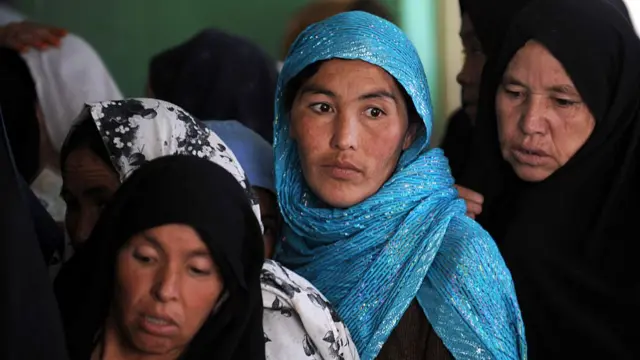
    Four Afghan women in a line, wearing Hijabs which show their faceImage source, Getty Images
    Image caption,

    Afghan women line up to cast their vote in Kabul in 2010

    While girls' and women's rights have drastically worsened after the Taliban resumed control of Afghanistan in 2021, "deep-rooted barriers" held women back long before then, the United Nations says.

    In 2011, Afghanistan was named the most dangerous country to be a woman, according to an international poll of experts on gender issues.

    High levels of violence, poor healthcare and poverty made Afghanistan the worst, the study by the Thomson Reuters Foundation said.

    But there was progress, too. In 2004, a new constitution allocated 25% of parliamentarian and provincial council seats to women, as well as 30% of civil service positions.

    It also bound Afghanistan to implement all international conventions on women's rights, and created a women's affairs ministry.

    This Flourish post cannot be displayed in your browser. Please enable Javascript or try a different browser.

  10. 'The day the government fell to the Taliban was worst of my life'published at 07:47 BST

    A blue banner with the words "Shakiba, 18. Jewellery maker in Kabul".

    Since I was a child, studying has always been one of the biggest dreams of my life.

    I studied until grade nine at high school and at that time I believed that like every other girl I would be able to finish school, and go to university and one day achieve my dreams.

    But when the government collapsed everything changed for me and for thousands of other Afghan girls.

    15 August, when the government fell, was the worst and most painful day of my life.

    Every year when this date comes I feel as if an old wound opens again and a new feeling of defeat fills my heart.

    That day I felt that many of the dreams I had carried inside me for years were suddenly taken away from me.

  11. The divisions within the Taliban over women’s educationpublished at 07:24 BST

    Yogita Limaye
    Afghanistan correspondent

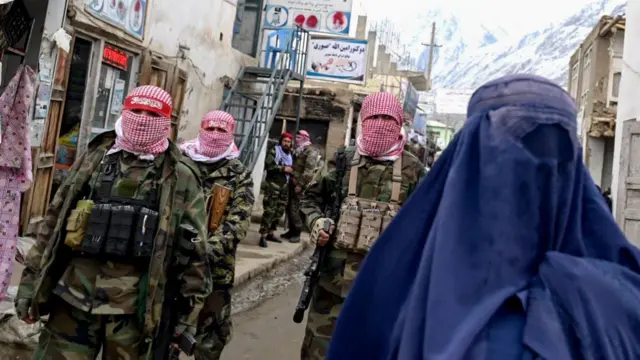
    Taliban security personnel stand guard as an Afghan burqa-clad woman (R) walks along a street at a market in the Baharak district of Badakhshan province on February 26, 2024.Image source, Getty Images
    Image caption,

    A woman pictured passing Taliban security personnel in the Baharak district of Badakhshan province

    It has been evident to us for a long time that there are divisions within the Taliban government on the issue of women’s education.

    Off camera, many Taliban officials we have met, including senior leaders, have confessed that they would like schools and universities to be reopened for female students.

    But the Kandahar-based emir, or supreme leader, has remained intransigent and over the years has hardened his stance bringing more restrictions against women.

    There has been no public breaking of ranks with the emir’s diktats, with the exception of remarks made early last year by Sher Mohammad Abbas Stanikzai, the Taliban’s former deputy foreign minister, who called for schools to be reopened for girls.

    Soon after, he left the country and since then does not appear to have returned to Afghanistan.

  12. 'I was unable to continue my studies'published at 07:05 BST

    A blue banner with the words "Noori, 24. Works in Kabul jam factory".
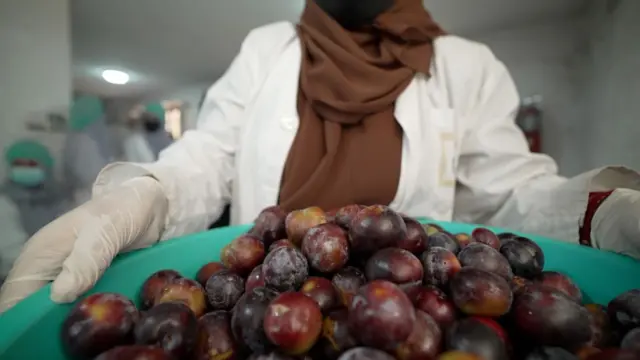
    A woman, her face not visible, holding jam in a bowl - with other women wearing face masks and hair caps visible behind her

    I am a young Afghan woman. I completed my schooling with many difficulties because of challenges within my family.

    Despite all these problems, I never gave up. I continued my education and successfully completed high school.

    After that, I entered university and chose to study Law and Political Science because I wanted to support women who have suffered - by giving them a voice and defending their rights.

    And I continued my studies with many difficulties because our family's economy was very poor. I even borrowed money for my university expenses.

    To get to the university, I had to travel from the district to the city, which took me almost three hours to get to the university.

    Now, due to the progress of my work, I lack financial resources and need the tools to stand on my own feet so that I can help other women.

    Unfortunately, after some time, I was unable to continue my studies because of the changes and political situation in Afghanistan, which led to the closure of universities.

  13. Women took part in rare protest in Junepublished at 07:01 BST

    A Taliban official stands in the street holding a gun, as people walk byImage source, AFP via Getty Images
    Image caption,

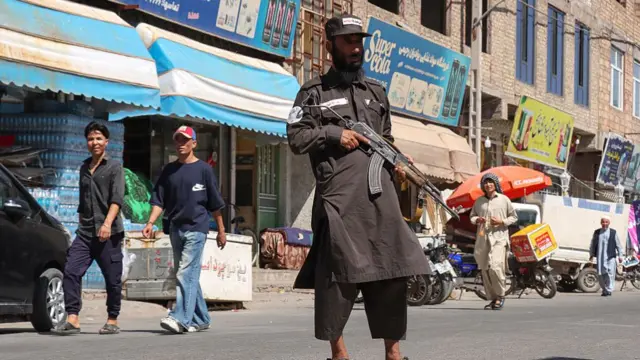
    A Taliban security official stands guard in Herat, Afghanistan, a day after the women's rights rally

    Men and women took to the streets of the western city of Herat in June, days after local Taliban government officials reportedly began arresting women perceived to be "improperly wearing the hijab".

    Taliban police used live fire to disperse the rare protest against the detention of women accused of violating strict Islamic dress codes, witnesses and protesters said.

    Medics told the BBC two people died, but did not specify how. A number of others at the protest were injured.

    Police in Herat denied there had been any deaths, but have acknowledged they responded to the protest, telling the BBC that officers had "taken action to ensure security and maintain public order".

  14. 'The hopes and dreams I had worked for were suddenly buried'published at 06:41 BST

    A blue banner with the words "Zuhal, 32. Former journalist from Bamyan province".

    During the republic, I prepared with great enthusiasm and interest and went to TV with energy and hope. I read the news and felt happy that I was present in society and doing what I loved.

    I had many hopes and dreams for my future and believed that I could progress and achieve my dreams.

    But with the change of regime, my life changed completely. I was away from work and social activities and was forced to stay home. It was as if all the hopes and dreams that I had worked for for years were suddenly buried under the ground.

    Today, I spend most of my time at home, preparing bread for my husband, washing clothes, sweeping the house, and doing daily household chores.

    Doing housework is valuable in itself, but it is very difficult and burdensome for me because I was a woman who worked outside the home, read the news, had goals, and dreamed about my future.

    My greatest pain is that not only did I lose my job, but part of my identity, independence, and hope for the future was taken away from me.

    Those same dreams are still alive in my heart, and I hope that one day I will have the opportunity to return to what I love and rebuild the life I dreamed of for myself.

  15. Taliban responses through the years on female educationpublished at 06:28 BST

    Yogita Limaye
    Afghanistan correspondent

    Media caption,

    Watch: The Taliban's varied responses through the years on female education and work

    “We are going to allow women to study and work within our framework," the Taliban had announced in their first news conference shortly after seizing power.

    Since then we have repeatedly questioned Taliban government spokesmen on why education remains closed for teenage girls and women.

    Over the years we have had varying replies.

    First they said that families themselves do not want to send girls to school. When challenged, a Taliban spokesman changed his response to ‘the security situation needs to be improved before schools can be reopened’.

    The next year another spokesman told us they had to allay the ‘concerns of religious scholars’.

    In 2023 and 2024, we were told that education is an important issue for the Taliban government and that its leaders are working to resolve the situation.

    Since then, though, the answer has changed to a more evasive ‘ask the education ministry’.

    We have asked the education ministry too but so far we have not received a reply.

  16. One midwife serving a population of 50,000published at 06:05 BST

    A blue banner with the words "Maryam. Midwife - age & region held for security reasons".

    Earlier we heard from Maryam, a midwife in an area where one female doctor and one midwife serve a population of around 50,000 people.

    Alongside her work as a midwife, Maryam completed a six-month training course in obstetric ultrasound and now performs ultrasound scans.

    I was studying midwifery at university when universities were closed to women.

    I then enrolled at a medical institute to continue my studies, but that was closed too.

    If I am not here, many women cannot be examined because families often do not allow male health workers to examine female patients.

    For context: Before she started working there, there was no woman providing ultrasound services in the area. Women had to travel around three hours on poor roads to another clinic for a scan.

    The journey is very difficult for pregnant women.

    It is expensive as well, and most families here are very poor.

  17. Afghanistan faces an acute shortage of midwivespublished at 05:45 BST

    Three women in white medical coats, face masks and headscarves are shown standing with their arms crossed.Image source, EPA-EFE/REX/Shutterstock
    Image caption,

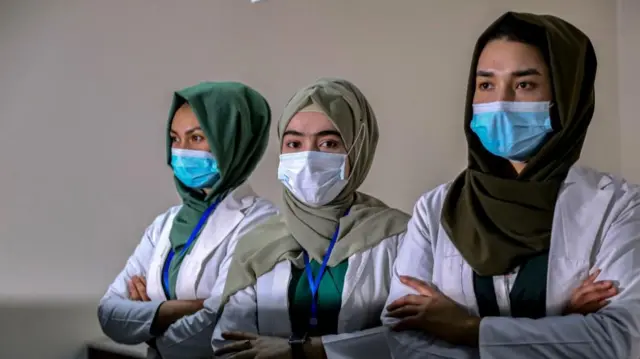
    Afghan nursing and midwifery students at a private hospital in Kabul in 2024 - they suffered a devastating setback when the Taliban imposed a ban on female medical education

    According to the Ministry of Public Health, Afghanistan currently has around 6,000 midwives - almost the same number reported during the final months of the former republic.

    Two years ago, the UN said Afghanistan needed 18,000 additional midwives on top of those already working.

    Since the Taliban banned women from attending medical institutes in late 2024, the training pipeline for new midwives has effectively stopped.

    At the same time, Afghanistan's population continues to grow, increasing the demand for healthcare workers.

    The UN estimates that Afghanistan's population will reach 48.6 million this year - with more than 1.5 million babies born annually.

    This Flourish post cannot be displayed in your browser. Please enable Javascript or try a different browser.

  18. 'What will happen to my daughter's future?'published at 05:20 BST

    A blue banner with the words "Maryam. Midwife - age & region held for security reasons".

    Maryam is a midwife in an area where one female doctor and one midwife serve a population of around 50,000 people, and is expecting a baby girl.

    Sometimes I think about my daughter's future.

    If things continue like this, what will happen to her? She will not even have the chance to finish school like I did, let alone go to university.

    If one day she gets married, becomes pregnant and needs a female doctor during childbirth, what if there isn't one? This is a matter of life and death.

    I am a midwife. I have seen mothers die. I know this is not only my concern.

    I believe it is the concern of every mother in Afghanistan.

  19. How foreign journalists operate in Afghanistanpublished at 05:02 BST

    Yogita Limaye
    Afghanistan correspondent

    To enter the country to report in Afghanistan, foreign journalists must receive permission from the Taliban government’s foreign ministry.

    That is usually just the first step in the process.

    Once on the ground, depending on what you want to cover, including if it is filming on the streets of Kabul or at a hospital or traveling to other provinces, other departments and ministries would need to be approached for approvals.

    However, we are able to operate independently on the ground with no minders or officials accompanying us.

    During interviews with Taliban officials, we have had editorial independence to ask any questions we had.

  20. A timeline of the Taliban's restrictions on women and girlspublished at 04:38 BST

    As a reminder, here's a timeline of how the Taliban has tightened restrictions on women and girls over the past five years:

    September 2021: Secondary schools reopened for boys not girls.

    December 2021: Women traveling long distances must be escorted by male relative.

    May 2022: Women ordered to be covered from head to toe, only eyes visible.

    November 2022: Women barred from parks, gyms, swimming pools, public baths.

    December 2022: Women barred from university.

    July 2023: Beauty salons closed.

    August 2024: New law barring women from raising voices in public.

    December 2024: Women banned from midwife and nursing training.

    December 2024: Taliban bars all NGOs from employing Afghan women.

    September 2025: Afghan women banned from visiting UN headquarters.

    May 2026: Law codified implying legal approval for child marriage, says silence of minor girl can be treated as consent to marriage.