Summary

  1. Kremlin says Burnham becoming PM won't improve relations with Moscowpublished at 16:17 BST

    Bryn Windsor
    Journalist, BBC Monitoring
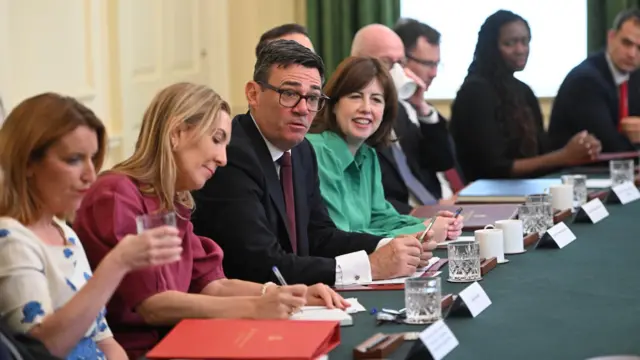
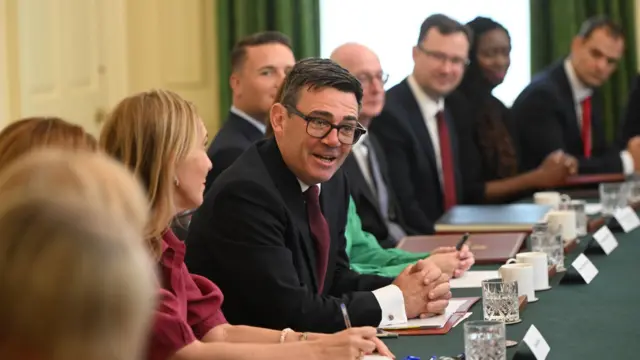
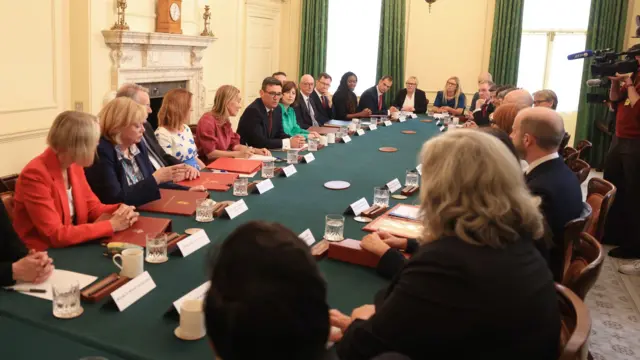
    Prime Minister Andy Burnham hosts his first Cabinet meeting with Minister for the Cabinet Office Louise Haigh (left), Cabinet Secretary and Head of the Civil Service Dame Antonia Romeo (second left) and Education Secretary Lucy Powell (fourth left) at 10 Downing Street, LondonImage source, Daily Telegraph/PA

    Kremlin spokesperson Dmitry Peskov has said Russia "harbours no hope" that Andy Burnham's appointment will lead to an improvement in Russian-British relations.

    By declaring yesterday to back Ukrainian President Volodymyr Zelensky "100%", Burnham is only "prolonging the war", the Kremlin spokesman tells reporters in Moscow.

    Russian state TV and online commentators have been reporting extensively on the changes at No 10, claiming that the frequent turnover of PMs is evidence of the UK's chaotic and misguided politics, including towards Russia.


  2. Kremlin denies live-fire drills off British coast were 'signal' to new PMpublished at 16:13 BST

    Jonathan Beale
    Defence correspondent

    A view of the sea with a Russian frigate in the foreground and a Royal Navy ship further away in the backgroundImage source, MoD via Getty Images
    Image caption,

    A Royal Navy ship monitoring the Russian frigate Admiral Grigorovich

    When a Russian warship in the English Channel suddenly decides to conduct a live-fire artillery exercise on the very same day the UK is changing prime minister, it may be hard to dismiss as purely coincidence.

    Most navies do not conduct live gunnery drills near busy shipping lanes.

    Most navies give plenty of advance warning when they want to carry out such drills - to warn others.

    Asked by the BBC, Kremlin spokesman Dmitry Peskov said "there is no need to see any signals in this" directed at Downing Street.

    "All [military] exercises and all actions undertaken by our warships are carried out in strict compliance with international and maritime law," he said.

    But it is certainly a timely reminder that Russia poses a threat.

    Many European leaders and defence chiefs have been warning that the world is becoming a more dangerous place - including Starmer before he left office.

    Many defence commentators believe that Starmer’s warnings were never matched by enough money. This incident is a reminder that pressure will not have gone away for Andy Burnham.

  3. Analysis

    Still signs of Labour's green agenda, even if it's not been the focus in messagingpublished at 16:08 BST

    Faisal Islam
    Economics editor

    YOUR VOICE BANNER

    Sophie in High Wycombe asked if the new Energy Secretary, Miatta Fahnbulleh, will carry on the work of Ed Miliband - including encouraging more solar and the use of electric vehicles.

    I think the general strategy will continue, but at the margins we may get more of a lean into the idea of extending existing oil and gas fields.

    Even this morning, given the announcement about taking VAT off electricity bills, part of the rationale there wasn't just cost of living but to equalise the cost of electric and gas - because that's better for the green agenda.

    It's not disappeared, it featured very highly in Burnham's book, the idea of a green industrial revolution.

    We've heard about it before, but we haven't heard a great deal about it in his speeches over the past couple of days.

  4. Analysis

    What are Burnham's plans for immigration?published at 16:03 BST

    Damian Grammaticas
    Political correspondent

    A banner with 'Your Voice' written in white against a purple background

    Returning to the question-and-answer session we featured in the live stream above just now, John in Manchester asked what is known about Burnham's plans for immigration.

    It's a good question, and it's interesting because it's one of those issues that in polling comes right up there among the top issues in voters' minds.

    But Burnham has not talked about it very much - he's focused on cost of living and spreading opportunities around the UK.

    What we have to focus on here is that he's keeping Mahmood in the Home Office and what that signals, very clearly, is no overall change really in the direction of policy that existed under Starmer.

    That is reducing net migration, it's tackling illegal immigration and Burnham has signalled in the last month or so that he thinks the public concern on that should be heard.

    What we also know is that part of his agenda, his economic agenda for the UK, is about pushing skills, creating jobs for young people.

    All of that indicates, I think, that this kind of agenda of tightening up on visas for those entering the UK, especially low skilled workers, is likely to stay in place.

  5. Healey lays out his five priorities as chancellor in address to staffpublished at 15:45 BST

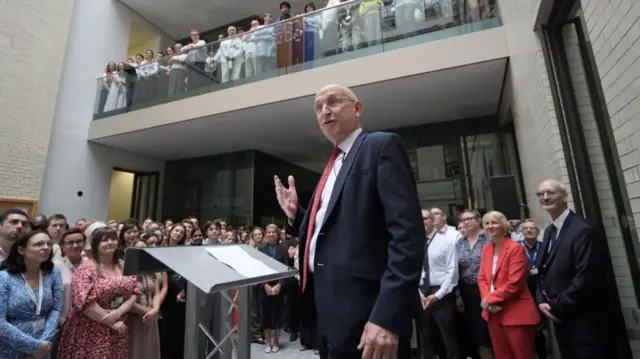
    John Healey gives his first all staff address at HM Treasury, LondonImage source, Reuters

    Chancellor John Healey has told civil servants that "fiscal credibility is the bedrock of economic stability and national security" in opening remarks to colleagues.

    "As for any chancellor, fiscal control must be the first duty. It is mine," he says, speaking at the Treasury on his first full day in the job.

    He also set out five priorities: fiscal discipline, growth in every postcode, backing Britain, wealth creation, and making life more affordable.

    Recommitting to the previous government’s fiscal rules, Healey says: "We will help people live well, we’ll invest in their success rather than paying for their failure."

  6. We answer your questions on the new government and its policiespublished at 15:27 BST

    A banner with 'Your Voice' written in white against a purple background

    The new government is under way - we've seen the newly formed cabinet gather at Downing Street, had the first major policy drop in the form of a VAT cut for domestic energy bills, and spotted certain ministers begin work within the realms of their portfolios.

    Our colleagues will shortly be answering your questions on what's going on, and what it means for you.

    Among those on hand are economics editor Faisal Islam, health editor Hugh Pym, political correspondent Damian Grammaticas and Sumi Somaskanda reporting from the White House.

    You can watch live at the top of the page from 15:30 BST - we'll also bring you some of the answers here.

  7. BBC Verify

    Which households are likely to benefit most from scrapping VAT on electricity?published at 15:20 BST

    A woman pouring water from an electric kettle into a mugImage source, Getty Images

    By Tom Edgington

    While the decision to scrap VAT on electricity bills from 1 October will save every household money, it raises the question about whether richer or poorer households will benefit the most.

    The answer comes down to how you measure the impact.

    If you just look at money saved, higher-income households stand to gain the most. That’s because they’re more likely to live in larger homes and therefore use more electricity - leading to bigger cash savings.

    However, poorer households tend to spend a larger portion of their total income on energy bills. So as a share of income, poorer households will likely benefit more.

    "The richest fifth will get about 25% of the total cost of the policy, whereas for the poorest fifth it’s only about 16%," explains Jonny Marshall, an economist from the Resolution Foundation think tank.

    But Marshall also told BBC Verify that the poorest third of households spend about twice as much on their energy bills, as a share of their income, compared with the richest third.

    "So you can make the argument both ways depending on which one you want to make."

  8. BBC Verify

    Why are UK electricity prices high?published at 15:16 BST

    By Anthony Reuben

    Despite the government saying it will cut the current 5% rate of VAT on domestic energy to zero from October, the cost of power in the UK remains relatively high.

    Comparing UK prices with the EU, external shows that medium-use households in the UK paid the fourth-highest electricity prices in the second half of last year including taxes and levies, although the government has taken steps to reduce bills since then.

    This Flourish post cannot be displayed in your browser. Please enable Javascript or try a different browser.

    One of the main reasons the price of electricity is high is that prices are often based on the cost of gas which is used to generate power. Gas prices are relatively high because of the war in Iran.

    The government is confident that its plans to get almost all electricity from clean sources by 2030 will mean the cost of electricity will no longer be dictated by the price of gas.

    But for that to happen there will need to be considerable investment both in green generation and the power grid to distribute it.

  9. Concerns that science could be 'second class' in Burnham governmentpublished at 15:09 BST

    Pallab Ghosh
    Science correspondent

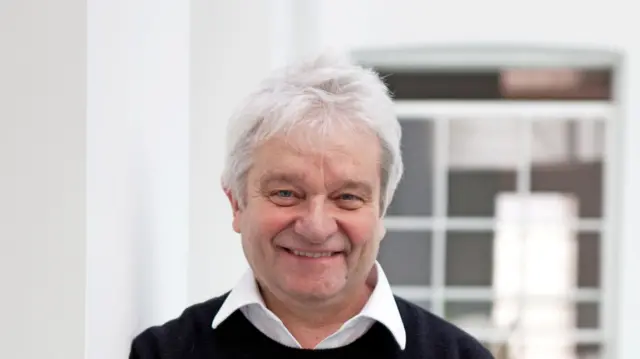
    Sir Paul Nurse, a man wearing a white shirt and dark sweater.

    Earlier today, the head of the UK’s leading scientific organisation expressed concerns that the absorption of the Department of Science Innovation and Technology (DSIT) into the business department risks making science "second class" within the new super department.

    Professor Sir Paul Nurse, who is president of the Royal Society, told BBC Radio 4’s Today programme that he has concerns that the scrapping of DSIT sends a signal that the Burnham government has de-prioritised science.

    He called on the prime minister himself to send a clear signal that the UK’s research base will be central to the government’s growth plans and drawn on by all departments.

    "The prime minister understands the transformative power of science, knowledge, innovation, and technology.

    "They are all parts of an interlinked and interdependent system of research that drives economic growth, health care, security, education, prosperity and the public good," he said.

  10. A major policy and a cabinet meeting - day of firsts for Burnhampublished at 14:55 BST

    Dan Woodland
    Live reporter

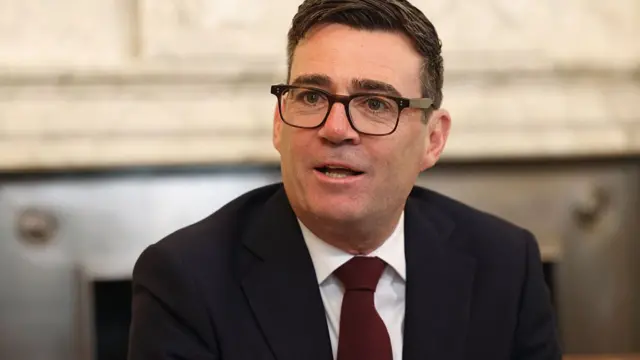
    Andy Burnham during his first cabinet meeting as prime minister in 10 Downing StreetImage source, EPA

    Andy Burnham has used his first cabinet meeting as PM to tell ministers he will lead a "cost-of-living government", insisting they must give people "a sense that help is coming".

    That came after a first major policy announcement on the removal of VAT from domestic electricity bills in October - expected to save a typical household £45 a year on average. Here's what that could mean for you.

    Easing financial pressures for people across the UK is one in a long list of issues Burnham and his top team will need to address.

    But the policy has already taken some flak - not least from inside the Labour Party. The former chief secretary to the prime minister Darren Jones questioned where the money would come from - comments that are likely to sting Downing Street, writes our political editor.

    There has also been criticism from other political parties, with Conservative leader Kemi Badenoch asking how it would be funded, Lib Dem leader Ed Davey saying it doesn't go far enough and Green Party leader Zack Polanski calling it "a start" but insisting more needs to be done.

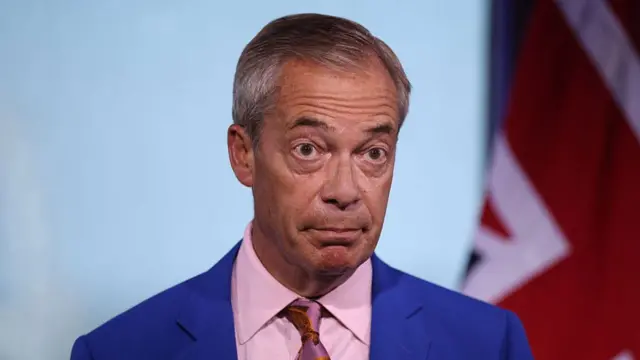
    Meanwhile, Reform UK leader Nigel Farage is calling for Burnham to hold a general election, saying he has "no mandate whatsoever".

  11. Cuts to household electricity bills a good start - energy bosspublished at 14:23 BST

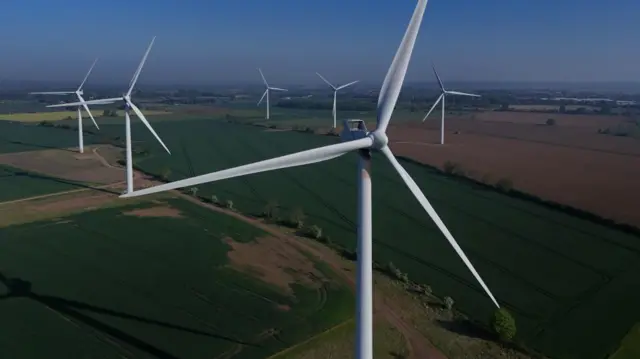
    An image made with a drone shows an onshore wind farm in Biggleswade, Britain, 01 May 2025.Image source, EPA

    The decision to cut VAT on household electricity bills is a "step in the right direction", according to the chief executive of energy company Octopus.

    Asked about the autumn rise in energy bills as a result of the ongoing war in Iran, Greg Jackson tells BBC Radio 4's World at One programme that without Burnham's policy, the increase would feel worse.

    Coupled with the Starmer government's measures to curb price rises, "bills are now going to be about £180 lower than they would have been," Jackson says as he calls for "fundamental reform".

    Pressed on how he'd go about doing this, the Octopus boss says electricity bills have "much higher social and environmental levies than gas".

    The government started to bring those levies down, Jackson says, but had they "finished the job" then that could potentially take a further £70 or £80 off bills.

    Another area that could lead to lower bills, he adds, would be to combat "wasteful" measures in the electricity system, such as "paying wind farms to turn off on windy days, rather than giving electricity away for lower prices".

  12. Analysis

    Promising to tackle the cost of living is one thing, delivering it is harderpublished at 14:13 BST

    Kevin Peachey
    Cost of living correspondent

    Prime Minister Andy Burnham hosts his first Cabinet meeting at 10 Downing Street, LondonImage source, Daily Telegraph/PA

    In January, the PM said every minute not talking about the cost of living is "a wasted minute". The chancellor said it was the government’s "number one focus".

    Seven months on, the PM told ministers that they need to be a "cost of living government" and give people a sense “that help is coming”.

    The only change is that’s it’s a different PM and a different chancellor.

    To state the blooming obvious, the evidence of this year is that saying it is easy, delivering it is harder – not least when some of the biggest factors, like a global oil price, are largely beyond their control.

    The cost-of-living in-tray is bulging: help with essential bills, both to come and those still unpaid; a lack of improvement in living standards; limited job prospects and security for those leaving education.

    A Burnham-led government has signalled with today’s VAT cut that it is willing to intervene, but – to ease market jitters – only when that’s offset with less spending elsewhere.

    Continuing that trend will inevitably create winners and losers, as well as tensions within and outside the government. Successfully navigating the course may well define whether Burnham and his team are winners or losers at the next general election.

  13. London-based officials offered relocation packages to join No 10 Northpublished at 14:01 BST

    Judith Moritz and Daniel Wittenberg
    Special correspondent and senior producer

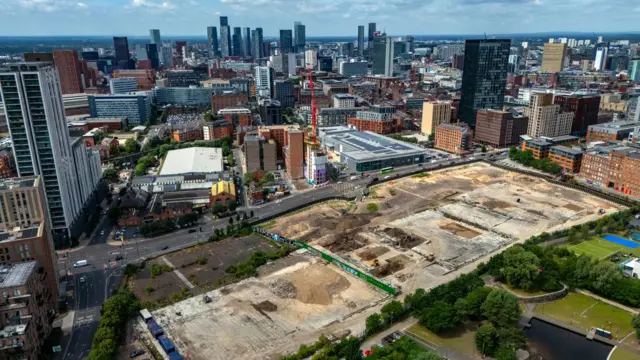
    The site of the former Central Retail Park, in Great Ascots Street, Manchester, the location for the Manchester Digital Campus development, which is the proposed site for Andy Burnham's "No10 North" department if he becomes prime ministerImage source, PA
    Image caption,

    Construction of the Digital Campus in Manchester will not be completed before 2032

    Civil servants working for government departments based in London have been offered relocation packages to encourage them to move to the North of England, the BBC understands.

    It comes as the first details are emerging about the new No 10 North which has already started work, according to sources close to new Prime Minister Andy Burnham.

    The BBC has been told that the Northern branch of Downing Street will be overseen by cabinet minister and ally of Burnham, Louise Haigh.

    Haigh, who is the first secretary of state, is thought to have been asked to lead a new Office for the Prime Minister, which will give her control of key decision-making bodies across government.

    It is understood that the initial location of No 10 Northwill be Heron House in central Manchester, in the same building which houses offices for the intelligence service GCHQ.

    It is likely that the longer term base for it will be at a new government "Digital Campus" which is under construction in the Ancoats area of Manchester. It is not due for completion until 2032.

    You can read more on the plans for No 10 North in this news story.

  14. Burnham 'agrees to disagree' with Scottish FM on independence referendumpublished at 13:46 BST

    Glenn Campbell
    BBC Scotland political editor

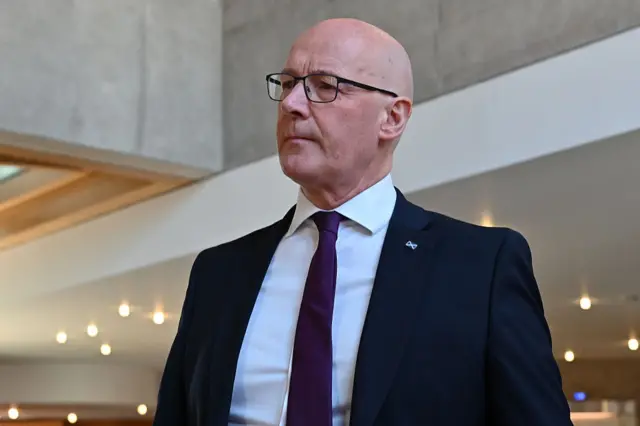
    First Minister John Swinney on the way to First Minister's Questions in the Scottish ParliamentImage source, Getty Images

    Andy Burnham has spoken with Scotland’s first minister John Swinney for the first time since taking office in No 10.

    The prime minister appears to have rejected Scottish government calls for another independence referendum.

    A Downing Street spokesperson says Andy Burnham was “focused on practical measures, not constitutional changes like further referendums”.

    Burnham’s team say he made clear in the conversation that they would need to “agree to disagree” on the issue.

    That is not disputed by the Scottish government with a source close to Swinney saying they set out their “respective positions”.

    More generally, both sides have described the call as “constructive”.

    Burnham and Swinney are expected to work together on issues like tackling the cost of living.

    The prime minister has also spoken with the leaders of the other devolved administrations and is likely to make early visits to Scotland, Wales and Northern Ireland.

  15. BBC Verify

    What other options are there to help with electricity bills?published at 13:38 BST

    By Tom Edgington

    The decision to cut VAT on electricity bills will apply to every family from October regardless of how rich or poor they are.

    The move is expected to save a typical household £45 a year on average - which is £3.75 a month.

    However, it’s worth remembering that the Starmer government has already extended a £150 discount on energy bills for eligible low-income households.

    Could Burnham have provided targeted help rather than a universal cut in VAT?

    “Doing something like that is a lot more complicated, so it would take a long time” says Jonny Marshall from the Resolution Foundation think tank.

    He told BBC Verify the government could have targeted those in receipt of welfare benefits - but this would have excluded a lot of people “given how many are struggling with their energy bills”.

    Another option would be to peg energy bill support to income so that if you earn below a certain amount you’d be eligible.

    “But to do that would take a lot of setting up” in time for this winter, added Marshall.

  16. 'We will show how we're going to pay for policies,' says Burnhampublished at 13:28 BST

    We can bring you more now from this afternoon's cabinet meeting, where Andy Burnham has pledged to always “show how we’re going to pay” for policies.

    In comments to his ministers at the top of the meeting, he promised to set out more plans "over the coming days".

    “But always we will show how we are going to pay for it, what we are reprioritising. That will be a theme that we will always come back to,” he says.

    Andy Burnham, UK prime minister, center, with ministers during his first cabinet meeting inside 10 Downing Street in London, UK, on Tuesday, July 21, 2026Image source, Getty Images
  17. Andy Burnham's first cabinet meeting - in picturespublished at 13:19 BST

    As we've been reporting, Andy Burnham is conducting his first cabinet meeting since becoming PM yesterday.

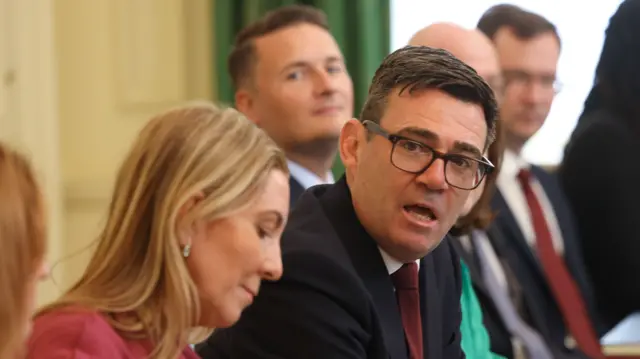
    Some familiar faces can been seen around the table, including former Health Secretary Wes Streeting - now defence secretary - and Labour Party deputy leader and new Education Secretary Lucy Powell.

    Andy Burnham, UK prime minister, center, with ministers during his first cabinet meeting inside 10 Downing Street in London, UK, on Tuesday, July 21, 2026GImage source, Getty Images
    Andy Burnham, UK prime minister, center, with ministers during his first cabinet meeting inside 10 Downing Street in London, UK, on Tuesday, July 21, 2026Image source, Getty Images
  18. Burnham says cabinet must be a 'cost of living government'published at 13:03 BST

    We can bring you some more now from Andy Burnham's first cabinet meeting as PM.

    He began the meeting by congratulating and thanking both new and reappointed ministers for being in his cabinet.

    He told ministers that they need to be a "cost of living government” and give people a sense “that help is coming”.

    Media caption,

    Applause as Burnham arrives for first cabinet meeting as PM

  19. Farage urges PM to call a general electionpublished at 12:58 BST

    Reform UK Leader Nigel Farage announces his resignation as a member of parliament while giving a statement on his "future in public life" at Millbank Tower on July 7, 2026 in London, EnglandImage source, Getty Images
    Image caption,

    Nigel Farage is campaigning for the Clacton seat after he resigned as the constituency's MP on 7 July

    Away from events in Westminster, Reform UK leader Nigel Farage has called on Prime Minister Andy Burnham to hold a general election.

    Speaking from a rally in Norfolk, Farage says Burnham became the leader of the Labour Party "unopposed" and "has no mandate whatsoever" to push through the changes he is proposing.

    "You cannot make the biggest change in British politics in 40 years without a mandate from the British people.

    "It would be only decent, right and proper to call a general election on that issue and to do it now."

    As a reminder, Farage triggered a by-election in Clacton after resigning as the constituency's MP on 7 July, following increased scrutiny over his finances and a parliamentary investigation.

    However, he is standing again. Farage is the only candidate from a Westminster party after Labour, the Conservatives, the Liberal Democrats and the Green Party all declined to take part in the contest for the Essex seat.

    A total of 34 candidates have been confirmed for the by-election, you can find the full list here.

  20. VAT, social care and defence: A recap of the key issues facing Burnham's top teampublished at 12:43 BST

    Charlotte Hadfield
    Live reporter

    Prime Minister Andy Burnham appoints John Healey as Chancellor of the Exchequer in 10 Downing StreetImage source, Downing Street

    Andy Burnham appointed his final cabinet ministers shortly before the clock struck midnight on Monday.

    As he prepares to hold his first cabinet meeting as PM, there's lots to unpack - here's the latest from our correspondents:

    Economy

    Burnham has promised to cut VAT from household electricity bills from 1 October. But already – within hours - he is taking flak from a man who just yesterday was in a senior job in Downing Street working alongside Keir Starmer, writes political editor Chris Mason. Here our cost of living correspondent looks at what the VAT cut really means.

    Foreign policy

    One of the first issues Ed Miliband will likely need to look at as foreign secretary is the US war with Iran, which is escalating again. Miliband is seen by diplomats I've spoken to as very competent, but he doesn't have much experience in the world of international affairs, says our international editor Jeremy Bowen.

    Health

    As Burnham pledges to reform social care, our health editor Hugh Pym says: "Yvette Cooper will in some ways be running one of the most significant areas of policy in England for the Labour government. Progress or not, social care and improving NHS performance are likely to be key areas on which voters assess Labour at the time of the next election."

    Defence

    John Healey’s appointment as chancellor has buoyed some of Britain’s biggest defence companies, writes our senior business reporter. Healey, who quit as defence secretary over the Treasury's “unwillingness” to fund a military spending plan, now overseas the public purse. Investors are hoping the UK will commit to increasing defence spending to 3% of GDP by 2030.