Summary

  1. Further US-Iran talks due on Sunday after conflicting messages on Strait of Hormuzpublished at 22:46 BST

    Katie Williams
    Live reporter

    An Iranian delegation has landed in Switzerland ahead of further talks with the US on Sunday, with JD Vance having departed Washington to attend.

    Speaking to reporters before boarding his flight, the US vice-president said he hoped to make progress on "the nuclear issue" and the "Lebanon ceasefire issue".

    Iranian state media says the country's delegation, led by Parliamentary Speaker Mohammad Bagher Ghalibaf, is there to follow up on the implementation of the existing deal - not to begin the second phase of negotiations.

    Agreement on a 14-point deal signed by both sides earlier this week - which aims to end the war and begins a 60-day negotiating period to resolve wider issues, including on Iran's nuclear programme - appears fragile.

    Earlier today, Iran's military claimed it was shutting the Strait of Hormuz in response to Israeli strikes in Lebanon. US Central Command said traffic in the waterway had continued.

    The existing deal demands an "immediate and permanent" end to fighting on all fronts, including in Lebanon. A US official said on Friday that a ceasefire between Israel and Hezbollah had been reached, but the two have continued to exchange fire, each blaming the other for violating the agreement.

    US President Donald Trump said there would be "NO TOLLS" in the strait "unless they are imposed by and for the United States of America".

    We're now bringing our live coverage to a close, but you can read more in our news story.

  2. Iran confirms delegation has arrived in Switzerlandpublished at 22:12 BST

    Iranian state news agency IRNA says the country's delegation has arrived in Switzerland, led by Parliamentary Speaker Mohammad Bagher Ghalibaf.

    The delegation is there to follow up on the implementation of the existing deal - not to begin the second phase of negotiations, IRNA says.

    Switzerland's foreign affairs office has also welcomed the Iranian delegation to the country in a post on X, adding that it is now on its way to Bürgenstock.

  3. Vance says he wants progress on nuclear issue and Lebanon at Switzerland talkspublished at 21:55 BST

    Before departing for Switzerland, Vice-President JD Vance told reporters he hopes to make progress "on the nuclear issue" and on the "Lebanon ceasefire issue".

    He says those are the "two big things" that will likely be focused on, adding: "I'm sure the Iranians are going to have issues they'd like to discuss as well."

    Asked about fighting in Lebanon and the possibility it could up-end the diplomatic process, he says: "Things are actually getting better there, and things are slowing down a little bit."

    But he describes the situation as something "we're just going to have to continuously manage".

    Vance says there would likely be a "couple days of talks" in Switzerland and that he can "only be there for a day or two".

  4. Vance heads to Switzerland for talkspublished at 21:44 BST
    Breaking

    JD Vance walks surrounded by officialsImage source, Reuters
    Image caption,

    Vance arrives at Joint Base Andrews, Maryland, to depart for Switzerland

    US Vice-President JD Vance has departed Washington for Switzerland, his press secretary Luke Schroeder says.

  5. BBC Verify

    Iranian flight lands in Zurichpublished at 21:36 BST

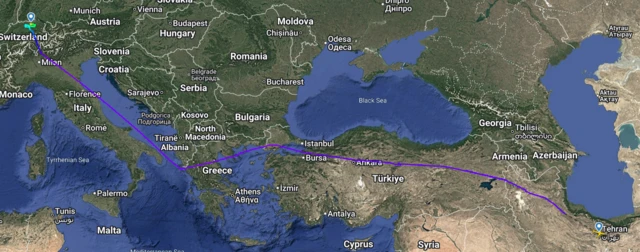
    Screengrab shows path of flight from Tehran to ZurichImage source, Flightradar24

    Paul Brown and Richard Irvine-Brown, BBC Verify

    As well as tracking vessels in the Strait of Hormuz, we’ve also been monitoring what may be a flight carrying an Iranian delegation to Switzerland, ahead of diplomatic talks tomorrow.

    We followed a Meraj flight from Tehran to Zurich, touching down at 22:14 local time (20:14 UTC) this evening. It's not clear who was aboard, but Iranian state media has reported that a group of national officials had departed this afternoon.

    Meraj is an airline identified by the US, and sanctioned, as being used by the Iranian government. It is also listed by aviation market intelligence company the Centre for Aviation as a "VIP charter carrier, offering services to the Heads of State and Government of Iran".

    The airplane used has the registration EP-SSM and is logged on Flightradar24 as having made flights in the past fortnight to several Iranian cities including Rasht and Najaf, as well as international return flights to Istanbul on 11 June and Moscow on 12 June.

    It is scheduled to fly from Zurich to Geneva later tonight.

  6. Analysis

    Friction in the air as talks currently look set to go aheadpublished at 21:09 BST

    Lyse Doucet
    Chief international correspondent

    First, the talks were off; now they seem to be on.

    Iran’s delegation, headed by its lead negotiator Mohammad Bagher Ghalibaf, is now enroute to Switzerland for high-level meetings meant to take place on Friday in the luxury resort of Bürgenstock.

    That means the US Vice-President JD Vance should soon be boarding a plane in Washington.

    There’s friction in the air too.

    Iran’s Foreign Ministry spokesman Esmael Baghaei emphasised this was not the start of negotiations, as set out in the new 14-point Memorandum of Understanding.

    "Negotiations for a final agreement will begin when the implementation of the commitments starts" he told the state-run IRINN news channel.

    Iran accuses the US of violating this framework, most of all the clause which calls for an "immediate and permanent termination of military operations on all fronts, including in Lebanon".

    Despite yesterday’s statements by Israel, and Iran-backed Hezbollah forces, that they would hold fire, their truce appeared to immediately fall apart.

    President Trump and his team want this deal to work – they’re exerting pressure on their Israeli ally not to jeopardise it.

    And Iran is also trying to stick to what it calls its red lines - without bringing the deal to breaking point.

  7. Adhere to deal or see energy supplies halted - adviser to Iran's supreme leaderpublished at 21:03 BST

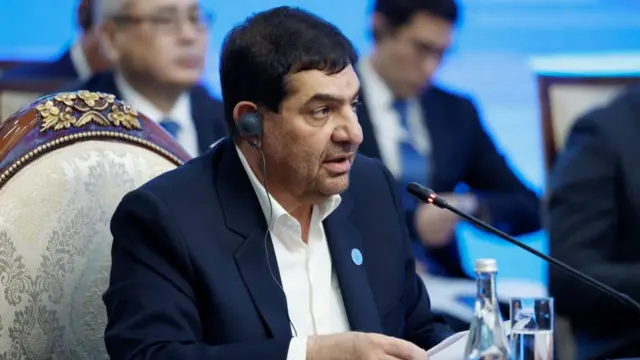
    Mohammad Mokhber pictured in 2023Image source, EPA
    Image caption,

    Mohammad Mokhber pictured in 2023

    In a post on X, also shared by Iran's state broadcaster IRIB, an adviser to Iran's supreme leader, Mohammad Mokhber, threatens that energy supplies will "come to a halt" if other parties fail to adhere to the US-Iran deal.

    He suggests the agreement is currently "on paper" only, adding that Iranian negotiators will only be satisfied with "full implementation".

    On the economic threat, he says: "Americans understand the language of economics and cost-benefit better."

  8. Trump: No tolls in Strait of Hormuz, unless imposed by USpublished at 20:27 BST

    US President Donald TrumpImage source, Reuters

    Donald Trump says there will be "NO TOLLS" in the Strait of Hormuz, either now or after the 60-day negotiation period set out for further peace talks ends.

    He also suggests the US could impose its own tolls if a broader deal is not reached between the US and Iran during the 60-day negotiation period.

    He writes on social media: "There will be NO TOLLS in the Hormuz Strait for 60 days during the Cease Fire Period, and there will be NO TOLLS after the 60 day period has expired, unless they are imposed by and for the United States of America, should the deal not be completed, for services rendered as the Guardian Angel to the countries of the Middle East for purposes of both past, present, and future reimbursement of costs. Thank you for your attention to this matter!!!"

    • As a reminder: the 14-point deal signed earlier this week stipulates that Iran "will make arrangements using its best efforts for the safe passage of commercial vessels with no charge, for 60 days"
  9. Analysis

    Israel-Hezbollah fighting puts MoU under strainpublished at 20:20 BST

    Tomos Morgan
    News correspondent in Washington DC

    For the past few days, President Donald Trump has been explicit in his language towards Israel - urging it to cease the fighting with Hezbollah in southern Lebanon.

    The tone from the US leader has been far stronger, far harsher, far blunter than any used by his predecessors towards its ally in the Middle East - lambasting Prime Minister Benjamin Netanyahu for continued attacks.

    Those clashes delayed the original signing of the peace deal, the Memorandum of Understanding (MoU), which specifically declared a ceasefire in Lebanon as well as between the US and Iran.

    Overnight, Tehran warned the US that if clashes continued there would be consequences.

    According to US media, US intelligence had also warned the American administration that Israel would undermine, and put the MoU in jeopardy, by continued fighting.

    Israel says it is in fact Hezbollah which has broken the ceasefire by firing more than 50 projectiles at Israeli troops. It says its own strikes, which have reportedly killed 20 people, are a retaliation.

    Yet in Washington there is confusion and contradiction, with both Vice-President JD Vance and US Central Command announcing the Strait of Hormuz is still open.

    No doubt this latest development will give even more ammunition to critics of the MOU like Republican senator Bill Cassidy, who branded it "the worst foreign policy blunder in decades".

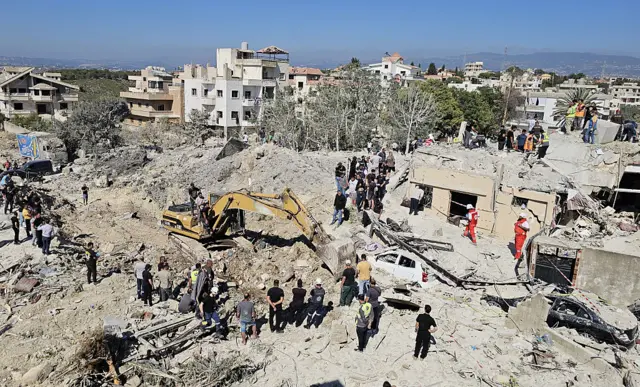
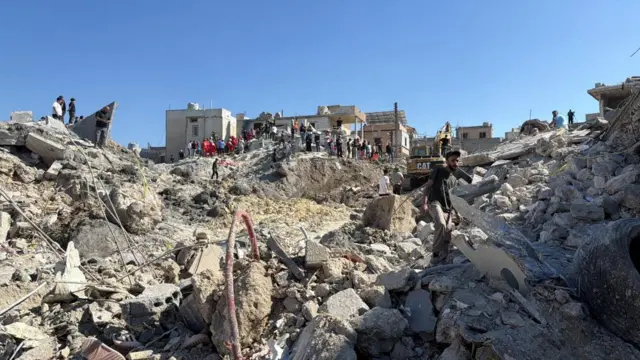
    Civil defense teams conduct search and rescue operations in the rubble of destroyed buildings after an Israeli airstrike target the town of Qanarit, despite the ceasefire and the U.S.-Iran agreement, on June 20, 2026, in Sidon, LebanonImage source, Anadolu via Getty Images
    Image caption,

    Rescue teams work in the rubble of destroyed buildings after an Israeli air strike targeted the town of Qanarit on 20 June

  10. Pakistan's PM to join talks in Switzerland on Sundaypublished at 20:07 BST

    Pakistan’s Prime Minister Shehbaz Sharif will attend the start of US-Iran talks in Switzerland on 21 June, his office has told the BBC.

    Pakistan has acted as a mediator throughout the war, and hosted a previous round of negotiations between the US and Iran in its capital, Islamabad, in April.

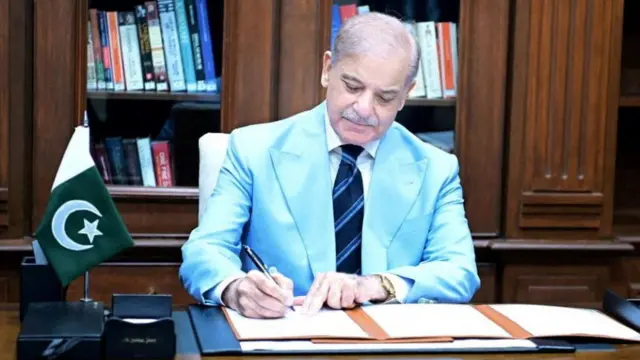
    Pakistan's Prime Minister Shehbaz Sharif signed the Islamabad Memorandum of Understanding (Islamabad MoU) as mediatorImage source, Press Information Department of Pakistan
    Image caption,

    Shehbaz Sharif signs MoU between US and Iran as mediator

  11. Iran's nuclear programme - explainedpublished at 19:46 BST

    Ghoncheh Habibiazad
    Senior reporter, BBC Persian

    Iran's nuclear programme has been the focus of diplomatic talks, sanctions on Iran, and inspections for decades.

    It was often referred to by Donald Trump as the reason the US joined with Israel in launching strikes on the country in late February this year.

    Iran maintains its programme is peaceful.

    The US and Israel have consistently rejected this and say there have been efforts to develop nuclear weapons.

    Under a nuclear deal agreed in 2015, Iran had limited its enrichment to 3.67%, which can be used to produce fuel for commercial nuclear power plants. Weapons-grade uranium is 90% enriched or more.

    Iran began openly escalating its enrichment levels after Donald Trump abandoned the previous agreement in 2018.

    By June last year, Iran was enriching at 60% and had amassed a stockpile of 400kg, according to the International Atomic Energy Agency (IAEA).

    In the 14-point US-Iran deal signed this week, Iran "reaffirms that it shall not procure or develop nuclear weapons", but other parts of the programme are still to be negotiated.

    The two parties also "agreed to discuss the issue of enrichment and other mutually agreed matters related to the Islamic Republic of Iran’s nuclear needs".

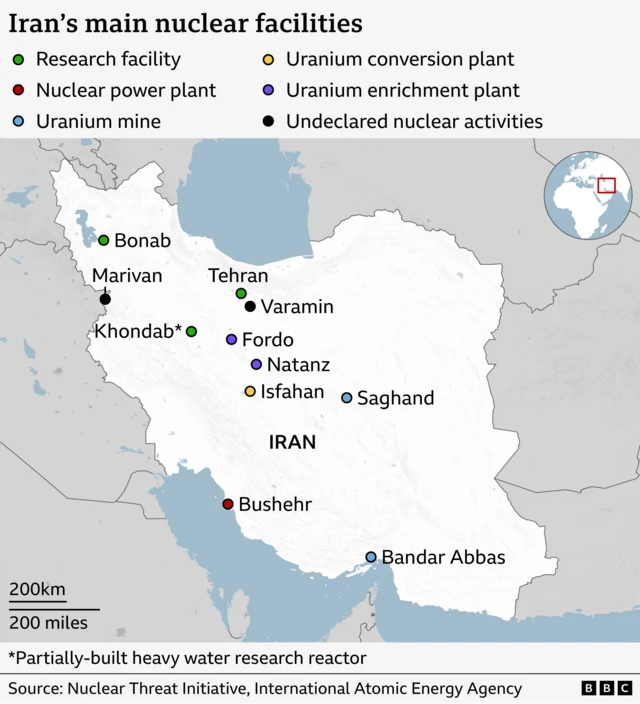
    Map of Iran showing the locations of its main nuclear facilities. Sites are marked with coloured dots representing different facility types: research facilities (green), nuclear power plant (red), uranium mines (blue), uranium conversion plant (yellow), uranium enrichment plants (purple), and sites of undeclared nuclear activities (black). Key locations include Natanz and Fordo (enrichment plants), Arak (research reactor), Bushehr (power plant), Isfahan (conversion plant), and others such as Tehran, Marivan, Varamin, and Saghand. A small inset map shows Iran’s location within the region. Source: Nuclear Threat Initiative and International Atomic Energy Agency.
  12. UN nuclear watchdog to take part in Switzerland negotiations - CBSpublished at 19:28 BST

    The head of the International Atomic Energy Agency, Rafael Grossi, is in Switzerland and is expected to lead some of the negotiations around Iran's nuclear programme, a source tells the BBC's US partner CBS News.

    The memorandum of understanding between the US and Iran includes a provision that the IAEA - the United Nations' nuclear watchdog - at a minimum oversees the process of diluting Iran's enriched uranium.

    Iran's nuclear programme has been a major sticking point in negotiations with the US, with the precise details of a nuclear agreement yet to be reached.

  13. Israeli soldier killed in southern Lebanon today - IDFpublished at 19:21 BST

    The Israel Defense Forces says five soldiers have been killed in southern Lebanon in the past two days.

    It says that in an incident on 19 June, four soldiers were killed in combat.

    In another incident on 20 June, one soldier was killed and three were injured, it says.

  14. Lebanese conservationist dies from wounds suffered in Israeli strike two weeks agopublished at 19:18 BST

    Mona Khalil, wearing a navy blue cap backwards, looks at a turtle on the coast in the southern Lebanese port city of Tyre in 2002.Image source, AFP via Getty Images
    Image caption,

    Mona Khalil, seen here in 2002, dedicated much of her life to protecting endangered turtles along Lebanon's south coast

    Lebanese environmental activist Mona Khalil, whose work helped turn a stretch of coastline in southern Lebanon into one of the eastern Mediterranean's most important nesting sites for endangered sea turtles, has died after being wounded in an Israeli strike two weeks ago.

    Khalil, 76, was injured when her house on Mansouri beach, near the southern city of Tyre, was hit during Israeli attacks in southern Lebanon.

    She died on Friday after several days in hospital, according to a local environmental group.

    The BBC has reached out to the Israeli military for a response.

  15. BBC Verify

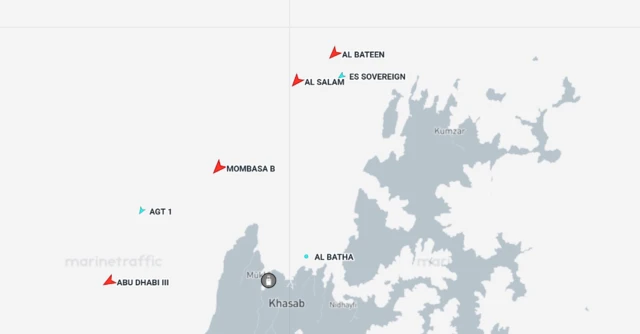
    Some tankers appear to have passed through the strait todaypublished at 19:07 BST

    Paul Brown and Richard Irvine-Brown, BBC Verify

    While several vessels appear to have made U-turns around the Strait of Hormuz today, the latest tracking data shows at least five tankers appear to have passed through the Strait.

    The Bitumen Star, listed as an asphalt/bitumen tanker, and Petrel 1, listed as an oil/chemical tanker, appear to have transited the strait today (they each began transmitting AIS data while already in the middle of the strait) by the northern route.

    The former appeared in the strait around 10:30 UTC (11:30 BST, 14:30 local) and exited the western side around 13:45, with the latter following about an hour behind.

    MarineTraffic map appears to show tankers passing through the strait earlier todayImage source, MarineTraffic

    Meanwhile, three vessels - the Mombasa B, Al Salam and Al Bateen - all listed as types of oil tanker, each appeared at the eastern end of the southern route between 09:30 and 10:30, and appeared to transit the strait, all having left on the western side by 12:10.

    However, Bahrain Prosperity appeared in the middle of the southern route around 12:45, but stopped while approaching the western edge of the strait at 14:15 without moving further, then disappearing by 15:15.

  16. BBC Verify

    Tracking ships turning back in the Strait of Hormuzpublished at 19:05 BST

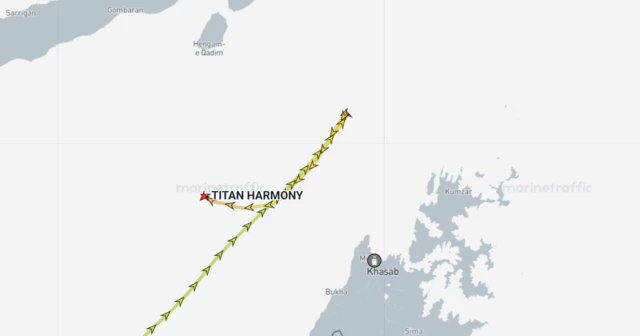
    Tracking data shows the Titan Harmony appearing to U-turn away from its trajectory that would have passed through the straitImage source, MarineTraffic

    Paul Brown and Richard Irvine-Brown, BBC Verify

    Monitoring shipping activity in the Strait of Hormuz, using maritime tracking website MarineTraffic, can be challenging as some vessels suddenly appear and disappear, likely because their AIS trackers are turned on or off. But there are some journeys worth noting.

    Five vessels look as though they have made sudden about-turns earlier today, two of which have stopped near the western edge of the strait according to the latest data.

    For example, the Lumina Ocean appeared on the western edge of the strait around 12:45 UTC (13:45 BST, 16:15 local), close to the time of Iran’s announcement.

    It was following the northern route through the waterway but made a 180-degree turn around 14:30 before appearing to stop at the western edge where it remains, edging slightly north, at time of writing.

    Tracking data shows another tanker, the Abu Dhabi III, approached the western side of the strait along the southern route around 10:00 and also appeared to U-turn, stop at the western edge at approximately 14:00, and then disappear from the tracking data around 14:45.

    Later, the Gulf Sunrise and Monaco Loyalty were seen to make the same adjustment and leave the strait in the opposite way to their original headings.

    Also on the southern route, the Titan Harmony is notable for entering the strait around 05:30, making a 180-degree turn at 07:30 (long before the announcement) and leaving by 10:30.

  17. Images show aftermath of strikes in southern Lebanonpublished at 18:45 BST

    As we've been reporting, at least 20 people were reportedly killed by Israeli strikes less than 24 hours after a new ceasefire between Israel and Hezbollah was announced.

    Both acknowledge attacking the other, but each claimed they were responding to violations by the other side.

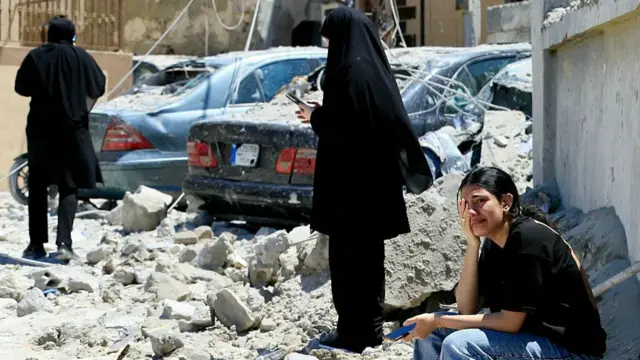
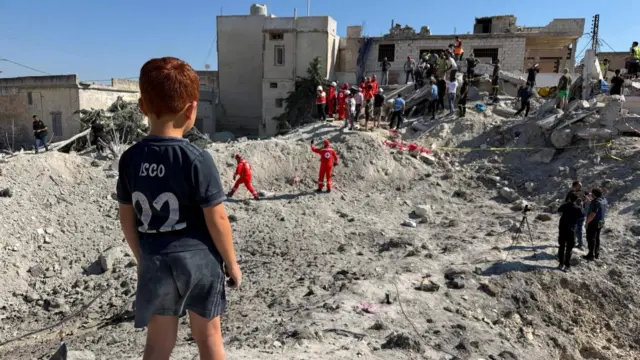
    A Lebanese woman weeps as she sits on the rubble at the site of an Israeli airstrike in Qennarit, southern Lebanon, 20 JuneImage source, Getty Images
    A child stands next to the rubble of a building damaged in an Israeli strike in Qennarit, southern Lebanon, 20 JuneImage source, Reuters
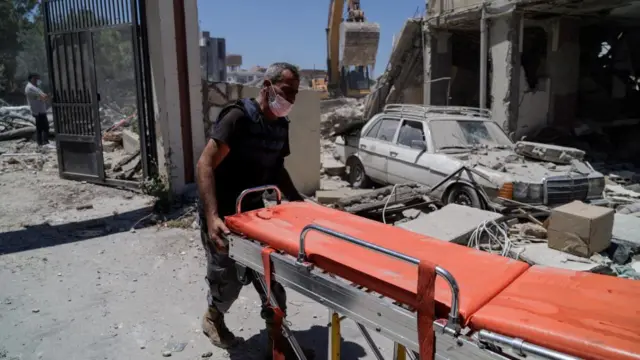
    A rescuer prepares a stretcher at the site of an Israeli air strike on a house in Barish, Tyre district, southern Lebanon, 20 JuneImage source, Reuters
    Civilians and Lebanese Red Cross personnel stand on the rubble of a damaged building after an Israeli strike on the village of Qennarit in southern Lebanon, 20 JuneImage source, Reuters
  18. Centcom says Iran does not control strait and traffic there continues - reportspublished at 18:07 BST

    US Central Command spokesperson Tim Hawkins has told Al Jazeera, the Washington Post and Reuters: "Iran does not control the Strait of Hormuz".

    He reportedly told them that "traffic continues to flow", with US forces "monitoring the situation to ensure this remains the case".

    The BBC has contacted Centcom for comment.

  19. What Israel and Hezbollah have said about the ceasefire todaypublished at 18:03 BST

    A US official announced a ceasefire between Israel and Hezbollah on Friday - but fighting between the two has continued, with both sides blaming the other for ceasefire violations. Here's what both sides have said:

    Israel Defense Forces

    • The IDF said Hezbollah had launched more than 50 projectiles toward IDF soldiers in southern Lebanon overnight
    • It described these as "repeated and ongoing violations of the ceasefire agreement"
    • The military said it had struck dozens of Hezbollah targets in response, including rocket launch positions and command centres
    • The statement said the IDF remains "committed" to the ceasefire agreement, "and will continue to operate to remove any threat posed to the State of Israel and IDF soldiers"

    Hezbollah

    • The armed group has also released statements today, saying it is committed to the ceasefire and accusing Israel of making "falsehoods" about Hezbollah violating the ceasefire "in an attempt to justify its ongoing aggression"
    • Hezbollah says Israel is attempting to "sabotage" the agreement between Iran and the US, and accuses it of repeated violations ceasefire violations
    • It says it has attacked Israeli forces, but says it was responding to attempts to make advances further into Lebanon, saying the Lebanese people have a right to defend their "land and sovereignty"
    • Israeli "aggression" will "not pass without a response", it says, adding: "The expulsion of the occupation from our land is only a matter of time"
  20. Fighting in Lebanon raises questions about future of US-Iran negotiationspublished at 17:31 BST

    Hugo Bachega
    Middle East correspondent in Beirut

    If there was ever a ceasefire in Lebanon, it did not last long. All day, waves of deadly Israeli air strikes took place across the south and the eastern Bekaa Valley, both areas where Hezbollah has a strong presence, hours after another truce was announced.

    In one of the attacks, in the town of Barich, a family of four was killed - a father, a mother and their two children. In another, on the Kafr Raman-Nabatieh road, a soldier of the Lebanese national army, which is not a party to the conflict, was killed.

    The Israeli military said it hit what it described as targets linked to Hezbollah, and that this was in response to the firing of around 50 projectiles by the group against Israeli troops occupying parts of southern Lebanon.

    Hezbollah confirmed attacks, saying it had targeted Israeli forces who were trying to make advances in the south of the country. It said that, while it is committed to the ceasefire, it will not tolerate attempts by Israel to seize more Lebanese territory.

    The conflict here raises questions about the future of negotiations for a permanent deal between the US and Iran. A halt to the fighting is a condition for those talks to go ahead. Israel, which was not involved in the talks, says its troops will continue in Lebanon.