Court breaks for lunchpublished at 20:07 BST
The court has now adjourned for lunch.
A former California street gang leader is on trial in Las Vegas for the 1996 murder of rapper Tupac Shakur, who died a week after being hit in a drive-by shooting
The prosecution and defence have delivered their opening arguments in the trial of Duane "Keffe D" Davis, 63, who faces one count of murder with a deadly weapon
Prosecutors allege that although Davis did not himself fire the gun that shot and killed Shakur, he was the ringleader of the group responsible. Davis has pleaded not guilty
Fans have remembered Tupac as one of the most successful and influential rappers of all time as a 30-year mystery still surrounds the circumstances of his death
You can watch the proceedings live at the top of this page
You can also follow the case on the BBC podcast Fame Under Fire: The Tupac Murder Trial, which is available now on BBC Sounds, BBC iPlayer or wherever you get your podcasts
The court has now adjourned for lunch.
Defence attorney Michael Sanft now gets to cross examine Stokes.
He asks her to draw a map of her friends' route that night through the Las Vegas streets. She draws a sketch on a piece of note paper, which Sanft then enters into evidence and displays to the jury.
Stokes tells him that when their car pulled up alongside Shug and Tupac's car, Tupac was "relaxed" and "sitting in the passenger seat.
"There was no engagement," she tells the court.
Ingrid Stokes says after she and her friends drove down a nearby street, and they then came back to the intersection where the shooting occurred.
Although they were sceptical of talking to police, Stokes says, they decided to share that they were nearby the shooting, despite not having seen much of what happened.
Police had them sit on the curb and asked them some questions, and she tells the court she was concerned about being seen talking to police.
The prosecution calls its next witness, Ingrid Stokes, who was present at the time of the shooting.
She had travelled to Las Vegas with friends that weekend in September 1996. They had planned to go to a Mike Tyson fight but missed it, she says.
She and her friends got in their car and started to drive around Las Vegas, before they ran into Marion 'Suge' Knight and Tupac "in the car".
Her friend knew Marion 'Suge' Knight, and Suge suggested the women follow them to a club, Stokes says.
They started to drive through Vegas, but “there was a car behind us, trying to get in front of us,” Stokes says.
At one point, they stopped at a light and pulled over, to switch drivers due to concerns about the other vehicle.
“We were head down, taking our seat belts off, when we heard the gunshots. All hell broke loose,” Stokes says.
Defence attorney Michael Sanft has also questioned Garry Dale.
Sanft asks Dale to describe the Las Vegas strip on the night of the shooting. Dale says it was an "average" night in terms of traffic, "nothing out of the ordinary".
Sanft then asks the former police officer whether "a caravan of cars" - a description used in the prosecution's opening statement earlier - was behind Tupac's car when it was pulled over. Dale says there was not.
Garry Dale then describes a scene about ten minutes later with the same vehicle.
He says Marion Knight was "outside of the vehicle, walking around, talking" and Tupac Shakur was being "removed by EMS (emergency medical services) people".
Dale says Knight was "adamant that we needed to go and take care of Mr Shakur," while the rapper was bleeding from a "chunk of shrapnel" in his head.
Dale says he rode to the hospital in the ambulance with Shakur, during which time he was still talking but when he asked Shakur who had attacked him he replied "something like 'no, we'll take care of it'".
The prosecution calls its first witness - Garry Dale, who was working for the Las Vegas Metropolitan Police Department in September 1996.
He says he was assigned to work on the Strip at 23:00 that evening.
Chief Deputy District Attorney Marc DiGiacomo asks Dale if he was involved in a "car stop" of a vehicle. Dale says he "initiated a car stop" on a black BMW "that had no licence plates".
Dale is then shown a map and is asked to point out where the car stop happened.
He says the occupants communicated their names after being asked. Dale adds he had "no knowledge" of them before that, and when asked if he recalls them, he identifies them as Tupac Shakur and Marion Knight.
Dale says he asked them why the vehicle had no licence plate and the response was because they were filming a video.
Dale then says he told them they would have to put "the plate back on their car", warned them and then released them.
 Shaimaa Khalil
Reporting from court in Las Vegas
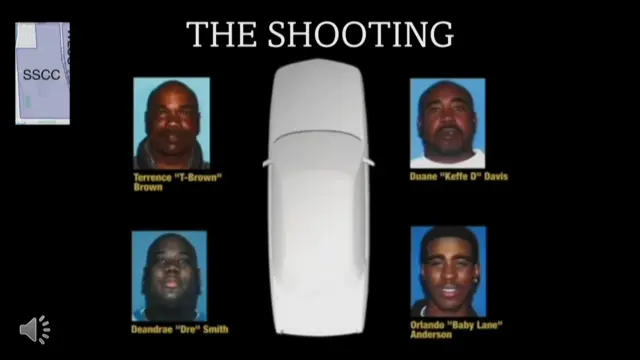 Image source, Reuters
A diagram shown to the jury of the alleged occupants of the white Cadillac on the night Tupac was shot
I’ve been inside the courthouse, watching the opening statements from an overflow room.
Duane “Keffe D” Davis—the only man ever charged in connection with Tupac Shakur’s murder—sat with a neutral expression, occasionally watching the prosecutor outline events from 7 September 1996.
Jurors were shown diagrams of alleged gang links, CCTV footage of the MGM Grand fight — in which Tupac and his entourage attacked Davis’s nephew— and a sketch of the white Cadillac and its four occupants.
That diagram placed Davis in the front passenger seat, with his nephew Orlando Anderson behind him.
Prosecutors say Davis obtained a gun before the four men spotted Tupac’s car, made a U-turn and pulled alongside it. They allege Davis passed the weapon to the back seat.
“You will hear from Keffe D himself,” the prosecutor told jurors.
Much of the case rests on Davis’s own accounts in interviews and his memoir
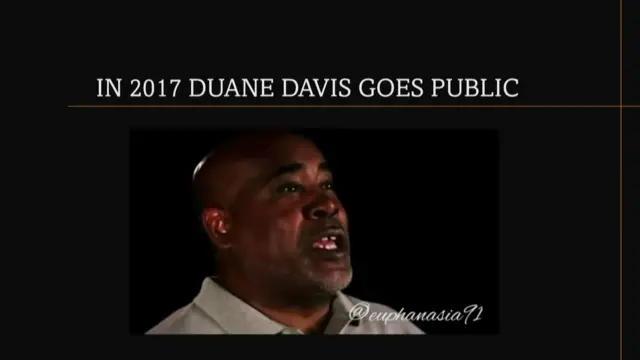 Image source, Reuters
A still from a recorded interview of Davis shown to the jury
The prosecution and defence have finished giving their opening statements.
The court is now taking a 15-minute break. Stick with us - we'll let you know when they return.
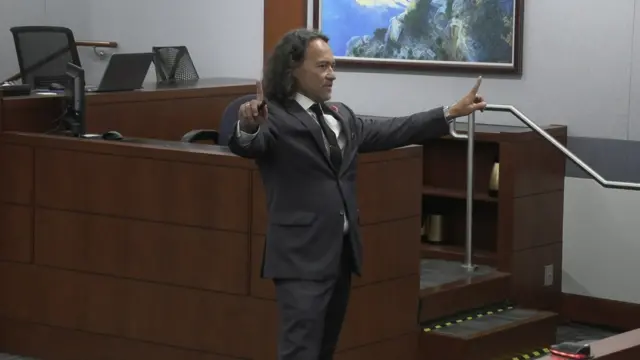 Image source, Reuters
Sanft says state witnesses will be "unreliable people with criminal records, financial motivations and inconsistent statements".
Among them is a security officer for Death Row Records, Reggie Wright Jr, and a "disgraced" LAPD detective, Sanft says.
On Wright Jr, one of the things Sanft says is that he had ordered his team not to be armed on the night of the shooting.
"He wasn't even around when the shooting occurred," Sanft says.
"So the principal, the person he should have been protecting the most - would have been Suge Knight, the head of Death Row Records, this man [Wright Jr] was nowhere to be found."
Sanft says that in 2017 a group called the Center of Investigative Reporting filed a Freedom of Information Act request to gain access to the murder files held by the Las Vegas police department.
After the police department refused to release the files, the Senate then filed a lawsuit forcing them to release the files, Sanft says.
That's when Detective Clifford Mogg comes in, saying he's just there to close out the case, not to solve the mystery of who killed Tupac, Sanft says.
Detective Mogg in 2018 then receives a copy of the "Death Row Chronicles" in 2018, which is not a deposition and not a testimony under oath, Sanft says.
"You know what happens when he receives that copy of the interviews that the state has basically shown you in this case? No charges filed," Sanft says.
Sanft says Mogg did not properly file reports and accuses his work of being "biased, sloppy and incomplete".
Sanft says misconduct and incompetence existed in the various police departments who had a role in the murder investigation.
He alleges another investigator, Detective Long, faced significant obstacles when he took over the investigation, which Sanft says he will testify to later in the trial.
Sanft says there were issues with the testing of the alleged murder weapon, and alleges the Los Angeles Police Department gave Long a "fake" gun to test.
Leads also began to wither and people's memories grew foggy as the case dragged on, Sanft says.
Sanft points out what he says are issues with the investigative practices that oversaw the case.
Sanft tells the jury that many reports by one detective, Brent Becker, are now missing, "they’re gone".
He said it is the responsibility of police to pass these records along to new detectives.
Sanft also alleges that Becker did not trust Compton’s police department due to a lieutenant’s purported ties to gang-affiliated individuals.
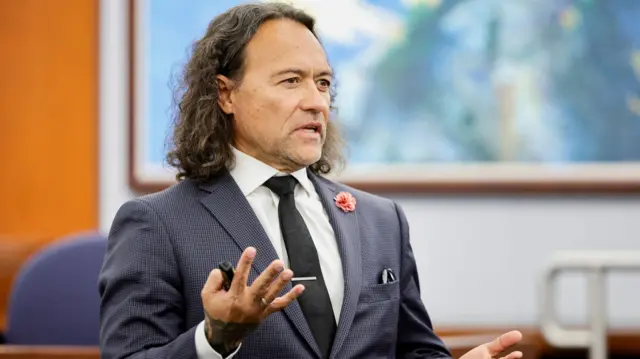 Image source, Reuters
Michael Sanft begins his opening argument before the jury
Palal has wrapped up his statement and the Davis's lawyer is now beginning his.
Defence attorney Michael Sanft is asking the jury to consider whether Palal has presented "fact or fiction" to them.
Sanft says the prosecutor has presented fictional details as fact.
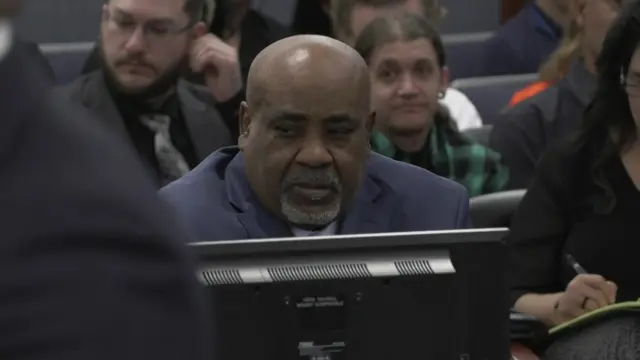 Image source, Reuters
Palal says in 2019 Davis published his own book, Compton Street Legend.
The prosecutor says the book shows Davis was "mad" about the beating of his nephew Orlando Anderson, that he was in Las Vegas the night of the fight, he got the gun, he was in the white Cadillac and he handed the gun to someone.
"A constant thing that always goes through these statements is Duane Davis' visceral anger at Tupac Shakur for putting hands on his nephew," Palal says.
He also reads a quote from Davis' book: "Them jumping on my nephew gave us the ultimate green light to do something to their ass."
Palal says there are no prosecutions following the shooting because in the world of guns and gangs "silence means survival".
But he says the "one person" who had a hard time staying silent was the defendant.
He then sets out that between 1998 and 2003, David gave a "number" of statements on the case.
Palal says in 1998, Davis spoke to the FBI and admitted being in LA at the time of the murder but denied being involved.
Palal then says it was in a secret interview with a federal taskforce that he "admits to his role in the murder".
The taskforce, he says, had been set up to investigate the murder of another rapper - Christopher Wallace aka the Notorious B.I.G - who was killed six months after Tupac's murder, after leaving a party in LA.
Palal says Davis said at the time he had no information on Wallace but they he can "tell you about Tupac".
"He tells a federal taskforce about his involvement which you've heard is orchestration of the murder of Tupac Shakur," Palal says.
This was secretly recorded and released later, the court hears.
In 2017, Davis then "decides to go public", Palal continues, as the court is shown a recording of a public interview.
Palal says he admits to being in the Cadillac and being part of the murder.
Palal says Davis got in the white Cadillac, which at that point was carrying three other men, including his nephew, Anderson.
They decided to “get some booze and go back to the Vegas strip and party”.
However, on their journey they saw a caravan of cars - and spotted that Tupac and Suge Knight were in one of the vehicles, Palal says.
Davis, and the others in the Cadillac, decided to make a U-turn to confront Tupac Shakur and Suge Knight, Palal says.
The prosecutor alleges Davis, who was in the passenger seat, passed a gun to Anderson.
Anderson then shot into Tupac's car, Palal says.
Palal says Davis believed the attack on his nephew, Orlando "Baby Lane" Anderson, could not "go unanswered".
Palal alleges Davis acquired a gun and organised for two vehicles to travel to Las Vegas club 662, one of them a white cadilac.
But Tupac Shakur and another man, Death Row Records executive Suge Knight, did not turn up while they are at the club, Palal says.
Prosecuting, Binu Palal begins by relaying the prosecution's version of events on September 7 1996.
He says Tupac had come to LA to attend a Mike Tyson fight, after which he and others ran into Orlando Anderson, the defendant's nephew.
He says that encounter resulted in an attack which was captured on video.
Davis can be seen in the courtroom watching as proceedings get under way.
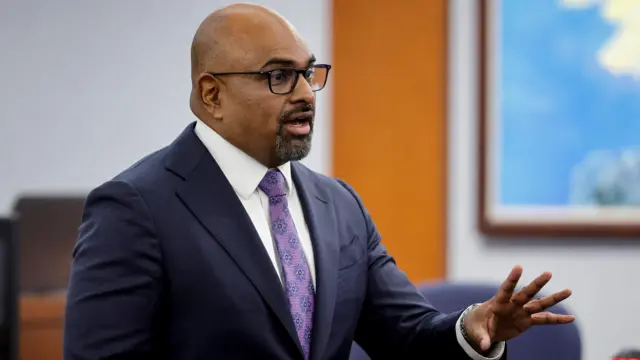 Image source, Reuters
Prosecutor Binu Palal delivering his remarks inside the Las Vegas courtroom
The prosecution in the trial of Duane Davis has begun outlining its case.
We'll bring you the key lines shortly.
