Summary

  • We've ended our live coverage - read our story here

  • Hundreds of thousands of students in England, Wales and Northern Ireland have received their A-level, T-level and BTec results today

  • The percentage of top A-level grades edges up again, while a record number of students secure a place at university

  • Sam, a college student in St Helens, is "thrilled" with his A* in maths, while Ella in Cornwall feels "excitement and relief" after getting her results

  • Meanwhile our experts have been answering your questions on clearing, grade boundaries, gap years and many more

  • Did you not get the results you were hoping for? Use this tool to help you figure out your next steps

  • In Scotland, students received grades for their National 5, Highers and Advanced Highers exams last week

How were your results?

  1. The results are in: Records broken and new paths ahead for studentspublished at 17:37 BST 13 August

    Madeleine Lake
    Live reporter

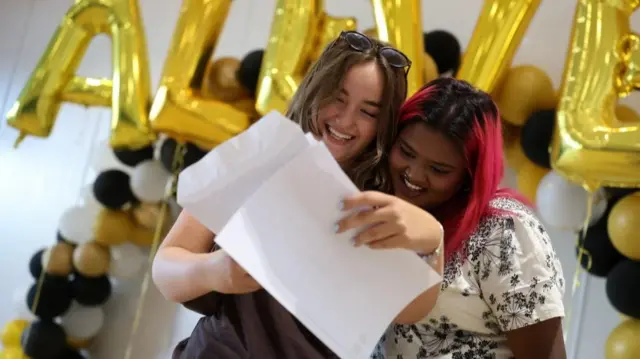
    Two young women celebrating the opening of their A level resultsImage source, Reuters

    Students in England, Wales and Northern Ireland tore open their results today to find out their next steps.

    For some it's a place at university, with a record number of 18-year-olds securing their top choice institution.

    For others it's been a difficult day with many feeling uncertain of what comes next, but options such as gap years, clearing and other routes have opened up alternative paths.

    T-levels - an alternative to A-levels which mix in classroom learning with on-the-job training - continue to grow in popularity. Almost 20,000 students received these qualifications today with a pass rate of 92.6%.

    It's been a day of emotional stories. One student who was brought up in the care system has landed a place at Oxford. While another live streamed her 35,000 followers to say she's a step closer to becoming a doctor.

    One student is looking at a wilder career, and plans to become a zoo keeper.

    Clearing has been talked about, not just for those who didn't meet their grades, but those who have decided to change their minds. You can read about how it works here.

    We're ending our live coverage for today, but you can read our key takeaways from results day here.


  2. Didn't get the results you wanted? I didn't eitherpublished at 17:29 BST 13 August

    Madeleine Lake
    Live reporter

    I remember the feeling of dread I felt when I logged into Ucas in 2019 to see both my firm and insurance offers gone, and replaced with a "you're in clearing" message.

    The place and accommodation I planned for at Edinburgh University had also gone along with it too. While others celebrated around me, I had no idea on my next steps.

    Ironically, my A-levels were BBC - the acronym for the place I work right now. It was a stark difference from my predicted grades of A*AB.

    I ended up taking not one, but two gap years. It was in these years that I gained the life experience that shaped my next steps.

    I poured pints in Wetherspoons, worked abroad, and freelanced for student magazines.

    I eventually decided that journalism was what I wanted to do. Had I gone to uni earlier I would have done a different course. I didn't have high enough grades to meet the entry criteria, so I did a foundation year.

    I was 21, older than my peers but determined to succeed. I applied to the BBC advanced journalism apprenticeship, and fortunately secured a place.

    If I could give advice to anyone who is feeling lost, it's that you're going to be OK, and that your grades don't define who you are.

    Rejection was the best thing that ever happened to me, because it led me to the future I'd hoped for, even if at the time I didn't know it.

  3. My results day didn't go to plan, but it worked out in the endpublished at 17:02 BST 13 August

    Emaan Warraich
    BBC News

    Journalist sitting behind a desk with the BBC newsroom in the background.Image source, Emaan Warraich

    I remember getting my A-level results during the Covid pandemic in 2020 and, unfortunately, not getting the grades I needed for my first-choice university.

    Like many students, I decided to take a gap year so I could resit one of my subjects and reapply. But during that year, I spent a lot of time researching apprenticeships and eventually applied for a journalism one with the BBC.

    In the end, I chose the apprenticeship route instead of going to university. At 19, I joined the BBC's politics team as an apprentice journalist, gaining hands-on experience whilst learning on the job.

    Nearly five years on, I'm so glad I took the apprenticeship route. It gave me valuable experience, helped me develop as a journalist and opened doors I might not otherwise have had.

    Looking back, not getting the results I wanted felt devastating at the time, but it led me to an opportunity that ultimately shaped my career.

  4. Vocational course boom likely to increase - exams chiefpublished at 16:51 BST 13 August

    Alex Taylor
    Education reporter

    Sir Ian Bauckman, chief regulator at Ofqual, speaking to BBC News
    Image caption,

    Sir Ian Bauckman, chief regulator at Ofqual, speaking to BBC News

    We've heard a lot today about the different routes available to young people beyond higher education as they look to forge a career.

    This follows an increased emphasis on technical qualifications in recent years, including T-levels - which jumped by 65% this year at a pass rate of over 90%.

    Sir Ian Bauckman, the chief regulator of Ofqual, says that while there's been an overall increase in entries for vocational qualifications across England, Wales and Northern Ireland, figures show a slight dip in England itself.

    Sir Ian told the BBC that T-levels - which focus on understanding one industry and include a mix of classroom study and hands-on experience - had seen another significant rise.

    "Students are having a broader range of subjects to choose from [within T-levels] and that is attracting a broader range of students to the qualification," he said.

    This means we will likely see "continued increases" in vocational courses over the coming years.

    The government wants to see at least 10% of young people enrol in higher technical courses or apprenticeships by 2040 - nearly double the current level. It follows concern that more than a million 16-24 year-olds are not in education, employment or training (Neet).

  5. What are UCAS points worth?published at 16:48 BST 13 August

    Mairead Nolan
    Digital Programmes Content and Events Manager, Sutton Trust

    Some of you on social media have been asking what Ucas points are worth, and how they work

    Comparing Ucas points across different qualifications can sometimes be confusing, as BTECs, T Levels and A-levels are graded differently. To check how many Ucas points a specific qualification is worth use the Ucas Tariff Point Calculator., external

    If your qualification is not listed on the calculator, please refer to the '2026 Tariff Tables' document linked on this webpage: Ucas Tariff Points – what are they and how do they work?, external. The number of Ucas points awarded will depend on the qualification and grade achieved.

    Your Voice banner
  6. If you get a D or an E at A-level, is that still a pass?published at 16:42 BST 13 August

    Diana Bird
    Executive Principal, Leeds City College

    Yes it's still a pass. A grade D is worth 24 Ucas points and a grade E is worth 16 Ucas points.

    Your Voice banner
  7. Text message error means Surrey applicants saw uni places before results releasedpublished at 16:35 BST 13 August

    Emaan Warraich
    BBC News

    While most students were waiting until results day to learn their next steps, more than 2,000 applicants to the University of Surrey received text messages on Wednesday - a day early - confirming whether they had secured a place.

    This broke the Ucas embargo, a strict period before exam results days, when universities and Ucas receive grades early but institutions cannot discuss decisions with applicants or advisers.

    A spokesperson for the University of Surrey said a results-day text message was sent at the wrong time to some offer holders: "The information and recipients were correct, but the message was sent at 8:10pm on Wednesday rather than 8:10am on Thursday."

    The university apologised, self-reported to Ucas and created a dedicated line for people who received the messages in error.

    A Ucas spokesperson said any student holding an offer from the university, and with any concerns, should contact the university directly.

  8. Army aspirations for William from Walespublished at 16:20 BST 13 August

    Alex Taylor
    Education reporter

    William Hopkins from Wales

    William Hopkins from Wales says he hopes to join the Army or Royal Marines as an officer after picking up his results today.

    He's been studying for a BTec in Uniformed Protective Services alongside his A-levels and achieved the 70 overall Ucas points he needed to follow in the footsteps of other family members.

    "I've enjoyed it, but I've never been really academic and I never really enjoyed school that much," he says. "I've always enjoyed new things and testing my limits."

    Regardless of how things pan out, he's confident about the future.

    "Even if I don't get into the Army I know I will land on my feet somewhere else," he says.

  9. Can you hold an offer from a university and go through clearing?published at 16:08 BST 13 August

    Chrissa Beaumont
    Director of Marketing, Nottingham Trent University

    If you are holding either a "confirmed firm" or an insurance offer then you can’t enter clearing or accept a place through clearing.

    First release yourself from your current offer via the Ucas hub - you can then explore as many universities as you wish before accepting the offer of your choice.

    'Your Voice' is written on a purple banner
  10. When do exam resits take place?published at 16:01 BST 13 August

    Kate Arif
    Careers Adviser, National Careers Service

    We’ve been asked:If I resit my exams, do I have to wait for next year? Or can I resit later this year?"

    Resits will take place in line with A-level exams, so prepare to take resits the following May or June.

    Your Voice banner
  11. A Rolls Royce apprenticeship and pro-cycling ambitions for these Northern Ireland studentspublished at 15:58 BST 13 August

    Daniel Logan
    BBC News NI

    Jack Brannigan smiles as he holds up his results. He is wearing a white hoodie
    Image caption,

    Jack Brannigan will do an apprenticeship with Rolls Royce

    Some students are thinking outside the box when it comes to their future plans.

    Jack Brannigan, a student at St Patrick's Academy Dungannon, is off to Derby to do a degree apprenticeship for Rolls Royce.

    The hope is that he’ll be able to work for them after the apprenticeship, but “we'll have to see", says Jack.

    Aliyah Rafferty, also from St Patrick's Academy, says professional cycling is her plan for the future.

    Having done Maths, Biology and PE, she applied for physiotherapy, “but I think I'm going to defer and take a year out”.

    “The plan is Australia for the winter, and I want to become a professional cyclist. Fingers crossed," she adds.

  12. What if I have an unconditional offer, but I still get bad grades?published at 15:54 BST 13 August

    Kim Eccleston
    Head of Universities and Colleges, UCAS

    A question sent in to us which our panel of experts have answered

    If you’re holding an unconditional offer, your place is guaranteed regardless of the grades you receive.

    So even if your results are lower than expected, your place will still be there, provided you accepted the offer.

    Your Voice banner
  13. Do universities treat A-levels and T-levels students differently?published at 15:51 BST 13 August

    Diana Bird
    Executive Principal, Leeds City College

    Another question from our BBC News YouTube account

    Universities accept students who have completed T-levels the same way they do with A-level students.

    These practical qualifications are the equivalent of three A-levels and carry Ucas points, which means you can progress to university if that’s the route you want to take.

    Other routes T-level students consider are apprenticeships or skilled employment.

    Your Voice banner
  14. 'I showed my results to 35,000 people, but first thought of my gran'published at 15:47 BST 13 August

    Madeleine Lake
    Live reporter

    A grandaughter and grandmotherImage source, Phoebe Illksey
    Image caption,

    Phoebe says it was her gran's last wish that she become a doctor

    Phoebe Harker went on TikTok live this morning to tell her 35,000 followers that her dream has come true.

    She's been documenting her journey for the last few years throughout mocks, UKCAT Exams, and says achieving A*A*A* has been "the best day of her life".

    Her dream of studying medicine started during work experience, when she saw the impact doctors could have on patients in their most challenging moments.

    Phoebe logged the hours of her study this year, and says she did more than 600 - which brought a lot of stress. As exams grew closer she would spend up to eight hours studying some days, she says.

    "I've worked so hard, it's been such a long process, every step has been a hurdle but my hard work has paid off," Phoebe tells me.

    She says upon opening her results, she first thought of her grandmother, Peggy, who lived with her until she died two months before Phoebe started her A-levels.

    "She was the first person I told everything to, she was kind-hearted and selfless," Phoebe says.

    She says her grandmother would tell her friends that Phoebe would become a doctor, and she was "proud of everything" she did.

  15. I met my offer - do I need to do anything on the Ucas website?published at 15:39 BST 13 August

    Kim Eccleston
    Head of Universities and Colleges, Ucas

    Another question submitted to us from our BBC News TikTok account.

    If Ucas has emailed you to confirm that you have been accepted onto your chosen course, you do not need to do anything else on the Ucas website.

    Keep an eye out for emails from your university or college though, as they will be in touch with information about enrolment and starting your course.

    Your Voice banner
  16. Can you use clearing for next year?published at 15:34 BST 13 August

    Chrissa Beaumont
    Director of Marketing, Nottingham Trent University

    No – spaces on courses are only available for this upcoming term, starting in September 2026.

    If students want to delay their entry by a year, most universities will advise to wait and apply through Ucas with all other students applying for September 2027.

    'Your Voice' is written on a purple banner
  17. If I get the results I need for university but want to take a gap year, what should I do?published at 15:28 BST 13 August

    Kim Eccleston
    Head of Universities and Colleges, Ucas

    If you’ve secured a place at university but are thinking about taking a gap year, the first step is to contact the university and ask whether they’ll allow you to defer your place.

    If they agree, you can usually start your course the following year instead.

    If they can’t offer a deferral and you still want to take a gap year, you may need to submit a new application for the following admissions cycle.

    Your Voice banner
  18. Have grade boundaries changed?published at 15:24 BST 13 August

    Diana Bird
    Executive Principal, Leeds City College

    Another question now from our BBC News YouTube account.

    Grade boundaries for every exam change slightly every year and are set after all exams have been marked and reviewed by examiners.

    They depend on the perceived difficulty of the paper.

    Exam boards review previous papers and compare with current ones to make sure there is consistency.

    So for example, if the current papers are found to be more difficult than previous years, the grade boundaries will be lowered and vice versa.

    This is to make sure that the grade a student gets this year is the same as they would have got if they had taken the exam the previous year.

    'Your Voice' is written on a purple banner
  19. What's more important – a degree or experience?published at 15:23 BST 13 August

    Mairead Nolan
    Digital Programmes Content and Events Manager, Sutton Trust

    Some of you have been asking if a degree is more important than experience

    This really depends on your career goals. Some professions, such as medicine, architecture, law and engineering will require a degree.

    However, there are many careers where experience, skills and apprenticeships can be just as valuable, and sometimes even preferred by employers.

    If you have a particular career in mind, it's important to do your research and check whether a degree is required before making your decision.

    Your Voice banner
  20. How does clearing work? What about re-marks? We answer some of your questionspublished at 15:16 BST 13 August

    Our experts are answering your questions on everything from clearing to student loans, and getting exam papers re-marked.

    We've already had a few responses, which you can catch up on below, but stay with us for more:

    'Your Voice' written on a purple banner