Summary

  1. Edinburgh Airport still managing disruption following severe thunderstormspublished at 18:06 BST

    The exterior of Edinburgh AirportImage source, Getty Images

    Edinburgh Airport is still managing disruption following severe thunderstorms overnight and in the early hours Friday.

    A spokesperson for the airport confirmed to the BBC that the situation has improved from the worst of the weather on Friday morning but it is still likely to have a knock-on effect throughout the day.

    In a post on X in reply to a complaint about long queues, the airport says because of delays caused by the thunderstorms "several flights are arriving off schedule and creating busier conditions than usual at certain times".

    Passengers have been advised to contact their airline for the latest travel information.

  2. Yellow thunderstorm warning for Northern Ireland cancelledpublished at 17:59 BST

    A thunderstorm warning that was issued for Northern Ireland until 22:00 BST has been cancelled by the Met Office.

    Yellow warnings for thunderstorms remain in place across Scotland until 03:00 on Saturday, and 21:00 over the north of England.

  3. More than 800 Welsh schools disrupted by heatpublished at 17:50 BST

    Nathan Standley
    Education reporter

    We've just heard from the Welsh education authorities, who say based on their understanding more than 800 schools in Wales were disrupted by the heat today, having to fully or partially close.

    However, they say this is not a complete or verified statistic, as that is held separately by each local authority.

    We previously reported that 600 schools in England had either closed or partially closed again today because of the weather, meaning at least 1,400 schools have been affected in England and Wales.

    The real number is likely to be much higher though, as a list of schools that have to close because of extreme weather is not published centrally, and local authorities are not obliged to publish them on their websites either.

  4. Derbyshire wildfire contained, fire service sayspublished at 17:32 BST

    We've just had an update from Derbyshire Fire and Rescue Service. It says that a fire in the Peak District is now contained.

    Earlier, we heard that the fire, which has been burning since Wednesday, had affected about 200 hectares (990 acres) of land on Tintwistle Moor.

  5. Delays, cancellations and reduced services: What to know as it hits rush hourpublished at 17:20 BST

    As people gear up to commute home and enjoy the weekend, parts of the rail network across the UK are facing cancellations and amended timetables. Here are some issues to look out for:

    Transport for London: Multiple tube lines are facing minor delays, with the Elizabeth Line and District Line both facing severe delays. The Mildmay Line has a reduced service.

    Avanti West Coast: Running fewer trains on Birmingham, Manchester and Liverpool routes, with major disruption reported.

    Great Western Railway: Fewer trains causing cancellations to services between Reading and London Paddington, Bristol Temple Meads and Severn Beach, Exeter St Davids and Okehampton, Reading and Gatwick Airport, and on other lines.

    Southern Railways: The Gatwick Express will not be running between London Victoria and Brighton this afternoon. Cancellations including from London Victoria to Bognor Regis, Brighton to Southampton.

    South Western Railway: Cancellations of services to Farnham, due to a fire. Warning that all routes may be subject to delay or cancellations.

    Northern: Reduced services on routes, including from Manchester Piccadilly to Manchester Airport, Manchester Victoria to Wigan, York to Leeds via Harrogate and Leeds to Manchester Victoria.

    Transport for Wales: Passengers are advised to only travel if absolutely necessary through the red weather warning area on Friday, adding that services may be delayed or cancelled at short notice.

    Sheffield Supertram: All services are currently suspended while temperatures remain high, the operator announced this afternoon.

  6. Alcohol bans, hottest days and events cancelled: Europe swelters as heatwave shifts eastpublished at 17:13 BST

    Jack Burgess
    Live page editor

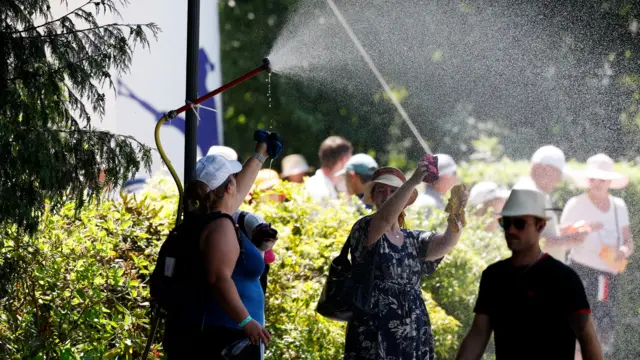
    A group of people are sprayed with waterImage source, Reuters
    Image caption,

    Tennis fans at the Bad Homburg Open in Germany cool down amid the heatwave

    France - state-owned energy giant EDF says it will give schools, kindergartens and day care centres millions of euros for air cooling systems. More than half of the country remains under a red alert for extreme heat.

    Meanwhile, French authorities have announced public alcohol consumption and sales bans in Paris, in a bid to ease pressure on the capital's hospitals during the heatwave.

    Germany - has experienced its hottest June day, the German Weather Service tells AFP, with preliminary recorded figures showing 40.9C in the western city Saarbrücken.

    Netherlands - a code red extreme heat warning has been issued for the first time. "The heat is oppressive. At times almost suffocating," our reporter in The Hague says.

    Spain - the highest June temperatures were recorded this week, with 45.1C in the southern town of Andújar on Monday. The MoMo monitoring system for reporting temperature-related deaths, external has counted 213 fatalities between Sunday and Wednesday that could be linked to the heat.

    Belgium - a re-enactment of the 1815 Battle of Waterloo has been cancelled as temperatures remain high in the country.

  7. Germany sees hottest June day as 40.9C recorded, AFP reportspublished at 17:05 BST

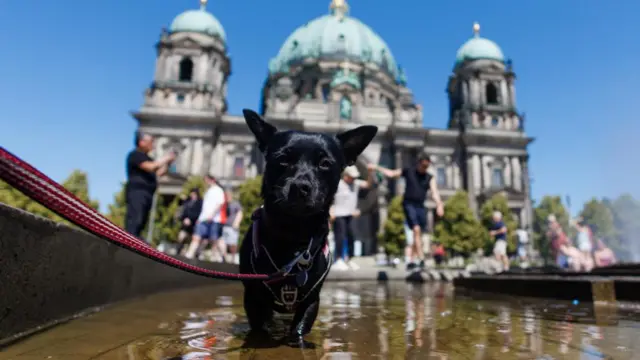
    A black dog stands in a fountain in front of Berlin Cathedral, he has a red leadImage source, EPA/Shutterstock
    Image caption,

    A dog called Minou stands in the water of the Lustgarten fountain in front of Berlin Cathedral during record breaking temperatures in Germany

    The German June temperature record has also been broken as provisional temperatures broke 40C at several locations across the country.

    Five different weather stations saw reading above 40C, including 40.9C in the western city of Saarbrücken, the German Weather Service tells the AFP news agency.

    It bets the previous recorded high of 39.6C for the month of June.

  8. 'Take care of those who struggle with their health'published at 16:54 BST

    Catherine Byaruhanga
    BBC News Presenter and Correspondent

    Two women wearing sunglasses sitting by the side of Hillingdon lido
    Image caption,

    Valentina Capsa (left) and Dana Pintilie (right) have brought their kids to Hillingdon lido in north London

    Valentina Capsa is visiting the UK with her two children from Mallorca, Spain, and today they're enjoying a trip to the Hillingdon Lido in west London with friends.

    Her children told me earlier that London’s weather is "very nice" and they are used to these hot temperatures.

    When asked for advice, Capsa says air conditioning is a must and that it is crucial to look out for those most vulnerable like children and the sick.

    "Watch out for them, for your neighbours, for your older neighbours," she says.

    Her friend Dana Pintilie, who lives in England, is thinking about the changes she and her family could make if the UK keeps getting hotter.

    "If the weather changes, we have to make some changes. The first one is air conditioner... more trees in our garden," she says.

    "And we’ll try to enjoy it, to go to the beach and maybe we can improve the beaches a bit."

  9. June record continues to creep higher as Suffolk reaches 37.3Cpublished at 16:45 BST
    Breaking

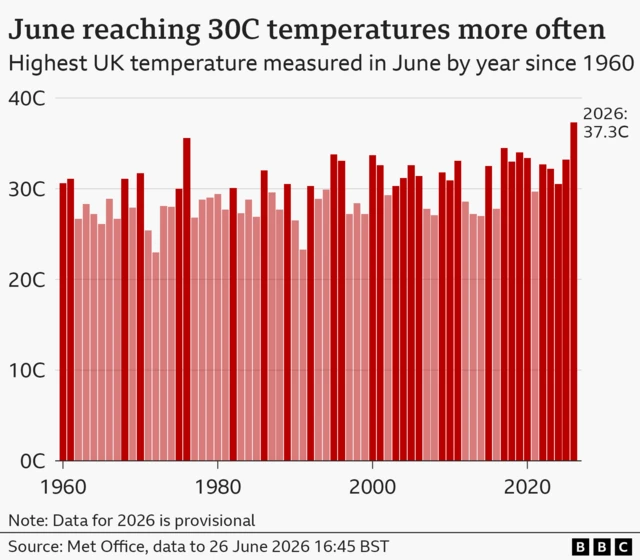
    June's record temperature has been broken again today, with Santon Downham, Suffolk provisionally reaching 37.3C.

    It topples the record of 37.1C set earlier in the afternoon, measured in Cavendish, Suffolk.

  10. How expensive are heatwaves to the UK economy?published at 16:36 BST

    Jemma Crew
    Business reporter

    This week we are seeing fewer and disrupted journeys, and more home working. Some workplaces and schools are closed, outdoor professions such as construction may work no or reduced hours, and heat-related sickness will hit productivity. Events are being cancelled.

    Other areas will see boosts.

    There’s likely to be a run on ice-creams and fans, and greater demand for summer clothes. A surge in sales of goods including sunglasses, sandals and BBQs during last month’s May heatwave fuelled a 3.7% rise in retail sales that month.

    Air-conditioned shopping centres and cinemas may also see more footfall as people seek to escape the heat. Verónica Vienne, an environmental economist from the University of Huddersfield, believes the negative effects of extreme heat on the economy “clearly outweigh the positive”.

    A construction worker buys an ice cream from an ice cream vanImage source, Getty Images

    She says cities where more heat is trapped and which depend more on service industries are likely to take a greater economic hit, while crops will also suffer.

    Vienne says the UK’s rail networks, offices and homes are not built for extreme heat. Until the government invests in adaptation measures to make infrastructure more resilient, she believes heatwaves will get more expensive.

    It’s tricky to put a number on these factors. The Office for National Statistics estimates £1.2bn in output could have been lost due to hot days on average each year between 1998 and 2021, based on experimental research.

    Some of its more recent research suggests the cooling effect of parks and lakes on urban spaces can avoid hundreds of millions of pounds of productivity losses.

    While in the grip of a heatwave it can feel like everything is grinding to a halt, some economists believe the impact is likely to be relatively small in terms of denting overall growth, and caught up at other points in the year.

  11. Why the ‘wet bulb’ temperature matterspublished at 16:24 BST

    Mark Poynting
    Climate reporter

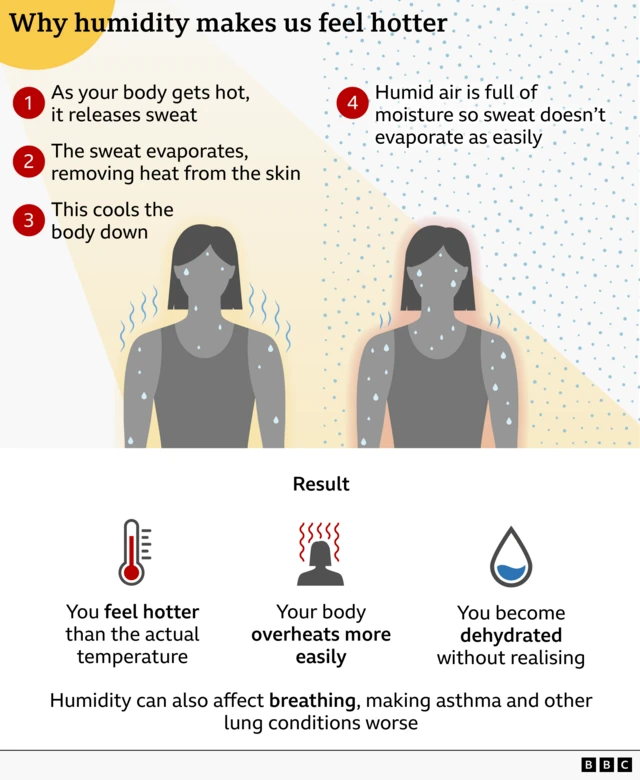
    This heatwave has felt particularly oppressive because it brings with it a double whammy of high temperatures and humidity.

    Scientists measure this combination with what’s called the wet-bulb temperature.

    Imagine doing a quick experiment where you cover the bulb of a thermometer with a piece of wet cloth.

    If the air is dry, the water will begin to evaporate. This uses heat energy, causing the temperature reading to drop.

    The wet-bulb temperature is the lowest temperature that can be reached through this process.

    If the air starts off more humid, it won’t be able to absorb as much moisture – so the wet-bulb temperature will be higher.

    The higher the wet-bulb temperature, the harder it is for the body to cool down through the evaporation of sweat.

    That is why this week’s temperatures in the mid-thirties might have felt worse than the 40C temperatures of July 2022, when humidity was lower.

    Graphic explaining why humidity makes us feel hotter. A simple illustration shows two human figures covered in sweat droplets. Step-by-step text explains: (1) as the body heats up, it releases sweat; (2) when sweat evaporates, it removes heat from the skin; (3) this cools the body; (4) in humid air, moisture prevents sweat from evaporating easily. The result section notes effects: you feel hotter than the actual temperature, the body overheats more easily, and dehydration can occur without noticing. It also states that humidity can worsen breathing and lung conditions.
  12. Top tips for staying cool during the heatwavepublished at 16:15 BST

    This Flourish post cannot be displayed in your browser. Please enable Javascript or try a different browser.

  13. Boy wears skirt to class in protest of school uniform policypublished at 16:05 BST

    Pritti Mistry
    Reporting from Lincolnshire

    George is wearing a white short-sleeved shirt tucked into a dark pleated skirt, along with white socks and light-colored slip-on croc shoes. He is standing on a grassy lawn in a back garden facing forward with arms relaxed at his sides. Behind him is a wooden fence with raised garden beds containing soil and plants, along with several potted plants and a bucket. To the left side of the image is a round outdoor light grey-colored chair.

    A boy who says he was frustrated with his school's policy of insisting boys have to wear trousers during hot weather chose to wear a skirt to classes in protest.

    George, 15, from Keelby in Lincolnshire, says wearing trousers during the heatwave has made it harder to concentrate during exams, and instead has been wearing a friend's skirt for the past two days.

    "If girls can wear a skirt and maybe feel a bit cooler, why can't I? So I did," he says.

    Caistor Yarborough Academy says it has not sanctioned George, and has since relaxed rules, with pupils allowed to wear PE kit on Friday as a "personalised approach to the uniform policy".

    The school says it has informed parents and carers of its decision.

  14. June record broken again as 37.1C seen in Cavendishpublished at 15:55 BST
    Breaking

    The June temperature record has again been broken with a provisional temperature of 37.1C recorded in Cavendish, Suffolk.

    It beats this afternoon's earlier record of 36.9C in Wattisham, Suffolk - which in turn beat Thursday's record of 36.7C in Merryfield, Somerset.

  15. Why do thunderstorms happen after hot weather?published at 15:50 BST

    Chris Fawkes
    BBC Weather presenter

    Thunderstorms are made from air rising quickly through the atmosphere. The sun heats the ground strongly during our summer months and this heats the air up near the ground.

    This bubble of warmed air will become more buoyant and will rise upwards through the atmosphere. As the air rises upwards, it cools down.

    Moisture in the air can then turn into water droplets and ice crystals. These can sometimes make thunder clouds.

    The ice is important for making lightning and the cracks of thunder we hear.

    Summer thunderstorms have much more energy in them, so can give us impressive lightning displays, flooding rain or sometimes large hail.

    Yellow warnings for thunderstorms are in place in northern England and Northern Ireland into this evening, and in Scotland into the early hours of tomorrow morning.

  16. Constant thunder overhead as storms develop in northern Englandpublished at 15:39 BST

    Danny Savage
    North of England correspondent

    Dark clouds in the sky hang above a house which is surrounded by trees with an empty road in front of itImage source, BBC Weather Watchers/@LizzieMcK
    Image caption,

    Dark clouds over Otley in West Yorkshire

    Live weather radar is showing thunderstorms now developing over parts of northern England.

    In western parts of North Yorkshire, where car thermometers have been showing 31C outside, permanent rolling thunder has been heard for a while.

    Not the odd rumble with a gap, just constant.

    The storm is drifting north-eastwards.

    As we reported earlier, thunderstorms are expected to develop through the day in Scotland, Northern Ireland and northern England with the threat of flash-flooding and some large hail.

  17. Sheffield tram network suspended due to high temperaturespublished at 15:32 BST

    Sheffield’s tram network has been suspended due to the heat, its operator says.

    "While we have experienced high temperatures throughout the week, this afternoon’s forecast is the highest we have seen, and we have therefore taken the decision to temporarily suspend tram services across the network," a spokesperson for Supertram says.

    The operator says it will monitor temperatures throughout the afternoon, with services resuming "once conditions have improved".

  18. M5 reopens following defect with overhead cablespublished at 15:26 BST

    The M5 in Somerset has reopened in both directions following a defect with overhead power lines.

    National Highways warns that there are delays of 160 minutes and 10 miles of congestion in both directions, adding that this will begin to ease.

  19. Brits try to stay cool as the heatwave continuespublished at 15:20 BST

    A woman holds an electric fan up to her face. She is carrying two bags and wearing a white vest and sunglassesImage source, PA Media
    Image caption,

    A woman uses a fans as she makes an early morning journey towards the centre of Bristol

    A group of six rowers pause for a water break. A seventh person sits at the end of the boat as the group drink bottles of waterImage source, PA Media
    Image caption,

    Rowers pause to rehydrate as they take an early morning row across the harbour in Bristol

    Commuters drink water and use electric and hand fans to try and stay cool on the Tube in LondonImage source, EPA/Shutterstock
    Image caption,

    Commuters use electric and hand fans while riding the London Underground during the hot weather

    Siblings Hayley and Em Vitiello, and their friend Rioghnach Iadicicco star jump into the water at Charlton LidoImage source, PA Media
    Image caption,

    Siblings Hayley and Em Vitiello, and their friend Rioghnach Iadicicco leap into the water at Charlton Lido in south east London

  20. Cool spaces offer respite from the heat across Londonpublished at 15:10 BST

    An aerial view of the O2 which is white and has long yellow metal structures coming up out of itImage source, Getty Images

    As the heatwave persists, a 'cool space' map in London is helping people find somewhere to take respite from the heat.

    Through the map, external, those in England's capital can seek shelter in the cool spaces, ranging from the O2 and the Royal Opera House to the Imperial War Museum, churches, community centres and libraries.

    Inside they will find cooler temperatures - some have air conditioning - free seating and water, and toilet facilities.

    At a minimum, the spaces are open five days a week from 10:00 until 17:00, according to the website.

    They can be found across the city, with the map also showing places covered by tree canopy, and areas where the surface temperature is generally cooler.