Summary

  1. Analysis

    Thorny trade-offs for Starmer will be waiting for his successor toopublished at 12:00 BST

    Henry Zeffman
    Chief political correspondent

    We knew before Starmer spoke what the reaction to his speech would be from most rival political parties and leading defence figures, as well as some within the Labour fold: that this is not enough funding given the scale of the threat the UK faces.

    Starmer nodded to the possibility that his successor may well have to come back before long with more defence spending when speaking about how this was a platform to be built on.

    Throughout there was an implicit acknowledgement of the unusual reality that he is the prime minister unveiling this significant amount of defence spending but will not be the one to deliver it.

    The PM also talked about the trade-offs of defence spending and how he has cut capital spending from other departments to spend money on defence. But he said that he did not want to cut spending on day-to-day public services, ie schools and hospitals.

    This was an argument made by some government sources off the record in the aftermath of John Healey’s resignation, now made explicit.

    Those are the thorny trade-offs that are going to be in Andy Burnham's in-tray before long.
  2. Recap in brief: What we just heard from Starmerpublished at 11:44 BST

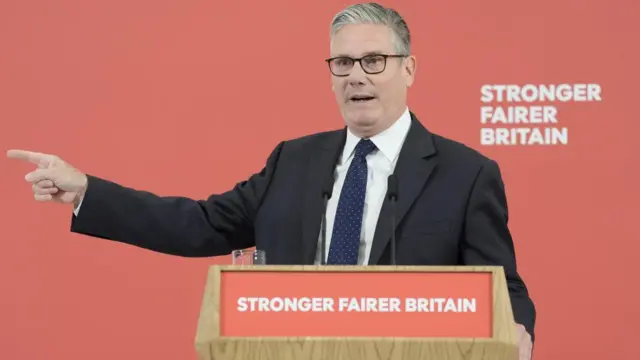
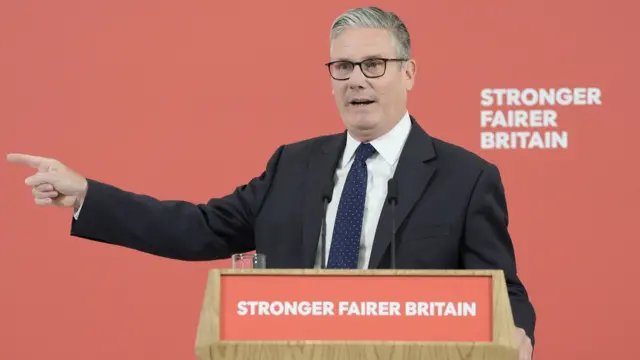
    Keir Starmer, a man, wearing a black suit, dark tie and white shirt, with his right hand pointing outwards, as speaks on a stage, with a lectern which reads "Stronger Fairer Britain", and a red background.Image source, Reuters
  3. Plan will take spending on defence and national security to 4.2% of GDP - Starmerpublished at 11:30 BST

    Finally, Starmer is asked whether it is realistic to expect the UK to meet Donald Trump's target for Nato members to spend 5% of GDP on defence by 2035.

    The prime minister says he spoke to the US president about the wars in Ukraine and Iran at the recent G7 summit, and to Mark Rutte, the Nato secretary-general, about the defence investment plan during a meeting at No 10 yesterday.

    Referencing the 5% commitment by 2035, Starmer says the plan takes the UK to 4.2% of GDP on defence and national security - 0.8 per cent below the target, which was announced by Trump at Nato last year.

    "I'll be very pleased to report that back to colleagues at Nato next week, they'll be very pleased to discuss that with us and I'm proud of the record I stand on in relation to defence and security as I go into that summit," Starmer says.

    And with that he finishes his remarks and exits the stage. We'll bring you a recap of what was said shortly.

  4. Starmer says money for military housing needs to be balanced against military capabilitypublished at 11:26 BST

    The prime minister is now asked about reports than £9bn set aside to improve military housing has now been reallocated to the defence investment plan itself, and is asked what his message is to military personnel.

    Starmer says he is "proud" that his government has put "a lot of money into military housing" and wages.

    He says the government will continue to support military personnel, but says that needs to be balanced "against investment in military capability that we need".

  5. There will always be those who say more should be spent - Starmerpublished at 11:24 BST

    Britain's Prime Minister Keir Starmer delivers a speech, following the publication of long-delayed defence investment plan, in Berkshire, Britain, June 30, 2026Image source, Reuters

    It's put to Starmer that some former military chiefs and experts are arguing that the extra money for defence is not enough.

    Starmer responds by saying the government's plans equate to the "highest sustained increase" since the Cold War.

    "That's nearly half a century, the biggest sustained increase for nearly half a century.. that is a huge step forward," he says.

    He adds that the plan has been "sharpened" even in recent weeks.

    He says he respects those with "great experience" that do not believe the funding is enough, but says "there will always be those that say, whatever the sum is frankly, it's not enough".

    He says it's his job to get it right, and says he is 100% confident in the plan.

  6. Starmer does not say, when asked, whether Burnham has seen the planpublished at 11:23 BST

    Starmer is now asked whether Andy Burnham has seen the defence investment plan.

    He avoids answering the question directly and says the plan sets out the capabilities of the UK military, what they will be and how they will be costed.

    He says this is something any Labour prime minister would want to stand behind, and adds he will ensure the transition is "orderly".

  7. PM says he'll leave UK defence in a better place than when he beganpublished at 11:21 BST

    Starmer is asked about the delays to the defence investment plan and how important Andy Burnham will be to its future - and if Burnham, likely to be the next PM, has given assurances on funding.

    Starmer says "a test of any prime minister is if they leave the country in a better state than they've found it".

    He says that is "undoubtedly the case" on the economy, public services and defence.

    He adds this isn't just "measured" by money, but also that "other countries" look to the UK as "a leader in defence and security".

    Starmer says for the future, he has "no doubt" that Labour will have a "number one committment" to defence and security.

  8. Starmer defends spending plans after criticism from retired generalpublished at 11:19 BST

    The BBC's political editor Chris Mason asks Starmer about comments by Gen Sir Richard Barrons, who told BBC this morning that Britain is not keeping up with its allies or enemies in terms of defence capabilities.

    Starmer says his government inherited an Army that was "hollowed out" and highlights his decision to boost defence spending prior to today's defence investment plan.

    He says a further £15bn has been invested as part of today's plan before acknowledging that there "will always be those that argue that even more should be spent".

    "I have to make the right judgements on the capabilities that I think is right for our country to meet the threats, not just of today but of tomorrow, and that is what this defence investment plan does," Starmer says.

    "This is a massive step forward," he adds.

  9. Starmer says armed forces can deter Russia from starting a conflict with the UKpublished at 11:17 BST

    We're now moving on to questions, and the PM is asked if the plan contains enough to, by 2023, deter a fight with Russia, and win a conflict were there to be one.

    "Yes I can," he says, "because of the increase in defence spending in place, announced last year" and the plan today building on that.

    "We've learnt a lot from Ukraine, and Iran as well about the capability that is needed in order to confront countries like Russia," he says.

    Starmer adds he's also confident because the UK is "working with our European allies".

    "The UK needs to show a leadership role to be a trusted ally" he says, adding "I believe we have built that."

  10. Starmer ends speech calling plan a 'decisive step' towards a better futurepublished at 11:13 BST

    Starmer concludes his speech by saying he knows "we will continue to rise to this moment, not just to weather the coming storms, but to use this moment to reach to a better future".

    He says the defence investment plan is "decisive step" towards reaching that goal.

    The prime minister then moves on to questions from reporters who are in attendance in Berkshire.

  11. UK will maintain support for Ukraine, Starmer sayspublished at 11:12 BST

    The PM says supporting Ukraine is the "right" and "just" thing to do, and that the outcome of the war will "shape our lives for decades to come".

    If Russia is to win, Starmer says, Putin "would not stop there, but turn his gaze to other allies".

    He says Ukraine is "holding strong", increasingly pushing Russia back, and says this is the moment to "ramp up the pressure" by continuing to back Ukraine.

    He says the government's defence investment plan will maintain the UK's support for Ukraine in full.

  12. Defence investment will help 'build a more European Nato' - Starmerpublished at 11:10 BST

    Prime Minister Sir Keir Starmer delivers a speech in Berkshire, following the publication of long-delayed defence investment plan (Dip). Picture date: Tuesday June 30, 2026Image source, Reuters

    Starmer says the defence investment plan will allow the UK to strengthen its international leadership and "build a more European Nato".

    This is not to the exclusion of the US but to strengthen the transatlantic alliance "which keeps our country safe", he adds.

    Starmer says the UK is already developing precision strike weapons with Germany, building frigates with Norway to hunt Russian submarines, but will go further will the defence investment plan.

    He also announces there will be a £8.6bn investment in building fighter jets under a programme with Italy and Japan that will "secure our skies for decades to come".

    The UK will also bring its investment in renewing the nuclear deterrent to £64bn, Starmer adds.

  13. Motto for defence procurement will be 'back British'published at 11:08 BST

    Starmer says defence spending plans will enhance the economy, by creating "almost 60,000 jobs".

    The motto is to "back British", he says.

    He says they will bring start-ups into the defence supply chain, which "pays off in every region and every community".

    "The fact is defence jobs are different. They are high skilled, well paid. They offer career paths, training and a greater sense of meaning," Starmer says.

    He announces they will be creating a new "£50bn defence export facility", which Starmer describes as a "once in a generation boost".

  14. Starmer says plan will 'make the British people safer'published at 11:06 BST

    Starmer says the defence investment plan will deliver change for Britain in three primary ways.

    He says the plan will "make the British people safer" by reversing the cuts of recent years and rebuilding ammunition stockpiles, ensuring the UK is "better prepared to win".

    The plan will also "drive a generational transformation of our armed forces," Starmer says, adding that the military will be modernised off the back of lessons learned in Ukraine.

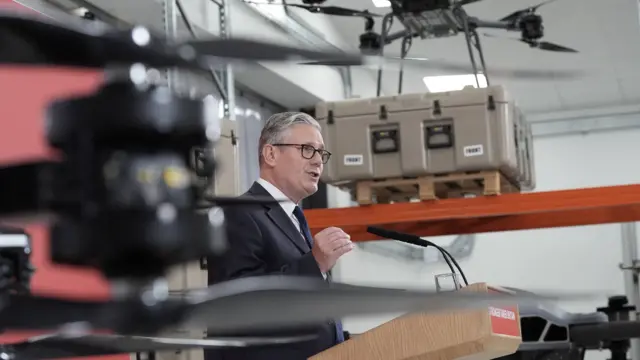
    The prime minister confirms that more than £5bn will be invested into drone technology - "the largest ever UK investement in this technology".

    He also says the UK will build a "hybrid navy," meaning that when British frigates move to intercept a threat to British interests, like a Russian ship, "they will do so with outriders, uncrewed ships above and below the surface".

    Starmer says this will be joined by the next generation of the RAF, highlighting Typhoons flying with autonomous wingmen, making them "invisible" to enemy detection.

    He goes on to say that the Army will be "10 times more lethal", highlighting further investment in one-way attack drones, long-range missiles, armoured vehicles, and counter drone defence systems.

  15. Almost £80bn on defence per year by 2029, Starmer sayspublished at 11:02 BST

    Starmer says the government is already delivering the "biggest sustained increase" in defence spending since the 1980s.

    He then announces that under the defence investment plan, the government is increasing defence funding "by a further £15bn, setting a new record".

    He says the previous government spent £54bn on defence per year before his government took office, which he says is being increased to "almost £80bn" per year by 2029.

    "That is a real terms increase of 27%," he says.

    Starmer says at last year's Nato summit he committed to spending 5% of GDP on "wider security", which also includes energy security and critical infrastructure, and says the DIP "takes us to 4.2% under that commitment".

    He says that in the past military spending has been seen as a "bottomless pit", and adds "this time must be different, we can't just spend more we have to spend better".

  16. Some road and energy projects to be scrapped to fund defence, PM sayspublished at 11:00 BST

    StarmerImage source, PA Media

    Starmer says that increasing defence spending through borrowing would push interest rates higher.

    "Defence bonds are just borrowing by another name," he says.

    He adds the government has fought hard to bring public finances "under control" and should not "sacrifice that now".

    Starmer says strong public finances are a "fundamental part" of the UK's strength, and the nation will be poorer and less secure if it loses control of them. Slash funding for public services in favour of defence "and we would be fundamentally weaker as a nation", he says.

    He says there are "no easy answers" but the defence investment plan is the "right choice for the country".

    The PM goes on to say that some road and energy projects that are not "immediately vital" would be scrapped to pay for increased defence spending.

    The plan is funded by "reallocating spending from across government departments, reallocating capital budgets by one penny in every pound, while still maintaining public investment at the highest sustained levels since the 1970s", he adds.

  17. Defence plan 'a platform on which I know my successor will build' - Starmerpublished at 10:56 BST

    The defence investment plan "delivers on last year's review", Starmer says.

    In a rapidly changing world, it goes "further", he adds.

    Starmer thanks the defence secretary, chiefs of defence and chancellor for their work to "sharpen and strengthen the plan in recent weeks".

    "So we can set out today how we can transform our armed services," the prime minister says.

    He continues and says the plan "represents our best judgement of what the country needs to meet this moment, and it is a platform on which I know my successor will build".

    Starmer adds this plan is "costed" by examining the defence budget "line by line".

  18. 'Innovating at speed and scale is more important than ever'published at 10:52 BST

    Starmer says the "very nature of conflict is changing before our eyes", before referencing the war in Ukraine.

    He says that despite having limited resources, Ukraine has managed to destroy the Black Sea fleet, strike deep into Russia and stop its army from advancing.

    Starmer says Ukraine has done that not only through "sheer courage", but also by embracing technology.

    "Innovating at speed and scale is more important than ever," he says, adding that AI will "accelerate that further".

    In that context, he says, Nato remains "more important than ever," adding that in order to sustain the alliance, European nations must take "more primary responsibility for their own defence".

    Starmer says his government has "reversed at last the corrosive hollowing out of our armed forces" and says the UK's defence programme has been "underfunded and unsuited" to the threats faced for too long.

    The prime minister says these changes are being made not because the UK wants war, but to avoid it.

  19. Threats are 'not remote', foreign states are targeting UK - Starmerpublished at 10:48 BST

    Prime Minister Sir Keir Starmer delivers a speech in Berkshire, following the publication of long-delayed defence investment plan (Dip). Picture date: Tuesday June 30, 202Image source, Reuters

    Prime Minister Keir Starmer starts by thanking "all of those that serve our country".

    He says he meets people from all walks of life as PM, and says he knows how worried they are "about the state of the world".

    "They're feeling tired at being at the mercy of events beyond our shores," Starmer says.

    He says the human toll of international conflicts cuts across the UK's "values of justice" and the "simple British impulse that bullies and dictators cannot be allowed to push people around".

    He adds that these threats "are not remote", but that foreign states are also targeting the UK.

  20. Reeves praises Starmer's 'moral clarity' on facing threats to UKpublished at 10:46 BST

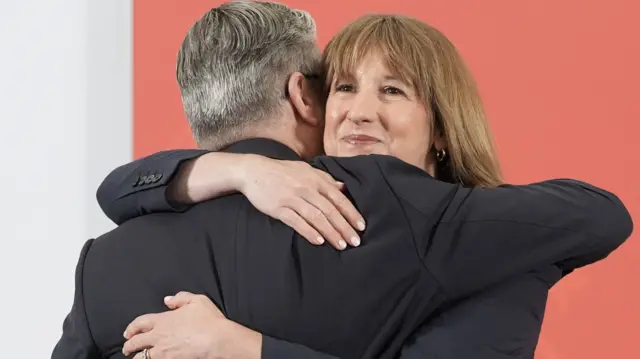
    Britain's Prime Minister Keir Starmer hugs Chancellor of the Exchequer Rachel Reeves, on the day he delivers a speech, following the publication of long-delayed defence investment plan, in Berkshire, Britain, June 30, 2026Image source, Reuters

    Reeves continues her speech by paying tribute to Starmer.

    She says the UK's defence has been a "defining pillar" of his leadership and his "moral clarity" against the threats the country faces will be part of his legacy.

    Reeves calls Starmer her "friend" before introducing him to the stage.