Summary

  • An Indonesian court has found 19 people guilty of trafficking 34 babies in Indonesia and Singapore

  • The ringleader, a 70-year-old woman, was given the harshest sentence of seven years while others received sentences ranging from three to six years

  • The trafficking ring illegally bought babies in West Java and sold them for adoption in Indonesia and Singapore between 2023 and 2025

  • Of the 34 babies, 12 are believed to already be in Singapore

  • The high-profile case has highlighted the enduring problem of child trafficking in Indonesia, often fuelled by parents who sell their children

Media caption,
A baby trafficking ring has been convicted - but what now for the babies?
  1. What to know about today's verdictpublished at 08:59 BST

    An Indonesian court has convicted 19 members of a trafficking syndicate that illegally bought at least 34 babies in Indonesia and sold them under the guise of adoption, including to couples in Singapore.

    Here are the biggest takeaways:

    • Lie Siu Luan, 70, is the ringleader who recruited people to source babies, forge documents and broker deals. She has been sentenced to seven years in prison - the longest out of everyone
    • The other 18 defendants, which include the babies' caregivers, brokers and some who posed as the children's biological mothers, were handed jail terms ranging from three to six-and-a-half years. At least one defendant has said she would appeal
    • A brief timeline: The trafficking ring, which was operating since 2023, came to light last year under police investigation

    We're ending our live coverage now - thank you for joining us

  2. What happens now to the babies?published at 08:56 BST

    Nineteen people have been found guilty of trafficking, but the biggest question hasn't been answered in court: what will happen to the trafficked babies?

    Our reporters Tessa Wong and Astudestra Ajengrastri explain what's next.

    Media caption,

    A baby trafficking ring has been convicted - but what now for the babies?

  3. What happens to trafficked babies in Indonesia?published at 08:55 BST

    Astudestra Ajengrastri
    BBC World Service

    According to Indonesia's Ministry of Social Affairs, rescued babies from trafficking cases undergo assessment and rehabilitation to determine their legal status and the most suitable care arrangements.

    Authorities assess whether a child can safely return to their biological family or should be placed in alternative care “in accordance with child protection regulations, with the goal of ensuring safe, legal, and long-term caregiving”.

    It is unclear how long this process typically takes.

    “Information about where the children go afterward and who has access to them is generally not public,” said Ni Made Martini Puteri, a criminologist and lecturer at the University of Indonesia, in an earlier interview with the BBC.

    If the children were eventually placed with adoptive families, they "generally do not want to discuss those details,” she added.

    Currently, eight rescued babies remain under state care at an orphanage in West Java.

  4. No evidence that defendant committed forgery - lawyerpublished at 08:48 BST

    As we reported earlier, Lai Siu Ha, who was accused of forging identity documents for the babies, has decided to appeal her sentence.

    She was handed six years and seven months in prison.

    In a statement, her lawyers have said that they are "disappointed" with the sentence.

    While Lai "did carry out the acts in question ... what she did was purely in line with her assigned role, which related to the processing of civil registration documents", they argue.

    There was no evidence during the trial that showed she had committed document forgery, they add.

    The lawyers say that their two other clients, which include Astri Fitrinika - the alleged main broker in the syndicate - are still considering their options.

  5. Case has raised questions in Singaporepublished at 08:35 BST

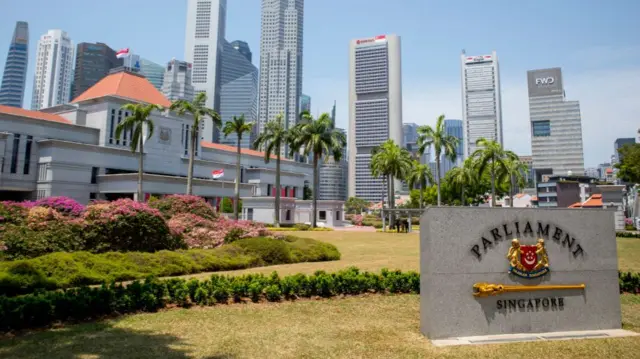
    Singapore's parliament buildingImage source, Getty Images

    While the alleged syndicate has now been convicted in Indonesia, the case has also made headlines in Singapore, where at least a dozen of the allegedly trafficked babies are believed to have ended up.

    Since accusations against Lie and her associates first surfaced last year, Singaporean lawmakers, from both ruling and opposition parties, have raised multiple questions about the country's adoption regulations.

    Some have questioned the effectiveness of these regulations when it comes to overseas adoption. Others asked for authorities to step up measures to support adoptive parents in conducting due diligence.

    The Ministry of Social and Family Development has argued that the adoption agencies are responsible for conducting rigorous checks, and adoptive parents should do their due diligence.

    In February, Singaporean authorities pledged to review child adoption processes after facts surrounding the alleged baby trafficking ring become clearer.

  6. Knotty issues raised by trafficking casepublished at 08:29 BST

    The case has raised difficult questions about international adoption, how trafficking networks operate and why vulnerable parents give up their babies.

    Last week our reporters Tessa Wong in Singapore and Astudestra Ajengrastri in Jakarta dissected these knotty issues with Mariko Oi of the Asia Specific podcast - have a listen.

  7. 'I just cried every day': A mother in a baby trafficking ordealpublished at 08:23 BST

    Quinawaty Pasaribu
    BBC Indonesian

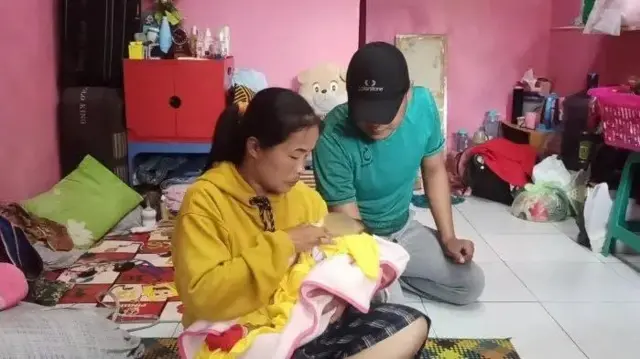
    Erika cradling her baby in a room

    I previously spoke to Erika Ratna Sari, 39, a mother and victim of another baby trafficking ring.

    Her experience took place in 2023 and is not linked to today's syndicate.

    Erika, who lives in Jakarta, said a midwife had pressured her to surrender her newborn daughter because she could not afford the Rp3.5 million (US$200; £150) delivery fee.

    She said the midwife had urged her and her husband to put the baby up for adoption, arguing that they could not provide a proper future for the child.

    The couple gave in after what they said was hours of persuading. They signed the papers and received some money from the clinic - it is not clear how much. Erika was told she would never see her daughter again.

    "I just cried every day," Erika said.

    For 26 days, she returned to the clinic almost daily, pleading for information about her daughter, but was repeatedly turned away.She eventually sought help from a pro bono lawyer and was reunited with her baby a month later.

    The child had already been placed with adoptive parents, who, upon learning the baby had allegedly been obtained through an unlawful scheme, agreed to return her to Erika.

    "I hugged my baby immediately... [and] thanked God for bringing us back together," she said.

  8. Difficulties of transnational crime investigationspublished at 08:10 BST

    Astudestra Ajengrastri
    BBC World Service

    One of the issues raised by the case is how justice will be pursued across Indonesia and Singapore.

    "That's one of the difficulties with transnational crimes," Ni Made Martini Puteri, a criminologist and lecturer at the University of Indonesia told the BBC.

    "Should they be treated under Indonesian law or Singaporean law?"

    She noted that differences in legal definitions, jurisdiction, and bilateral agreements can complicate investigations.

    She also warned that transnational cases can become entangled with national interests.

    "Cross-border crime is always more difficult. Often, instead of focusing on the crime itself, countries become concerned with defending their image," she said.

    "People don't want their own country portrayed negatively."

  9. We accept the decision, says ringleader's lawyerpublished at 08:01 BST

    We are now hearing from the lawyer of one of the defendants, Lie Siu Luan, also known as Lily - the ringleader of the syndicate.

    "This was a consideration from our client, essentially accepting the decision. That was her decision. We lawyers are not allowed to give any direction. But in essence she accepted the decision," Sendi Senjaya told the BBC.

    "What is clear is that this is still much better than the demands of the prosecution service, who charged her with 10 years. So I think maybe the judge's consideration was that she regretted her actions. And secondly, in terms of age, she is already quite old, more than 70 years of age," said Sendaya, who added that Lily had recently been in hospital, adding that it could have been a contributing factor in the judge's sentencing.

  10. Indonesian and Singaporean governments contacted for responsepublished at 07:47 BST

    Tessa Wong and Astudestra Ajengrastri

    The BBC has contacted Indonesia's Ministry of Foreign Affairs to ask about the government's next steps regarding the babies currently in Singapore, including whether any coordination has taken place with Singaporean authorities on their potential repatriation to Indonesia

    We have also asked the Indonesian police whether there will be any further coordination with their Singaporean counterparts.

    In Singapore, we have asked the ministries overseeing home affairs and social and family development for comment on the verdict.

    We have also asked whether they will be taking action against the Singapore-based individuals who purportedly collaborated with the Indonesian trafficking ring, and the Singaporean adoption agency that allegedly handled the babies.

    We'll update with the latest if we hear back from either government.

  11. 'What will happen to our son?' asks Singaporean parent of adopted babypublished at 07:36 BST

    Tessa Wong
    Asia Digital Reporter

    I've just spoken to David, the Singaporean parent who I interviewed for our piece on the case.

    David and his wife Ally had adopted Marcus from Indonesia a few years ago. Marcus is believed to be one of the babies trafficked by the West Java syndicate.

    Upon hearing the verdict of the case, this is what David told me over text:

    "I do not wish to focus on the verdict itself. My main concern has always been, and continues to be, what will happen to my son.

    "I sincerely hope that both authorities can come to a decision based on the best interests of the child. We respectfully ask that, in making this decision, consideration be given to the fact that both our son and our family are victims of the circumstances surrounding this case.

    "Our only wish is to live a normal family life, like any other couple hoping to raise a child in a safe, stable, and loving home. We hope that this matter can now be brought to a resolution so that our son can move forward with certainty and security.

    "Since the case is concluded, how can we move on and what will happen to our son? It’s been almost a year of fear and anxiety of waiting."

    Read more on Marcus' story here.

    Names have all been changed

  12. How the case came to lightpublished at 07:14 BST

    Tessa Wong
    Asia Digital Reporter

    In April 2025, Dani Hidayat marched into a police station in West Java, Indonesia with a disturbing claim: his newborn son had been kidnapped.

    A woman he had met online had taken his baby and now she could not be contacted, Hidayat claimed.After police probed further, they found out that Hidayat had met the woman on a Facebook group for adoptions.

    The woman had claimed she could not have children, and Hidayat said she could adopt his baby in exchange for millions of rupiah. Hidayat had gone to the police after he failed to receive one of the payments.

    That woman turned out to be Astri Fitrinika, the alleged main broker in the trafficking ring. When police caught her and inspected her phone, they found she had procured dozens more babies - uncovering the rest of the syndicate's activities.

  13. All 19 defendants convicted and sentencedpublished at 07:08 BST

    All 19 defendants have been found guilty and sentenced to between three and seven years in prison.

    At least one of them - Lai Siu Ha, who falsified documents - is appealing against their sentence.

    Apart from the sentences detailed below, a group of six women who posed as the biological mothers of the babies and took care of them were sentenced to three years and four months each.

  14. Six-and-a-half years for main baby brokerpublished at 07:00 BST
    Breaking

    Liza Tambunan
    Reporting from court

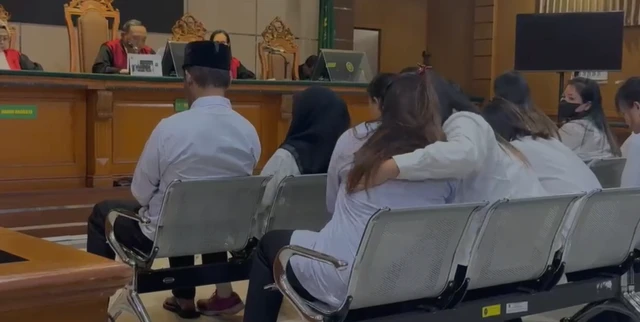
    Astri (woman on the left) was hugged by another woman as her verdict was read
    Image caption,

    Astri (woman on the left) was hugged by another woman as her verdict was read

    Six years and seven months for Astri Fitrinika, who is accused of being the main broker who allegedly sourced and procured almost all of the babies.

    We saw Astri in court just now looking distraught, and officials had to calm her down.

    She was being hugged by another defendant in court. They held onto each other tighter as her verdict was read out. And upon hearing it, she let out a small wail and seems to be crying.

  15. Ringleader Lie Siu Luan sentenced to seven years in prisonpublished at 06:45 BST
    Breaking

    Liza Tambunan
    Reporting from court

    Lie Siu Luan, the ringleader of the baby trafficking syndicate, has been sentenced to seven years in prison.

    This is lower than the 10-year sentence prosecutors had sought for her.

    She was accused of recruiting others and running the trafficking operation.

    I can only see her face partially, as she and the other defendants are seated in front of me, but she appeared to keep a straight face, sitting upright as the judge read out the verdict.

  16. Only man in syndicate given six-and-a-half years in prisonpublished at 06:42 BST

    Djaka Hamdani Hutabarat, the only man among the 19 defendants, has been given six years and seven months in prison. He had acted as a broker in the trafficking syndicate.

    Another woman, who also acted as a broker, has been sentenced alongside him.

  17. Three more women sentenced: Three years in prisonpublished at 06:38 BST
    Breaking

    Two women who had acted as brokers in the trafficking ring has been sentenced to three years and four months in prison.

    Another woman, who had served as a caregiver to the babies, was also handed three years and four months in prison.

  18. Six years in prison for woman who falsified documentspublished at 06:36 BST
    Breaking

    Lai Siu Ha, one of the main figures in the trafficking ring, has been sentenced to six years and seven months in prison.

    She was accused of providing falsified information for documents for the babies, including birth certificates and Indonesian family cards.

  19. Caregivers handed three years in prisonpublished at 06:33 BST
    Breaking

    The first batch of the verdicts are out: Five women, who acted as caregivers to the trafficked babies, have each been sentenced to three years and four months in prison.

  20. Chief judge's opening remarkspublished at 06:26 BST

    Yuli Saputra
    Reporting from court

    Gatot Ardian Agustriono, the chief judge on a panel of three, has made his opening remarks, addressing the defendants:

    "I would like to convey to you that whatever this decision is, you have the right to accept this decision if it is in accordance with the wishes that exist within you, or reject this decision by making efforts to educate yourself if you still don't accept the verdict."