Summary

  • Record numbers have voted in Hungary, where Prime Minister Viktor Orbán and his party Fidesz are seeking to retain power after 16 years

  • Péter Magyar and his party Tisza could be on course for victory, according to some of the final opinion polls - though there is no reliable exit poll and counting is only just beginning

  • Magyar, who has promised closer ties with Europe and to reverse controversial Orbán-era reforms if he wins, says he is "optimistic but cautious"

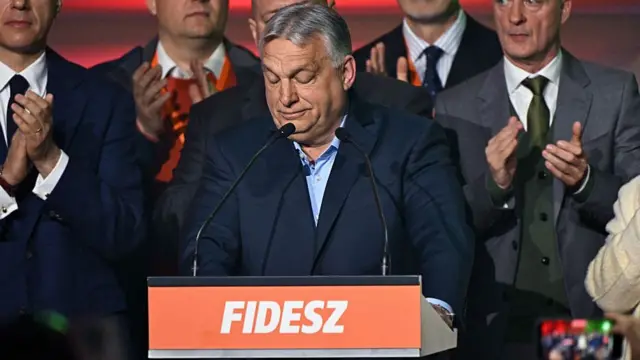
  • Orbán is a Donald Trump ally who has close ties with the Kremlin, has sought to block support to Ukraine and has been accused of undermining Hungary's democracy by the EU - we're yet to hear from him this evening

  • The prime minister's fate will be watched closely by his allies Trump and Vladimir Putin, our Europe editor Katya Adler writes

  • Polls were due to close at 19:00 local time (18:00 BST) but voters already waiting at polling stations can still cast their ballot. We'll bring you the latest results and analysis from our team in Budapest throughout - get up to speed on the background to the election here

  1. Far-right party could make it into parliament, early results suggestpublished at 19:58 BST

    Nick Thorpe
    Central Europe correspondent, in Budapest

    Just 21.5% of the vote has been counted so far, but as it stands, the far-right Our Homeland party is hovering close to the 5% threshold needed to enter parliament.

    It looks set to be the only minor party in contention for a seat, though it massively trails the two main parties.

    The race between Fidesz and Tisza looks close, with only 3 or 4% dividing them - Fidesz leading in some places, Tisza in others.

    The count has been fastest in mostly western Hungarian districts.

  2. Counting under way and early results coming inpublished at 19:43 BST

    Paul Kirby
    Europe digital editor in Budapest

    Polls closed more than an hour and a half ago in most places and results have started to trickle in.

    It's far too early to make any assessment but we're now at 21.54% of the vote and so far Tisza is ahead in 92 constituencies, while Fidesz is in the lead in 13 constituencies.

    Earlier, we explained that Hungarians voting in Hungary have two votes - and that second count isn't as far advanced as the seats.

    In other words, it's still very early to draw any conclusions.

    Another point to make is that the big cities take longer to report their results, while the smaller towns and villages where Fidesz is strongest tend to be quicker.

  3. What is Moscow’s interest in the Hungarian elections?published at 19:36 BST

    Natalia Zotova
    BBC News Russian

    Hungarian Prime Minister Viktor Orbán and Russian President Vladimir Putin, both wearing suits. Orbán is wearing a dark green tie and Putin is wearing a red one.Image source, EPA-EFE/REX/Shutterstock
    Image caption,

    Orbán and Putin following talks in Moscow in July 2024

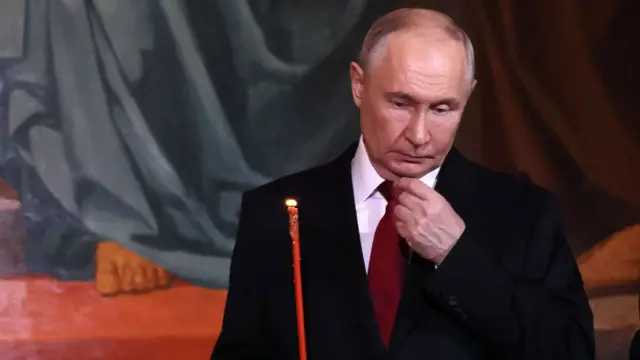
    Moscow’s interest in the Hungarian elections has been evident, with Viktor Orbán the only EU leader who systematically blocks sanctions and military aid to Ukraine, as well as supports gas deals with Russia.

    Before the elections, Bloomberg published a transcript of a conversation between Russian President Vladimir Putin and Orbán from October 2025.

    In it, Orbán reportedly compared himself to a mouse that saves a lion, after which the lion does not kill it.

    Orbán also reportedly assured Putin that on any issue where he could be useful “I am at your service”.

    That publication did not trouble the Kremlin in the slightest, which said it “shows Orbán from a very pragmatic and effective point of view”, someone who “defends the interests of his country”.

  4. Orbán tried to link main rival with Zelensky throughout campaignpublished at 19:28 BST

    Katya Adler
    BBC Europe editor, in Budapest

    A wall of Hungarian election posters, showing Volodymyr Zelensky and Péter Magyar.in black and white

    One of the main election posters put up by Fidesz, Victor Orbán’s party, throughout the campaign sported two black and white mugshots featuring Ukraine’s President Volodymyr Zelensky and Hungary’s leading opposition figure Péter Magyar.

    “Let’s stop them!” reads the slogan. I’ve covered many elections here, and Orbán loves to select an enemy he promises to protect voters from.

    In the past, it’s been migrants, the EU, the political left. This year it was the war in neighbouring Ukraine.

    Orbán tells Hungarians the opposition would open the floodgates to the war over the border, putting lives at home at risk.

    But will it have been eneough to persuade voters to flock to him?

    People we’ve spoken to are generally concerned about the poor state of Hungary's economy - the rising inflation and dwindling standards of living suffered in recent years.

  5. Opposition lured new and disillusioned voters, poll suggestspublished at 19:22 BST

    Rita Palfi
    BBC World Service, in Budapest

    One of the key polls we've reported on this evening, by respected pollster Median, asked Hungarians who they backed four years ago in the days leading up to today's vote and the answers are intriguing.

    Opposition party Tisza won the support of 62% of Hungarians who either did not vote or were not old enough to in 2022, while Fidesz secured the backing of just 16% of these two groups, Median suggests.

    The pollster also says Tisza managed to lure 9% of Fidesz voters as well as 91% of pro-opposition voters from 2022.

    Meanwhile, Median's poll says Fidesz maintained the support of 79% of its 2022 electorate.

    But remember, this is just one opinion poll and there is no reliable exit poll. We won't know where this election is heading until we start to get results.

  6. Champagne corks go pop among Magyar supporterspublished at 19:13 BST

    Rajini Vaidyanathan
    BBC presenter, in Budapest

    Crowds in BudapestImage source, Reuters

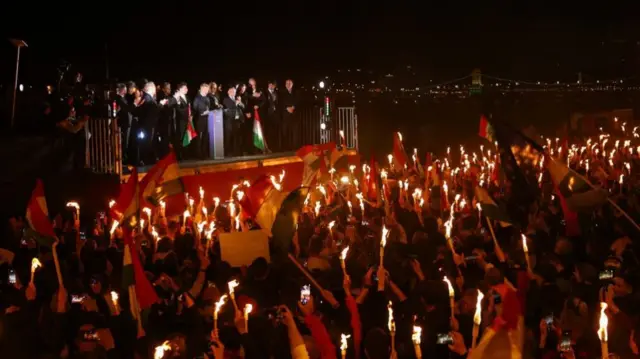
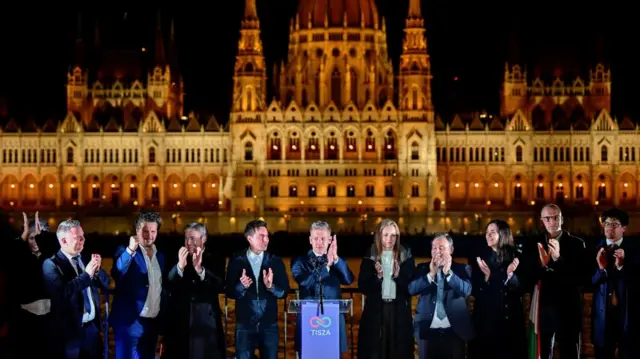
    Large screens have been put up on the banks of the Danube here in Budapest, close to the National Assembly parliament building.

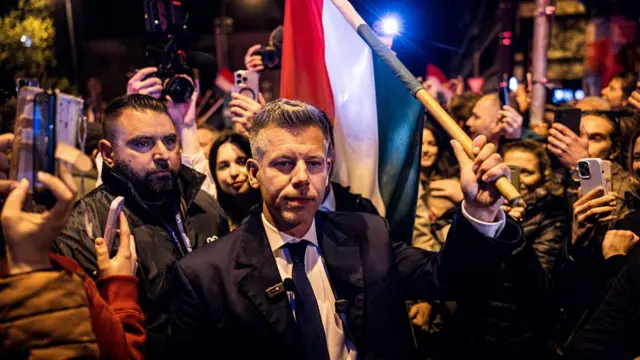
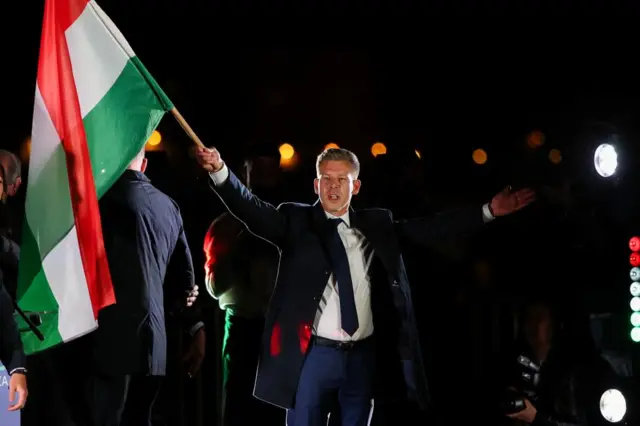
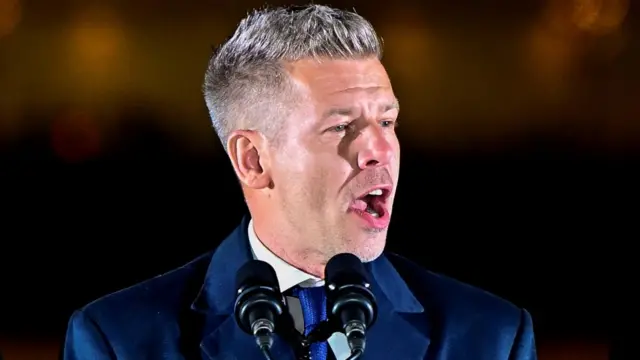
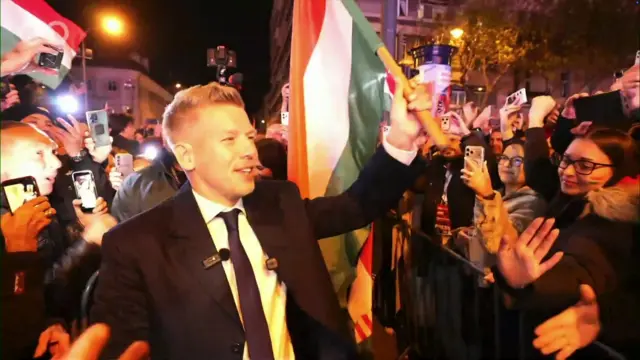
    Péter Magyar appeared on those screens to deliver his supporters a message, saying: "We are optimistic but cautious."

    He said his campaign chief would update everyone in 45 minutes time, but suggested this would be a good night for his Tisza party.

    The only poll that really matters, he said, is the final tally when votes are counted.

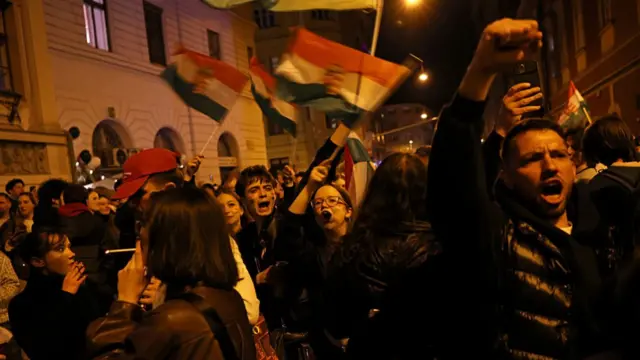
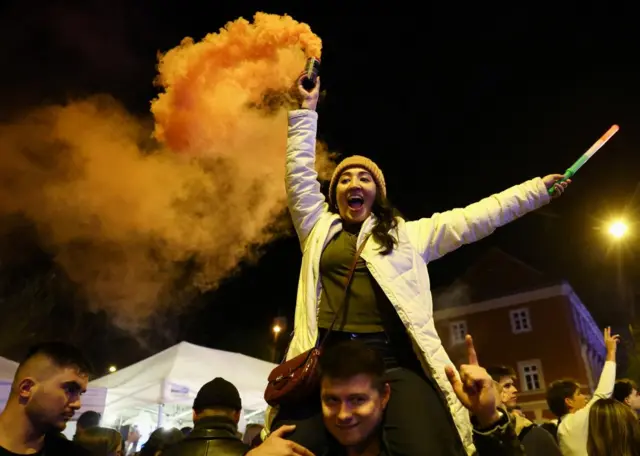
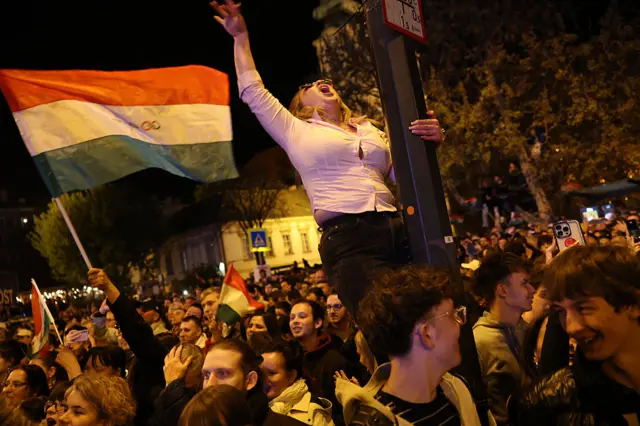
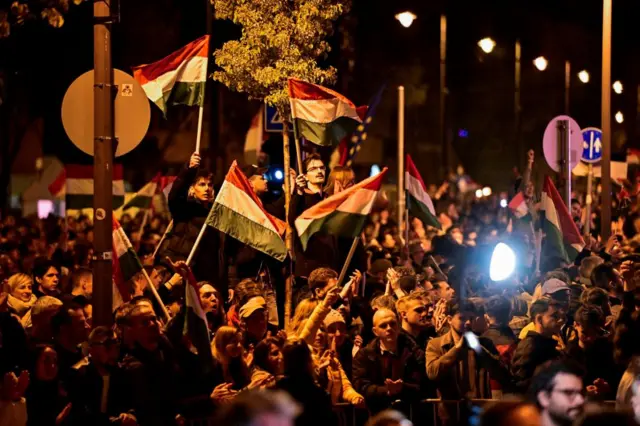
    But celebrations have already started and we could hear champagne corks popping.

    It's still too early, perhaps - but is this a sign the Orbán years might be coming to a close?

  7. Pollster close to government suggests Orbán victorypublished at 18:59 BST

    Paul Kirby
    Europe digital editor in Budapest

    The two opinion polls we've reported so far pointing to a Magyar victory are both well respected and have a good record in Hungarian elections, both Median and 21 Research Centre.

    But there are other pollsters - and Alapjogokért has published its research this evening suggesting Orbán is heading for victory rather than his rival.

    Until we have results to go from, we can only report what we see.

    According to the Alapjogokért poll, the ruling Fidesz party is on course for 44.5% of the vote and Tisza 42%.

    Take this poll with a dose of scepticism, and we expect the first results to emerge in the coming hour.

  8. Magyar labels claims of violent agitation a 'hallucination'published at 18:53 BST

    Zsofia Paulikovics
    BBC World Service

    Péter Magyar is still speaking at a press conference. He thanks everyone who helped counter what he calls election fraud, and says you can see from the data that buying votes has been less successful than in elections in 2022 and 2018.

    The challenger says Fidesz have claimed there will be violent agitation later on in the day, which he dismisses as “an hallucination”.

    He asks everyone to be peaceful, patient, and prepare for celebrations later on.

  9. Outcome of opinion polls in line with their earlier surveyspublished at 18:43 BST

    Paul Kirby
    Europe digital editor in Budapest

    Just a note of caution about the two opinion polls that have just come out.

    As we've reported, they are not exit polls and they were not conducted among Hungarians who had yet voted, but up to and including yesterday.

    And it is also worth pointing out that previous polls by the same pollsters, Median and 21 Research Centre, also suggested a big margin of victory for Péter Magyar.

    So while Magyar is currently talking about history being written - we need to wait for the results to give us a sense of what Hungarians have actually voted for since 06:00 (05:00 BST) this morning.

  10. Opposition candidate 'optimistic but cautious' after polls suggest Orbán losspublished at 18:42 BST

    Zsofia Paulikovics
    BBC World Service

    Peter MagyarImage source, Reuters

    Péter Magyar, who is seeking to replace Viktor Orbán as prime minister, is now holding a press conference on what he calls a "historic day".

    He thanks all voters for turning out in record numbers and recognising the importance of the election.

    Magyar says he is "optimistic but cautious" after some opinion polls pointed to him winning.

  11. Postpublished at 18:35 BST

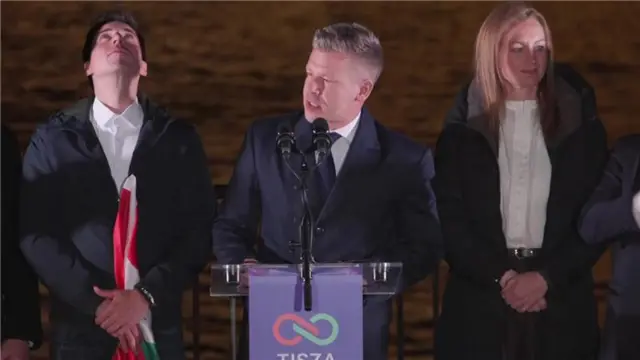
    Péter Magyar is speaking now for the first time since polls closed - we'll bring you more soon.

  12. Final opinion polls suggest Péter Magyar heading for big victorypublished at 18:18 BST
    Breaking

    Paul Kirby
    Europe digital editor, in Budapest

    Two opinion polls have just been published to mark the end of voting and both give opposition party Tisza a big victory, which would see Péter Magyar oust Viktor Orbán.

    The Median poll has put Magyar's party on 57.1% of the vote. It suggests that would give Tisza 135 seats, just over the 133 it needs for a two-thirds majority, while a 21 Research Centre poll gives Magyar 55% and 132 seats.

    Median suggests Orbán's party is heading for 37.1% of the vote, and 21 Research Centre gives Fidesz 38%.

    These are only opinion polls - Median says its survey was conducted from 7-11 April, while 21 Research Centre says its poll was taken between 8-11 April.

    These are not in any sense exit polls - but if confirmed, it means Orbán would be out of office after 16 years.

  13. Polls due to close in pivotal Hungarian election with record turnoutpublished at 18:00 BST
    Breaking

    Rita Palfi
    BBC World Service, Budapest

    Across Hungary, polling stations are due to close now. We won't know any results for a while and there's no exit poll in this election.

    But some of the polling stations won't close their doors immediately. They will remain open until everyone queuing up to vote at that time has had a chance to cast their ballot in this highly significant election.

    We already know there's been a record turnout - the latest figure from half an hour ago was 77.8% - well above the previous record in 2002 of 73.51%.

    The reason behind the long queues is partly due to the high turnout but also, under Hungarian electoral law, voters can choose to go to polling stations in other cities and vote for candidates in their hometown.

    That means thousands of extra voters have been turning up at polling stations particularly in big cities such as Budapest.

  14. What you need to know about Hungary's pivotal electionpublished at 17:59 BST

    Joe Coughlan
    Live reporter

    If you're just joining our coverage, we've had analysis and reporting from Hungary throughout the day. Here's what you need to know:

  15. Péter Magyar, the former Orbán ally who could replace him as PMpublished at 17:40 BST

    Roland Sebestyén
    BBC World Service

    Péter Magyar talks to media while wearing a navy suit and a black tie.Image source, EPA/Shutterstock

    Until recently, it was inconceivable that anyone could really challenge Viktor Orbán from within Fidesz’s circles - and Péter Magyar, the former husband of ex-justice minister Judit Varga, was certainly off the radar.

    But he quit the party following the resignations of President Katalin Novák and Varga after a child-abuse scandal in February 2024, becoming one of its fiercest critics and quickly establishing himself as Hungary's most visible opposition campaigner.

    Through his party connections, Magyar has had a front-row seat on how Fidesz operates, understanding what Orbán is all about.

    The prime minister dominates the political sceneand knows how to create an argument that he, and only he, can win.

    But Magyar, a 45-year-old lawyer, has taken every opportunity he has had to gain visibility since announcing he was running in the election.

    If Orbán organises a march, so does he. If Orbán tours the country, so does he.

    We'll know shortly whether that's enough to topple him after 16 years.

    You can click here to read a longer feature about Magyar's rapid rise in Hungarian politics.

  16. Who is Viktor Orbán, the Hungarian PM fighting to stay in power after 16 years?published at 17:29 BST

    Joe Coughlan
    Live reporter

    Hungarian Prime Minister Viktor Orban leaves after voting during the Hungarian parliamentary election in Budapest, Hungary, on 12 April 2026. He is wearing a white shirt and black blazer and is accompanied by several colleagues..Image source, Reuters
    Image caption,

    Orbán leaves a polling centre after voting in this year's election

    Viktor Orbán became leader of the Fidesz party in 1993, pushing it to the centre-right and leading it to election victory in 1998 - becoming Europe's youngest prime minister at 35.

    His political ideology is thought to have shifted during the second half of the 1990s, according to political scientist Zoltan Lakner, when he realised he had to transform his party into a nationalist force to combat the liberal-socialist coalition governing Hungary.

    Orbán suffered two political defeats in 2002 and 2006, before being swept back into office in the turbulence of the global economic crisis in 2010 and winning four consecutive elections.

    Since then, he has transformed Hungary with a host of changes to its laws and constitution, passing more than 40 "cardinal laws" in an attempt to secure his legacy.

    However, expensive state projects were placed in the hands of Orbán's inner circle and he has been accused of wielding huge influence over the country's media and judiciary, which many analysts say has undermined democracy in Hungary.

    Under Orbán, Hungary has been labelled the EU's most corrupt member by Transparency International - though the long-serving prime minister has won support from many voters during his time in office.

    You can read more about Orbán and how he has changed Hungary elsewhere on the BBC News website.

  17. Volunteer groups watch for voter intimidation at polling stationspublished at 17:22 BST

    Nick Thorpe
    Central Europe Correspondent, in Budapest

    A voting slip is examined by someone at a polling station in HungaryImage source, Getty Images

    "We are very happy and proud that so far, our film seems to have had a strong deterrent effect," says Aron Timar, the filmmaker behind The Price of the Vote documentary.

    The DE Action community spent six months documenting past and present voter intimidation in poor settlements across Hungary. Their film was posted on YouTube in March, and has 2.2 million views so far.

    They identified 100 districts where the population are particularly vulnerable to intimidation and vote buying.

    On voting day, their network of 2,400 volunteers and 200 motorcyclists have kept watch outside polling stations in those districts, to identify suspicious activities, in particular, bussing people to vote.

    Timar tells the BBC that "known organisers largely stayed away, fearing legal consequences", and turnout has consequently been far lower than the very high turnout registered elsewhere in those districts.

    The human rights and democracy office of the Organization for Security and Co-Operation (OSCE) has a full mission in Hungary. There are also a number of civic initiatives, watching for fraud.

    The Patriots for Europe group in the European Parliament, to which the governing Fidesz party in Hungary also belongs, has also organised there own monitoring mission. There have been several allegations of fraud.

  18. Who are the smaller parties on the ballot?published at 17:04 BST

    Zsofia Paulikovics
    BBC World Service

    A Hungarian election poster showing a cartoon of a dog with two tails wearing a tieImage source, Getty
    Image caption,

    A poster for the Hungarian Two-Tailed Dog Party

    While all eyes are on Fidesz and its challenger Tisza, there are some smaller parties vying for a place in parliament. To do so, they must secure at least 5% of the votes.

    The Hungarian Two-Tailed Dog Party (Magyar Kétfarkú Kutyapárt) is a satirical opposition party which gained some seats in local government in 2024 and now have their sights set on the national list.

    The Democratic Coalition (Demokratikus Koalíció) is a social democratic party founded by former Prime Minister Ferenc Gyurcsány in 2011, as a breakaway faction of the Socialist Party (MSZP). It is currently led by Klára Dobrev, an MEP and Gyurcsány’s ex-wife.

    The far-right Our Homeland (Mi Hazánk), led by László Toroczkai, is the small party which the polls predict is most likely to make it into parliament. While they claim they intend to act as a counter-balance to any reigning party, analysts have suggested that Our Homeland might informally support a minority Fidesz government.

  19. High turnout good news for opposition, says Magyar colleaguepublished at 16:51 BST

    Paul Kirby
    Europe digital editor, in Budapest

    Turnout being on course to break records is “absolutely good” for the opposition, the man picked by Péter Magyar to run his health policy, Zsolt Hegedűs, told me earlier today.

    “The message was all the time that every vote counts and everybody should turn out… so I hope that the two-thirds [majority]” will be achieved,” he said at a polling station a stone’s throw from Budapest’s parliament building.

    Hungarians complain their health system is dilapidated and underfunded and staff have gone to work abroad in big numbers.

    With a simple majority Hegedűs believes he could make a difference, with a change in attitudes across the healthcare system because “honesty and transparency and professionalism is missing in the Hungarian healthcare system”.

    “Obviously with a two-thirds majority it’ll be much easier, because… the government will be more stable, and in this way we can show much more easily some early achievement to the people and the pressure on the health system will be just a little bit less.”

    • For context, 133 parliamentary seats - a two-thirds majority - is the number needed to push through changes to Hungary's constitution. We have more on this in our earlier post.
  20. Turnout breaks Hungarian record - and voting isn't finished yetpublished at 16:38 BST
    Breaking

    Paul Kirby
    Europe digital editor, in Budapest

    We've just had the turnout figure for 17:00 (16:00 BST) and it's now 74.23%, a record for an election in Hungary.

    Last time around in 2022 it was 62.92%, and with more than an hour until polls close turnout has already surpassed the previous highest level of 73.51% in 2002.

    Political analyst Gábor Török suggests it could be on course for an 80% turnout when polls close.

    That doesn't necessarily mean it favours one party over another - although it's bad news for the far-right party Our Homeland and other smaller parties that need 5% of the vote to get into parliament.

    Péter Magyar's Tisza has already said it's good news for the opposition, but both leaders are calling on voters to get to the polls by 19:00.

    Here's Viktor Orbán's take on social media: "There are a lot of people voting. This means only one thing. If we want to protect Hungary's safety, not one patriot can stay at home!"

    Meanwhile Magyar says: "Now we have to give all we've got! Vote and encourage everyone to do this. Every vote could be decisive!"