Summary

  • This live coverage has closed - see our analysis here

  • Ballots are being counted in four Indian state elections - West Bengal, Tamil Nadu, Kerala and Assam - and the federal territory of Puducherry

  • Voting trends show PM Narendra Modi's BJP is well ahead in Assam and West Bengal and its alliance looks set to return to power in Puducherry

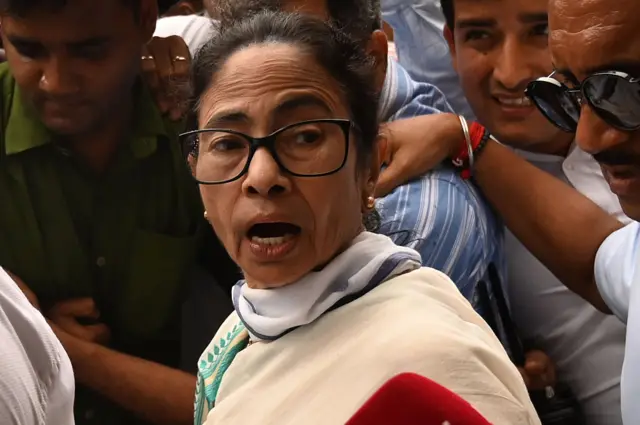
  • West Bengal's incumbent Chief Minister Mamata Banerjee is headed for a shock defeat after serving three terms

  • A setback for Banerjee, as trends suggest, could weaken the opposition bloc in the run-up to the 2029 general election, analysts say

  • Tamil Nadu too is seeing huge political disruption as a new party led by superstar Vijay races ahead, shocking older regional rivals

  • In Kerala, the Congress looks set to defeat a Left party alliance, which had governed the state for two consecutive terms

  1. A day full of surprisespublished at 13:11 BST

    We are now pausing our live coverage. Counting is still under way, but the results are largely clear - and what stands out is just how many surprises these elections have produced.

    • West Bengal is expected to deliver perhaps the biggest shock of all, with PM Modi’s BJP on course for what would be a historic breakthrough. If trends hold, the party is expected to decisively cross the majority mark in a state that has long resisted it, dealing a major blow to Mamata Banerjee’s TMC which ruled the state since 2011.
    • In Tamil Nadu, there's been another unexpected twist. Actor-turned-politician Vijay has emerged as the breakout figure, with his party’s surge dismantling the state’s entrenched two-party order and putting incumbent chief minister MK Stalin under pressure.
    • Even in Kerala, where politics is often more predictable, there are notable shifts. The Congress-led alliance is ahead of the Left, pointing to yet another swing in the state’s cyclical pattern. But what's also significant is that the BJP is on course to win two seats, marking a modest yet symbolic breakthrough.
    • In Assam, the BJP appears set to retain power, reinforcing its dominance in the northeast region. In Puducherry, the contest remains tight, but the alliance in which BJP is also a part seems poised for a win.

    Taken together, these results suggest an interesting shift - the BJP is expanding into newer areas, while regional parties face unexpected challenges.

    To read more about the elections - and why they matter - click here.

  2. Analysis

    What next for Tamil Nadu?published at 12:37 BST

    Anbarasan Ethirajan
    Global Affairs Reporter

    In a party meeting last year, film star-turned politician C Joseph Vijay kept repeating his name as he read out the names of the constituencies his fledgling party would contest. It went - "Madurai central - Vijay, Tiruchi - Vijay" and so on.

    The message was simple - "don’t worry about the candidates, I am contesting in all the constituencies".

    His supporters, mainly Gen Z, took the message and went all out on social media. Now, they have made history by helping Vijay's TVK emerge as the single largest party - but still short of the majority mark of 118 - in Tamil Nadu as the current trends indicate.

    The superstar can form the state's next government if he can get the support of parties like Congress or other regional parties.

    If that happens, it will be a watershed moment for Tamil Nadu politics. For the first time in 60 years, a non-Dravidian party will be in power.

    Barring a few, almost all his candidates are new to politics and several of them will likely become ministers. There may be questions about how experienced they are to run the government of one of the richest and industrialised states in India.

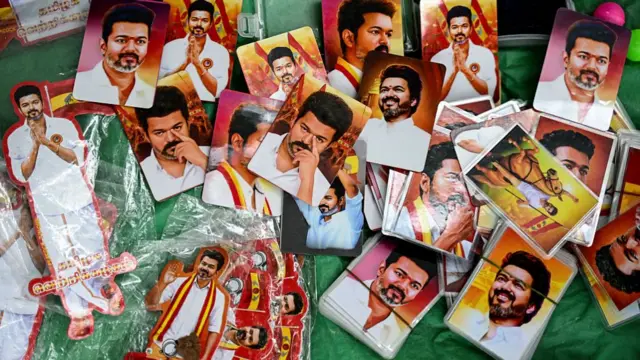
    A vendor sells pictures of Indian actor and Tamilaga Vettri Kazhagam (TVK) party president C. Joseph Vijay during vote counting for the Tamil Nadu Legislative Assembly elections, at the party headquarters in Chennai on May 4, 2026Image source, AFP via Getty Images
    Image caption,

    Trends indicate Vijay and his TVK party are decisevely in the lead - though still short of the halfway mark

    This emerging scenario also raises questions about the performance of the state's two main parties - the DMK and the AIADMK. The current chief minister and leader of the DMK, MK Stalin, is himself staring at a defeat in his Kolathur constituency.

    Despite having an established party machinery, it’s clear now that the party's leaders failed to connect with the youth or understand their anger and frustration. Young people wanted a change, and they have delivered it now.

    It's also a huge setback for AIADMK leader Edappadi K. Palaniswami. It may take a while for supporters to adjust to the new reality and come to terms with how they underestimated the popularity of Vijay.

    Both parties will be going back to the drawing board to see what went wrong and how they can recover from this stunning turn of events.

    But until then, it’s a new dawn for Tamil Nadu.

  3. Big win for Congress in Keralapublished at 12:15 BST

    Votes are still being counted but if trends hold, these are the key takeaways from the state:

    • The Congress finally has something to celebrate after two successive defeats in Kerala (and several other states). Along with its allies, the party look set to form the government.
    • The CPI(M)-led Left coalition could not make history by winning a third term in the state, but what is more worrying for them is that some of their ministers have also lost their seats and others are trailing.
    • The defeat means there will be no state government run by the Left in India for the first time in about five decades. That raises some painful questions for India’s Communist parties, which have seen an erosion in their support base across the country.
    • The BJP looks set to win at least two assembly seats in the state, which would be its highest ever tally in Kerala. The vote share of its larger National Democratic Alliance has increased from the last assembly election in 2021, which will give its future ambitions stronger ground.
  4. A dejected TMC supporterpublished at 12:00 BST

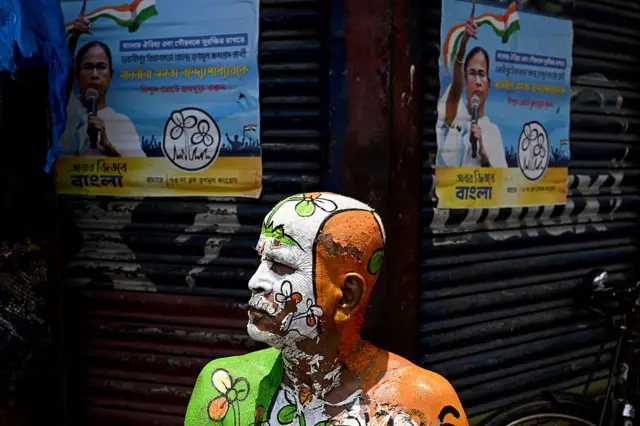
    A supporter of the All India Trinamool Congress (TMC), his body painted with the party’s twin-flower symbol, looks visibly dejected as he follows the results in West Bengal - his downcast expression reflecting the mood among many party workers.

    After more than a decade in power under Chief Minister Mamata Banerjee, the party now appears headed for defeat, with Election Commission trends showing it trailing and unlikely to retain office.

    A TMC supporter with the party election symbol painted on his body sits next to posters of West Bengal Chief Minister Mamata BanerjeeImage source, Dibyangshu SARKAR / AFP via Getty Images
    Image caption,

    A TMC supporter with the party election symbol painted on his body sits next to posters of West Bengal Chief Minister Mamata Banerjee

  5. Analysis

    The urban shift that may have tilted Bengal to BJPpublished at 11:45 BST

    Soutik Biswas
    India Correspondent

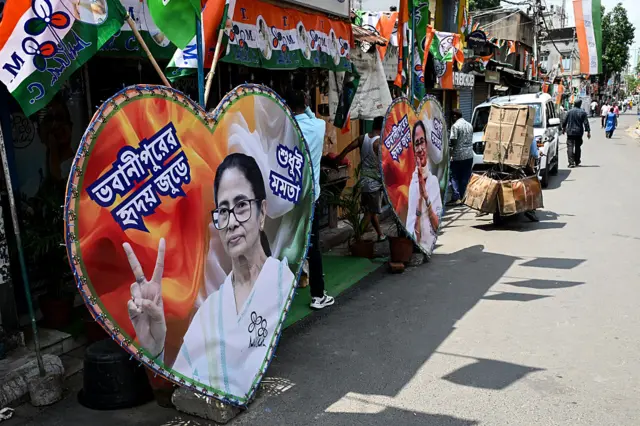
    Posters featuring West Bengal chief minister and All India Trinamool Congress (TMC) party chairperson Mamata Banerjee are placed along a street leading to her residence in Kolkata on May 4, 2026 during vote counting for the West Bengal Legislative Assembly elections. Vote counting in key Indian state elections was underway on May 4 under tight security, with the focus on West Bengal, where Prime Minister Narendra Modi's party appeared set for victory. (Photo by Dibyangshu SARKAR / AFP via Getty Images)Image source, AFP via Getty Images
    Image caption,

    Posters featuring Mamata Banerjee in Kolkata

    Trends in West Bengal appear to mirror findings from a post-election survey by the Data Action Lab for Emerging Societies (DALES), which pointed to a growing urban-suburban shift towards the BJP.

    The survey suggested the party had made significant inroads in Kolkata and its expanding suburban belt - areas where the BJP historically struggled in Bengal.

    Researchers found a clear urban-rural divide emerging in voting behaviour.

    Urban men were markedly more inclined towards the BJP than their rural counterparts, while urban women appeared less supportive of Mamata Banerjee and the Trinamool Congress than women in rural Bengal, where welfare delivery remains politically potent.

    The findings hinted at a broader “urbanity effect”: frustration over governance, corruption and declining faith in welfare delivery may have eroded the TMC’s advantage among middle-class and suburban voters now visible in the counting trends.

  6. Uneasy calm outside Mamata Banerjee's residencepublished at 11:21 BST

    Moyurie Som
    Reporting from West Bengal

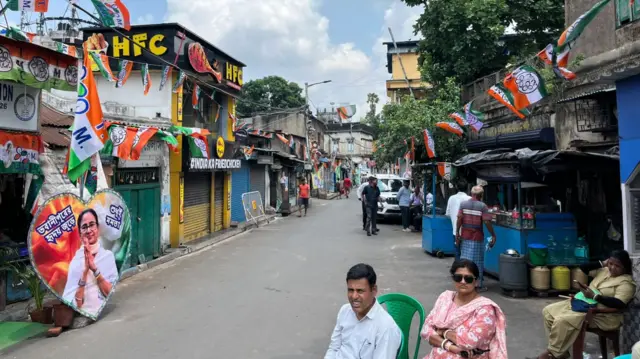
    The mood is subdued in Kolkata’s Kalighat area - home to Chief Minister Mamata Banerjee - which is usually a hub of post-election celebrations.

    Trends indicate a historic victory for Modi's BJP in West Bengal, after years of failed attempts to make a mark here.

    In previous elections, the roads here would be awash in the TMC's green colour, with supporters chanting “Joy Bangla” - a slogan meaning “Victory to Bengal”. This time, the crowd is thinner and the atmosphere muted.

    The slogans are still being chanted, but by BJP supporters on motorbikes who have been moving through the area with party flags.

    People sitting on the street, with a small eatery in the background. The shops are all closed.Image source, Rubaiyat Biswas
    Image caption,

    There is an uneasy silence near Banerjee's residence

    When BBC Bangla spoke to TMC workers here about the results, they declined to comment. Some, however, said that voters had “betrayed” Banerjee, whom they credit for extensive welfare schemes.

    Throughout the campaign, Banerjee maintained her party would win more than 226 of the 294 seats. But on Sunday night, she urged supporters to monitor counting centres closely and ensure the process remained free of irregularities.

    A short while ago, Banerjee posted a video message alleging "slow vote counting" by election officials. She urged party workers and candidates to stay strong, saying trends could reverse once all counting rounds were complete.

  7. Analysis

    What next for Mamata Banerjee?published at 11:09 BST

    Soutik Biswas
    India Correspondent

    KOLKATA, INDIA - APRIL 29: Chief Minister and AITC candidate for Bhabanipur Assembly Constituency Mamata Banerjee visits and interacts with people on 2nd phase and final phase of West Bengal Legislative Assembly Election at Chakraberia area in Bhabanipur on April 29, 2026 in Kolkata, India. Voting for the second and final phase of the West Bengal Assembly Elections 2026 is currently underway across 142 constituencies. The second phase recorded a massive 89.99 per cent voter turnout till 5 pm, according to Election Commission data. The first phase of polling was held on April 23. Vote counting for all 294 seats will be held on May 4. The main contest in the state is seen between the ruling Trinamool Congress and the BJP. (Photo by Samir Jana/Hindustan Times via Getty Images)Image source, Hindustan Times via Getty Images

    What would defeat mean for Mamata Banerjee?

    At 71, Bengal’s most formidable politician faces perhaps the hardest battle of her career: holding together a party many analysts describe as less an ideological movement than a sprawling political club bound by access to power.

    The Trinamool Congress was built around Banerjee’s charisma, welfare politics and relentless street-fighting instinct.

    But Bengal’s politics has long been unforgiving to defeated ruling parties, with leaders and local strongmen often drifting rapidly towards the new centre of power.

    The immediate question is whether Banerjee can prevent defections to the BJP and preserve the TMC as a coherent force.

    Bengal has effectively been ruled by only two dominant parties over the past half century.

    Whether Banerjee can reinvent herself once again - or gradually fade from the centre of the state’s politics - may now define the next phase of Bengal’s political history.

  8. BJP’s ally set to retain power in Puducherrypublished at 11:04 BST

    Anbarasan Ethirajan
    Global Affairs Reporter

    In southern India’s Puducherry, the National Democratic Alliance, led by a regional party named All-India N R Congress (AINRC) is on course for the majority mark.

    The AINRC and its ally BJP are so far leading in 15 constituencies, of which they have won four, according to Election Commission’s live data.

    Chief Minister N Rangasamy, who heads AINRC, has won the Thattanchavady seat with a margin of more than 4,000 votes.

    In this coastal enclave too, the political party of Tamil actor-turned-politician Vijay has made its electoral debut - it has already won one seat and is leading in one more.

    The main opposition in the state is an alliance of the DMK and Congress parties, which witnessed internal friction over seat sharing. A few Congress party candidates refused to withdraw their nominations even after the constituencies were allocated to their alliance partners.

  9. Election Commission slowly starts rolling out resultspublished at 10:54 BST

    Nikita Yadav
    BBC News, Delhi

    It’s nearly 15:30 in India [10:00 GMT] and most of what we’re seeing right now is still based on leads rather than confirmed results. But the Election Commission has started calling a few seats, and we should see many more being declared as the evening sets in Delhi.

    In Puducherry, results are in for 17 of 30 seats. Among the key winners is sitting chief minister and AINRC party leader N Rangasamy, who has held on to his Thattanchavady seat.

    Kerala has seen results declared for 34 of its 140 seats so far. In Tamil Nadu, things are moving slower - just two results have been officially confirmed out of 234 seats.

    In Assam, four seats have been declared so far, with the BJP showing strong leads in early trends.

    West Bengal, the most closely watched battleground, hasn’t declared any seats yet. All eyes are on Chief Minister Mamata Banerjee, who is facing a tough fight - a loss here would be a major political moment for both her and the state.

  10. Analysis

    What is behind the BJP’s success in Assam?published at 10:48 BST

    Abhishek Dey
    Reporting from Delhi

    The BJP’s success in Assam rests on a layered strategy rather than a single factor, analysts say.

    One part of the party's strategy was focused on identity, Akhil Ranjan Dutta, professor of political science at Gauhati University, told the BBC. “The party tried to bring indigenous communities closer to a broader Hindu identity, while portraying some groups as outsiders.”

    This, he says, was combined with targeted outreach. “The BJP engaged women, young people, farmers and small business owners through schemes and messaging aimed at their needs.”

    Dutta adds that development also shaped voter response. “Improvements in roads and connectivity, including in rural areas, helped strengthen the party's appeal.”

    He also points to alliance-building, especially with a range of tribal communities, as a key element of BJP's success in Assam.

    Political analyst Yogendra Yadav has argued that a series of announcements on development schemes by PM Narendra Modi, immediately before election-related restrictions kicked in, helped his party develop an edge in Assam.

    Yadav wrote, external in the National Herald newspaper that BJP’s campaign in Assam was also marked by polarising rhetoric targeting Bengali-speaking Muslims. This struck a chord in a state where linguistic identity and worries around immigration have shaped politics.

  11. Analysis

    Mamata Banerjee's Delhi dream faces collapsepublished at 10:40 BST

    Soutik Biswas
    India Correspondent

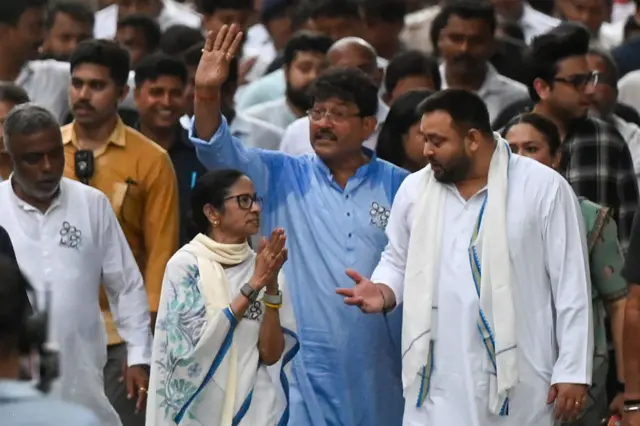
    KOLKATA, INDIA - APRIL 27: RJD leader Tejashwi Yadav joins with Chief Minister and AITC chairperson Mamata Banerjee during a padayatra (rally) from Jadavpur to Gopal Nagar on the last day of campaign ahead of 2nd phase of Assembly Election on April 27, 2026 in Kolkata, India. (Photo by Samir Jana/Hindustan Times via Getty Images)Image source, Hindustan Times via Getty Images
    Image caption,

    Mamata Banerjee was joined by RJD leader Tejashwi Yadav on her campaign during the election

    Just weeks before the election, Mamata Banerjee declared at a rally that she would “take over Delhi” after securing another victory in Bengal, promising to unite opposition parties and “dismantle” the BJP at the centre.

    That ambition now appears shattered.

    A defeat in Bengal would not merely end Banerjee’s 15-year rule in the state; it would dramatically weaken her standing within India’s already fragile opposition alliance.

    With the Congress under Rahul Gandhi struggling nationally, Banerjee had increasingly positioned herself as perhaps the most credible anti-BJP leader with administrative experience, political aggression and mass appeal.

    But Indian opposition politics is unforgiving to leaders who lose their home turf.

    Instead of emerging as the nucleus of a national anti-BJP coalition, Banerjee may now find herself fighting simply to preserve the relevance - and unity - of her own party.

  12. 'Feeling the heat now': Bengal's BJP workers mock Mamata Banerjeepublished at 10:22 BST

    Anahita Sachdev
    Reporting from Delhi

    BJP supporters in West Bengal are celebrating their party's lead as election trends continue to place them far ahead of their rival Trinamool Congress.

    A video shows party workers eating and distributing jhal muri - a spiced puffed rice mix which is the most popular street snack in the state. In the Bengali language, jhal means hot and spicy and muri is puffed rice.

    "Jhal legeche, didir jhal legeche (Sister is feeling the heat now)" some of them sang, mocking Trinamool leader Mamata Banerjee who is often referred to as didi or elder sister.

    Jhal muri had briefly become a talking point after Prime Minister Narendra Modi was photographed eating it at a roadside stall during the election campaign.

    Media caption,

    Watch: BJP supporters celebrate their party's lead with a popular local snack, jhal muri

  13. Kerala's Vijayan leads in Dharmadam but larger questions remainpublished at 10:14 BST

    Zoya Mateen
    Reporting from Delhi

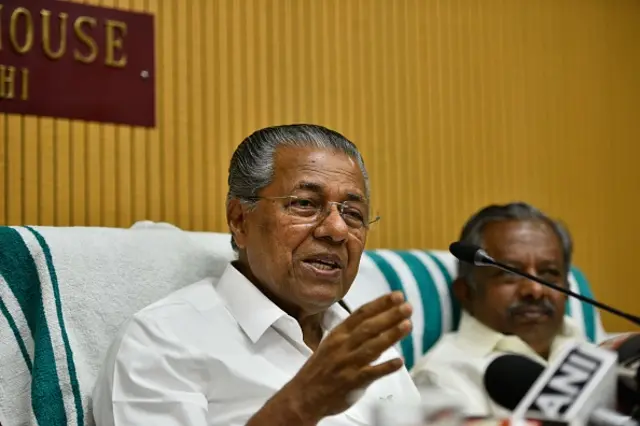
    After trailing for some time, incumbent Kerala Chief Minister Pinarayi Vijayan is leading in his constituency Dharmadam by a comfortable margin. But even if the veteran leader holds on to his seat, it is unlikely he will return to the chief minister’s office.

    Known for his firm, no-nonsense style, the 81-year-old has led the state through several crises - including the Covid pandemic and devastating floods - with strong government intervention.

    However, anti-incumbency has been a challenge and leads now point to a tough contest, with a clear edge for the Congress-led UDF.

    Pinarayi VijayanImage source, Getty Images

    Vijayan, a leader of the Communist Party of India (Marxist), was hoping to secure a historic third consecutive term for the Left Democratic Front (LDF).

    In 2021, he had made history by breaking Kerala’s long-standing pattern of alternating power between the LDF and the UDF, becoming the first chief minister in decades to retain office.

    If Vijayan's coalition loses, for the first time in decades, Left parties will not lead a government in any Indian state. And that opens bigger questions about the state of India's communist parties.

  14. BJP races ahead in several key battlegrounds in Bengalpublished at 09:52 BST

    Mid-day trends in West Bengal point to a clear advantage for the BJP, placing Chief Minister Mamata Banerjee and her TMC party under mounting pressure in one of India’s most consequential state elections.

    While leads continue to fluctuate between rounds, the BJP has gained an early statewide edge across several key battlegrounds.

    In the closely watched Bhabanipur seat, where Banerjee is facing BJP leader Suvendu Adhikari, the contest remains tight.

    Nandigram and other high-profile constituencies are also witnessing intense fights, though the BJP appears to be consolidating gains well beyond its traditional pockets.

    The party’s strongest advances are emerging from north Bengal and the tribal-dominated Jangalmahal region, where it has steadily expanded over recent years.

    The TMC continues to hold ground in parts of Kolkata and adjoining urban belts, but if current trends persist, the result would mark the BJP’s most significant breakthrough yet in Bengal - and the gravest challenge to Banerjee’s dominance since she came to power in 2011.

  15. Analysis

    An unexpected result is unfolding in Tamil Nadupublished at 09:29 BST

    Anbarasan Ethirajan
    Global Affairs Reporter

    An electoral shock is reverberating across Tamil Nadu.

    The fact that chief minister MK Stalin is trailing from his stronghold of Kolathur in Chennai is a stark indicator of the broader trend.

    Chennai, the state capital, has long remained a stronghold hold of Stalin's governing DMK. In a major upset, film star Joseph Vijay’s TVK party is leading in most of the constituencies in the city.

    Several ministers from the governing DMK are facing reverses - including Palanivel Thiagarajan, who’s trailing in the Madurai Central constituency.

    Meanwhile, Vijay himself is leading from the two constituencies - Perambur and Tiruchirappalli East - he contested from.

    Overall, several ministers from the DMK are facing setbacks.

    Until now, few would have predicted that the dominant political parties of the state - DMK and AIADMK - would be battling for second place in multiple constituencies.

    If the current trends continue, Tamil Nadu will be facing a new political reality for the first time since 1967, when a Dravidian party, the DMK, rose to power.

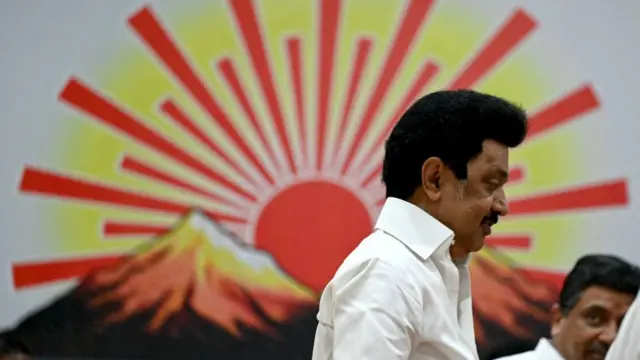
    Chief Minister of India's Tamil Nadu state and Dravida Munnetra Kazhagam (DMK) party president MK Stalin (L) walks past the party symbol after releasing their manifesto ahead of India's upcoming national elections in Chennai on March 20, 2024Image source, AFP via Getty Images
    Image caption,

    DMK chief MK Stalin is trailing in his constituency

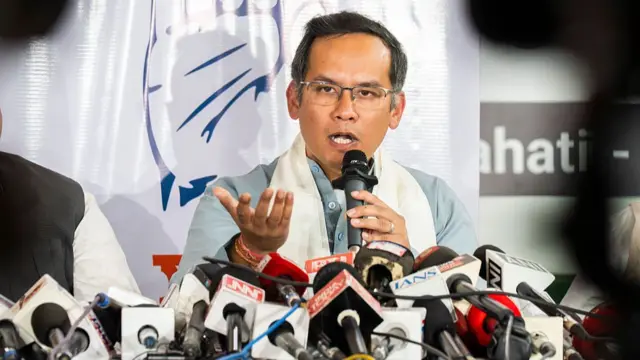
  16. Congress state chief Gaurav Gogoi trails in Assampublished at 09:12 BST

    In Assam, the main opposition leader Gaurav Gogoi of the Congress party is trailing by nearly 20,000 votes from the Jorhat assembly constituency.

    He was the face of the opposition's campaign in Assam, where the Congress has allied with some smaller regional parties.

    BJP leader Hitendra Nath Goswami, a three-term legislator from the Jorhat seat, is leading, according to trends from India's Election Commission.

    Gogoi, son of former Assam chief minister and veteran Congress leader Tarun Gogoi, is a member of the Indian parliament representing the region which includes the Jorhat assembly seat.

    Congress leader Gaurav Gogoi, wearing a grey kurta and while stole, speaks on a mic, addressing a press conference in Assam's Guwahati city in February 2026.Image source, Getty Images
    Image caption,

    Congress leader Gaurav Gogoi addresses a press conference

  17. Here is the latest breakdown of trendspublished at 09:07 BST

    Here is the latest breakdown of trends as being reported by BBC Hindi:

    • West Bengal: The BJP is leading in over 193 seats, followed by the TMC in 96 constituencies. The state has 294 seats - any coalition or party needs to win 148 seats to come to power.
    • Tamil Nadu: Actor-turned-politician Vijay’s political party TVK is leading in around 110 seats, followed by AIADMK in almost 64 seats. The ruling DMK is leading in around 60 constituencies. Tamil Nadu has 234 assembly constituencies - the magic number here is 118.
    • Assam: The BJP is leading with a huge margin with more than 98 seats while the Congress is leading in around 26 seats. Assam has 126 assembly seats and a party or coalition needs 64 seats to win.
    • Kerala: The coalition led by the Congress party is leading in over 101 seats, followed by the incumbent CPI(M)-led coalition in almost 37 constituencies. Kerala has 140 assembly constituencies - the winning number is 71.
    • Puducherry: The coalition led by BJP is leading in 16 seats, while the alliance led by the Congress party is leading in 11. The assembly in this federally-administered region has 33 seats, including three nominated members. Any coalition or party needs to win 17 seats to govern this region.

    A note of caution: these are still trends and can change.

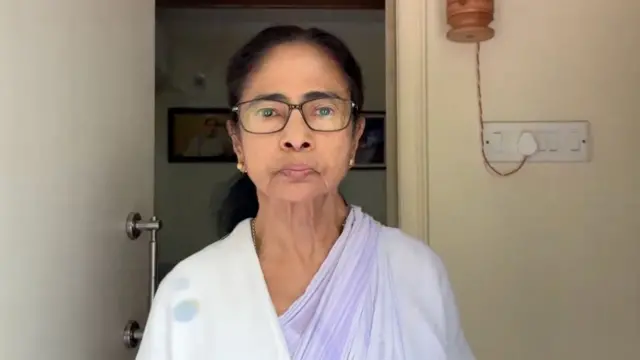
  18. Mamata Banerjee alleges 'slow vote counting' in Bengalpublished at 09:02 BST

    A short while ago, West Bengal Chief Minister Mamata Banerjee posted a video message, external on X where she requested all party workers to not leave the counting venue.

    "I have been saying since yesterday that they would do the counting for constituencies where the BJP is likely to win first," she said.

    Describing it as BJP's "plan", the leader said that officials had "stopped counting in nearly 100 constituencies after two-three rounds".

    Banerjee also accused the police and central paramilitary forces of "harassing" her party workers and alleged that the Election Commission was behaving in a biased manner.

    "There are about 70-100 seats where we are leading but the EC is not reporting it," she said.

    "Once the counting continues, you will see the results after 14-18 rounds of counting," she added and urged party workers to not be worried.

    The EC, BJP and the security forces have not commented on the allegations yet.

    Banerjee is a three time-chief minister of West Bengal state, and a loss for her Trinamool Congress party would be a big blow for the opposition at the national level.

    A mid close up of Mamata Banerjee who is wearing a white saree with a purple backgroundImage source, Mamata Banerjee/X
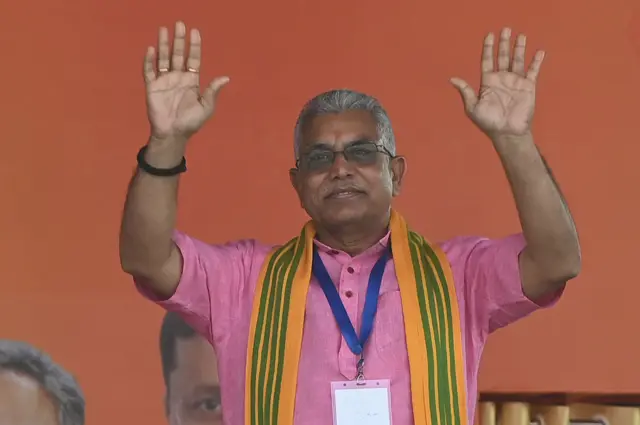
  19. BJP celebrations in West Bengal as Dilip Ghosh leadspublished at 08:52 BST

    Soutik Biswas
    India Correspondent

    Dilip GhoshImage source, Getty Images

    Bengali news networks are showing BJP supporters dancing to drumbeats and waving party flags as trends put Dilip Ghosh, a prominent BJP leader, ahead in the railway town of Kharagpur Sadar.

    The constituency - home to one of India's largest railway workshops and a sprawling migrant, working-class electorate - has often punched above its weight in Bengal politics.

    Once a Congress bastion and later fiercely contested by the Trinamool Congress and the BJP, the constituency reflects the state’s social churn: railway workers, traders, Hindi-speaking migrants and Bengali middle classes packed into a growing industrial town.

    Ghosh, a former RSS worker and ex-state BJP chief, was among the architects of the party’s dramatic rise in West Bengal after 2014.

  20. Analysis

    Analysis: Win will cement Himanta Sarma's place as a frontline BJP leaderpublished at 08:49 BST

    Pinaki Chakraborty
    Reporting from Delhi

    The BJP appears set to form the government in Assam for the third time in a row. According to trends, their alliance is comfortably ahead in over two-thirds of the 126-member assembly.

    The result is likely to cement Chief Minister Himanta Biswa Sarma's position among the party’s frontline national leaders, and also as a poll strategist in the wider northeast region.

    His strategy of mixing freebies with development, along with his hard stand against Bengali Muslim migrants, seems to have paid off on the ground.

    In the build-up to the polls, Sarma promised that his party would double down on issues that have got him success, including evicting encroachers from government and forest land.

    This will be Sarma's second term and it is expected to set him up as the BJP's face across all seven states in the northeast.