Summary

  • President Donald Trump says the US struck seven Iranian "fast boats" after vowing to help stranded vessels out of the Strait of Hormuz

  • Iran's military said it fired warning shots at American warships. The US Central Command denies a claim in Iranian state media that Iranian missiles hit a US destroyer - here's what we've heard

  • Meanwhile, the US says Navy destroyers and US-flagged merchant ships have sailed through the waterway, with Iran claiming this is "entirely false"

  • Elsewhere, the UAE says it is defending itself against "missile and drone attacks originating from Iran" - Tehran has yet to comment

  • Officials say a drone attack has sparked a large fire at the UAE's biggest oil port, in Fujairah

  1. Too early to tell if Trump's 'Project Freedom' is positive step, says oil tanker grouppublished at 20:40 BST

    Oliver Smith
    Live reporter

    A group representing independent oil tanker operators has called for "clear, verified information" on how Trump's so called "Project Freedom" will work in practice.

    On Sunday, Donald Trump said the US would help guide stranded ships out of the closed Strait of Hormuz; a process he has termed "Project Freedom".

    "It is too early to assess whether this represents a positive step", reacts Philip Belcher, the Marine Director at Intertanko which has member companies operating a total of 105 tankers in the Gulf.

    "Details remain limited, and the threat to merchant vessels from Iran persists. It is unclear whether the United States would intervene in the event of an Iranian response, or how traffic flows would be managed by the Omani Coast Guard", Belcher adds.

    He explains that the group’s understanding is that the US would provide "oversight from naval and air assets" and that ships would be expected to transit within territorial waters, with the Omani Coast Guard responsible for co-ordinating ship movements.

  2. Tensions spike in the Strait of Hormuz - what's the latest?published at 20:22 BST

    Adam Goldsmith
    Live reporter

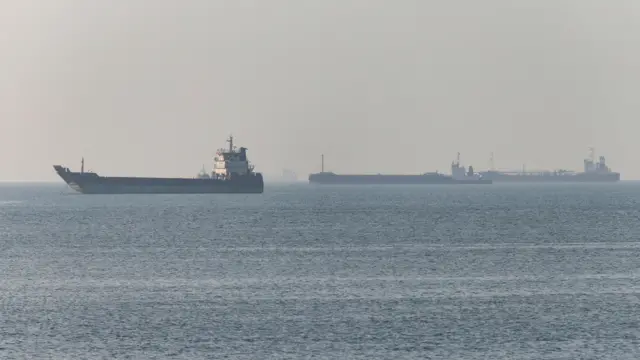
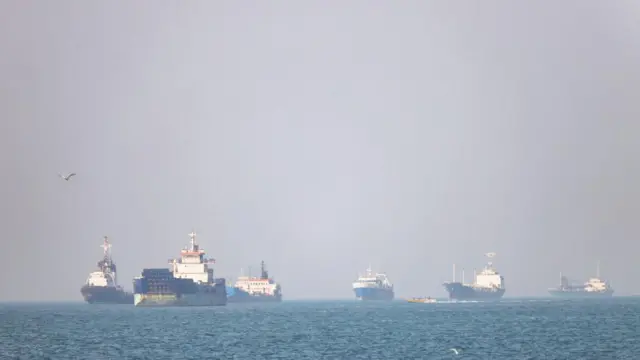
    Vessels in the Strait of HormuzImage source, Isna/Wana/Reuters

    It's been a day of back-and-forth claims and denials between the US and Iran over action in the Strait of Hormuz, as tensions have reignited in the vital waterway.

    It can be difficult to track vessels' movement in the key shipping route - our colleagues at BBC Verify explain why.

    We've taken a brief look back at what we've heard about incidents in the strait today:

    Fast boats sunk: Trump has said the US struck seven Iranian "small boats" in the Strait of Hormuz - Iran is yet to respond.

    Crossing the strait: Earlier, the US Central Command claimed US-flagged merchant ships and US navy destroyers had crossed the strait. Iran called this claim "entirely false".

    Warning shots: The Iranian Army Navy said it fired warning shots at US destroyers. Separately, Iranian media reported Iran had hit one US warship - a claim Washington denies.

    A serious warning: The Islamic Revolutionary Guard Corps (IRGC) has, according to Iranian state media, shared a warning with vessels in the strait that any who pass through the "closed" waterway will be "struck and destroyed".

    UAE vessel reportedly hit: The United Arab Emirates reported a tanker affiliated with its state-owned oil company Adnoc has been hit. Iran has not commented.

    'Suspected strike': Meanwhile,South Korea said it is investigating a "suspected strike" on a cargo vessel anchored in the strait after a reported explosion in the vessel's engine room. In his latest Truth Social, Trump blames Iran. Tehran has not commented.

  3. US plan to guide vessels out of the strait may not work as expected, ex-Pentagon official sayspublished at 19:50 BST

    Bernd Debusmann Jr
    White House reporter

    There's still considerable confusion in the US - and around the world - about what Project Freedom actually entails, and what comes next.

    To try to get a clearer picture, I’ve been messaging current and former military officials for their take on the operation.

    Mick Mulroy, a former deputy assistant secretary of defense for the Middle East and a veteran of both the Marine Corps and the CIA’s paramilitary wing, told me he believes the project will provide air cover and defence from missile and drone attacks from ships - rather than physically escorting vessels through the Strait of Hormuz.

    "Helping guide ships through would be helpful and well within international law," he said.

    However, Mulroy said there’s no guarantee it will succeed in restoring freedom of movement and commerce in the strait.

    "The question is whether ships will trust their ability to get through without being attacked, and more importantly, the insurance company," he said.

    "If not, the effort will not have the impact we hoped."

  4. IDF 'monitoring' situation in Gulfpublished at 19:21 BST

    In an update just now, the Israel Defense Forces (IDF) says it is closely monitoring the situation in the Gulf.

    "Our air defence systems and offensive capabilities remain at a high state of readiness, which has not changed since the ceasefire came into effect," it says.

  5. Analysis

    In Lebanon, diplomacy has also failed to stop the warpublished at 19:04 BST

    Hugo Bachega
    Middle East correspondent in Lebanon

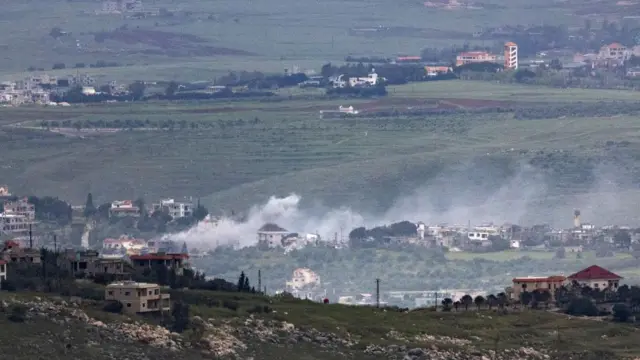
    Wide view of rural hills shows homes and farms, with white smoke drifting above a village amid green fields landscapeImage source, EPA
    Image caption,

    Smoke rises after a strike in southern Lebanon, 4 May 2026

    Meanwhile, in southern Lebanon, this is a ceasefire in name only. Israeli air strikes have continued, every day.

    According to the health ministry here, the attacks have killed at least a hundred people in the last four days alone, including civilians. And there have been new evacuation warnings for several villages outside the region currently occupied by the Israeli military - the self-declared security zone. Israel accuses Hezbollah of breaching the ceasefire deal that was struck with the Lebanese government.

    And Hezbollah is attacking Israeli troops in Lebanon and northern Israel with rockets and drones, saying it is responding to Israel’s violations.

    Diplomacy has so far failed to stop the war. Lebanese authorities hope direct talks with Israel will pave the way for a negotiated solution.

    But Hezbollah has rejected those efforts. And without the group’s consent, any initiative to bring lasting peace is unlikely to succeed.

  6. Analysis

    US-Iran military confrontation could returnpublished at 18:48 BST

    Sebastian Usher
    Global affairs correspondent

    The prospect of a renewed military confrontation between Iran and the US seems to be rising, as the UAE has faced several missile strikes.

    As reported earlier, the emirate of Fujairah in the UAE says that a fire has broken out in a major petroleum complex after an Iranian drone attack, with three people injured.

    The UAE has described the Iranian attacks as a dangerous escalation. It has certainly broken the lull in attacks since the ceasefire between the US and Iran began.

    That truce now seems increasingly at risk, as Tehran has shown its readiness to respond to US efforts to break its blockade of the Strait of Hormuz.

  7. Analysis

    Do boat strikes signal a return to military operations for Trump?published at 18:37 BST

    Bernd Debusmann Jr
    White House reporter

    Donald Trump says the US has struck seven Iranian "small boats" as it works to open the Strait of Hormuz.

    For Trump, these limited operations are something he has previously signalled a willingness to do - but they fall well short of resuming the kind of large-scale, country-wide strikes seen earlier in the war.

    In mid-April, Trump suggested strikes against Iranian boats were possible, warning they would be "immediately eliminated" using the "same system" being used against alleged drug boats in the Caribbean and Eastern Pacific.

    "It is quick and brutal," he added.

    While more "kinetic" than the blockade, these small-scale strikes also allow the Trump administration to avoid returning to a war that was already unpopular among many Americans, instead adopting a "slow burn" approach.

    That isn't to say wider strikes are off the table if Trump believes he has run out of alternatives to secure the strait or pressure the Iranians.

    Just this weekend, he said further strikes are a "possibility" if Iran "misbehaves" or "does something bad".

    He did not, however, provide any details on what that could be.

  8. Trump says US struck seven Iranian 'small boats'published at 18:28 BST
    Breaking

    Bernd Debusmann Jr
    White House reporter

    Donald TrumpImage source, EPA

    We've just heard from US President Donald Trump, who says US forces struck seven Iranian "small boats" as they work to open the Strait of Hormuz.

    In a brief post, Trump also says Iran has "taken some shots at unrelated nations", including a South Korean vessel.

    He again encourages other nations to step up and do more to support US efforts to secure commerce in the region.

    "Perhaps it's time for South Korea to come and join the mission," he says.

    Trump adds that Defence Secretary Pete Hegseth and Joint Chiefs Chairman Gen Dan Caine will hold a news conference tomorrow morning to provide further updates.

    We're expecting to see Trump at an unrelated event at the White House in about an hour and a half.

  9. UAE says it reserves 'full and legitimate right' to respond to attackpublished at 18:07 BST

    We've just seen a new statement from the United Arab Emirates, saying it holds Iran "fully responsible" for new strikes today.

    "These attacks constitute a dangerous escalation and an unacceptable transgression," the statement says, adding that it violates the principles of international law and the Charter of the United Nations.

    The UAE also says it "reserves its full and legitimate right to respond to these attacks" in line with international law.

    Iranian state TV has quoted an unnamed "senior military official" saying that "Iran has had no plans to target the UAE". No officials have responded further.

  10. Brent crude rises above $115 after reports of Fujairah firepublished at 17:43 BST

    Ben King
    Business reporter

    It has been another day of wild swings on the oil market, and the benchmark Brent crude oil price hit its highest levels of the day following reports of drone strikes in the UAE.

    Brent passed $115 a barrel shortly after 17:00 BST after reports that the key oil port of Fujairah had come under attack, up more than 5% on the day.

    Fujairah lies on the east coast of the UAE, beyond the Strait of Hormuz.

    A pipeline from the oilfields of Abu Dhabi runs to Fujairah, allowing limited amounts of crude to be loaded on to tankers and shipped to world markets despite the strait being effectively blockaded.

    Brent crude hit $114 earlier in the day after reports that Iran's military had hit a US destroyer. Prices fell back again when the US said its ships had not been hit.

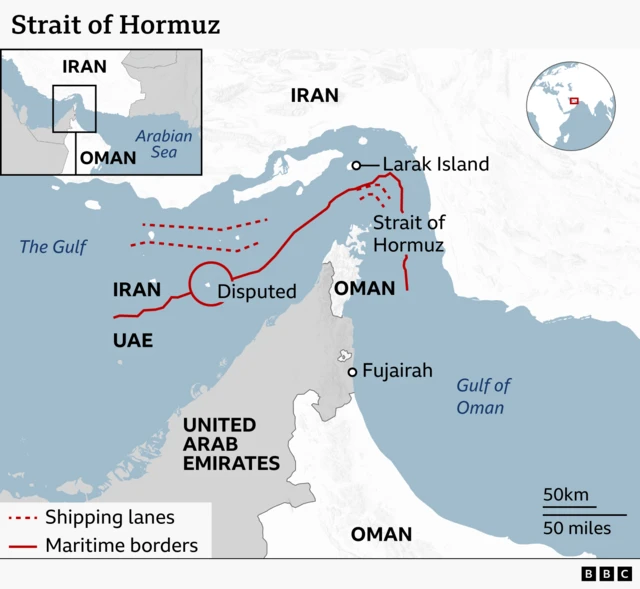
    The Strait of Hormuz, a narrow shipping route in the Gulf region, is one of the world's most important shipping routes. Bounded to the north by Iran and to the south by Oman and the United Arab Emirates (UAE), the Strait of Hormuz connects the Gulf with the Arabian Sea. The strait is deep enough for the world's biggest crude oil tankers, and is used by the major oil and gas producers in the Middle East - and their customers.
  11. Three people suffer 'moderate injuries' after strike on oil industry zone - Fujairah authoritiespublished at 17:32 BST

    Now an update from Fujairah, which reported a large fire after a drone attack from Iran earlier.

    Three Indian nationals have been taken to hospital for treatment after the strike on the Fujairah Oil Industry Zone (Foiz), according to the city's media office.

    In a statement, the media office says the three nationals sustained "moderate injuries".

    The Foiz is an energy hub hosting one of the largest oil storage facilities in the Middle East.

  12. Qatar calls reported attack on UAE vessel 'violation of international law'published at 17:19 BST

    The latest reports from Fujairah in the UAE come after a tanker linked to Adnoc, the state-owned oil company, was reportedly hit in the Strait of Hormuz.

    Neighbouring Qatar has condemned the tanker attack. In a statement, its foreign ministry called the attack "a blatant violation of international law and the principle of freedom of maritime navigation".

    It has again called for the strait's "unconditional reopening".

    Meanwhile, the UAE continues to report missile attacks, with its latest warning issued at 19:49 local time (16:49 BST).

    We're yet to hear from any Iranian officials confirming the attacks.

  13. UAE reports large fire at oil port after drone attack from Iranpublished at 16:50 BST
    Breaking

    We're also hearing from local officials in Fujairah, who say a large fire has broken out at the key UAE oil port after it was hit by a drone attack from Iran.

    Fujairah is the Emirates' biggest port and oil storage facility. Before the ceasefire, it was also targeted in drone attacks.

    In a statement shared on social media, the Fujairah Government Media Office says civil defence teams are working to contain the fire.

    The report of the strike came after the UAE defence ministry said it had intercepted three missiles launched from Iran.

    The Iranian government has not commented on the attack.

  14. Three missiles from Iran intercepted - UAE defence ministrypublished at 16:28 BST

    The UAE's defence ministry says it has intercepted three missiles launched from Iran, while a fourth fell into the sea.

    In a post on social media, it says explosions heard in parts of the country were due to the interceptions.

    This comes shortly after the country's emergency management authority said it was responding to missile threats.

    Iran has not commented on the attack.

  15. UAE says its air defences responding to missile threatpublished at 16:11 BST

    The UAE says its air defences are responding to a missile threat.

    The country's National Emergency Crisis and Disaster Management Authority is urging people to stay in a safe place.

    This comes after an earlier missile alert was sent to UAE residents. South Korean officials have also said a cargo vessel anchored in waters near the UAE may have been struck, causing an explosion.

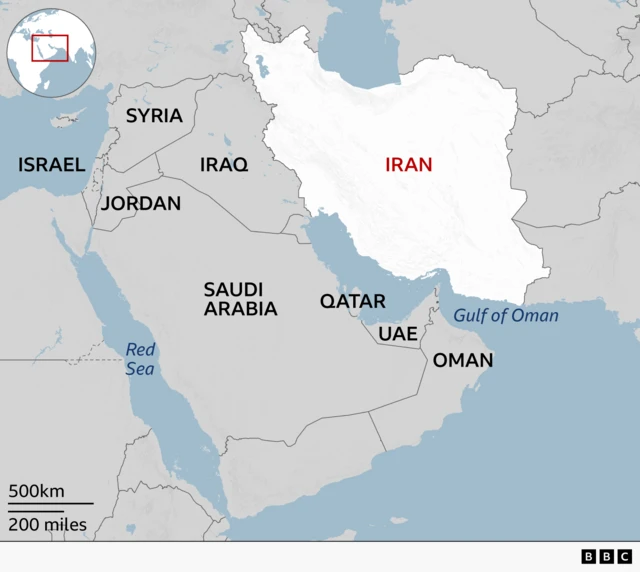
    A regional map highlighting Iran in white with its name in red. Surrounding countries are labeled in grey, neighbouring Iraq to the west and other Middle Eastern countries including Syria, Jordan, Israel, Gaza and Saudi Arabia, Qatar, UAE, and Oman. Bodies of water such as the Red Sea and the Gulf of Oman are marked in blue.
  16. Iran says US claim about ships passing through the strait 'entirely false'published at 15:54 BST

    Vessels in the Strait of Hormuz near Bandar Abbas, Iran, May 4, 2026Image source, ISNA/WANA/Reuters

    Iran’s Islamic Revolutionary Guard Corps (IRGC) has called the US claim about ships passing through the Strait of Hormuz “outright lies”.

    Earlier, US Central Command said two US-flagged merchant vessels had “successfully transited through the Strait of Hormuz”.

    Now, Iranian state media have shared a statement from the IRGC saying “no commercial vessels or oil tankers” have passed through the Strait of Hormuz in “recent hours”.

    The IRGC says the US statements are “baseless and entirely false”, and warns that any other movements against the instructions of the IRGC Navy “face serious risks”.

  17. 'Suspected strike' hits South Korean vessel and causes explosion - officialpublished at 15:43 BST
    Breaking

    There’s been a suspected strike on a South Korean cargo vessel anchored in the Strait of Hormuz, according to the country’s Ministry of Oceans and Fisheries.

    At about 12:40 BST (11:40 GMT), a "suspected strike" was reported on a cargo vessel named HMM Namu in the Strait of Hormuz, the ministry says.

    The vessel was reportedly anchored in waters near the UAE. There are 24 crew members on board, including six South Koreans and 18 foreign nationals, according to the ministry. No casualties have been reported.

    The ministry says an explosion is believed to have occurred on the port side of the engine room during the suspected strike.

    This comes after reports from the UAE that a tanker linked to Adnoc, its state-owned oil company, was hit in the Strait of Hormuz earlier today.

  18. Iran says warning shots fired at US destroyerspublished at 15:33 BST

    Earlier, Iranian state media reported that the military had hit a US destroyer trying to enter the Strait of Hormuz - something the US has denied.

    We've now had further comment from the Iranian military.

    It says the Iranian Army Navy "issued a warning and fired warning shots along the route of the hostile enemy destroyers".

    The Iranian military says US destroyers turned off their radars before approaching the strait, and were "detected immediately" after reactivating them.

    The destroyers then received a radio warning from the Navy "regarding the dangers of violating the ceasefire", the Iranian military adds.

    Another "explicit warning" was sent to the destroyer, according to the Iranian military, saying that "any attempt to enter the Strait of Hormuz would be considered a violation of the ceasefire and would be met with a response from naval forces".

    It says warning shots were fired after the Americans "disregarded" the warning.

  19. BBC Verify

    We're looking into Centcom's claim that two US vessels have crossed the Strait of Hormuzpublished at 15:16 BST

    By Emma Pengelly

    We've been checking the ship tracking tool MarineTraffic after US Central Command (Centcom) said two US-flagged merchant vessels "successfully transited through the Strait of Hormuz".

    We haven't seen vessels matching this description on MarineTraffic but are continuing to monitor the site.

    As we mentioned earlier, MarineTraffic publishes details about vessels including their locations using information broadcast by an onboard tracker called Automatic Identification System (AIS).

    But vessels can also turn off their location transmissions, meaning they wouldn't be visible on tracking platforms like MarineTraffic. It's also possible for vessels to falsify their positions, a process known as spoofing.

  20. US says Navy and merchant vessels have passed through strait - recappublished at 15:07 BST

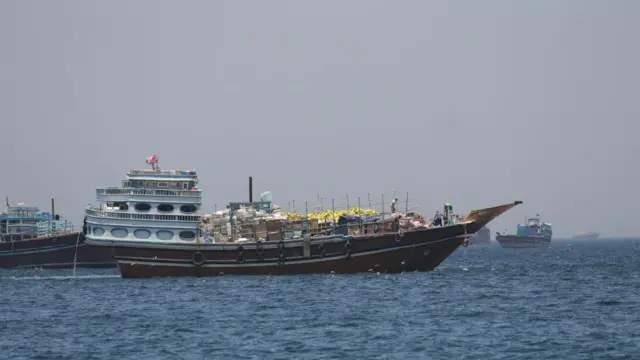
    A small ship in the strait of hormuz.Image source, Reuters

    Donald Trump says the US military will guide ships through the Strait of Hormuz - but Iran insists any ships wanting to cross the crucial shipping passage will need its permission.

    Here’s what else to know:

    Centcom says plan is working: In an update, it says two US-flagged merchant ships have crossed the strait - Iran has yet to comment.

    Conflicting messages: Iran says it stopped a US destroyer from entering the strait. US Central Command (Centcom) denies this, saying none of its ships have been struck.

    Thousands still trapped: Sailors have been trapped in the waterway since the start of the war - with supplies said to be dwindling, our international correspondent reports.

    Oil prices rise again: Oil prices have jumped after Iran said it hit a US destroyer, soaring to $114 per barrel - a 5% rise from the market opening.