Summary

  1. In Spain's Basque region, the temperature could hit 40Cpublished at 12:50 BST

    Guy Hedgecoe
    BBC News in Madrid

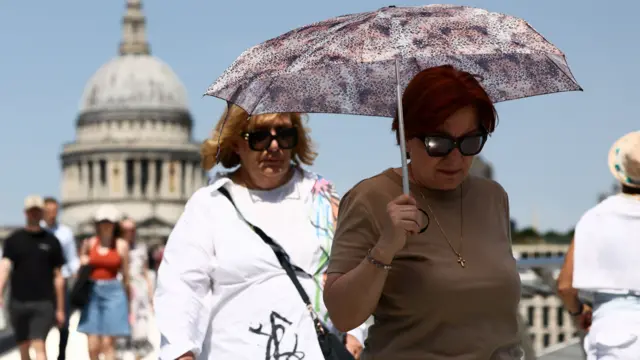
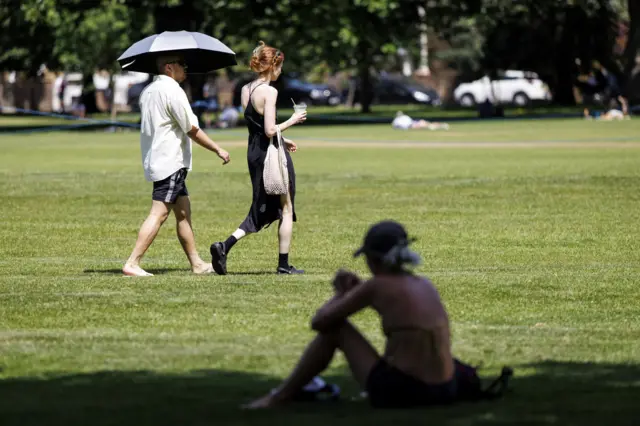
    Tourists visit Zaragoza, Aragon, Spain, 21 June 2026Image source, EPA
    Image caption,

    Tourists shielding themselves from the sun in Zaragoza on Sunday

    The temperature is expected to rise up to 40C today in parts of the Basque Country, which is unusual for the northern region - much of which is on a red weather alert.

    The Basque regional government has brought forward its plan to manage high temperatures, which includes asking companies to adapt timetables for workers, increasing their breaks and guaranteeing access to water.

    Yesterday, 25 people received medical treatment for heat-related issues in the Basque Country.

    The north-eastern region of Aragón is among several expected to see temperatures in the low 40s.

    In the region’s capital, Zaragoza, authorities have announced a discount on the price of entry to municipal swimming pools.

    The city has also made available around 60 "heat refuges", which are air-conditioned public buildings, such as libraries, churches and civic centres, where people are encouraged to spend time during the hottest part of the day.

  2. Swiss authorities urge caution as temperatures climbpublished at 12:40 BST

    Jessica Parker
    BBC News in Switzerland

    Lake Lucern in Switzerland, wiith mountains in the distance and boats in the water.

    It is baking on the shores of Switzerland's Lake Lucerne, where people are taking a dip to escape the heat.

    This week temperatures are set to peak here at about 33C. Elsewhere in Switzerland, temperatures are set to get even hotter - including in the southwestern city of Geneva and northern city of Basel.

    Switzerland's Federal Office for Meteorology and Climatology is urging people to drink plenty of water, seek shade and keep in touch with those who may be particularly at risk in their neighbourhood.

  3. Heatwave causes hundreds of school closures in Francepublished at 12:18 BST

    Hugh Schofield
    Paris correspondent

    People play in a fountain at the Andre Citroen park as temperatures rise in Paris during a second heatwave affecting a large part of France, June 21.Image source, Reuters
    Image caption,

    Children and adults cool off at a fountain in a Paris park on Sunday

    The hot weather the UK is experiencing this week is spreading from continental Europe where an extremely intense hot spell has developed.

    In France, 845 junior and middle schools have closed because of the heat and a further 1800 have reorganised their teaching hours. That is about 5% of the total in the country.

    But many more schools have told parents informally that it would be better not to bring their children, especially in the afternoon when temperatures will soar into the late 30s or higher.

    Me personally, I have two children in junior school who will leave at lunch.

    The school buildings will be simply intolerable later – despite air-conditioning units which parents have clubbed together to buy.

    We are organising among ourselves to share childcare over the coming days because we assume the heatwave will last all week.

  4. Trains cancelled as speed restrictions come into forcepublished at 12:11 BST

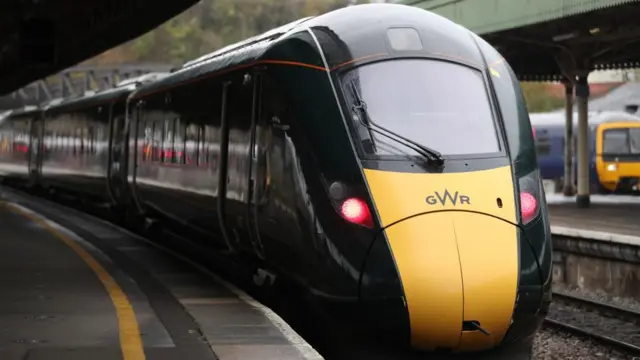
    Great Western Railway says some trains are delayed or cancelled due to the hot weather.

    Stations in the Thames Valley are affected, and some trains between Reading and London Paddington will be cancelled.

    The train operator says "track temperatures are forecast to reach levels requiring speed restrictions. Extreme heat can cause rails to expand and buckle, so when temperatures reach certain thresholds, trains must run more slowly to keep services safe."

    National Rail says there is disruption on the routes from Coryton and Penarth in south Wales, and between Pontypridd and Cardiff Bay, and people can use their tickets on the bus routes instead.

  5. School rules relaxed ahead of extreme heatpublished at 12:01 BST

    Vanessa Clarke
    Education reporter

    The government doesn’t normally advise schools to close – it says most of the time it can be managed safely and keeping children in school is important.

    But it does expect schools to adapt to keep children safe and comfortable.

    Some parents, like me, will already have had a message from their schools saying uniform rules are being relaxed, PE kits are allowed and sunscreen and sun hats are needed.

    Head teachers in older school buildings, which are sometimes harder to keep cool, will have been up early opening up doors and windows to keep air moving.

    Advice from the UK Health Security Agency says schools may have to close their windows later in the day if it becomes hotter outside than inside, and fans shouldn’t be used if temperatures go above 35°C.

    Lessons may be moved to cooler areas of the school and hot meals may be switched for cooler options.

    And schools could even look at changing start and finish times to avoid the worst of the heat – so things could look a little different this week.

  6. Schools to close early in west of England as temperatures soarpublished at 11:40 BST

    Bea Swallow
    BBC News, West of England

    A number of schools across the West region have confirmed they will close early, citing concerns over staff and pupils spending prolonged periods inside stuffy classrooms.

    In Wiltshire, Kingdown School, Clarendon Academy, Pewsey Vale School and Dilton Marsh Primary are among those who say lessons will finish at 12:30 BST.

    Kingsholm Primary in Gloucester will close its doors at 13:30 BST every day until Thursday, and it has advised pupils they are welcome to wear their PE kits to class.

  7. Why this heatwave is more than just hot weatherpublished at 11:27 BST

    Justin Rowlatt
    Climate editor

    A graph showing how temperatures have risen since 1950 into the 2000s

    We tend to experience heatwaves as: a sweaty commute, a sleepless night, a warning to stay indoors. But the bigger story is even more unsettling.

    Human civilisation has developed during roughly 12,000 years of unusual climate stability - a narrow band of conditions in which farming, trade, cities and all of modern life became possible.

    Now, over the course of a few decades, we are pushing that system into new territory.

    One broken temperature record does not prove climate change. But records falling repeatedly, across continents and seasons, show the dice are being loaded towards extremes.

    That is why this heat matters.

  8. Extreme heat could cause danger to lifepublished at 11:08 BST

    A table showing what each of the weather warnings meanImage source, Met Office

    A red warning is the most severe level of alert which indicates dangerous weather is expected with a high likelihood of risk to life.

    It could also lead to failures of critical national infrastructure, such as power outages or roads and rail lines being closed.

    In situations where a red warning is issued, the Met Office advises people to avoid travelling where possible and to follow the advice of the emergency services and local authorities.

    The first ever red heat warning was issued in July 2022, although the extreme heat warning system was only introduced in 2021.

  9. Where is covered by the red weather warning?published at 10:48 BST

    Simon King
    Lead weather presenter, BBC Weather

    A map showing the areas of England and Wales covered by the red weather warning

    The rare red extreme heat warning issued by the Met Office covers parts of southern England, as well as the Midlands and southern Wales.

    It will come into effect at 09:00 BST on Wednesday until until 21:00 BST on Thursday.

    Red warnings indicate that dangerous weather is expected with a high likelihood of risk to life.

    The Met Office is also warning of substantial disruption to travel, energy supplies and possibly widespread damage to property and infrastructure.

  10. More details on red warning for extreme heat in parts of UKpublished at 10:41 BST
    Breaking

    The Met Office has issued a rare red warning for 09:00 on Wednesday to 21:00 Thursday for parts of England and Wales.

    This means the heat is likely to bring impacts to health and could be a danger to life, but also a risk to infrastructure such as power supplies and transport.

    Temperatures will increase significantly in the next few days with the potential for 38 or 39C by Wednesday and Thursday.

    Amber warnings are also in force across a wider area from now until Thursday.

    A map graphic showing red and amber extreme heat alerts across England and Wales.Image source, Met Office
  11. Rare red weather warnings issued for parts of England and Walespublished at 10:36 BST
    Breaking

    The Met Office has issued a red weather warning for parts of England and Wales on Wednesday and Thursday.

    We'll have more on this in our next post.

  12. Why is it so hot?published at 10:20 BST

    Helen Willetts
    BBC Weather

    A weather graphic showing where the extreme heat is circling

    This potentially record breaking and dangerous heatwave is not limited to here in the UK, it's affecting much of western Europe.

    The heat is building due to a combination of factors:

    Firstly there is a strong high pressure sitting across Europe which acts like a lid trapping the heat in the lowest layers of our atmosphere.

    Then at this time of year we have a positive energy balance, simply we get more heat in from the sun than we lose.

    As a result of the high pressure position we have a southerly drift over the UK, so as well building our own heat we are importing heat from Europe - where it's also highly likely to be record breaking.

    Despite recent rain, the ground is now pretty dry which means all of the sun's heat goes into raising the ground and air temperature and not evaporating moisture.

    Red warnings are in force for extreme heat across much of France, and some French schools have closed for the day.

    Red warning are also peppered across Spain and Germany today with Luxembourg joining tomorrow, and more extensive amber warnings.

    Here is a forecast for the next few days in Madrid, Bordeaux, Paris and London:

    A BBC weather forecast for Europe
  13. Wear loose clothes and eat cucumber - tips to stay cool in the heatpublished at 10:02 BST

    There are a number of obvious and not-so-obvious tricks to keep yourself and your pets cool during the hot weather. Here we've rounded together tips you can follow as temperatures soar this week.

    This Flourish post cannot be displayed in your browser. Please enable Javascript or try a different browser.

  14. Paris likely to reach an unprecedented 40C in Junepublished at 09:57 BST

    Several people try to cool off in a fountain in front of the Eiffel Tower in Paris. They have removed their trousers to go into the fountainImage source, EPA/Shutterstock
    Image caption,

    People cool off in the Trocadero Fountain by the Eiffel Tower, in Paris, on Friday

    As we've been reporting, the heat is spreading from continental Europe where an extremely intense hot spell has developed.

    Temperatures in parts of western France could climb to 43 or 44C (109-111F) over the next few days.

    Red heatwave alerts have been issued for about half of the country for Monday, with nearly 850 schools closed and 1,500 more allowing pupils to leave early.

    Paris is likely to reach 40C (104F) which would be unprecedented for June.

  15. Heatwave expected to be record breaking and potentially dangerouspublished at 09:51 BST

    Helen Willetts
    BBC Weather

    On Sunday, an official heatwave was declared at Writtle, near Chelmsford, Essex.

    It has now seen three consecutive days above the heatwave threshold of 27C, and many others will join today or tomorrow.

    This is expected to be a record breaking and potentially dangerous heatwave and while hot weather is not uncommon during the UK summer, the current amber warning and potential escalation to red highlights the severity, duration and widespread nature of this event.

    On top of daytime heat, overnight temperatures are forecast to remain unusually high, with some urban areas struggling to fall below 20 or 21C, resulting in so-called tropical nights.

    This combination of hot days and very warm nights gives no chance for the body to cool down, some places are likely to have a run of three or four successive days and nights in this heat, so it will soon become exhausting, especially, but not only for the vulnerable.

    This heatwave is likely to differ from that in 2022 as the humidity is higher, making it even more uncomfortable.

  16. Four-day extreme heat warning as temperatures could reach 38C in parts of Englandpublished at 09:43 BST

    A middle aged man with black hair wearing a white shirt and black shorts washes his face in a public water fountain in the middle of the streetImage source, EPA
    Image caption,

    A man washes his face with water in Seville on Sunday

    Temperatures could soar to 38C (100F) in parts of England this week as the Met Office has issued a four-day amber warning for extreme heat.

    The warning came into effect at 01:00 BST on Monday and will remain in place until 23:59 BST on Thursday.

    Large swathes of England and Wales are covered by the warning, which will extend to more northerly areas on Wednesday and Thursday.

    The warning means population-wide impacts are likely, including serious health risks, disruption to daily routines and increased pressure on infrastructure.

    The heat is spreading from continental Europe where an extremely intense hot spell has developed.

    In parts of western France the mercury is expected to climb to 43 or 44C over the next few days, while temperatures in Belgium are expected to be "the hottest ever recorded".

    We'll bring you the latest forecasts, developments and top tips on how to stay cool during the warm weather on this page - stay with us.