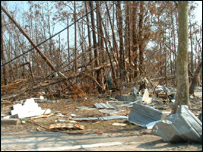
In the aftermath of hurricane Katrina there are so many questions that need to be answered. But no issue has proved to be more controversial than race. In many eyes this month’s natural disaster in Louisiana has highlighted the racial inequality that still exists in present day America. Hip-Hop star Kanye West spoke out in front of a worldwide audience last week when he attacked the government stating: “Bush doesn’t care about Black people”. A generalisation or not, all I know is that a lot of African Americans here are feeling like a neglected part of society. A poll published by USA Today says six in ten African Americans believe this is the case but only one in ten whites agreed. President Bush denied these accusations the other day when he said: “The storm didn’t discriminate and neither will the recovery effort”. | "In many eyes this month’s natural disaster in Louisiana has highlighted the racial inequality that still exists in present day America. " | | Chris Ackerley |
When civil rights leader Jesse Jackson arrived in New Orleans to listen to the grievances of those sheltering in The Super Dome he likened it to a slave ship. I do not completely agree with this comparison. But when I had a chance to go down to the evacuation centre in Baton Rouge the overcrowding and uncomfortable conditions were difficult to take. On the other hand, there is obviously a massive amount of pressure on FEMA and the Red Cross to accommodate these displaced people on such a large scale. So I feel it is unfair to completely criticise their good work. It did seem to me that a lot of looters in TV footage were Black. Yet when I spoke to a policemen who was in New Orleans during the initial problems he told me people of all races were looting shops, not to get televisions or stereos but to get food and water in order to survive. For the huge numbers of poor African Americans who lost their rented homes one of the most worrying consequences of the hurricane is the regeneration process. The black ghetto areas of New Orleans have been there for years. But now they have been destroyed there is an opportunity for land owners to bulldoze these sites in favour of a profitable, tourist friendly areas. America is a country that projects to the rest of the world an image of democracy and security. But if it fails to provide a safety net for the thousands of people that have so unfortunately fallen off the lowest rung of the ladder then it this will prove to be a façade. |