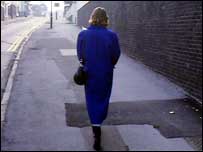
STALKINGHigh profile cases of stalkers hounding celebrities frequently make headlines, but it's not just the rich and famous who become victims of obsessive harassment. Inside Out meets members of the general public who became targets for stalkers. In 2004 over 150,000 cases of harassment were reported to the police nationwide - a 26% increase on the previous year and in Yorkshire, stalking is becoming one of the fastest growing crimes. Whilst some of these cases were reported by those in the public eye, the vast majority of victims were members of the general public. Unwanted attentionVictims of stalking find themselves targets of a relentless campaign of harassment from a person they have often had little - or in some cases - no contact with at all. 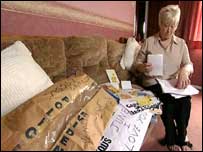 | | June received numerous letters from David Leyland |
This is the situation that Bradford care worker June Gillard found herself in after a dance at a birthday party sparked a two-year harassment campaign by stalker David Leyland. "He started phoning saying "come for a drink"," explains June. "I said in no uncertain terms "I'm married", but the letters came saying "I love you", he sent me chocolates, I got great big bunches of flowers delivered." Sinister twistThe gifts quickly took a sinister turn however when June started receiving brochures from funeral homes and information about home security equipment. Deliveries of concrete, peat and other unordered items would turn up at June's house in the early hours of the morning. Despite June approaching his wife with the collected evidence, Leyland's campaign continued with an even greater intensity than before.  | | June found some of the messages threatening |
It was thanks to the 1997 Protection from Harassment Act that June could put her ordeal behind her. With two years of evidence collected against him, Leyland was finally sentenced to three months in prison. The conviction may have signalled the end of David Leyland's campaign, but for June, the ordeal is ongoing. "I don't think there's a day that I don't think about it. I'm looking over my shoulder. I'm not the same person."
Women on the rise| "Most of the victims have something special about them which is very important to the stalker's psyche. Everything in their life is secondary to the pursuit of this other person." | | Dr Rajesh Nadkarni |
Although stalking is often associated with men, Dr Rajesh Nadkarni, who runs Britain's first stalker rehabilitation unit in North Yorkshire, insists that female stalkers are on the increase. Mike McPherson found himself on the receiving end of the unwanted affections of a female stalker after he became bank manager in Pickering, North Yorkshire. After politely but firmly refusing the advances of customer Elizabeth Sykes, 38-year-old Mike became the target of an harassment campaign. "I had to explain to her, 'Look I've got a young family, I've got a position and a job that I would never compromise,' but it just spurred her on."
After insisting they had been having an affair in which he had betrayed and beaten her, Elizabeth would tail Mike's car on his journey to and from work, driving erratically to ensure she secured his attention.  | | Stalkers often hound victims over the phone |
"I feared for Mike's safety as he was driving to and from work," remembers Mike's wife Karen. "Sometimes I was quite frightened to come in the house really." Mike and Karen succeeded in capturing Elizabeth's driving on camera which later helped to secure an harassment conviction. Psychological scarsLike David Leyland, the Protection from Harassment Act was used to convict Elizabeth and she was jailed for 14 days. For now an injunction to prevent Elizabeth contacting Mike, ensures he and his family are free from harassment. The mental scars however are harder to erase as Mike explains. "It has totally haunted me. I've had counselling regarding matters, but even now it's there at the back of my mind. "The injunction runs out in 2005 so that's really a benchmark date for me to get past."
The power to act| "There is research which has looked at victims of stalking and I believe a significant majority of them have developed mental heath problems." | | Dr Rajesh Nadkarni |
A survey to study the affects of stalking is currently being conducted online by the Network for Surviving Stalking and the University of Leicester. The research aims to gather first hand experience of stalking and how it affects victims and their families. The 1997 Protection from Harassment Act is a giant step forward in the battle against stalking, yet not all victims feel the law is doing enough to protect them. Tracey Morgan, Head of the Network for Surviving Stalking, reasons that many police are still not yet fully aware of the power the Harassment Act. "It's quite a powerful piece of legislation with the restraining order being the teeth to the act," explains Tracey. And it is largely thanks to Tracey that the act exists at all. Ten years ago, Tracey was herself a victim of stalking. | "It's very frustrating because you can't see the injuries. The injuries are going on in the mind." | | Tracey Morgan |
Tracey battled to secure anti-stalking legislation which is now protecting victims across the country. With June, Mike and Tracey's stalkers all successfully convicted, the battle against harassment is slowly gaining momentum. For past victims of stalking, time will hopefully allow mental scars to heal. Whilst for future victims, an increased awareness of the power of the act and a greater understanding of the devastating effects of stalking will hopefully secure swifter justice. Click here for further information about dealing with stalkers and sources of help and support. | 



 Inside Out - Yorkshire & Lincolnshire: Monday January 10, 2005