

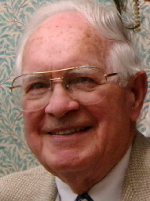
Photo of me taken in 2004 when I was 89
- Contributed by
- Bogeybuilder
- People in story:
- Alexander McIntosh
- Location of story:
- PADGATE AND BLACKPOOL
- Background to story:
- Royal Air Force
- Article ID:
- A8946895
- Contributed on:
- 29 January 2006
STORY 3
PADGATE AND BLACKPOOL
Apart from being my ‘kitting-out’ Station, Padgate served as my
introduction to R.A.F. life. I was just one of many raw recruits at the camp and I
recall that at an early stage, we were kitted out with our uniforms, greatcoats, and the
other items of headgear and clothing which fell to be issued to us. I also remember
that some care was exercised by the Equipment Section in ensuring that the various
elements of the uniform etc. were of a good fit, giving us reasonable satisfaction
when we examined ourselves before a mirror on the change-over from civilian gear.
I could not have remained at Padgate for a very long time because my next
port-of-call was to be Blackpool and I was there in time to attend a musical film show
in the Opera House there called ‘Up and Doing’ starring Binnie Hale, Cyril Ritchard,
Patricia Burke, Stanley Holloway, the Caroll Gibbons Band, and Leslie Henson,
during the week commencing 2nd December.
I certainly was there long enough to catch up with the first of a number of
‘super-efficient’ Corporals whose job in life seemed to be to remove any semblance
of self-confidence which had been built up from peace-time work, by reducing a
recruit as far as possible, to a pliable being and to act as an automaton when he, the
bearer of these 2 chevrons, pulled the proverbial strings. The situation was
particularly exemplified in the dormitory where he imposed an iron-rule discipline. I
had been introduced to my bed in a large hut sheltering 30 or 40 new entrants to the
Royal Air Force. The bed was an iron one on top of which were to be placed 3
‘biscuits’, i.e. short mattresses which when put together formed a complete single
mattress, along with blankets etc. We were all obliged, nay, commanded, to leave
each bed in the morning in a special kind of way, with the 3 ‘biscuits’ being gathered
in a very neat pile at the end of the bed, and the blankets etc. folded and stacked on
top, all in accordance with the specimen demonstrated. I had to ensure that the
stack was erected inch-perfect — otherwise there would be a ‘bawling’ from the
Corporal, and, of course, that non-commissioned-officer could alter the position of
the inches if he felt like doing so, to give himself something to complain about. The
Corporal never did his rounds without finding faults. It wasn’t for you to think that
the whole ceremony was a needless waste of time. It was an essential part of the
introduction to service life and you had to comply — to the complete satisfaction of
that Corporal — and all for the purpose of being a Clerk/Accounting.
I was to meet up with another of the breed in Blackpool about whom I shall
write later. It is a mystery how these fellows developed into the dictatorial little
monsters they turned out to be. They give the impression that they had been
trained by ‘Big Brother’ who was still standing behind them! I wonder who told
them to adopt the fearsome pattern of putting their new charges down as far as they
were able — and was it really so necessary? Did the 2 chevrons automatically change
their personalities and did they get some satisfaction shooting down men who were
their seniors in education and intelligence? Alas, we shall never know!
Over in Blackpool, I was accommodated in a former boarding-house at 41
Alexandra Road, care of Mr. Isherwood. I do not know what the arrangement with
Mr. Isherwood was — whether he was an employee of the R.A.F. or otherwise. He
was certainly about the place and, if I remember correctly, the establishment was
responsible for providing meals for the airmen resident in the premises with or
without supporting R.A.F. personnel.
The group, or squad, with whom I found myself, were to be in Blackpool for
the next 6 weeks or so for the principal purpose of learning drilling. For this, we
marched up and down the Esplanade at the seafront carrying out right turns, left
turns, about turns, forming fours, sloping arms, presenting arms, etc. — all the drill
movements in the book - for the purpose of being a Clerk/Accounting.
There were breaks from the routine, of course. When the Corporal decided to
have a pause in the drilling manoeuvres, he would stand us ‘at ease’ and then he
would give us a lecture as a Professor of Psychology on a variety of topics culled
from his large repertoire — often it was ‘how bad the Germans were’, or ‘how we
could never hope to be good because we were not doing our drills as expertly as he
required’. Maybe it was words of wisdom from his past experience as a ‘regular’
airman.
Midway through the morning routine, however, he introduced one diversion
for which we gave him much credit. At about 11 o’clock, he would march us to the
Blackpool Entertainment Park where, among all the closed-down amusement
machines for the entertainment of holiday visitors, beside the ‘Big Dipper’, there was
still operational a friendly stall at which one could have a mug of coffee or cocoa or
other hot drink. I remember selecting Horlicks and it was very welcome on these
mid-winter mornings as an antidote to the cold east wind. It was one of the most
memorable interludes which I recall from these R.A.F. days for the pleasure it gave
us at the time, and we blessed our much-maligned Corporal for including it in our
programme. We were, incidentally, on the south shore in Blackpool, i.e. south of the
tower, while aircrew personnel were accommodated on the north shore.
Life was not completely monotonous as we experienced a number of other
variations from the routine. One day, not long after our arrival, all the south shore
recruits were formed into a large queue stretching along the promenade facing
towards the south pier, and snaking up to the entrance to the pier Concert Hall.
What this was for was a complete mystery to us — we were not given an inkling as to
what the purpose was to be. We were quite relaxed, however, during the lengthy
period — several hours — that we moved ever so slowly towards our goal. Having
discovered that there were new-found pals around, especially Welsh ones, we began
to sing such songs as ‘Land of my Fathers’ and ‘Men of Harlech’. After that we did
justice to the well-known Scottish songs — the longer we had to wait, the more
extensive grew our repertoire and others around substantially extended the choir.
The singing naturally became more muted when we were reaching the immediate
precincts of our destination. And guess what all the queuing and waiting was for! It
was to give each of us a tie! It must have been a second one because I cannot
believe that we had gone around tie-less since Padgate. On the other hand,
probably the original one was suddenly out-of-date because of a subtle alteration to
the uniform. In any event, it was a relaxing few hours which we had made use of in
the best way we could — even though the exercise had needlessly used up countless
man-hours and I wondered what sort of administrator had thought up this way as
being the most efficient method in which to give us each a tie — or maybe the waste
of man-hours was not an important consideration.
My second interlude from the daily round of drilling resulted from my
selection to guard the Brighton Hydro Hotel, this Hotel appearing to have been
taken over as a type of headquarters building within our patch of Blackpool. I was
provided with a rifle and blank ammunition and for 24 hours, I had to patrol the front
of the building, facing the sea, on a ‘2-hours on, 2-hours off’, basis. The night hours
were bitterly cold, aggravated by the loss of my normal sleep. The general
impression I had was that the sea was frozen, and there were so many inexplicable
noises occurring somewhere in front of me and my guarded building that it became a
bit unnerving — I was alone, and I just had the rifle with the blank ammunition. At
one stage in the night, because of all the peculiar sounds in front of me, I thought
that the invasion was taking place and that units of the German Army would shortly
be across the promenade. I was ever so glad when my 24 hours’ stint of guard duty
came to an end. It was, I assumed, all part of my training to be a Clerk/Accounting.
Many other fellows had to go through the same experience and their thoughts and
concerns would be different to mine.
The weekly routine was again broken on one day each week when squads of
Airmen were marched to the Derby Baths so that each could have a shower. We
placed our clothes in the cubicles and, in our nakedness, walked or trotted along a
corridor to the shower compartments where we spent a reasonable time taking
advantage of the soap and water provided. Those who preferred to swim were
permitted to do so in the swimming-pool — also in the state in which they were born.
I often wondered whether, in some secret corner, there were young lasses of
Blackpool viewing the naked R.A.F. talent and enjoying the demonstration of
manliness of the latest additions to the Air Force. I would imagine that the air crew
personnel on the north shore went through the same bathing procedure on another
day.
We were free of duties in the evenings, and this gave us the opportunity to
visit, according to our likes and dislikes, performances at the few winter shows
which had not become dormant or had been brought to an end because of the war,
or to hear the spectacular Wurlitzer organ in the tower ball-room being played by
some noted Organist. An effort was, in fact, being made by the Blackpool
Authorities to maintain some semblance of their established reputation as an
entertainment centre, especially, no doubt, for the benefit of the large number of
Royal Air Force troops who were accommodated there, although holiday-makers
were now non-existent.
© Copyright of content contributed to this Archive rests with the author. Find out how you can use this.


 Recommended story
 Story with photo