

- Contributed by
- Jackie Williams
- People in story:
- Lieutenant AV Kent 129202
- Location of story:
- Singapore
- Background to story:
- Army
- Article ID:
- A6881394
- Contributed on:
- 11 November 2005
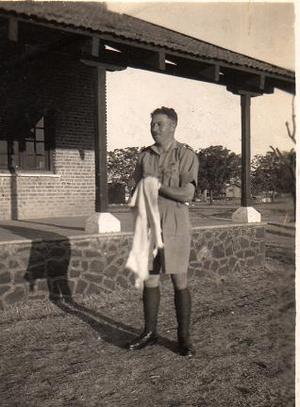
Lieut. AV Kent Jan 1942 Almednagar, India
Lieutenant A V Kent 129202
Early in 1939 the Territorial Army was enlarged by forming a second line to the existing units. 74th field Regiment RA (TA) of South Shields formed one of these in Sunderland and Lieut- Col. James Dean, DSO, MBE, DCM, .became the first commanding officer. In September 1939 the regiment became the 125 Field Regiment and joined 23 Division.
26th August 1939 the regiment set off for its first T.A. camp at Whitby, to be recalled after barely a week.
September 1939 the unit was embodied into the Regular Army and began serious training.
Alan Vincent Kent was a member of the Territorial Army 125 Field Regiment RA. In August 1939 he was recommended for a commission and joined O.C.T.U at Catterick Camp. On April 12th 1940 he received his commission having completed his training in the B1/2 Troop, 123rd Officer Cadet Training Regiment, R.A. and returned to 125 Field Regiment in Sunderland as a 2nd Lieutenant
When the army was reorganised after Dunkirk, 125 Field Regiment was moved to Norfolk and joined 18 Division and was converted into an anti — tank unit
By November 1940, the regiment was placed under War Office orders, and commenced to mobilise for service overseas.
The Regiment was moved to Dunns in Scotland, where in very snowy conditions they attempted “desert” training. In March 1941 they embarked at Gourock on the P. and O. liner Strathaird However, after just ten days the liner was forced to return to anchorage for repairs. The War Office could spare no equipment to refit so the 125 undertook the civilian jobs of fire-watching in Glasgow and then later in Liverpool. Three members of the regiment lost their lives in the Liverpool “blitz”. The regiment was again on the move first to Cheshire where Lieutenant Kent was billeted in Heaton Moor and then to Trawsfyndd for serious training and actual target practice. Just after I was born, at the beginning of October 1941 the regiment received final orders from the War Office. They embarked at Avonmouth on the S.S. Oronsay and sailed on 28th October 1941. After a few hours in the Clyde they headed for Iceland and subsequently Halifax, Nova Scotia. They arrived in Halifax on 8th November where they received orders to transfer to an American vessel the US ship Dickman and be ready to sail by midnight. By breakfast time on 10th November the convoy was heading south west for Trinidad. After refuelling they sailed for Capetown. On 9th December they reached Capetown, where they had a short break before sailing again on 13th December.
They sailed north to Bombay where they stayed for four days before setting off, on New Year’s Day, for Ahmednagar. After breakfast on 2nd January they set off on the long hot march to East Ridge where they spent the next three weeks getting used to working under tropical conditions. On 23rd Jan1942 they embarked on the Empress of Asia. At first Lieutenant-Colonel Dean refused to take over the ship because of its filthy condition but he was over ruled by a higher authority. The Empress of Asia had done trooping during the 1914/1918 war, and it appeared as though she had never been cleaned since! After passing Ceylon the ship set a course for Australia and then suddenly changed course to pass through the Sundra Srrait dividing Sumatra and Java. Extra precautions were now taken on board the Empress of Asia. Every available gun was brought out and men detailed as gun crews under Capt. Watts. The ship was literally bristling with guns and the men ready in case they were attacked by low flying Jap aircraft. Standing Orders in the event of enemy attack were posted throughout the ship and they had had a few practice alarms.
The Captain of the ship had not been happy with the stokers who were proving to be an unreliable lot.
On the morning of February 4th 27 Japanese bombers flew over the convoy at high altitude and now within 24 hours of their destination they heard the familiar whistle as a number of bombs were dropped around the ship. While no real damage was done the Captain’s fears about the stokers proved to have been well founded for they deserted the stokehole immediately the bombs were heard to explode. By the time they returned to their posts steam had been lost and speed reduced to about 10 knots. That afternoon the convoy split, the faster portion going on ahead whilst the Asia wallowed along as best she could with the Felix Rouxelle and the Canterbury as company
In response to an appeal for men to act as stokers in the event of a repetition, about 50% of the troops volunteered for this unsavoury task.
In light of the morning s attack Colonel Dean altered the Standing Orders to reduce the numbers of officers reporting to the Officers Lounge in the event of an attack and that all other Officers, W.Os and Sergeants should go with their men to troop decks.
The next morning, on the horizon, they sighted a pall of black smoke hanging over what they later found out was Singapore. During the withdrawal of the remaining arms and ammunition from the armoury the warning sounded and within 2 ½ minutes everyone was at Action Stations. The Felix Rouxelle was the first ship to receive a direct hit and was soon on fire. Luckily, a second direct hit landed in a water tank which burst and the rush of escaping water put out the flames. Then it was the Empress of Asias turn. The first wave of aircraft dropped their load wide and with a roar passed over followed by a second wave almost on their tail. Columns of water spouted all round but still the ship was untouched. Then a single plane appeared from the blue. For a second they saw a bomb released and heard, above the din of their own guns, the long swish getting louder and ending in a sickening thud. The bomb had passed over the bridge, through the roof of the Officers’ lounge and exploded somewhere below. Fourteen officers were assembled in the lounge at the time, and in a flash a scorching searing flame which removed hair and eyebrows filled the room, followed by dense fumes which made the smoke-laden atmosphere too hot to breathe. Tin hats, water bottles and haversacks were torn from the officers’ bodies by the suction created by the bursting bomb. Amidst the smoke, those who were able fumbled their way to the boat deck, there to gulp fresh air into their lungs. Unfortunately Lieutenant R.B. Wilson was killed in the attack and two more officers were seriously injured.
The enemy bombers then turned their attention on the escort ship H.M.S.Exeter, but by skilful manoeuvring and intense A.A. fire, no hits were registered and the attack was switched back to the Asia. Magazine after magazine was emptied as the men of the 125 stood up to their first encounter with the enemy but by this time the fire had got a real hold on the tinder-dry woodwork, and the “fiddley deck” where the guns were sited, was enveloped in smoke which made it impossible to see more than a few yards. More planes came over and further bombs made hits on the ship. Unfortunately although the hoses were run out there was no water to put out the fires as the pumps had been damaged in the explosion caused by the first bomb. The ship was burning furiously and it soon became evident that unless a miracle happened the Asia would soon be burning from end to end. They hung on in appalling conditions until, at 1.0pm the order was given to “Abandon ship”. Eventually my father was picked up and taken ashore some six miles away on the Queen of the South. The following day late in the afternoon every one had been accounted for but about 62% were suffering from burns and wounds. Eventually the Regiment moved into line on 9th February. “A” and “C” batteries and R.H.Q. to Serangoon to patrol the coast of Johore acting as infantry as they had no equipment. H Troop under the leadership of my father was the exception, being proud possessors of four anti-tank guns. They placed 2 guns at the Serangoon cross roads and the other 2 at Tengah Village. On 12th February they moved to occupy 4 gun positions at Newton Circus “A” and “C” Batteries were separated from the regiment and came under the control of 154 Infantry Brigade. After leaving Serangoon area they spent the remainder of the battle on the Bukit Timor Road
At that time Churchill ordered that the officers and troops of the 18th Division should fight to the death in the impossible task of defending the island “For the honour of the British Empire and British Army”.
My mother never forgave Churchill for sacrificing all those men to appease the Australians. After the fall of Singapore she received a message to say that my father was “missing presumed dead”
My father stayed with his guns until, on the afternoon of 15th February, he was ordered by a senior officer to withdraw because the white flag was going up. The “cease-fire” sounded at 4.00pm although the enemy were still dropping bombs on the town as late as 6.45pm.
The main reasons for the G.O.C. to capitulate were:-
1. Lack of artillery ammunition
2. The enemy had possession of the reservoirs and had cut the water supply to the town.
3. An ultimatum had been given by the enemy that unless there was unconditional surrender, every European on the island would be annihilated. (The authorities knew from experiences up country that this was no idle threat)
At 8.00 am on 16th February the Japanese Army marched into Singapore and the flag of the Rising Sun was hoisted over the Government buildings.
On 17th February the Regiment was marched to Changi some 20 miles away to begin their 3 ½ years of captivity.
My father told us of the wonderful sight and sound of the nurses from the hospital and other women from Singapore marching into the prison singing “There’ll always be an England”
The barracks at Changi had originally been built to accommodate about 4,000 men but by 20th February it was housing approximately 47,000 troops. Many of the buildings had been seriously damaged by bombing and shelling and to add to that the water supply, sewage system and electricity had been deliberately destroyed by the British engineers. Food was poor and in very short supply. The men of the 125 working in tropical heat, hewing timber and transporting it to camp, lost up to a third of their weight in two months.
During March, the Japs segregated all the sick and called for working parties to go to Singapore. By being firm Colonel Dean was able to prevent the regiment from being split up and on 3rd April the majority moved into Singapore to River Valley Camp. They were welcomed by some Chinese with their arms full of rolls and freshly baked bread. However the camp was far from being as pleasant. The grass was long and soaking wet, the ground was pitted with shell holes and bomb craters full of water and covered in frog spawn, latrines were none existent, there was no cookhouse, the huts were dark and dirty and lizards flitted about everywhere and sleep was impossible because of the croaking of the bullfrogs which began about an hour after dusk and continued all night until dawn.
Soon after their arrival at River Valley Camp they were sent out with hand carts to clear up the debris from the bombing. This gave them the opportunity to outwit the Japs by smuggling things back into camp which were collected from abandoned houses and shops not to mention guns and rifles which were to be repaired by a member of the regiment before being returned to the Chinese underground organisation. My father also talked about collecting eggs to take back for those who were sick, to supplement their diet of rice. He said throughout his captivity men from all walks of life contributed their skills to make life a little less uncomfortable for each other. One of the reasons why so many men did survive was the way they helped each other.
During August all senior officers above the rank of Lieut-Colonel were sent overseas.
At the end of August 1942 the Japanese Commander, called upon every prisoner of war in Singapore, irrespective of rank, to sign a certificate that he would not attempt to escape. EVERY MAN REFUSED TO SIGN. As a result, on 2nd September, the Jap Commander ordered all ranks except those sick in hospital to proceed to Selerang. These barracks consisted of blocks of buildings forming three sides of a rectangle with an asphalt square in the centre. In peace time the maximum accommodation was for 850 men. Into the square and surrounding buildings the Japs squeezed approximately 16,000 men. It was late evening before the final party arrived. There were no sanitary arrangements, and it was imperative that something be done immediately. No time was lost, and by the aid of the flickering light from oil lamps men worked all that night digging deep trenches all over the square. My father did have a photograph of the dug up barrack square but as yet I have been unable to find it. Hopefully before the end of the month I will be able to insert it.
The cheerful spirit in which they carried on their job seemed to annoy their hosts.
Rations were cut and the water supply was barely enough for drinking purposes. There was not room for everyone to lie down under cover of the buildings and all kinds of contraptions were erected where possible in the square to provide cover from rain and sun.
After the first day threats were made to cut still further the supply of both rations and water. Within 48 hours cases of Dysentery etc., were reported and the sick men were taken to an improvised shelter used as a makeshift hospital to await transportation to Changi.
The Senior Officers were in consultation almost continuously, but it was soon apparent that the Japs were determined to have their own way. They made a further threat that unless they signed soon all the patients from Changi Hospital would be moved to Selerang to swell the already hopeless overcrowded army of men pent up in the restricted area.
Arguments for and against signing were put forward but it was obvious that, unless the Japs relented or they signed, epidemics would soon break out.
On the third day the position was desperate and, acting on the advice of the Senior Medical Officer, the British Commandant ordered the forms to be signed-under duress. The troops returned to their camps on 5th September.
In September, 1942, the River Valley Camp was left with only 12 officers and 240 men from the original 25 officers and 400 men. The rest had been evacuated to Changi as being too sick to work.
In October orders were received to prepare to move north. No one knew their ultimate destination.
© Copyright of content contributed to this Archive rests with the author. Find out how you can use this.


 Recommended story
 Story with photo