

- Contributed by
- uptone20
- People in story:
- Joe Latham
- Location of story:
- Washford, Somerset, England
- Background to story:
- Civilian
- Article ID:
- A9004989
- Contributed on:
- 31 January 2006
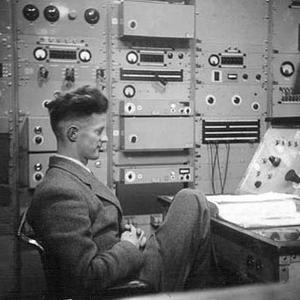
Joe in the Washford control room
I joined the BBC at the Droitwich Transmitting Station on 24th May 1943. I was just 17 and still had my Higher School Certificate to cope with later in the year.
I joined as a Youth in Training and the first five weeks were taken up with an excellent course run by Mr Lowry - the On-Station Instructor. I had vaguely heard of Ohm's law but little else that would help towards my understanding of the workings of high-powered transmitters. Before I left Droitwich in November I had started up the 230kW transmitter on my own, without supervision, so that it was ready to go on the air - air cooling, water cooling, interlock circuits, valve filaments etc. When you consider that each of the large valves in the output stages had its own generator just to heat the filament and that the EHT was 10kV and it was series-modulated making a total of 20kV I can only say that Mr Lowry did a good job and the engineers were very trusting!
I often cycled from Worcester for nightshift which started at midnight 'til 0930 and sometimes was accompanied by a few German bombers flying overhead. They never stopped at Droitwich I'm pleased to say! It was a wonderful station, with its 700ft masts, and I really enjoyed my first taste of the BBC.
Next I went to Maida Vale for the A1 course and after Christmas to Daventry for the B1 course - I was then promoted to Technical Assistant Grade II and posted to Washford - I'd never heard of the place until that moment.
Washford is in Somerset a couple of miles from Watchet where I had digs. It had two 50kW medium wave transmitters and directional aerial aimed at South Wales. The masts were a mere 500ft high! It had wonderful views of the Quantocks from the rest room (which also had a splendid snooker table!) The shift system was interesting and followed this Sunday to Saturday pattern: seven evenings (1400 - 2200), with a quick change-over to seven days (0700 - 1400), then seven nights (2200 - 0700) and back to another seven evenings - and so on.
We had one day off a week starting on Monday one week then Tuesday the next and so on, so that every seven weeks you had a long week-end off i.e., finish Friday at 1400 and start again at 1400 the following Monday.
Holidays were two weeks in the Summer and one in the Winter.
Incidentally, weekly pay for a TA ll was £2/5/0 (£2.25) at sixteen going up to £2/10/0 (£2.50) at seventeen, plus about £2 subsistence allowance, but no other payments for nights or anything else - I wonder if this had any bearing on my feelings later when in discussions about overtime, interrupted meal breaks and so on - ah well!
In October 1944, a young lady arrived from Weymouth H-Group transmitter and was posted to our shift - Sylvia Beechey by name. Years later, in 1949, we met again at 200 Oxford Street. She became Sylvia Latham on November 25th 1950 and we've been together now for..... etc., etc.
To get from TA ll to TA l you had to take a practical test on station with the EiC in attendance - starting up one of the diesels (450 hp marine driving one of the 220volt DC generators) and connecting the latter's output on to the main switchboard; starting up various sets of machines; putting batteries on charge; answering questions about the transmitters and so on. Sylvia and I both passed this test during our stay at Washford.
Washford was in a group of three medium wave stations all on the same frequency so that German aircraft could not use the carriers for direction finding. If any one of the transmitters in the group was off the air for more than three minutes the others had to close down. This gave plenty of incentive to get a move on when a fault occurred and to get back on the air. Mains failures were fairly frequent and this meant the inevitable shut-down for the whole group. I well remember rushing down the corridor to the engine room to get three out of the four diesels started up to cope with the station load - five minutes at least! Incidentally the station mains were DC and mercury arc rectifiers were used to convert the incoming 415 volt AC into 220 volts DC. The two control rooms were powered by batteries. There were three sets of batteries, one on each Control room and one on charge. These had to be changed over from time to time by using three banks of knife switches - plenty of scope for the odd error there!
Round about D-day the frequency of one of the transmitters was changed. Rumour had it that we were on the same frequency as Calais so that German aircraft could not use it for direction finding. The transmitter was "switched on" from somewhere in London and the whole thing was called Operation Bareback - I never did find out too much about it - hush hush, you know!
Before the war ended, I served as a Radio Mechanic in the Royal Signals - my National Service lasted for two years eight months. On de-mob, I rejoined the BBC in Radio OBs for the period of the Olympic Games. Shortly after, I retrained as a Programme Engineer and worked as a PE, later Studio Manager, at 200 Oxford Street for over six years before becoming an Instructor with Staff Training for more than seven years.
In 1962 I got the job as SSM Central Unit at BH and later as Operations Staff Organiser, Chief Production Services Manager and eventually Head of Programme Operations, Radio. I retired at the end of December 1983 - over forty years since joining. The two jobs I enjoyed most in the BBC were being a TA I at Washford and working as an SM at 200 Oxford Street.
On retirement I was able to concentrate more on watercolour painting and have sold more than 550 pictures since then. I was elected a full Member af the Guild of Aviation Artists a couple of years ago and in 1997 won the award for best watercolour - who says there's not life after work?
© Copyright of content contributed to this Archive rests with the author. Find out how you can use this.


 Recommended story
 Story with photo