

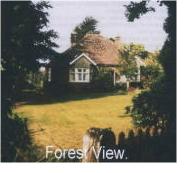
The home we moved to in 1939.
- Contributed by
- IRWinter
- People in story:
- Ivan, Paul and Brian Winter.
- Location of story:
- Landford Wilts
- Background to story:
- Civilian
- Article ID:
- A8419359
- Contributed on:
- 10 January 2006
Local Farms.
As town children we were fascinated with our new surroundings, trees, fields full of animals, wild birds everywhere what a treasure house. The New Forest ponies had the run of the roads there being no cattle grids to deter them. Gates had to be kept shut or they would enter and clear the vegetable gardens. To us they were a welcome sight but increasing traffic and fast Jeeps were a hazard to the ponies.
We all got to love the countryside in the next six years and chose it to live in during the rest of our lives when the opportunity arose. Both Paul and Brian now live in the lovely villages of Olney and Markington respectively and I when I had the first chance moved back to Hampshire and live on the edge of the countryside in Cowplain.
We were lucky that our Aunt Dorothy was always keen to teach us the names of the wildlife that surrounded us, particularly the birds and their tunes, although her habit of blowing wild bird eggs for us was not a good example.
In those days nests could easily be found every few yards in the hedgerows unlike now when the agrochemical industry has decimated the birds.
We were surrounded by several farms. Big was not best in 1939 and most farmers were mixed with about thirty cows, a few pigs and chickens, always two cart horses and mixed crops.
The most obvious farm was Bill Grayers at Glebe farm and Horace Hutchins the other side of the Lyndhurst road. Both of these were small market garden type enterprises. Glebe farm had of course been in the Winter family up to the war when Alice sold it to Bill Grayer upon the advice of Lesley, one of her sons.
As we got older we ventured on to local farms to play and take an interest in the activities. Strangely only two of the farms drew us, that of Mr Tayler and that of Mr Densham probably because we were made welcome, this was particularly true of Bridge Farm run by Mr Taylor.
Bridge Farm, down the A36 and over the bridge, over the years was to prove to be a magnet to us lads. Mr Taylor {Bert} employed two farm hands, Reg Drew the dairyman and Bill Hatcher the carter the farmer himself was a jack-of-all-trades, driving the Fordson Tractor, thatching the ricks after the harvest and making all of the decisions. Bill had two carthorses to look after, Polly a grey mare and Smart a dark brown horse. Both were even tempered enough to tolerate young lads about them and as heavy working animals they were kept busy all year round doing the hay cutting, harrowing, rolling, harvest cart etc. I can only remember one disaster when during harvest time Smarts single axle cart had been loaded and he was told to stay whilst the double axle tractor cart was loaded. As soon as we were all out of eyesight Smart decided to make for home and the barn, which were not far away. Unfortunately he was stood on a steep slope and on moving across the slope over he went with his cart.
This was not seen until we were all making our way back with a full load. Mr Tayler and Bill Hatcher raced to the scene but all was well and Smart scrambled to his feet when released from his harness. He probably got a smack across the nose for that but it would be the kind that a child gets for falling over.
Reg assisted by Bill was the dairyman and had about thirty cows to milk by hand twice a day at about 6am and 3pm.
The cows would be collected from a near by field, by us boys as we got older and proceeded in a rigid order to the farmyard passing the two ponds on the way.
Not only did they know which order they had to be on the journey to the farm they also always went unasked to their allotted place in the cowsheds. Before the days of TT testing the farmyard was a pretty messy place but the dairy was kept clean and the drinking trough always full of water.
The milk would be carried from the cowshed to the dairy and poured into a cooler and then into a churn. The cooler was cooled by water running through tubes over which the milk ran. The churns would be stacked outside the farm on the A36 for collection. In the summer it would sometimes curdle, a disaster for the farmer.
{Map of fields and farms around us in 1940s, Bridge farm Mr Taylor T, Glebe farm Mr Grayer G, Manor Farm Mr Densham D. Foot paths are shown in green.}
The cows were restrained in the sheds with a chain around their neck, some didn’t mind us boys tying them in but others were not keen and would let us know with wild looks, which kept us away. Even more important was the untying which had to be done in sequence so that each animal quickly followed the next out or panic would ensue from the still tied cow, which obviously imagined all sorts of dire consequences when it was not released.
A couple of times we started to release the cows and would then come to one which was not child friendly, the resulting racket and cow releasing the contents of it’s bowel in a mighty stream would get Bill on the scene or a braver one of the three of us would dive in and release it. Even the most docile animal would object strongly to a change in the normal pattern.
Sometimes the farm entertained a bull who would be locked in the shed nearest the dairy or if he was lucky would be let out in the field opposite the Shears where he would stand trying to catch a glimpse of his lady friends. When he was offered to a cow in the farmyard us boys would be discouraged from watching the event, what a hope.
I always found a cow with a calf in the sheds far more dangerous than the bull. You could walk down the A36 pass the farmyard gate but before you could look over the gate the cow in the field would come charging into the yard to defend her baby and mean business.
Mrs Tayler was a very shy lady who was usually not to be seen, however during the harvest she would assist. To me she was a very ancient lady but was probably in her 50s and had no children and seemed incapable of conversing with kids.
The other member of the Tayler family was Timmer their wire haired Terrier, now he knew how to get on with kids and delighted in joining in the games such as digging out mice in the harvest field or waiting for the rabbits to appear as the diminishing uncut section grew smaller, the rabbits usually got away even if Mr Shears appeared with his gun. Then all part of the fun but now the safety people would die at the thought of the mixture of children, dog, farm hands and shotgun.
As we got bigger we could assist putting the sheaves thrown out by the binder into stooks to dry, up to then we would walk for hours behind the Binder, which was pulled by the orange Fordson Tractor. On the Binder would sit Bill Hatcher with a stick to clear blockages. If it rained on the stooks they would be broken down and turned to ensure that the sheaves were built into dry ricks which would be thatched by Mr Tayler in the traditional manner using willow and tools that had been used for years.
The building of the ricks meant that one of the two petrol driven machines would appear. This was the small Lister prime mover engine, which by means of a rather dangerous belt drove an elevator, took the sheaves to the top of the Rick
When Painters threshing machine was available another exciting event would take place with many farm hands and helpers in attendance. Dust, noise, madly writhing drive belts and the lovely smell of oil, petrol and harvest accompanied this activity. Again a health and safety at work inspector’s nightmare.
The number of mice that ran from the diminishing rick depended on how long the ricks had stood. Again Timmer, suitably excited by us lads would come into his own but the number of mice even exceeded his ability to catch them and others would join in with large sticks etc.
Below is shown a layout of Bridge farm as it stood in the 1940s. Much of it is now demolished or small industrial units.
Layout of Bridge Farm 1940
Hay/Straw ricks
Barn for hay/straw and Machinery. Small shed
Bullpen Farm House.
cow Stock Yard Dairy
shed
pig Cow
pens Shed
To field
Stable
Cow Sheds Cow sheds
A 36 A 36 Salisbury
Pride of place on the farm went to the orange Fordson tractor, which did most of the heavy work. Mr Tayler seemed to be the only one with the skill to drive it until one day when we were on our summer holidays, six weeks with our war time Mums, he asked Paul to drive it during the harvest time. This made him free to help elsewhere.
Paul who was about 11 was so impressed that he vowed that he would work on the land when he left school. He now says that Mr Tayler actually offered him a job but his parents would not agree to him moving to Landford again. His subsequent job on a government agriculture scheme in the West Country did not go well so maybe he was destined not to be a farm hand.
Bridge farm land included the field in front of us at Forest View, fields along the A36 up to the ponds and across to the common and a couple reached from a drive by the school. Two other fields were opposite the Shears home with an old road called the drove, which had a source of fresh water a lovely stand of trees with owls and many banks full of rabbits. The stream, which ran through his land went across the bottom of the hill adjacent to the rectory and across to stocks lane. In the far right corner, just the other side of the hedge was a large pond surrounded by trees, which always seemed a foreboding place, probably because it was always dark.
A footpath up to the church ran across these fields but a marshy bit just before the footbridge prevented access to the dry summer months. The profusion of bull rushes encouraged us kids to construct baskets and things.
When these fields were taken over by Gradidge much of this was removed in the interest of modern farming. No ponds, no hedges and no trees or owls. The banks were flattened removing the rabbit’s home.
The only other farm that we ventured on was Mr Denshams Manor Farm. This seemed to be a posher outfit with a herd of black and white Friesian cattle. Again two horses were kept for work on the land, Prince and Blossom. The only farm hands I can remember are Bill Shepherd, who lived in Stocks lane, George Bundy and Ern Pierce.
Bill must have been the carter because I have a photo of him taken whilst he was turning hay on church hill.
Manor farms land was clustered around the manor house but it included a couple of fields nearer us. These ran the other side of the A 36 from Shears place down to Rose Cottage [now off the main road]. In one of them the Landford bomb dropped. Mr Densham always seemed a bit more intimidating to us, a big man with a red face. A gentleman farmer with the obligatory peaked cap. He was a bachelor and could be considered a very good catch so there was a lot of horse play with the land army girls which did not go unnoticed even to us. There would be assistance to girls who were threatened with mice accosting them. Do mice ever run up girl’s legs?
George Bundy, a local lad, always provided amusement to us. He was one of the farm hands. His best trick was to attempt to get a rabbit out of it’s burrow by getting his arm down as far as possible. This once went horribly wrong when a snake came out instead of a rabbit. There were of course many large snakes in the fields at that time before harvest mice were exterminated by efficient farm methods.
There were other farms around us but not visited by us probably because we would have to cross main roads. Grayers and Muspratts come to mind.
After the war we spent our six weeks Summer holidays in Landford for about five years. Leaving our sister in Gillingham we travelled up to London and then down to Southampton on a Royal Blue coach finally getting on the old familiar No 36 bus at the Southampton bus station.
It was a holiday looked forward to with much enthusiasm, the departure from Gillingham and leaving our parents behind did not matter a jot to us boys. The bond forged in the war years was so strong that we all loved to get back to Landford. In hindsight this seems very sad for our parents, as we never regained the family bonds that must have been there before the war.
During those six weeks everything seemed to return to the war years with reunions with familiar faces and much time spent on the farms and the occasional outing to Swanage or Bournemouth on the Skylark coach.
Eventually my parents wanted us at home for the summer holidays and the link was slightly broken. Very infrequently Aunty Dorothy would travel up to Gillingham for a few days holiday. But contact was maintained by letter and eagerly awaited Christmas parcels.
When I was 16 I decided that I would cycle to Landford to see Gran and Dorothy again. My mum did not think for one minute that I would make the 110-mile journey and waited for my return back home within an hour or two.
Although this was a considerable feat on my heavy old bike things were not quite the same. It was nice to see all of my relations but on your own it was different particularly as I was now very shy and would cross the road rather than greet a familiar face.
I did repeat this cycle journey once more but later acquired a motorbike and then a car and when I got a job in Portsmouth frequently visited Gran and Aunty Doll. When Gran died in 1963 I spent many weekends at Forest view were there was always a Dorothy work list to pass the time.
Paul also visited now and again but avoided the work list by always having his best suit on.
The farms of course also changed. Mr Densham sold up, married and moved to Damerham ?, near Salisbury. He died from a heart attack at what can be considered an early age.
On Mr Taylor’s farm things stayed the same for a few years, in fact for all the years that we spent our six weeks holiday. Then we heard that Polly the Shire horse had gone down in a ditch and had to be put down. We still saw old Smart standing lonely in the field for a couple of years then he went.
Mr Taylor was diagnosed with lung cancer and passed away leaving Mrs Taylor to sell all but her home.
She and Dorothy became good friends and I would join them on walks around the old fields in the late 1960s. Unfortunately Mrs T was hiding a serious problem through misplaced modesty and it was already too late when she showed Dorothy the terrible growth on her breast. She swore to the doctor, who had been called in by Dorothy, that it had only been there a few weeks but he knew better. While she was away getting treatment Dorothy looked after her home, garden and chickens for many months. The poor woman died and Dorothy’s reward was the bequeath of her old 1950s Hoover. I have never seen one so old and dilapidated. Mean while the vultures that had up to now been absent gathered in flocks.
© Copyright of content contributed to this Archive rests with the author. Find out how you can use this.


 Recommended story
 Story with photo