

- Contributed by
- vicjacqui
- People in story:
- Irene May Chatfield, Jack Ward
- Location of story:
- East Grinstead, West Sussex
- Background to story:
- Civilian
- Article ID:
- A4536759
- Contributed on:
- 25 July 2005
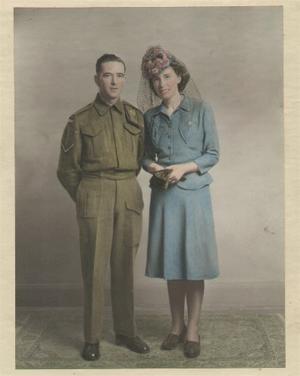
Wedding of Irene May Chatfield and Jack Ward, East Grinstead, West Sussex, December 29, 1943
My mother, Irene May Chatfield, was born and raised in East Grinstead and lived there during the war. Before the war she worked for Dixon's Chemist in the High Street in the office above the shop. She became very good friends with Mr. Woosenham, the chemist at Dixon's, and his family who lived in the house attached to the shop. One of their daughters was at home along during an air raid and was so traumatized that she suffered from epilepsy for the rest of her life, brought on by the terror she suffered according to the doctor.
My mother was a very fast typist and shortly after the war began she started working as a teletype operator in Vital Communications at the Post Office in London Road. She told me of having to cope with the rationing and the hardships and deprivations of everyday life. But she also spoke of the community spirit, of everyone working together against a common enemy, saying that in many ways it was good times. One weekend she went to London for a show and her purse was stolen while she and her friends were having tea. Without identification it was almost impossible to do anything or get any rations but her friends rallied around and helped her to make it through until she got replacement documents.
She told me of the wonderful work done at the Queen Victoria Hospital on the burned pilots. As part of their rehabilitation the pilots went into town to the pubs, sometimes wheeled in their hospital beds, and the townspeople of East Grinstead were asked to treat them normally, which they did. That says a great deal about the spirit of the town and its people.
The Brighton to London road ran through East Grinstead, and the German bombers follwed the road, turned at the St. Swithun's church tower, and headed to London. My mother watched them and the dog fights and saw the reflection of flames from the London Blitz in the sky. She remembered all kinds of heavy military equipment being parked around town in the run-up to D-Day and the sky being black with planes on the day itself. She told me many stories, including one about a lady haunted by dreams of being bombed in her bathtub who left London and moved to East Grinstead to be safer. During a bombing raid her house was hit and she was found - in the bathtub. Luckily she recovered. People with cats were often the first people to be warned of an impending raid. According to my mother a full 10 minutes before the air raid sirens went off the cats would disappear to a safe place, usually under the stairs, and the people who watched this behaviour were able to get to safety faster.
I asked my mother if she had been bombed and she said yes. Her very typical British response to my question of what was it like was "Well, you just climbed out of the rubble and carried on." Although she never directly said so I think she may have been working at the Post Office in London Road when the Whitehall Cinema was bombed in July, 1943. I know that for the rest of her life she ducked whenever a low-flying aircraft flew overhead.
My father, Jack Ward, was also born and raised in East Grinstead, and emigrated to Canada in 1928 to join his brother Arthur on a farm near Vancouver, British Columbia. Arthur enlisted in the Royal Westminster Regiment soon after war being declared and left Jack to help with the farm work. But Jack could not stay away from the action and enlisted in the same regiment. He was sent to England in 1942 and became one of the many Canadians stationed at Aldershot. He knew my mother from childhood and they met again and were married on December 29, 1943 at St. Swithun's Church in East Grinstead. By late 1944 my mother was pregnant with me and the V2s were taking their toll in southern England. She went to stay with friends in Rothesay on the Isle of Bute in Scotland and I was born there on May 15, 1945, a week after VE day. In May, 1946, my mother and I sailed Canada with many other War Brides and their children.
My father remained stationed in England training troops throughout the war, while his brothers fought in Italy, Europe and Burma. Miraculously all came home with no injuries and no-one in his family was injured in the bombing at home. One of my mother's cousins was killed during the strafing of a schoolyard by a German bomber, but the rest of the family came through the war safely.
Not long before he died my father gave me a small book written by T. P. Peters, Head Warden, Norton House Post, East Grinstead, Sussex, entitled "Reminiscences of 1938-1945 By a Head Warden". Reading the book I found many of the stories she told me and so much more. I have nothing but admiration for the people who lived during that time and I am very proud of my heritage.
In 1955 my mother and I visited East Grinstead and some of the bomb scars were still visible and I was able to see some of the places where bombs had hit. When we returned for another visit in 1960 all the damage had been repaired. I'll always be glad that I had the opportunity to see a little bit of what my parents and their generation went through, and to come to know the beautiful town of East Grinstead better.
© Copyright of content contributed to this Archive rests with the author. Find out how you can use this.


 Recommended story
 Story with photo