

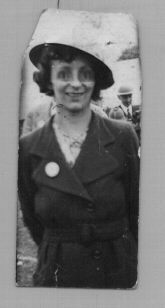
Mrs Doris Cowie ARP Hyde Park Rally 1938/9
- Contributed by
- Cowie - Doris and Bill
- Background to story:
- Civilian Force
- Article ID:
- A8883057
- Contributed on:
- 27 January 2006
In 1990 my mother Doris Cowie wrote these memories of her experiences. They have just come to light! I have put her notes into what I hope is the right sequence. She told us something of these things, although my dad didn't speak about his time in 6th then 190th Field Regiment Royal Artillery which the became amalgamated with the Northumberland Hussars. Any information on this would be appreciated.
--------------------------------------------
Bill and I joined the Civil Defence in June 1938. In 1939 there was a rally in Hyde Park, before Queen Mary, King George, Queen Elizabeth and the two little princesses. The order was eyes right, I looked left! Amongst thousands attending I saw my mum and dad (Henry and Florence Smith).
We had lectures, evacuated children and mums, through 1939. it was still the Cold War. Bill's work was surveying the area, listing occupants, number of rooms and height of buildings. I,STAB, but everyone did gas protection and overall training. Taking part in exercises, rescue work etc. Lectures by FA (Fire Auxiliary), Police Ambulance.
Sept 2nd 1939 "Terriers" called up. Busy in shop, bread and corned beef for their sandwiches. Bill's parents had been on their first holiday for 4 years at Lancing. The previous Sunday Bill had taken our children, Irene age 6 and Ken age 4 plus two of neighbours children to Lancing and brought his parents back. Sept 3rd, I was scrubbing the shop floor when Chamnberlain announced war had started. Bill went to Warden's post to muster his men, met him on the way back, none had turned up! "you must help me," he said. I had to report to Belgrave Hospital as I was FA or auxiliary nurse, so instead of signing on I signed off as my husband needed me to train street wardens. I had always from a child wanted to be a nurse. We used a school in Camberwell Road. Demonstrated to mums the gas masks for the under 2 year olds. Cumbersome things, the babies went in and mums had to pump. Must remember to put on your own gas mask first. Always the fear of a gas attack. Siren went on Sept 3rd, I was out on bike, blowing whistle, telling folks, Take Cover! It was a single plane on the Thames - unidentified. Talk about panic. Cold War - with intensive training and more shelters, some unenforced concrete surface. Anderson, then Morrison shelters in gardens. We had to inspect them. Got to know people. Our area was from The Horns Public House to Borough - Kennington Road - Kennington Lane - Kennington Park Road. Very strict instructions, stay only there, otherwise confusion when sending in MI forms for ambulance, Fire or Police.
Post 11 Kennington Park Road had a long garden, with a chicken run. We each decided to buy a fowl, also one cockerel. An incendiary bomb fell in the garden. From behind the blast we saw the chickens run up the ramp. Cockerel ran over the heads of the chickens (coward) got in first. One poor hen lost all her feathers when an HE fell near - she probably ended in a pot. Afraid the hens did't lay as we hoped so they all ended up in pots.
(This next section cross references to "People At War" ed Michael Moynihan, Chapter 7 Love and War by Joan Veazey.)
We met the Veazeys in Switzerland in 1970. Being the same age Bill and Christopher chatted and realised both were in Kennington in 1940. Joan and I swapped stories and I realised that I had issued them with their gas masks. The raids had started in earnest on September 7th 1940, wish I'd kept a diary. My dad said I should write a boook about my adventures or were they misadventures?
I too stood by a bomb crater during hours of darkness in case ambulances or fire vehicles came that way. When the land mine dropped the Post Warden and I were the only ones at Post 11 - we hung onto each other around the re-inforced poles. Only a blast wall outside, not even a basement. The LM fell behind the Kennington Theatre, next to the park (Peoples War page 139 dates this to 16th October 1940). The bomb went down the ramp into the shelter, the shelter marshall was killed. As he took the tally of people in there no correct amount known, reckoned on 300. One soldier and I took over; we identified a child by a shoe only. The shelters were divided by a path. Bill was shelter marshal for the other side. That side leaked so much I phoned the Town Hall at Lambeth to say it was dangerous. I had to go in and sign a book "Mrs Doris Cowie says shelters unfit", no doubt thre are records kept somewhere. An unexploded bomb went off as I went back to my post, it was outside The Horns public house. In front of Prince Albert's Shooting Lodge a child was playing in the park. I pushed us under a park seat, rammed my tin hat on her head as bits of tram were flying around.
(No dates on next bit so sequence may be wrong)
Outside the Waifs and Strays home, the old Town Hall Kennington as I was on patrol and ambulance driver avoided a crater, could go no further, he passed a mother and child over to me, "Find a rest centre". The school was near but before we got there a stick of bombs fell. One, two, three, nearer - four fell in the next street. I got them safely to the school and went back to the post.
At same Town Hall, having 200 inside, the mains water and gas outside were hit. No one could get there till morning. Amb...and Bishop..etc. (cannot read this word in original.The water was coming down the steps outside. Prayers said for the dead. Across the road cheers and shouts shelter marshal got them all out the pub, very merry. One woman asked me "When it's drained will you find my knitting, it's pink wool?" Can't remember if I did.
27th October Joan's diary mentions chemist shop. I was sent over to estimate damage, the sanitary towels, in those days unmentionables, were all over the road, being young and having a 15/16 year old messenger boy with me was a bit embarrassed.
As Joan says in the book, night after night, day time too. We were lucky to get to sleep for two hours on a concrete floor, one blanket apiece. Another HE on a tram outside The Horns. Old gents playing dominoes in the corner by the window, they were killed by the blast.
Bill had a car so 6 of us decided to get out of London for a night's sleep. We drove to Reading. There was no room anywhere. We had a snack in an underground cafe, chatting and joking about sleeping accomodation - the men in sewe pipes we had seen in a field and Miss Malcolm and I in the car. As we walked to the car park a couple who had lstened to our conversation said "That's against the law. Cars are not allowed here overnight. If you follow us we will give you beds." We thought of 5th columnists capturing us, we were all carrying gas masks and tin hats. One of our group was in intelligence. We drove with dimmed lights, no idea where we were heading. Raid over Reading, flak everywhere. We stopped at a cottage. At home we had no water, gas or electricity. We all had a bath - oh what bliss- hadn't had our clothes off for days or even a wash. Room for Bill and I, single for Miss Malcolm, mattresses in front of the fire for the others. Breakfast, eggs, 4 each for the men, bacon the lot. Chappie even mended Bill's cigarette lighter. (This couple were Mr and Mrs Bryant). Bill asked if they were short of anything, sugar, tea etc, as they often gave hospitality. As we had the shop Bill posted them some. We never saw them again. Lack of petrol and Bill called up in Jnauary 1941 we sold the car to the Mayor of Lambeth for £90. It was new in 1939, a Vauxhall.
Christmas 1940 at a pub room in Kennington Road we danced to "In The Mood". Crowded and the bombing started. Found a house with a piano and got permission to take it to the post. Oh - talk about "turn it the other way round", when hefty wardens and rescue party first helped it out of the ruins, then between re-enforced supports behind blast wall at the post. I played well in those days to while away the hours on duty, and wardens, messnger boys 15/16 year olds (we each had one), sang all the old songs. Same when we had to patrol, to surface or undreground shelters, everyone who wasn't sleeping, sang the louder as the bombs fell.
Bill joined up in January 1941. I helped in the shop. Mrs Cowie senior was in hospital in Leatherhead. We had an unexploded HE ouside, incendiaries on the flat roof. I climbed through the skylight to cover them. Then Mr Cowie had his second stroke, we had to hand over the shop. I went to stay with Nurse and Miss Crossgill at St Agnes Place, had my ginger cat and a fireguard. That was bombed the night of Bill's first leave.
My thoughts are disjointed, it was a long time ago.
(Mum went on to be a billeting officer and took evacuees, including my brother and sister, to Kettering. I was born July 1944 and we lived in Kettering until my dad came out of the army in 1945. They did not return to London to live.)
© Copyright of content contributed to this Archive rests with the author. Find out how you can use this.


 Recommended story
 Story with photo