

- Contributed by
- Jackie Williams
- People in story:
- Lieutenant AV Kent 129202
- Location of story:
- The Railway of Death
- Background to story:
- Army
- Article ID:
- A6929742
- Contributed on:
- 13 November 2005
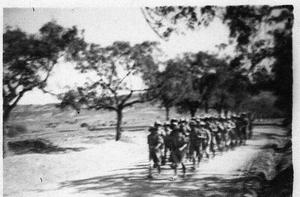
125th march to East Ridge, India Jan 1942
The Regiment was now split into several parties, the sick at Changi under the Colonel, the overseas party under Lieut. Carter, “D” Battery up-country party under Lieut. Rich and the balance up-country party under Major Brodie. Every effort was made to keep a reasonable sized party together wherever possible, together with at least one officer.
Just before the various parties left a consignment of South African Red Cross food and clothing arrived and was distributed among the troops.
Lieut. Rich’s party left on October 12th. Major Brodie’s party left on 14th October and the Colonel followed about fourteen days later from Changi with all the fit men he could muster. As far as I can tell my father was with Major Brodie.
He was taken up country by train. He and 31 others travelled in a steel truck in atrocious conditions for three days and four nights until they reached Ban Pong on the morning of 18th October. It was extremely cramped and the heat was intense. They soon realised that if anyone was going to get rest they would have to adopt some workable system. This was accomplished by half the men standing close together at one end of the truck whilst the remainder lay curled up on the floor. After a reasonable period of time the position was reversed so that every man got his turn to lie down. The heat was so intense that they would always remember the relief when, at one of the stops, they were able to stand for a few minutes under the outlet of a locomotive water tank by the side of the railway. They were also very grateful for the Red Cross supplies they had received before leaving during those four nights and three days on that ghastly journey.
From Ban Pong he moved to Kanburi base camp. My father worked on the building of the wooden bridge across the Kwae Yai and as an officer going out with his troops acted as a buffer between the troops and the Japanese engineers. He tried to learn their language and because he was an engineer in civilian life he gained some respect from the Japanese engineers. He was also involved with the building of the Wampo viaduct and he talked about the hospital camp at Chunkai. Many a grave he dug to bury his comrades.
My father talked about the forced marches when they were expected to keep going even if they were sick and how they supported each other to prevent beatings.
He tended not to talk about the dreadful things which happened but occasionally we heard of how an officer, who tried to speak up for his men, was thrown into the “cooler”, a hole in the ground covered with bamboo poles where they could neither lie down nor stand up, and left in the tropical heat without water for days as a punishment.
The POWs took great delight in outwitting the Japs at every opportunity and one way was to carry a radio with them wherever they went. When moving from camp to camp they were searched so they had to find a way of getting the radio out and in without being caught. On every move one of the POWs had to carry the kit of the Japanese commanding officer. You can guess who looked after the radio! And it was never discovered.
At every opportunity they found humour in the situation. My father was always very particular about his appearance. Before becoming a POW he kept his uniform immaculate, the creases in his trousers were specially done to hold in place, the buttons and buckles shone and any leather, boots and belts were polished until you could see your face in them. He had quite a reputation in the Regiment. How amusing it was for the troops to see him marching out in a dirty loin cloth and a pair of boots with the toes flapping. My father was able to see the funny side too. They were very inventive putting everything they could find to good use. They used old kerosene tins to make ovens and rain water collecting containers until the Japs, in a spiteful mood, removed them all. Somehow many of them reappeared with the POWs!
Collecting small items was very important as these were their only possessions. My father, who lost everything when The Empress of Asia was bombed, carried a small shaving mirror and an old metal cup all through captivity. When he came home he framed the mirror and kept it on the wall until he died. I still keep his cup polished for him.
In July 1944 orders were received that all fit personnel were to be sent overseas and the first party had to be detailed forthwith. One officer from the Regiment had to be sent with the party. Some of the troops asked my father if he would go but he felt that having “lost” two ships he would bring them nothing but bad luck. The names of all the officers were put into the old hat and Capt. Keys was drawn out. Unfortunately, with or without my father they were to run out of luck, the ship went down and many were lost including Capt. Keys.
About this time the Allied Air Force were beginning to bomb the railway. Unfortunately this meant that the POWs had to go back into the jungle to repair the damaged sections. While working on the bridge section my father saw the American planes high overhead and as the bombs began to drop all around, the POWs threw themselves into the river. Unfortunately the only thing that was hit was the hospital camp at Chunkai. Later a lone RAF plane flew low over the bridge and scored a direct hit.
In January 1945 the officers were separated from the men and moved to Kanburi. My father recalled the heaviest punishments and more restrictions than had been known before. They were beaten severely with bamboo poles on a daily basis for no reason at all. Allied air raids were increasing but unfortunately the POWs suffered more casualties than the Japs
August 1945 arrived at last. One day the Japanese guards disappeared and American planes flew over and dropped food supplies. They found it hard to accept that it really was all over.
My father talked of the amazing experience he had when he arrived at Bangkok airport and he heard someone shout “Any 125 men there?” It was the voice of the pilot of one of the planes which had been sent to fly them to Rangoon and it turned out that he was an ex police constable from Sunderland. The first voice from outside!
My father also talked about his “stop over” in Rangoon, the caring, the cleanliness, the comfort and the FOOD. He remembers eating tinned pears and evaporated milk. He said he went “missing” for three days and just indulged in all the good things available.
The long journey home had begun and after a short stop in Columbo it was on to Suez. There was a great reception waiting for them first on the quayside and then on the train journey to Adabiya where they were equipped with winter clothing. There was also a huge shed which had been transformed into a replica London Department store. My father bought a beautiful leather handbag for my mother and a leather horse for me which I have cherished all my life and still hold very dear.
The final story he told was of his arrival back in Liverpool where my mother was waiting on the quayside along with the Mayor’s party. My father spotted her and got all the troops around him to join him in shouting her name.
Fortunately, my father was a fit man and strong willed and he survived and lived to 93 but his ordeal never left him and when he was dying and slipping in and out of consciousness he was begging someone to hold him up and keep him moving. I dread to think where he thought he was.
Although he was fit, living for three and a half years on a little rice and boiled river water he did suffer with Malaria ,Beri Beri and Dysentery as did all the prisoners. As a child I remember all the bottles of vitamins he was given to take when he returned at the end of the war. I also remembered him having bouts of Malaria when he would be sweating one minute and shivering the next. My mother also suffered many bruises when, in the middle of the night, my father would start throwing his arms around to protect himself from the beating he thought he was about to get in his nightmares.
His nightmares have finally ended.
© Copyright of content contributed to this Archive rests with the author. Find out how you can use this.


 Recommended story
 Story with photo