

- Contributed by
- Alan J Brown
- People in story:
- Harold Orchard
- Location of story:
- Various RAF Stations in Britain
- Background to story:
- Royal Air Force
- Article ID:
- A6806937
- Contributed on:
- 08 November 2005
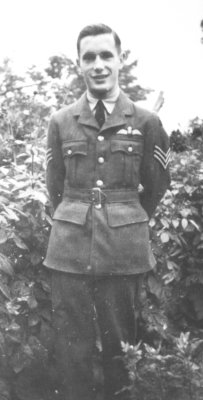
Sgt Pilot Harold Orchard, Scotland, late 1940.
Sgt Pilot Harold Orchard RAF - Part 1
No.523288 Aircraftman 2nd Class Orchard, H.C. joined the Royal Air Force on the 26th August 1935, exactly eight months after his eighteenth birthday. His designation was 'Aircrafthand'.
He had been educated at the Central School, Weymouth, and on leaving at 15 had tried to join the Navy. He had, however, been rejected as not being tall enough, and was told to 'go away and grow a bit'. He worked for a few years, therefore, at Portland Dockyard like his father.
After several years of indecision as to its Defence Policies, the British Government had finally awoken to the threats to World peace when, in March 1934, the Prime Minister, Stanley Baldwin, announced that if the Disarmament Conferences failed, the RAF would be brought up to a strength equal to that of the strongest air force within striking distance of the UK. In June 1935 the Government announced that the number of RAF squadrons would be increased from fifty-two to seventy-five at home, with a total force of 128 squadrons including those overseas. In order to attract the necessary personnel, advertisements appeared in newspapers and magazines, and the RAF became the armed force to join. Harold gave up the idea of the Navy in order to volunteer for the newly attractive service.
Under the scheme some 2,500 pilots and 27,000 airmen would have to be trained in under two years. Between April 1935 and the end of 1936 some 4,045 boys and 16,907 men were recruited, of which Harold was one of the latter. In addition, several new Technical Training establishments were required, one of which was established at Henlow, in Bedfordshire.
The Operations Record Book of the Home Aircraft depot, Henlow, shows that on 19th August 1935 the unit was reorganised as a Training Centre. This followed a complete re-structuring of the RAF Command structure, doing away with the old 'Air Defence of Great Britain', and creating four new Commands, namely Fighter, Bomber, Training and Coastal.
At Henlow, a Station Headquarters and three Training Wings were to be established. No.1 Wing was to take over the duties of the old Home Aircraft Depot, and also run courses for the conversion of aircraft Fitters; No.2 Wing was to undertake the Training of Flight Riggers; and No.3 Wing, to which Harold was attached, was to train Flight Mechanics. The latter two Wings were established straight away, but No.1 Wing and the Station Headquarters were not fully operational until the following July.
On any particular course there were to be 54 Machine Tool setters and operators, their course lasting 2 years; 1570 trainee Flight Mechanics and the same number of trainee Flight Riggers, all on 8 month courses; and 500 personnel on the Fitters Conversion course, for a 12 month period.
Nos.2 and 3 Wings were both divided into 4 administrative squadrons, No.3 being housed in a new hutted camp to the west of the existing technical camp, and designed to accommodate 1000 men, complete with its own Institutes and Dining Accommodation. Harold was a member of the first group to be trained at the new Wing.
Training at Henlow followed the long-established RAF Technical Training, which had been in operation at No.1 School of Technical Training at Halton for some years, although some modifications were made to cater for the intake of adult volunteers. The skills taught included manual mechanical skills, preliminary engineering, air- and water-cooled engines, magnetos and carburetors, instruments, rigging and splicing of metal, fabric work, float repairs, aerodrome work etc. Except for a short break, Harold was at Henlow until the following September.
The short break came on 15th November 1935 when he was posted for two months to the School of Technical Training for specialist skills. The School was located at Manston in Kent, and although Harold could not have realised it at the time, this base was to be of great significance to him in four and a half years time. On returning to Henlow in January 1936, Harold had gained the title of Flight Mechanic.
A change of routine occurred on May 23rd 1936, when Henlow was opened to the public for Empire Air Day. These events were the idea of the Air League of the British Empire, and served the dual purpose of continuing the relationship between the RAF and the public, and raising funds for the RAF Benevolent Fund. This year saw 8,414 visitors to Henlow, and the sum of £23 15s 11d being raised for the Fund.
A month later the Flying Squadron and Parachute Flight provided a 'Parachute Event' for the penultimate RAF Display at Hendon, an annual event since 1920. No doubt Harold and the other trainees watched the preparations with great interest.
By the end of July 1936, the re-organisation at Henlow was complete and there were a total of 4830 men on the station, consisting of 130 Officers and 4700 Airmen.
Training at Henlow being completed in September 1936, Flight Mechanic Orchard was posted to his first operational squadron.
When AC1 Orchard was posted to No.12 (Bomber) Squadron on 28th September 1936, the squadron had just returned from Aden.
The invasion of Abyssinia by Italy in 1935, had brought Britain close to the brink of war, and several squadrons had been sent to the Near and Middle East to strengthen the RAF. Among them were Nos. 12 and 41 Squadrons, who were posted to Aden. Both squadrons returned to England in less than a year, and No.12's Operation Records show that it left Aden on 11th August aboard HMT 'Somersetshire', arriving in Southampton on the 29th, from where it proceeded to its home station at Andover.
Also based at Andover at this time were two other bomber squadrons, Nos.103 and 107, as well as a Staff College and a Station Flight. On October 6th 1936, control of the Station was transferred from No.3 to No.2 Bomber Group.
For some years No.12 Squadron had been the only one in the RAF equipped with Fairey 'Fox' aircraft, a type issued in 1925. In 1930 the machines had been fitted with an improved engine, but by the time they were posted to Aden the Squadron had been re-equipped with Hawker 'Harts', a light bomber which, in one variant or another, equipped several squadrons during the 1930's, some still being in service with Auxiliary Air Units as late as 1940. Shortly after Harold joined them, the squadron's Harts were replaced with a day-bomber version known as the 'Hind', and Harold was assigned to the care and maintenance of aircraft number K5550, in which he had a great deal of pride.
The Hind was not a particularly large aircraft. It was, of course, a biplane, and had an upper wing span of 37ft 3in and a length of 29ft 7ins. It is interesting to compare this with the Spitfire's wing span of 36ft 10in and length of 29ft 11ins. The Hind carried a bomb load of some 500lbs, and was armed with two machine guns, one Vickers and one Lewis. The aircraft was powered by a Rolls Royce Kestrel engine, giving it a maximum speed of around 180mph and an operating ceiling of just over 21,000ft providing the crew were equipped with oxygen. The Hind was the final biplane design to enter service with the RAF, and in 1937 was still its most advanced light bomber.
During Harold's eight months with 12(B), much of his time would have involved the routine of aircraft maintenance, as well as continuing his training, as he attended classes two or three times a week. In addition to the routine, the Operations Records of both No.12 Squadron and Andover Station note several interesting events.
On December 3rd 1936 No.142(B) Squadron returned from its overseas postings arising from the Abyssinian crisis. They had been stationed at Mersa Matruh, and later Ismailia.
In February 1937, the majority of the personnel of 'B' Flight left 12(B) to form the nucleus of a new Squadron, No.63(B). Harold himself was to be involved in a similar exercise later that year. The formation of these new squadrons was part of the Government's continuing expansion of the RAF announced in 1936. The threat from Hitler's Germany was being taken seriously by now.
Later that month, No.107(B) Squadron moved to Old Sarum, and a few weeks later 36(B) moved to Upwood, 103(B) to Usworth, and 44(B) arrived at Andover from Wyton.
On 13th April, 12(B) was on parade with the rest of the Station when Air Chief Marshal Sir John Steel presented the Squadron with its unit badge.
The next event of note occurred on 12th May 1937, when the Operational Record notes that 'S/Ldr. C.E.N. Guest O.B.E. and 11 other ranks took part in lining the streets of London for the coronation of King George VI'. Harold was not one of the 11.
A visit of great historical interest took place seven days later when the German General Field Marshal von Blomberg came to Andover, and inspected the aircraft and personnel of 12(B), 44(B) and 142(B) Squadrons. Afterwards he was treated to a 'fly past in various formations' by 10 aircraft, five from 12(B) and five from 44(B) Squadron, and also saw some of the RAF's new aircraft in the shape of Blenheims, Whitleys and Harrows. No doubt the German War Minister was pleased with what he saw. At this time the Luftwaffe was far in advance of the RAF in terms of equipment and experience, units of it being involved in the Spanish Civil War. This did not prevent von Blomberg from urging caution in the Nazi moves towards a European war, and he was dismissed by Hitler early in the following year, ostensibly because of an 'unsuitable marriage' with his secretary.
A few days after that, on the 25th May, another demonstration was laid on, this time for the members of a Higher Commanders course. A target representing a bridge was laid out at Porton. Three patterns of bombs were dropped, two scoring direct hits.
On the 29th May, Empire Air Day came round again. 12(B) is recorded as having provided four demonstrations for the visiting public. These consisted of a squadron formation of three flights of three aircraft and formation changing; a low flying attack on a motor convoy by three flights of three aircraft in line astern; dive bombing by a flight of three aircraft; and a high level bombing raid whilst under attack by fighter aircraft and anti-aircraft guns. In all, there were more than 3000 visitors to Andover, and œ117 was raised for the RAF Memorial Fund.
Yet another demonstration was provided by 12(B) on 2nd June, this time for members of the Imperial Defence College. The 'bridge' at Porton was again used, but this time poor weather meant that bombs had to be dropped from 250ft. Four patterns were dropped, scoring three direct hits. No doubt all these events kept the ground crews, including Harold, more than busy with maintenance and repairs.
This was the last event witnessed by Harold whilst with 12(B) Squadron, although he would no doubt have seen the preparations for the squadron's contribution to the last RAF Display at Hendon, held on 23rd June, as his new squadron remained at Andover until early in July.
On 14th June 1937, No.82(B) Squadron was formed at Andover, initially as a two-flight squadron. The nucleus of the new unit came from No.142(B) Squadron, but personnel, including AC1 Orchard, also came from other units. Not for the last time the Government's decision of 1935 to expand the RAF had a direct effect on Harold.
The first aircraft equipping the squadron were Hind bombers, as was the case with 12(B), but these were soon to be replaced. The first Squadron Commander was Sqn. Ldr. N.C. Pleasance. On formation, the unit's strength was 13 officers, 13 senior NCO's, 13 corporals and 53 aircraftsmen.
The unit remained at Andover for three weeks, but then, on 8th July 1937 (at 0900, according to the Operations Record) it was established at its new base at Cranfield, in Buckinghamshire, where the new Station Headquarters had been established on 1st June previously. 82(B) joined No.108(B) Squadron which had arrived two days earlier from Farnborough. No.62(B) followed 82(B) from Andover four days later. This squadron and airfield were to be Harold's home for the next two years, his longest stay in one unit.
For the next few months, the Operational Record shows the growth of the new squadron, with references to new postings and promotions. During this period, on 1st August, Harold himself was promoted to Leading Aircraftsman, with a consequent increase in pay of some 1s 3d a day.
A tragedy occurred on 12th October when Pilot Officer J.L. Wells was killed whilst flying a Hind at night.
Another accident occurred on 5th November, when three Hinds were coming in to land, flying in a 'V' formation. The wing tips of the central and right hand aircraft touched and the two planes swung into each other, nose to nose, and were completely wrecked.
Harold was away from the squadron and Cranfield from 23rd October to 9th December, attending an Air Gunners course at No.2 Air Armament School, located at North Coates, Lincolnshire, returning to 82(B) with the new designation of 'Part-time Air Gunner'. During his absence, influxes of personnel and promotions had continued.
For 7 weeks, from 23rd October to 9th December, 1937, Harold found himself on the rather bleak, and at that time of the year desolate, location of No.2 Armament Training Camp at the quaintly named North Coates Fitties, on the coast of Lincolnshire, just south of the Humber Estuary.
In 1935, the RAF had only three such Camps. Besides North Coates, there was one at Catfoss, in the East Riding of Yorkshire, and one at Sutton Bridge near Wisbech, in Cambridgeshire. Under the 1936 expansion scheme, nine more such Camps were established, including No.4 at West Freugh in Scotland, and No.6 at Warmwell in Dorset.
When Harold arrived at North Coates the establishment was still referred to as an Air Observor School, but during his stay, on 1st November to be precise, a major administrative change occurred, although it was unlikely to have had much effect on the ordinary airmen attending the training camp. On that date, the Station Headquarters and Air Observors School were merged to become No.2 Air Armament School, and S/Ldr J. Marsden was posted as Commander of the Temporary Armament Training Camp. In April 1939, these schools underwent another name change when they became Armament Training Stations.
The purpose of the schools was to train pilots and aircrew in bombing and gunnery, and as such they were located in places where, as 'Flight' Magazine put it at the time 'bombs could be dropped and machine guns fired without risk to the persons of the King's lieges'. As with similar present day schemes, protests were raised by societies intent on keeping the camps away from their locality.
Normally two squadrons would be based at the Camp at a time, usually for about a month. As well as training airmen engaged in active flying, the AAS's were also involved with the RAF's scheme whereby ground personnel would be taught the basics of air gunnery, so that in the event of a war, navigators could quickly become pilots, and their roles be taken over by the trained Part Time Air Gunners. Hence the reason for Harold's stay at North Coates.
The camp had hutted accommodation (Harold lived in Hut No.23), and included sleeping quarters, messes, a hospital and a N.A.A.F.I. As Harold himself said in a letter written from the camp to his sister, the latter organisation provided free shows, as well as food, drink, and other 'groceries'. He also pointed out how cold Lincolnshire was at that time of year, but by stoking up the hut stove in the evening, it could be kept going all night.
Gunnery training consisted of two main practices - air to ground and air to air. The ground targets were mainly located along the shore, over which the RAF had rights to some seven and a half miles, extending about 8,000 yards out to sea. These targets consisted of old aeroplane fabric stretched over a framework, each with a large Roman numeral indicating the target number. The aircraft used were often the Station's own, Gordons and Tiger Moths.
Air to air firing was at flags or drogues towed by one of the station aircraft, generally on a cable some 1,000 feet long. After the flag target had been fired at, the towing aircraft dropped it to the ground, and then released a drogue type without having to land. This target resembled a wind-sock, and was the same size as the fuselage of a Bristol 'Bulldog' fighter. In order to make the most use of a drogue, the bullets fired at it during different practices were smeared with different coloured paint, which left distinguishing marks around the holes caused during each practice. After various 'attacks' the drogue was also dropped to the ground for marking. Under normal conditions, firing was carried out between ranges of 100 and 300 yards.
Harold successfully completed his course at No.2 AAS, and returned to the routine of his Squadron with the added title 'Air Gunner Part Time'.
© Copyright of content contributed to this Archive rests with the author. Find out how you can use this.


 Recommended story
 Story with photo