

- Contributed by
- actiondesksheffield
- People in story:
- See Part One
- Location of story:
- South Atlantic Station 1939-41
- Background to story:
- Royal Navy
- Article ID:
- A5409632
- Contributed on:
- 31 August 2005
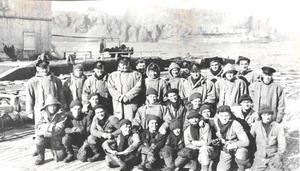
JDA 4th from left, with some Norwegians.
This story was submitted to the People’s War site by Bill Ross of the ‘Action Desk — Sheffield’ Team on behalf of Brian Armstrong, and has been added to the site with his permission. Mr. Armstrong fully understands the site's terms and conditions.
================================================
July 12th: quite a while since the last entry but there has been nothing of interest to record. Leaving Freetown we were in three watches due to losing three watch keepers a few hours before sailing and we had a couple of days working shorthanded, until some of the day workers were pulled out of their snug billets and made to a job. On Saturday 21st June I went down with malaria and the next few days were a complete blank. I was hot and just dripped with a temperature around 105°; most unpleasant. However a week later, 28th, I had my first sniff of fresh air, but felt very wobbly and on 29th we dropped in at St. Helena again for some oil and stores, and I was allowed a run ashore and resumed duty the following day. I was the first of a large contingent who made the sick bay party work overtime and for a time the ship was very short handed. In fact today the last of the wardroom brigade has just returned to duty.
After leaving St .Helena we were told to patrol off Lobito in Portuguese West Africa, where a Vichy French ship was lurking and after a week of skulking out of sight of the coast, she is still there having been unable to obtain any bunkers, as the local coaling firm in British.
This patrol business is getting our skipper down; he can't take it. Added to which there is the constant anxiety about what will go next in the engine room. Boiler tubes or pumps seem to fail daily due to our delayed refit, and there is still no news of when or where we will go. We can hang out here for another six days, when we will have to return to harbour, being out of many stores already and very short of water. It's getting people down, no doubt about that. Since we left the refit port eleven months ago, we have had on an average 23 hours 45 minutes leave per month. That's not much spread over nearly a year. I myself have had six hours ashore since March 20th in Falklands. So at times, I wonder what it would be like to have a real run ashore.
August 27th: another large gap in the history book, but many things have happened since July 12th. It was four days later when we got orders to proceed to Cape Town, and it was with mixed feelings that the ship set off in that direction. We did not know what was coming as the refit had been put off so often. Still it was S. Africa and civilization and with the skipper getting more and more liverish, well it was high time we arrived somewhere.
We arrived on Monday 21st July and found - no mail, no orders in fact no anything. I was greeted on the dock by one of the berthing masters who told me we were going to refit in the States. Cheerful news I don't think. Still we were in port and alongside.
A couple of days later the skipper lined the ship's Company up and told them the sad sad story. We were going to refit in the States, but before that we were going to make a quick trip up to Durban, so that wasn't too bad. We sailed from Cape Town July 30th with a convoy of four ships; three decent sized cargo vessels and one Polish passenger ship with troops and after an uneventful passage, apart from the Peachey tantrums, which were marked at times, we arrived off the port on Sunday morning, 3rd August and berthed at the oil site for fuel.
Due to the fact that the Peach turned sour and made himself so disliked ashore, our stay was cut short by 48 hours and he took us out to an anchorage on the 19th August. No one would play with little Allan so he went out to the bay to sulk; unfortunately he took all the ship's company with him and after two days of teeth gnashing, we turned south with a fast convoy: - Durban Castle, Duchess of Bedford, Sobieske and New Zealand. We arrived at Cape Town on the 24th, early in the morning, having sailed at dusk on the 21st from Durban, a much quicker passage south. We stayed put in Cape Town till Tuesday afternoon, the 26th when the same convoy formed up except that we now had an exalted passenger in the Durban Castle; none other that a real live King, the Greek one and all his staff. It will be interesting to see how closely rumour has been to the real thing. In spite of it being kept very secret, I first heard about the show in Durban, and it seemed very common knowledge around the waterfront there. So far, we are supposed to be taking him to Trinidad. I suppose the skipper will get the order of Chastity Fourth class. Probably if he managed to get on board withal the Greeks, they might make him a Knight of the Golden ***** ! in view of his sweet smell. It's worth considering. I don't know how the Greeks like their meat; scented I should think.
While in Cape Town on the way home, we picked up some 20 officers and 150 ratings from H.M.S. Bothia and King Gruffyd to take passage with us to Bermuda, their ships having paid off. Although straining the wardroom capacity somewhat they make a welcome addition to the watch list as we went into 5 watches by way of a change. We have now got a complement somewhere in the region, of a small cruiser, but still there seems to be a shortage of hands to do any work. It's amazing where they all disappear to during the day, as I don't see any more to work part of ship, in fact today I was down on the balance. I hope they are working somewhere.
Sept 15th: an uneventful run with our charges from the Cape through the fine weather and no alarms or excursions, not even a solitary ship. The weather gradually warmed up and we went into whites on the 31st of August. We ambled along in fine style until the 2nd of Sept when we met Newcastle. That upset the Peachey applecart as Newcastle was senior to us and for once, he had to take orders from a senior officer. He didn't take kindly to that and proceeded to vent his spleen on all and sundry here. Nice man! It was about the same time, perhaps the day before that "Cilicia" joined us and after a short spell, took the rest of the convoy off to Lagos. We had one day on our own with Durban Castle before Newcastle joined. On the 4th of Sept, we opened up and proceeded at our best speed for Trinidad. The old girl rattled and shook and managed all of 17½ knots; nice work.
We arrived at Trinidad on the morning of 9th and spent the day oiling at Pointe à Pierre - miles from anywhere and returned to Port of Spain the same evening. No leave though and a Sub on the gangway with O.O.W. on the bridge in the best flagship style. We remained in the port till the morning of Sept 10th when we departed for the high seas, where the same three vessels took to the open water. Everything proceeded according to plan until the night of Sept 14th when sometime during the dark hours, the Chief Pippin of the convoy got adrift and when daylight came, there was the escort, but the king and all his cuties had gone. They turned up later on, none the worse and no one knew how they'd got away.
On Monday forenoon (next day) H.M.C.S. Prince David came on the scene and Newcastle turned off for Boston (lucky devils!). Meanwhile little Allan took command of the party and proceeded to shoot his neck out as the other ship is commanded by a Commander (acting). So now we proceed in a northerly direction into the cold north Atlantic.
Sept 20th: the North Atlantic became very much its old self and on Thursday the 18th, when daylight came in after a very dirty night, we found we'd lost the Prince David. We couldn't stand the weather and had to heave to. So we carried on and next day, the 19th, we met the destroyers, only 600 miles from the Irish coast too. We turned over the Durban Castle and set our course for St. Johns N.F.
We had the usual sort of weather in which the old Queen rolled and wallowed like a cow in labour; altogether most unpleasant. We are due in harbour tomorrow morning, about 10 am, provided we don't have any fog and at the moment, it looks quite fine with a N.W. breeze and reasonable weather.
------------**************************--------------
Ships Convoyed.
Avila Star 14443 tons Lord Willingdon
Ernesto Tornquist 6547 tons Antarctic
Lancing 7866 tons do
Southern Empress 12398 tons do
Svend Foyn 14795 tons do
Thorshammer 12215 tons do
Pulaski 6300 tons
Clan Forbes 7529
Pampas
Elizabeth Bakki 5450
Duchess of Bedford 20123
Niew Zealand 11100
Sobieski 11030
Durban Castle 17388 King of Greece.
Email from:
Jane Cameron
Government Archivist
Falkland Islands Archives
Tel: (500) 27249
Fax: (500) 27259
Dear Mr Armstrong,
Many thanks for your letter and for this extract from your father's diaries, which seem to be a most interesting record of the war in the South Atlantic. During World War II our shipping records normally only registered the arrival of merchant vessels (presumably for security reasons), but we do know about the visit of the Queen of Bermuda in March 1940, because the Captain wrote a letter to the local Red Cross which was printed in the local newspaper as follows:
The Officers and Men of HMS "Queen of Bermuda" greatly appreciated the woollen comforts which the Society had knitted, as is exemplified by the following letter from Captain Hawkins, MVO, DSO, RN:
March 23rd. (1940)
Dear Miss Henniker-Heaton,
Will you please convey to your Committee and to all the 'knitters' the most grateful thanks of myself and all my Ship's Company for the magnificent "woollies" you have so kindly sent to the ship.
I shall personally interest myself in the distribution of them and I can assure you they will be of great use and, I need hardly say, very greatly appreciated by those who are fortunate enough to wear them.
Very many thanks indeed to all of you.
Yours sincerely,
G.A.B.Hawkins.
We would be delighted to add a transcription of your father's diaries to our records of World War Two. Thank you for the offer.
kind regards,
Jane Cameron
Government Archivist
Falkland Islands Archives
================================================
Continued in part eight: A5409731
Pr-BR
© Copyright of content contributed to this Archive rests with the author. Find out how you can use this.


 Recommended story
 Story with photo