

- Contributed by
- actiondesksheffield
- People in story:
- See Part One
- Location of story:
- South Atlantic Station 1939-41
- Background to story:
- Royal Navy
- Article ID:
- A5409731
- Contributed on:
- 31 August 2005
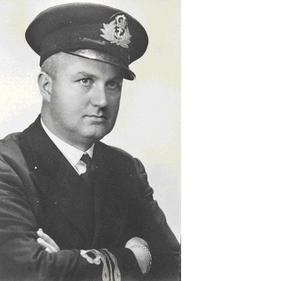
J.D. Armstrong (Lt. Cdr. R.N.R. 1942)
This story was submitted to the People’s War site by Bill Ross of the ‘Action Desk — Sheffield’ Team on behalf of Brian Armstrong, and has been added to the site with his permission. Mr. Armstrong fully understands the site's terms and conditions.
================================================
Reply Email sent 24th March 2005
Dear Brian,
Very many thanks for sending us this copy of your father's journal of his experiences in the South Atlantic in World War II. It is extremely interesting and entertainingly written. It is particularly fascinating for us to have an account, which includes patrolling Antarctic waters, and encounters with the whaling fleet.
Just a couple of minor corrections to names of factory ships where presumably your father's handwriting was not quite clear. The vessel which appears on pages 29-33 as the SVEND FOEZN should be the SVEND FOYN and the vessel which appears on page 30 as the ERNESTO TORNOGUST should be ERNESTO TORNQUIST. On page 32 THORSHAMER should read THORSHAMMER.
The journal will make a valuable addition to our Naval files and we are most grateful to you for sending it to us.
With all good wishes and thanks again,
Jane Cameron
Government Archivist
Falkland Islands Archives
Post Script which should be sent to Jane Cameron sometime together with photographs if possible:
Dear Jane,
Thank you very much for your reply to my recent Email regarding my father's Wartime diary of his time on the South Atlantic patrol during the first years of the war. After this tour of duty he was promoted to Lieutenant Commander and was in command of H.M.S. Royal Scotsman in the Mediterranean and involved in the North African landings. He was badly injured at this time by an explosion on board, which was not due to enemy
action. He was invalided and lost his sight for some time, but fortunately his sight recovered in time. He was awarded the D.S.C. at this time and I was at his investiture by the King with my Mother at Buckingham Palace; I was eleven years old then. After this he spent time as harbourmaster at Gourock on the Clyde. On demobilization he returned to Cunard and eventually was in command of, amongst others, the Mauretania. Also he was Staff Captain of the Queen Elizabeth and the Queen Mary prior to this.
I will now copy the diary into this message and hope that it transmits successfully. If there are any spelling mistakes relating to the names of the Norwegian whaling ships or others you spot, please would you let me know as his writing is somewhat difficult?
I should point out that there is no love lost between Captain Hawkins and my father nor most of the crew. There is no point in my changing his name as of course he is already known to your records. This is his record and I don't feel it should be sanitised in any way even though there will no doubt still be relatives alive today.
Yours sincerely,
Brian Armstrong.
©Brian J. Armstrong
This article was published in the ‘Nautical Magazine’ in Dec.1972 and can be read as a lead in to J.D.Armstrong's ‘H.M.S. Queen of Bermuda’ wartime diary even though it was written over 30 years later.
During the summer of 1939, the express passenger service between Southampton and New York was running flat out. There were six ships employed. The British Queen Mary and Aquitania: the French Ile de France and Normandie, and the German Bremen and Europa.
The weekly service consisted of Queen Mary, Ile de France and Europa one week, with the Aquitania, Normandie and Bremen the following week. This meant a turnround of all the ships every 14 days, which allowed 24 hours in New York, and a little longer for the faster ships in their home ports of Southampton, Havre and Bremerhaven.
The Queen Mary, Normandie, Bremen and Europa had several knots advantage over the Aquitania and Ile de France and the Aquitania was the oldest, but by no means the bottom of the list of what was advertised as "gracious living". Her pre-war first-class public-rooms and dining-room were amongst the finest afloat.
We all knew that the International picture was cloudy; there had been the Munich affair in 1938, which solved nothing, and did not ease anyone's mind. In addition, we in the Aquitania had received a consignment of civilian gas respirators, which were ready for assembly, and in addition, the necessary equipment for dealing with incendiary bombs. And there was a Home Office Instructor on board for three round voyages to train the crew and put them through anti-gas drill, and procedure for dealing with incendiaries.
All the ships were sailing near to capacity on the westbound voyages, but eastbound was comparatively light. Outward, the Americans were rushing home, and such refugees from Europe who could raise the fare, sailing from French and British ports, but not in German ships. British and French civilians were making for home in case war did come.
Voyage No. 327 westward, sailing from Southampton, Wednesday , August 23, 1939, was hectic. Aquitania had embarked 1412 passengers in three classes; just 1000 more than on the previous westbound voyage. There was not a spare bed in the ship; even the servants' cabins, on the boat deck, were all sold.
The outward passage, apart from listening to radio broadcasts, was uneventful, although some of the more enthusiastic passengers asked for, and got, some pots of grey paint, with which they managed to cover up some of the more accessible parts of the upper deck.
But on arrival at New York on Tuesday, August 29, the war scare had reached full proportions. Queen Mary and Ile de France had sailed eastbound with capacity passenger lists, but the Bremen had pulled out without a single passenger, a fact which did not go unnoticed, either in the Press, or on the New York waterfront.
’
Meanwhile there were more than the usual crop of rumours. The Bremen was being held by the Coastguards on the pretext that she did not comply with the United States Passenger Steamboat Certificate requirements. More than the usual number of boat and fire-drills were being carried out, and her clearance was not forthcoming.
The local radio stations had got hold of a story, which they broadcast frequently, that the Bremen was being delayed pending the arrival of the British cruiser Ber--wick (their pronunciation), steaming towards New York at high speed in order to shadow the German ship when she sailed.
Then the Normandie sailing was cancelled, and her passengers were transferred to the Aquitania. As a point of interest, the French ship never sailed again. In February, 1942, she was burned out in New York, after being taken over by the United States authorities and renamed Lafayette; she was subsequently refloated, towed to Newark, New Jersey, in 1946 and scrapped. A story current after the burning was to the effect the Americans gave 20 liberty-class vessels to the French as compensation.
On the evening of Wednesday, August 30, our sailing had been put back from noon till 7 p.m., the Bremen backed out into the North River, no passengers on board and the ship's company mustered on the fore-deck, while the band played "Deutschland Über Alles" and the crew gave the Nazi salute and shouted "Heil Hitler!" Then she headed down harbour for the open sea.
We followed as soon as she was clear. As soon as the Bremen passed Quarantine all her deck lights were switched off and she darkened ship. Dropping her pilot at Sandy Hook, she disappeared into the night. The Berwick never did find her, and some two weeks later she arrived at Murmansk, subsequently returning to Germany, only to be destroyed in an air-raid in 1941.
On Sunday, September 3, we got the news by radio that war had been declared, and the job of assembling the respirators started. The ship's company did a good job, assisted by a number of British passengers who had A.R.P. training. By evening everyone had been fitted; even a temporary mask had been adapted to a box for a small baby.
Our eastbound numbers, including the Normandie passengers, were 1109, and again there were many willing volunteers for painting.
As we were routed, and there were no positions posted for daily runs, the amateur navigators amongst the crew, who depended on previous log-cards of past voyages, were completely lost.
The eastbound Cherbourg call was missed out, and when normal docking-day showed the ship still at sea and out of sight of land there was consternation amongst the crew. We approached the Nab Tower from a mid-channel course at daylight on the morning of the 6th, to be greeted by an elderly destroyer, obviously recently commissioned and pouring out dense clouds of black smoke, with an offer of escort; but her speed was totally inadequate.
The destroyer's opening signal, by lamp caused Captain Gibbons to blow his top. "Four-funnel ship please indicate." He remarked, "We are the only *****four-funnel ship in the world and the so and so wants to know our name."
On arrival at Southampton, three of the Naval Reserve officers were called up, and my last sight of the "old lady" was an army of painters covering up the peace-time colours.
**********AFTER THE WAR IN EARLY 1947***************
When the new Caronia was arriving at Southampton for dry-docking after her sea-trials the Aquitania was berthed at the New Dock Extension, close to the Dry Dock entrance.
As the new ship passed on her way to the dry dock we thought it appropriate to hoist the following signal, "Welcome Child." It was the shortest two-flag signal we could think up at short notice. Apparently the Duke of Edinburgh was on Caronia's bridge at the time, and suggested the reply, "Thank you Mother." The youngest and oldest ships in the Company's fleet at their first meeting.
Aquitania, built 1914 scrapped 1950
(The No.1 Cunard liner until replaced by the Queen Mary 1936)
Mauretania, built 1907, scrapped 1935
Mauretania, (New) built 1939, scrapped 1963
Berengaria, 1920, scrapped 1938, ex Imperator (World War reparations)
Imperator, built 1913 became Berengaria,1920 see above.
Part One of this story is at: A5408093
Pr-BR
© Copyright of content contributed to this Archive rests with the author. Find out how you can use this.


 Recommended story
 Story with photo