

- Contributed by
- actiondesksheffield
- Location of story:
- South Atlantic Station 1939-41
- Background to story:
- Royal Navy
- Article ID:
- A5408093
- Contributed on:
- 31 August 2005
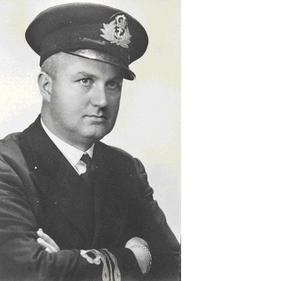
J.D. Armstrong (Lt. Cdr. R.N.R. 1942).
This story was submitted to the People’s War site by Bill Ross of the ‘Action Desk — Sheffield’ Team on behalf of Brian Armstrong, and has been added to the site with the author’s permission. Mr. Armstrong fully understands the site's terms and conditions.
================================================
“HMS "Queen of Bermuda”
Her First Commission
Commissioned at Belfast on 4th November 1939 by Captain M. Brock Birkett RN and superseded by Captain G.A.B. Hawkins RN, 12th December 1939 who was relieved by
Captain Allan Peachey RN at Freetown 24th April 1941.
J.D. Armstrong (Lt. Cdr. R.N.R. 1942)
Officers.
Captain Brock Birkett RN
Lieut. Cdr. G.T. McInnes RN
Lieut. Cdr. N.A.F. Kingscote RNR
Lieut. H.J. Aldiss RNR
Surn. Lieut J.C.Boyd RNVR
Lieut. J.D. Armstrong RNR
Mr. Kingswell Commissioned Gunner RN
------------**-----------
Captain G.A.B. Hawkins superseded
Captain Brock Birkett at Portsmouth December 1939
Left at Freetown:
Midshipman Smith RNR
Midshipman Toynbee RNR
Midshipman Stretton RNR
Midshipman Scott RNR
Joined ship at Portsmouth
Midshipman Barton RNR
Midshipman Battrick RNR
Midshipman Murray RNR
Lieut. R. Richards Brown RNR joined ship Buenos Aires
Commander G. Healey relieved McInnes at Durban in August
Sub Lieut Caldwell RNVR joined ship at Freetown vice Stretton (Sept 41)
T.124 Officers
S. Burns Temporary Commander RNR
H. Dupont Temporary Lieut. Cdr. RNR
A. Molts Temp. Lieut. RNT
L. Sylvester Temp. Lieut . RNR
L. Pert Temp. Midshipman RNR
F.Marks Temp. Cadet RNR
W. Milroy Temp. Commander(E) RNR
W. Saul Temp. Commander(E) RNR
J. Walker Temp. Lieut.(E) RNR
H. Hill Temp. Lieut. (E) RNR
W. Nevison Temp. Lieut.(E) RNR
H. Bates. Temp. Lieut. (E) RNR
W. Dalziel Temp. Pay Lt. Cdr. RNR
S. Wheeler Temp. Pay Lieut. RNR
S. Clements Temp. S/Lt. RNR
J. Holt Temp. S/Lt. RNR
A. Norrie Temp. S/Lt. RNR
S. Milliken (left) Temp. S/Lt. RNR
J. Heatlie Temp. S/Lt. RNR
J. Phillips (left) Temp. S/Lt. RNR
S. Whicker Temp. S/Lt. RNR
W. Arnold (left) Temp. S/Lt. RNR
A. Thomas Temp. S/Lt. RNR
W. Anderson Temp. S/Lt. RNR
D. Martin (left) Temp. S/Lt. RNR
F. Sinclair Temp. S/Lt. RNR
F. Gilmour Temp. S/Lt. RNR
M. Duffield Temp. S/Lt. RNR
H. Campbell (Elect) Temp. S/Lt. RNR
J. Cameron. (Elect) Temp. S/Lt. RNR
D. Pitman (Elect) Temp. S/Lt. RNR
J. Lancaster (Elect) Temp. S/Lt. RNR
J. Hill (Elect) Temp. S/Lt. RNR
L.Patterson (Plumber) Temp S/Lt. RNR
J. White Temp S/Lt. RNR
W. Smith (left) R.O.I.
G. Shrebridge R.O.2A
R. Price Lloyd R.O.3
A. Gail W.V.O.
D. Sproat R.O.2.
J. Macdonald R.O.1
Keyes Sub.E
Buxton Sub.E
McCullough Sub.E(left Freetown)
Coleman Sub.E
Griffin Pay Sub (left Freetown)
Lawrence Pay Sub RNVR
(joined Freetown)
When the Aquitania sailed from New York on 30th August 1939 at 7.30pm, I did not think that the Furniss Liner "Queen of Bermuda" had any interest for me. I saw her arrive in port on her normal run from Bermuda. However she sailed the following day, Thursday 31st, for Belfast, on a different route to that taken by Aquitania. We arrived in Southampton on Wednesday 6th September, having taken an extra day to do the passage. War was declared on Sept. 3rd and the remainder of the voyage was spent zig zagging.
The day after the ship arrived, three officers were mobilized: McLean, Tone and myself, and I was duly appointed to the A.M.C. "Queen of Bermuda" fitting out at Belfast.
When I arrived at that port I found that a Captain R.N. retired had been appointed in command of the ship; he had been out of the service some years and an executive officer was also there, Lieut. Commander McInnes retired.
McInnes had spent about 6 years in the R.N. and left the service in 1922, apart from a brief 3 weeks refresher gunnery course in the summer of 1939, he'd had nothing to do with the navy since returning as a young Lieut. Two other active service R.N.R. officers, Kingscote & Aldiss were also appointed, plus a Commissioned gunner, Mr. Kingswell. He had been working at Woolwich Arsenal since his retirement, so was right up to date so far ammunition was concerned.
With the arrival of Surgeon Lieut. Boyd R.N.V.R. the naval personnel was complete so far as fitting out was concerned, and work proceeded in the yard of Messrs. Harland & Wolff under the inexpert supervision of an Admiralty overseer, Mr. Tuck who succeeded in making a complete mess of the conversion, so much so that the ship had to proceed to Portsmouth for a semi refit. Owing to a lack of interest shown by the Commanding Officer Brock Birkett, his daily attendance on the ship was from 1100 to 1130 Monday to Friday, and on the weekly meeting at the works, it was even less, and because of the inexperience of the Executive Officer, the admiralty overseer was able to do pretty well as he liked.
In addition to this there was a definite undercurrent of resentment amongst the ship's staff at the so-called intrusion of the navy into the select circle of the Furness New York Bermuda organization. So all in all, conditions for a decent fitting out were not ideal.
As time went on, the ship's people were undecided whether to engage in naval service under what is known as T.124 agreement. However the promise of their American rates of pay, turned into sterling at a rate somewhere in the neighbourhood of $4.00 to the £1.00, was sufficient inducement to make them sign the agreement. A typical example of this unfairness was the comparison of wages paid to a wardroom petty officer, £24 monthly, while an R.N.R. Lieutenant on the active list was only entitled to £20.00 on naval rates. I may add that the wardroom P.O. was one of the lowest paid in the ship.
By the time sundry commissions had been handed out to the temporary officers, the ship resembled a Greek man-o-war more that anything else and there it was. During the fitting out period, a great part of the interior of the ship was gutted. This was entirely right and proper as a reduction of fire hazard, but the gutting out party ran wild and began to remove part of the accommodation, which was necessary for the wartime requirements of the ship's company. But nothing could stop this. The stuff must come out and out it came, only to be replaced in Portsmouth a month or so later. Wooden screens were fitted where windows had once been. This was pointed out as a glaring error as the first gun blast blew them all down.
And so it went on. Ignorance had its way while the people who could have stopped it didn't know any better, or were not sufficiently interested to make a stand. By the time the ship was ready for the acceptance inspection, she was just about as complete a mess as it was possible to imagine. Still, the Admiral walked round and looked at the things which were pointed out and carefully ignored those things which he was not supposed to see. And the ship was accepted!!
About a week prior to this, there was a great commotion; the ship was to be fitted with some patent nets which would catch torpedoes, and an already upset schedule was further complicated. A special vessel was used to bring some hundreds of tons of gear, wire, shackles, booms and what not all the way round from Portsmouth to Belfast; gear incidentally, which had been designed for another ship altogether. This stuff was duly installed; holes were cut in the ship's side and the jigsaw commenced. If ever there was a Heath Robinson contraption, the nets were it. Still, on it went and by superhuman efforts on the part of the dockyard, the job was finished in time. Then we got our crew, about 200 odd ratings. Some dozens were active service - about 30 were pensioners and the remainder were R.N.V.R seamen with a leavening of R.N.R’s. Few if any of the R.N.V.R’s had ever seen a ship before. We found this out by bitter experience after the ship left.
One of my braves, who had been told off severely, confessed to three weeks in the Navy!! Chaos reigned everywhere but after commissioning on Nov 4th. And after ammunitioning the ship on the 5th and 6th, we had to go to sea on the 7th, and we did. With a ship load of experts and net party, and various other odds and ends, we did gun trials. The result, all Mr. Tuck's fancy woodwork fell down and was rendered useless. However our orders were to proceed to Portsmouth, so next day, after tying all the broken bits together, we set off.
The ship behaved like a sick cow. The result was as we had forecast of putting nearly 1,000 tons of rock ballast in the fore part. When ballast was suggested, we offered our suggestions as to its disposal, but some junior grade clerk in the admiralty department at Bath knew better. In all probability, he had never seen a ship, so down No's 1 & 2 holds it went and we finished up with the ship drawing seven feet more forward than aft. Just a dangerous loaded condition - but by trimming water ballast, we managed to reduce this trim to almost even keel - a very temporary measure indeed. However we sailed round to Portsmouth and by some miracle, we got there unmolested. We were anybody's meat.
The net booms effectively prevented the lowering of any boats and none of the guns worked properly. In any case, none of the guns crews had any idea of their duties, so I for one was very thankful when we screwed alongside the dockyard near Portsmouth.
During the stay in Portsmouth, where the errors and omissions of Belfast were being made good, we lost our first Commanding Officer. His alcoholic consumption was so heavy, that it was found necessary to ship him off to hospital for a cure and he was relieved by Captain G.A.B. Hawkins D.S.C. M.V.O. Captain Hawkins had the good fortune to be "in the know"; he was a nephew by marriage of the Duke of Connaught, and one of those singled out for promotion. After a week or so of harbour routine, the ship began to show signs of becoming something more than a burlesque. Divisions were knitting into shape and many hours were spent playing with the nets under the eyes of the A.N.D. otherwise "Action net Defence". A lot of time and money was expended in this hobby, which was quite useless in a ship of this class. Half an hour in heavy weather would have carried the whole lot away and wrapped it round wing propellers. Still, it kept the ship at home and enabled everyone to have Christmas or New Year leave, which was the one bright spot in an otherwise complete "black out"
1940
It was just after the leave period that the "buzzes" began to spread throughout the ship. Having prepared ourselves for the rigours of the Northern Patrol, we were told to get tropical kit and speculation was rife as to our ultimate destination. The trend of popular speculation was "South", so on the 24th January (1940), in better weather, we departed from Portsmouth via Weymouth where we were to do gunnery trials for "furrin Parts". (Foreign?)
The trials should have been completed in one day but we took a week. The weather was very much against us. Portland harbour was the scene of an adventure, amusing afterwards but unpleasant at the time. Owing to transport difficulties we sailed from Portsmouth without some wardroom stores - a case of tobacco and it followed us by rail. So as tobacco caterer, I had to go ashore and try to collect it.
A motorboat was provided and we set off in a complete "blackout", taking a draft for R.N. Barracks and the surgeon who wanted to try and trace a missing parcel. I had never been ashore in Portland Harbour before and assumed that the Midshipman in charge of the boat and the coxswain, who had both been running trips for 24 hours, knew their course inshore. After we had been under weigh for some 20 minutes, we should have reached our destination in just that time. I thought it was about time to have a look round. In addition to the blackout there was a persistent drizzle - nothing was visible, not even the loom of the beach. So I decided to carry on a bit longer at slow speed. About five minutes later I caught sight of something blacker than the surrounding water, and gave orders to go full speed astern.
There was just sufficient time to take the weigh off the boat and we touched something very lightly. Investigation with a torch showed it to be some kind of cement groyne or pipeline with a beacon marking the outer end. We were about ten feet from the beacon. Once we had touched, I gave the order to "Stop" and the midshipman obeyed literally. He switched off the engine in the excitement of the moment. After he had been cursed roundly, we managed to get the engine running again: the engineer had a lot of trouble doing so as with the cussedness of all motor boat engines, it wouldn't start when we needed it in a hurry.
No one knew where we were and the Doctor mournfully remarked that he wished he'd brought a lifejacket instead of a gas mask. With the boat under weigh once more we started all over again and I thought it best to take charge of things, and steering a compass course, we got away from the obstruction. The trouble was that the pier we wanted to find was rather small and there was some wreckage a little way clear of it, which was very dangerous, had it been necessary to make an exact landfall. I spotted what looked like a faint mooring light and decided if one boat could float there, we could do likewise, and making a wide sweep, we finally landed at the proper pier. Everyone was very cold and wet, so I took half the crew up to look for something warming to drink. I found a Hostel which provided hot cocoa and left instructions for them to relieve their mates in the boat while I took a couple of hands and went off prospecting to find the place and the tobacco.
Our first inquiries were met with a flat denial of any such place in the harbour. This was at first sight, rather strange, as I was seeking information at a Salvation Army Sailors Rest and they are usually helpful. Our next call was more fruitful, a pub. They told us where to find our people and off we went, landing at a dead garage. The place was open but in darkness, and no one answered our knocks or hails. Eventually a passer by volunteered the information that we might find the proprietor in the adjoining pub. There we found the reason for the apparent lack of knowledge in the Hostel. We had arrived at our destination and the firm we were seeking were not only the owners of the garage, but the pub as well and the good people in the hostel were only trying, as they thought, to prevent us going on a blind.
We got our tobacco and scrambled back to the pier in pitch darkness, collected up the crew and prepared to return. At the first kick of the engine it backfired and the engine room burst into flames, fortunately we managed to get the engineer out unsinged and put out the blaze without any damage being done, and we crept back to the ship in pouring rain.
===============================================
Continued in part two: A5408840
Pr-BR
© Copyright of content contributed to this Archive rests with the author. Find out how you can use this.


 Recommended story
 Story with photo